
Festive Fun: Christmas Crafts with Kids
 By Speech Blubs Team•Dec 22, 2025•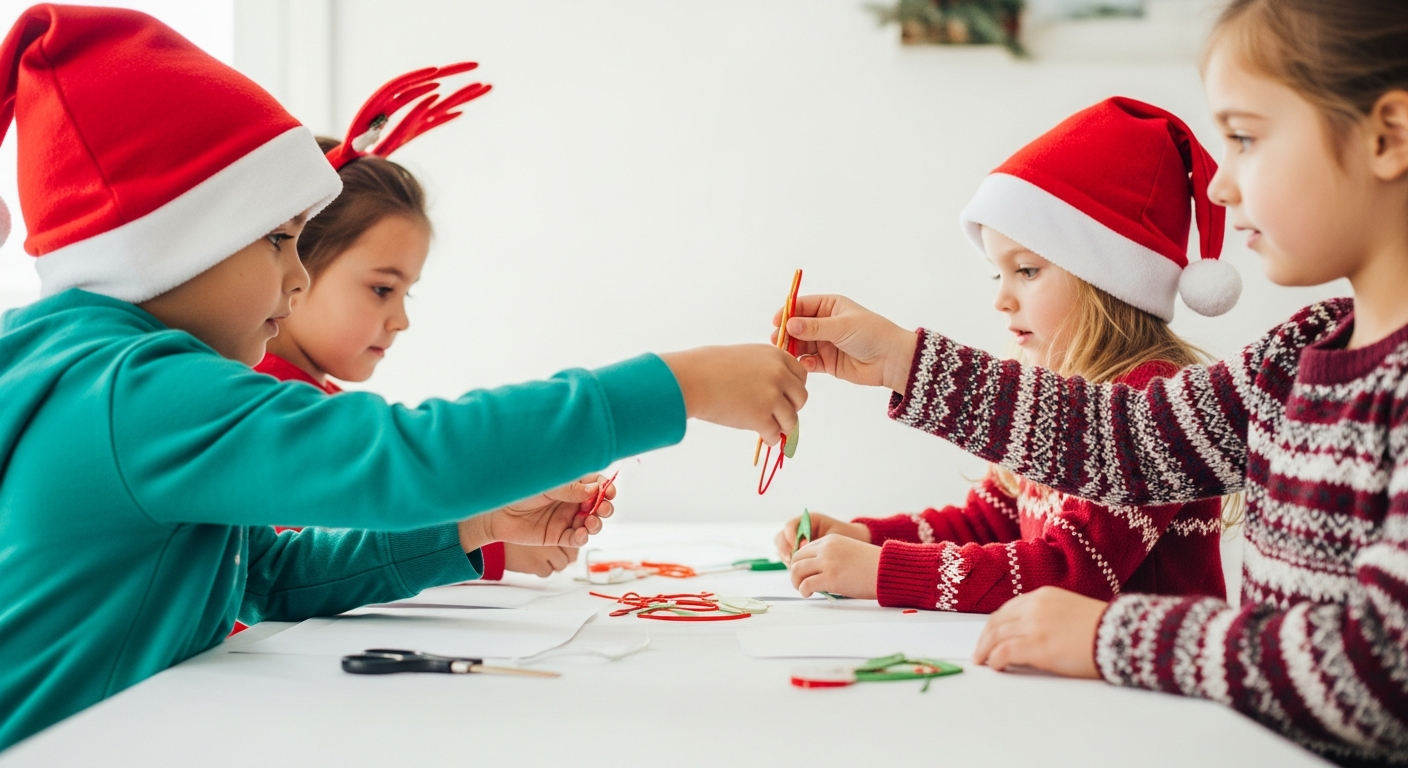
Table of Contents
- Why Christmas Crafts are More Than Just Fun
- Our Favorite Christmas Crafts to Boost Speech and Language
- Maximizing the Speech-Boosting Potential of Crafts
- When to Consider Extra Support
- Integrating Speech Blubs into Your Child's Development Plan
- Unlocking the Full Potential: Our Subscription Plans
- Conclusion
- Frequently Asked Questions
The crisp air, the twinkling lights, the scent of pine – Christmas is a magical time of year, filled with wonder and joy, especially for our children. But beyond the glitter and gifts, this season offers a unique opportunity for connection, creativity, and incredible developmental growth. Imagine the delight in your child's eyes as they transform simple materials into festive masterpieces, all while unknowingly building crucial communication skills. This isn't just about making pretty decorations; it's about crafting conversations, sparking imagination, and strengthening those tiny muscles needed for speech.
In this comprehensive guide, we'll dive into a treasure trove of engaging Christmas crafts that are perfect for kids of all ages. We'll explore not only how to make them but, more importantly, how each activity serves as a powerful springboard for speech and language development. From descriptive vocabulary to following instructions and expressing ideas, these crafts are designed to be joyful learning experiences. You'll discover practical tips for maximizing verbal engagement, adapting activities for different skill levels, and creating cherished family memories. We'll also explore how Speech Blubs complements these hands-on experiences, providing a year-round resource for empowering your child to speak their minds and hearts.
Why Christmas Crafts are More Than Just Fun
Engaging in arts and crafts during the holiday season offers a multitude of benefits that extend far beyond simply creating pretty things. For children, these activities are vital playgrounds for development, touching upon cognitive, fine motor, emotional, and, significantly, communication skills.
Fostering Communication Through Creativity
When children engage in crafts, they are naturally immersed in a language-rich environment. Every step, every choice, every material offers a chance to talk, listen, and express. This is precisely why we at Speech Blubs advocate for activities that transform "screen time" into "smart screen time" and hands-on play into meaningful learning experiences.
- Vocabulary Expansion: Think about all the words associated with Christmas crafts: sparkle, glitter, red, green, sticky, soft, round, star, tree, Santa, ornament, gift. As you work together, you're introducing and reinforcing a rich lexicon.
- Following Instructions: "First, we glue the cotton ball onto Santa's beard. Then, we add the eyes." This sequence of commands helps children develop their receptive language skills, a crucial component of understanding and responding to others.
- Descriptive Language: "Tell me about your shiny, blue star." "What does the reindeer's nose feel like?" Encouraging children to describe their creations helps them develop expressive language, moving beyond single words to more complex sentences.
- Turn-Taking and Sharing: Crafting often involves sharing materials and taking turns with steps. This natural interaction fosters pragmatic language skills, teaching children the unspoken rules of conversation and social interaction.
- Problem-Solving and Sequencing: When a craft doesn't go exactly as planned, or when deciding the next step, children engage in problem-solving and learn about cause and effect – "If I put too much glue, it gets soggy." This internal monologue can often become an external dialogue, further boosting communication.
Building Fine Motor Skills for Speech Development
It might seem indirect, but the dexterity required for crafts – cutting, gluing, drawing, molding – directly supports the fine motor control needed for speech. The same brain areas that control hand movements also influence the muscles of the mouth, tongue, and jaw.
- Hand-Eye Coordination: Aligning shapes, coloring within lines, and placing small embellishments enhance coordination, which translates to better control over articulation.
- Finger Strength and Dexterity: Squeezing glue bottles, tearing paper, manipulating small beads – these strengthen little fingers and improve precision, vital for tasks like self-feeding and eventually, clear articulation.
- Bilateral Coordination: Using both hands simultaneously (one to hold paper, one to cut) is a foundational skill that supports many complex tasks, including coordinating the movements of the lips and tongue.
Emotional and Social Growth
Beyond language and motor skills, Christmas crafts are a powerful vehicle for emotional expression and social bonding.
- Self-Expression and Confidence: Creating something unique gives children a sense of accomplishment and pride. This boost in confidence can translate into a greater willingness to communicate and express themselves verbally.
- Patience and Persistence: Some crafts require time and effort. Children learn to persevere through challenges, celebrating the final outcome.
- Family Connection: Working on crafts together creates shared experiences, laughter, and lasting memories. These positive interactions are the bedrock of strong family bonds and a secure environment for communication development.
At Speech Blubs, we believe in creating tools that foster this holistic growth. Our app was born from the personal experiences of our founders, who all grew up with speech problems and created the tool they wished they had. We know firsthand the frustration and challenges children can face, and our mission is to provide an immediate, effective, and joyful solution for the 1 in 4 children who need speech support, blending scientific principles with play into one-of-a-kind "smart screen time" experiences. We provide a screen-free alternative to passive viewing (like cartoons) and a powerful tool for family connection, much like the bonding created through shared crafting experiences.
Our Favorite Christmas Crafts to Boost Speech and Language
Now, let's get to the fun part! Here are some fantastic Christmas craft ideas, complete with specific ways to integrate speech and language practice.
1. Cotton Ball Santa Craft
A classic, simple craft that's perfect for younger children and packed with opportunities for language development.
Materials: Red construction paper, white cotton balls, googly eyes, red pom-pom for nose, glue.
How to Make It:
- Cut a large triangle from red paper for Santa's hat and a large circle for his face.
- Glue the circle onto the wider end of the triangle.
- Have your child glue cotton balls along the bottom edge of the hat and for Santa's beard.
- Add googly eyes and the red pom-pom nose.
- Draw a mouth.
Speech & Language Boosters:
- Verbs: "Glue the cotton," "Stick the eyes," "Draw the mouth." Focus on action words.
- Adjectives: "Soft cotton," "Round face," "Red hat," "Wiggly eyes." Describe the textures, shapes, and colors.
- Body Parts: "Santa has a beard," "These are his eyes," "Where's his nose?"
- Following Multi-Step Directions: "First, we glue the hat, then the beard."
- Storytelling: Once Santa is complete, ask, "What is Santa doing now?" or "What does Santa say?"
Relatable Scenario: For a parent whose child is a "late talker" and primarily uses single words, working on Santa's beard provides a chance to repeatedly practice the word "soft" while touching the cotton balls, or the verb "glue" as they apply it. Our Speech Blubs app has sections like "Action Verbs" and "Amazing Adjectives" that reinforce these concepts through engaging video modeling, showing children imitating their peers saying these very words.
2. Pinecone Christmas Trees
Bringing nature indoors for a simple yet beautiful decoration.
Materials: Pinecones, green paint, glitter or small pom-poms, glue.
How to Make It:
- Collect pinecones outdoors (a great opportunity for nature walk vocabulary!).
- Paint the pinecones green. Let dry.
- Add glue and sprinkle with glitter or attach small colorful pom-poms as "ornaments."
Speech & Language Boosters:
- Sensory Vocabulary: "Prickly pinecone," "Sticky glue," "Sparkly glitter," "Smooth paint." Engage all senses!
- Prepositions: "Put the glitter on the tree," "Paint under the branches."
- Counting: Count the "ornaments" as you put them on.
- Comparatives/Superlatives: "Which pinecone is bigger?" "This is the smallest pom-pom."
- Questioning: "What color should we paint it?" "Where should the glitter go?"
3. Handprint Reindeer Ornaments
A cherished keepsake that captures tiny hands and provides wonderful language moments.
Materials: Brown construction paper, red pom-pom, googly eyes, glue, scissors, string.
How to Make It:
- Trace your child's hand on brown paper. Cut it out.
- Turn the handprint upside down. The palm is the reindeer's face, and the fingers are the antlers.
- Glue on a red pom-pom for the nose and googly eyes.
- Draw a mouth. Punch a hole at the top and thread string through for hanging.
Speech & Language Boosters:
- Body Parts: "Show me your hand," "This is a thumb," "We need eyes for the reindeer."
- Action Words: "Trace," "Cut," "Glue," "Hang."
- Emotional Words: "Happy reindeer," "Silly eyes."
- Sequencing: "What did we do first? Then what?"
- Imagination: "What is your reindeer's name?" "Where does your reindeer live?"
4. Paper Plate Wreaths
Simple circles transform into festive door décor.
Materials: Paper plate, green paint, red paper, scissors, glue.
How to Make It:
- Cut out the center of a paper plate to create a wreath shape.
- Paint the wreath green.
- Cut small red circles or bow shapes from red paper.
- Glue the red "berries" or "bows" onto the green wreath.
Speech & Language Boosters:
- Shapes: "Circle plate," "Round berries," "Triangle bow."
- Colors: "Green wreath," "Red berries."
- Spatial Concepts: "Glue around the circle," "Put the berries on the wreath."
- Opposites: "Big plate," "Small berries."
- Requesting: "More glue, please," "I need the red paper."
5. DIY Snow Globes
A slightly more involved craft that yields a magical result, perfect for older preschoolers and early elementary children.
Materials: Clean glass jar with lid, distilled water, glitter, waterproof glue, small plastic or ceramic figurines (Christmas trees, snowmen, Santa), optional: glycerin.
How to Make It:
- Glue your chosen figurine to the inside of the jar lid. Let it dry completely.
- Fill the jar almost to the top with distilled water.
- Add glitter. (A few drops of glycerin can help the glitter fall slower.)
- Put a ring of waterproof glue around the inside edge of the lid.
- Carefully screw the lid onto the jar, making sure it's tight.
- Turn it upside down and watch the magic!
Speech & Language Boosters:
- Abstract Concepts: "Magic," "Sparkle," "Still," "Falling."
- Prediction: "What do you think will happen when we shake it?"
- Process Description: "First, we glue the snowman. Then, we add water and glitter."
- Vocabulary Specifics: "Distilled water," "Figurine," "Glycerin," "Waterproof glue."
- Comparison: Compare different snow globes or different glitter types.
Relatable Scenario: For a child who might be struggling with describing sequential events or explaining "how-to," the snow globe craft provides a clear, tangible sequence. You can narrate each step, then encourage them to retell it. Our Speech Blubs app features activities that encourage children to follow and imitate sequences, helping them build the foundational skills for narrative development.
Maximizing the Speech-Boosting Potential of Crafts
Crafts are inherently language-rich, but with a few simple strategies, you can turn every creative session into an even more powerful speech and language lesson.
1. Talk, Talk, Talk!
Narrate everything you're doing. "I'm cutting the paper." "You're painting the star green." Ask open-ended questions that require more than a "yes" or "no" answer. "What do you want to make next?" "How does that feel?"
2. Model and Expand
If your child says, "Tree," you can expand it to, "Yes, a big green Christmas tree!" If they point to the glitter, say, "You want the sparkly silver glitter? Here it is!" Our "video modeling" methodology at Speech Blubs is built on this very principle: children learn by watching and imitating their peers, providing them with clear, engaging models for speech. You can apply this same approach during crafts by modeling desired words and phrases.
3. Offer Choices
"Do you want the red paper or the green paper?" "Should we glue or draw the eyes?" Offering choices empowers your child and encourages them to use their words to express preferences.
4. Create a "Need" to Communicate
If your child just points to the glue, pretend you don't understand (briefly, and with a smile!). "You want what? The glue? Can you say 'glue'?" This gentle nudge encourages verbal requests.
5. Focus on the Process, Not Just the Product
The perfect ornament isn't the goal; the shared experience and the language opportunities are. Praise effort and participation, regardless of the final aesthetic outcome. This helps reduce frustration and builds confidence.
6. Embrace Repetition
Children learn through repetition. If you're working on the word "star," try to incorporate it multiple times: "Look, a star! My star is sparkly. Can you make a star?"
7. Make it a Family Affair
Involve siblings, grandparents, or other family members. The more voices and interactions, the richer the language environment. Speech Blubs is designed to be a tool for family connection, providing activities that parents and children can enjoy together.
When to Consider Extra Support
While these crafts are wonderful for boosting everyday communication, sometimes children may need a little extra help on their speech journey. If you notice your child struggling with:
- Not babbling by 7-10 months
- Not saying single words by 15-18 months
- Not combining two words by 24 months
- Limited vocabulary compared to peers
- Difficulty understanding simple instructions
- Trouble making specific sounds
- Frustration due to not being understood
It might be time to explore additional resources. Our quick 3-minute preliminary screener can help you understand if your child might benefit from speech support. It involves 9 simple questions and provides an assessment and a next-steps plan, along with a free 7-day trial of our app. We are committed to providing robust support, and our methodology is backed by science, placing us in the top tier of speech apps worldwide. You can explore the research behind our approach here.
Integrating Speech Blubs into Your Child's Development Plan
Speech Blubs is designed to be a powerful supplement to your child's overall development plan and, when applicable, professional therapy. It’s a tool we wished we had as children. Our app is packed with thousands of engaging activities that are built on our unique video modeling methodology, where children learn by watching and imitating their peers. This active participation turns screen time into a learning opportunity, promoting essential communication skills from articulation to vocabulary and social language.
Consider how our themed sections can align with your holiday craft fun:
- "Animal Kingdom" can help your child articulate animal sounds and names, which can then be applied to making reindeer or polar bear crafts.
- "Amazing Adjectives" reinforces descriptive words like "sparkly," "smooth," and "rough" – perfect for describing craft materials.
- "My Body" helps children learn parts of the face and body, ideal when crafting a Santa or a gingerbread person.
- "Yummy Time" introduces food vocabulary, fantastic for talking about gingerbread cookies or other edible crafts.
By blending hands-on craft time with targeted digital practice, you create a comprehensive and joyful learning environment. We believe in providing realistic expectations: while our app is incredibly effective, it fosters a love for communication, builds confidence, reduces frustration, and develops key foundational skills, creating joyful family learning moments. It is a powerful tool to complement your efforts. See what other parents are saying about their child's success with Speech Blubs.
Unlocking the Full Potential: Our Subscription Plans
As you embark on these festive crafting adventures and consider how to further support your child's speech and language development, we want to be transparent about how Speech Blubs can be a year-round resource for your family.
We offer two straightforward plans designed to fit your needs:
- Monthly Plan: For $14.99 per month, you get access to our core features, allowing you to support your child's development on a month-to-month basis.
- Yearly Plan: This is by far our best value, priced at just $59.99 per year. This breaks down to an incredible $4.99 per month, meaning you save 66% compared to the monthly option!
The Yearly Plan isn't just about significant savings; it's about unlocking the full Speech Blubs experience with exclusive, high-value features that our Monthly plan does not include:
- A 7-day free trial: Experience everything Speech Blubs has to offer before committing.
- The extra Reading Blubs app: A fantastic companion app to foster early literacy skills.
- Early access to new updates: Be the first to try out exciting new content and features.
- 24-hour support response time: Get prompt assistance whenever you need it.
To truly get the most out of Speech Blubs, we strongly encourage you to choose the Yearly plan. Not only does it offer the best value, but it also includes that invaluable 7-day free trial and the Reading Blubs app to supercharge your child's learning journey.
Ready to get started? Download Speech Blubs on the Apple App Store or Google Play Store to begin your free trial and explore all the features that empower children to speak their hearts and minds.
Conclusion
The magic of Christmas isn't just found in sparkling lights or wrapped gifts; it's woven into the shared moments of creativity, laughter, and discovery with our children. Engaging in Christmas crafts with kids is a wonderful way to celebrate the season, create lasting memories, and, perhaps most importantly, provide a natural, joyful environment for significant speech and language development. Every snip, glue, and sparkle becomes an opportunity to expand vocabulary, practice following instructions, build fine motor skills, and express imagination.
By embracing these hands-on activities, you're not just decorating your home; you're nurturing your child's ability to communicate, building their confidence, and fostering a lifelong love for learning. And remember, Speech Blubs is here to support you every step of the way, transforming screen time into "smart screen time" that complements your family's efforts to empower your child's voice.
Ready to infuse your holiday season with both festive fun and meaningful learning? Start your child's communication journey today! Download Speech Blubs from the App Store or get it on Google Play and sign up for our Yearly plan to unlock your 7-day free trial and all the fantastic features, including the Reading Blubs app. Let's make this Christmas a season of delightful discoveries and powerful communication for your little one!
Frequently Asked Questions
Q1: What age group are these Christmas crafts suitable for?
A1: The crafts listed, such as the Cotton Ball Santa and Handprint Reindeer, are generally suitable for toddlers (2-3 years old) with significant adult assistance, and preschoolers (3-5 years old) who can participate more independently. Older children (5+) can enjoy these crafts with more intricate details and might also engage in more complex projects like the DIY Snow Globes. Always adapt the complexity and materials to your child's developmental stage and ensure safety.
Q2: How can I make these crafts more engaging for a child who is reluctant to talk?
A2: Focus on creating a no-pressure, fun environment. Instead of demanding words, model language, narrate your actions, and use exclamations ("Wow! Look at that!"). Offer choices, use silly voices for characters, and incorporate songs or rhymes related to the craft. Remember that non-verbal communication, like pointing or gesturing, is also a form of expression. Slowly introduce opportunities for verbalization by creating a "need" to communicate, like holding out an item and waiting for a sound or word. The Speech Blubs app uses video modeling with peer examples, which can be highly motivating for reluctant talkers, as they see children just like them successfully producing sounds and words.
Q3: What if my child makes a mess during crafting?
A3: Messes are a natural and often beneficial part of creative play! Embrace it as an opportunity for sensory exploration and learning about cause and effect. Prepare your crafting area by laying down newspaper or an old tablecloth. Have wet wipes and paper towels ready. Focus on the learning and bonding experience rather than the pristine outcome. Involve your child in the cleanup process, which also offers language opportunities ("Wipe the table," "Put the glue away").
Q4: How does Speech Blubs specifically help with the speech skills practiced in these crafts?
A4: Speech Blubs complements these hands-on activities by providing structured, engaging, and repetitive practice for the same underlying speech and language skills. For example, when you use descriptive words like "sparkly" during a craft, our app's "Amazing Adjectives" section reinforces that vocabulary through interactive video modeling. If your child struggles with action verbs like "cut" or "glue" during crafting, our "Action Verbs" section offers playful exercises. The app's clear models from real children encourage imitation, helping children build confidence and master sounds, words, and sentences in a fun, consistent way, enhancing the learning from your craft sessions.