
Festive Fun: Easy Christmas Activities for Kids
 By Speech Blubs Team•Dec 19, 2025•17 min.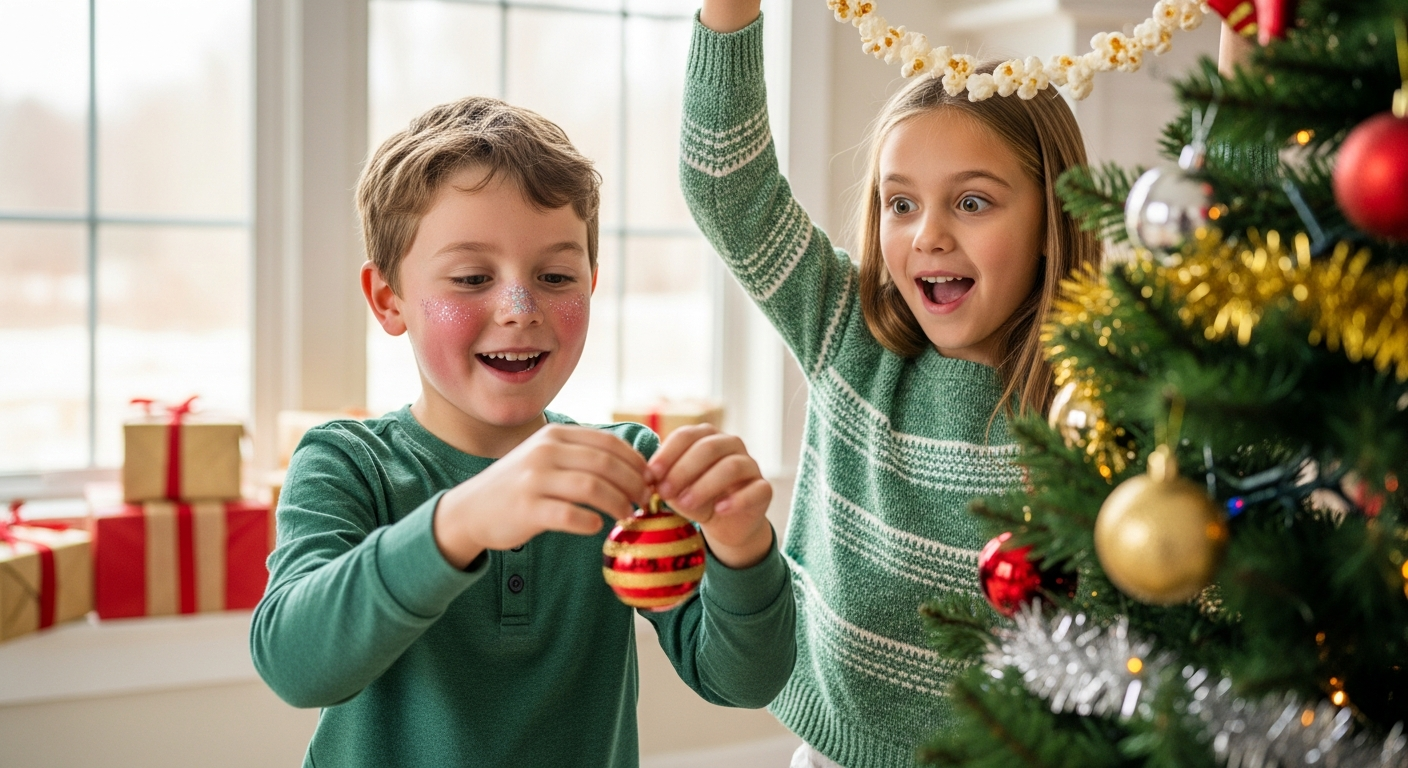
Table of Contents
- The Simple Power of Holiday Play
- Engaging Christmas Crafts & Creations
- Delicious Holiday Baking & Kitchen Fun
- Festive Music & Movement
- Enchanting Christmas Stories & Reading
- Sensory & Imaginative Christmas Play
- The Speech Blubs Difference: Empowering Communication Through Play
- Choosing Your Journey with Speech Blubs: Value and Pricing
- Conclusion
- Frequently Asked Questions
The air crackles with anticipation, tiny eyes widen at twinkling lights, and the scent of pine fills the room. Christmas is a magical time, but for parents, the holiday season can sometimes feel like a whirlwind of overwhelming expectations. We dream of heartwarming moments and festive traditions, yet the reality can often involve complicated crafts, elaborate baking, and the struggle to keep little ones engaged without succumbing to endless passive screen time.
What if we told you that the most memorable and beneficial Christmas activities for kids are often the simplest ones? This article is your guide to embracing the joy of the holidays through easy, low-stress activities that not only create lasting memories but also naturally foster vital communication skills and strengthen family bonds. Forget perfection; this Christmas, let's focus on presence, play, and empowering our children to speak their minds and hearts through everyday holiday magic. We'll explore a variety of delightful ideas, from simple crafts to interactive games, and share how these easy festive activities can be powerful springboards for language development, especially when paired with supportive tools like Speech Blubs.

The Simple Power of Holiday Play
In our busy lives, it's easy to overcomplicate the holidays. We see picture-perfect scenes online and feel pressure to replicate them. However, children thrive on connection, repetition, and genuine interaction, not elaborate setups. Easy Christmas activities reduce parental stress, making us more present and available to engage with our children. This relaxed atmosphere is crucial for fostering language development, as children feel safe and encouraged to experiment with new words and expressions.
Think about it: when you're laughing over a lopsided gingerbread man or singing along to a holiday classic, you're naturally providing rich language input. You're modeling new vocabulary, encouraging turn-taking in conversation, and building a foundation for strong communication. These are the moments children cherish and learn from most. By simplifying, we create more space for joy, curiosity, and the organic growth of communication skills.
Why Less Is More During the Holidays
The holiday season often brings overstimulation, from bright lights and loud music to new people and disrupted routines. For many children, especially those who are still developing their communication skills, this can be overwhelming. Opting for easy, familiar, and predictable activities helps create a sense of calm and control.
- Reduces Overwhelm: Simple activities are easier for children to process and engage with without feeling pressured or rushed.
- Boosts Confidence: Successfully completing a simple task, like decorating a cookie or identifying a color, builds self-esteem and encourages further participation.
- Promotes Connection: When activities are easy, parents can focus more on interacting with their child—asking questions, commenting, and enjoying the shared experience—rather than managing a complex project.
- Encourages Language: Simple activities provide clear contexts for language use. "More glitter!" "Big red ornament!" "Shake the bells!" These are all natural opportunities for verbal expression and imitation.
At Speech Blubs, we understand the importance of making learning joyful and accessible. Our approach is rooted in the belief that children learn best through play and positive interaction. Just as simple holiday activities create a low-pressure environment for communication, our app provides a "smart screen time" experience that engages children without the stress of formal lessons.

Engaging Christmas Crafts & Creations
Crafts are a classic holiday staple, but they don't have to be complicated to be fun and educational. Focusing on process over product is key. These easy craft ideas provide excellent opportunities for language development, fine motor skill practice, and creative expression.
1. Simple Ornament Decorating
Forget delicate glass baubles! Gather some plain, shatterproof ornaments (plastic or wooden), non-toxic paints, glitter glue, and stickers. Let your child go wild.
- Language Opportunities:
- Descriptive Words: "What color paint are you using? Red! It's so sparkly! Is it big or small?"
- Action Verbs: "Squeeze the glue. Paint carefully. Stick the star."
- Following Directions: "First, we'll paint, then we'll add glitter."
- Prepositions: "Put the sticker on the ball. The glitter is in the jar."
- Relatable Scenario: For a parent whose child is just starting to string together two-word phrases, decorating an ornament can be a goldmine. As they point to the red glitter, you can model, "Red glitter!" and encourage them to imitate. Our "Colors" or "Shapes" sections in Speech Blubs offer similar interactive experiences where children see and hear peers pronounce these words, which can then be reinforced during hands-on activities like this.
2. Homemade Christmas Cards
All you need are construction paper, crayons, markers, stickers, and maybe some paper cutouts. Children can draw pictures, dictate messages for you to write, or simply decorate freely.
- Language Opportunities:
- Social Language: Discussing who the card is for ("Grandma will love this!").
- Storytelling: "Tell me about your drawing. What is the snowman doing?"
- Vocabulary Building: Introducing words like "sender," "receiver," "festive," "greeting."
- Relatable Scenario: If your child loves animals and is practicing animal sounds, they might draw a reindeer. You can ask, "What sound does the reindeer make?" prompting a 'neigh' or 'snort.' Our "Animal Kingdom" section within Speech Blubs is perfect for reinforcing these sounds and associated vocabulary through fun video modeling.
3. Paper Snowflakes & Chains
Cut out simple paper snowflakes or create colorful paper chains to drape around the house. These are fantastic for developing fine motor skills and following multi-step instructions.
- Language Opportunities:
- Sequencing: "First, fold the paper. Then, cut a shape."
- Spatial Concepts: "Fold it in half. Cut along the line."
- Comparisons: "This snowflake is big, that one is small."
- Relatable Scenario: A child who is working on action verbs will benefit from the clear, repetitive actions involved in folding and cutting. "Fold!" "Cut!" "Open!" These words are visually paired with the action, just as our "Action Verbs" section in Speech Blubs pairs a peer demonstrating an action with the spoken word, creating a strong learning connection.
Delicious Holiday Baking & Kitchen Fun
The kitchen is a fantastic sensory environment, rich with smells, textures, and tastes that naturally spark conversation and language development. Choose simple recipes that allow for plenty of child participation.
1. Decorating Christmas Cookies
Bake or buy plain sugar cookies and set up a decorating station with icing, sprinkles, and candies. This is pure joy for little hands!
- Language Opportunities:
- Sensory Words: "The icing is sweet. The sprinkles are crunchy."
- Colors & Shapes: "Pick a red star sprinkle. What shape is this cookie?"
- Action Verbs: "Spread the icing. Shake the sprinkles. Eat the cookie!"
- Requests: "More sprinkles, please!"
- Relatable Scenario: For a child who struggles with expressing desires or making requests, decorating cookies offers a perfect low-pressure opportunity. You can hold up the sprinkles and ask, "Sprinkles?" prompting a nod or a verbal "Yes!" or "More!" Our app's focus on clear, repetitive sound and word modeling helps children build the foundational vocabulary they can then use to articulate these requests in real-life, delicious situations.
2. Hot Chocolate Bar
Set up a simple hot chocolate bar with different toppings: whipped cream, marshmallows, chocolate syrup, and candy canes. Let your child choose and add their own.
- Language Opportunities:
- Choice Making: "Do you want whipped cream or marshmallows?"
- Quantity Concepts: "A little whipped cream? Or a lot?"
- Taste Descriptions: "Yummy! It's so warm and sweet."
- Following Multi-Step Instructions: "First, pour the hot chocolate. Then, add toppings."
- Relatable Scenario: If your child is working on distinguishing between "more" and "less" or making choices, this activity is ideal. You can use exaggerated gestures and verbal cues to highlight the difference. In Speech Blubs, we use clear visual cues and repetition to help children grasp these concepts, which makes them more prepared to apply them during fun activities like this.
3. Simple Snack Assembly (e.g., Pretzel Rods)
Melt some chocolate, dip pretzel rods, and add sprinkles. Easy, delicious, and engaging!
- Language Opportunities:
- Sequencing: "First, dip. Then, sprinkle."
- Action Verbs: "Dip, twist, shake."
- Vocabulary: "Melted, crunchy, sweet."
Festive Music & Movement
Music and movement are incredibly powerful for language development. They enhance rhythm, phonological awareness (the ability to recognize and manipulate the sounds of language), and encourage expressive communication.
1. Christmas Carol Sing-Alongs
Play your favorite Christmas carols and sing along! You don't need to be a professional singer; enthusiasm is contagious.
- Language Opportunities:
- Vocabulary Expansion: Learning new words through song lyrics ("jolly," "sleigh," "tinsel").
- Rhyming: Identifying rhyming words within songs.
- Auditory Memory: Remembering lyrics and sequences.
- Emotional Expression: Singing allows children to express joy and other emotions.
- Relatable Scenario: For a child who is exploring different sounds and phonemes, singing provides a joyful, low-pressure way to practice. The repetition in songs helps cement new words and sounds. Our app incorporates auditory and visual cues to help children articulate sounds, making them more confident when joining in a family sing-along.
2. Holiday Dance Party
Put on some upbeat Christmas music and just dance! Encourage silly movements and free expression.
- Language Opportunities:
- Action Verbs: "Spin! Jump! Wiggle! Clap!"
- Following Directions: "Let's all jump like reindeer!"
- Body Parts: "Shake your arms! Stomp your feet!"
- Expressing Emotions: "Are you happy dancing? You look so excited!"
- Relatable Scenario: A child who is working on motor imitation can benefit greatly from watching and imitating movements during a dance party. This mirrors the "video modeling" approach we use at Speech Blubs, where children learn complex communication skills by watching and imitating their peers. This direct observation and imitation activate mirror neurons, making learning feel natural and intuitive. You can learn more about our science-backed methodology on our Research page.
3. Jingle Bell Rock
Hand out jingle bells (or improvise with shakers made from rice in plastic bottles) and let children shake them to the rhythm of Christmas music.
- Language Opportunities:
- Rhythm & Beat: Understanding fast/slow, loud/quiet.
- Sensory Language: "The bells are loud! They jingle!"
- Turn-Taking: "My turn to shake, then your turn."
Enchanting Christmas Stories & Reading
Reading together is one of the most powerful activities for language and literacy development, and the holiday season offers a wealth of beautiful stories.
1. Cozy Christmas Story Time
Snuggle up with classic or new Christmas books. Read aloud, pointing to pictures and engaging your child in the story.
- Language Opportunities:
- Vocabulary Expansion: Introducing new words from the story.
- Comprehension: Asking questions about the plot, characters, and setting.
- Narrative Skills: Discussing the beginning, middle, and end of the story.
- Predicting: "What do you think will happen next?"
- Relatable Scenario: For a child developing narrative skills, reading a Christmas book together is invaluable. You can pause and ask, "How is Santa feeling here?" helping them connect emotions to characters and events. Our commitment to fostering a love for communication extends to early literacy, which is why our Yearly plan even includes access to our companion Reading Blubs app, designed to support reading readiness.
2. Create Your Own Christmas Story
Take turns adding sentences to create a fantastical Christmas story. Start with "Once upon a time, on Christmas Eve..."
- Language Opportunities:
- Imagination & Creativity: Encouraging imaginative thought.
- Sentence Structure: Practicing forming coherent sentences.
- Turn-Taking: Learning to listen and build on another's ideas.
- Sequencing: Ensuring the story makes logical sense.
- Relatable Scenario: This is fantastic for children who are starting to put sentences together. If your child tends to use single words, you can model expanding their idea. If they say "Santa!" you can say, "Yes, Santa is flying his sleigh!" and encourage them to repeat or add more. This kind of interaction helps bridge the gap between single words and more complex expressions.
3. Holiday "I Spy" with Books
Look through a Christmas book or picture and play "I Spy." "I spy something red!" "I spy something round!"
- Language Opportunities:
- Descriptive Words: Using adjectives like "sparkly," "tiny," "fluffy."
- Categorization: Identifying objects by color, shape, or function.
- Auditory Processing: Listening carefully to clues.
Sensory & Imaginative Christmas Play
Engaging multiple senses can deepen a child's understanding and provide more avenues for language acquisition.
1. Christmas Playdough or "Snow Dough"
Make homemade playdough (using Christmas colors like red, green, white) or create "snow dough" with cornstarch and conditioner. Add cookie cutters and small Christmas figures.
- Language Opportunities:
- Sensory Vocabulary: "It's so soft! It smells minty. It's squishy."
- Action Verbs: "Roll the dough. Cut a tree. Squeeze it."
- Pretend Play: Creating scenarios with the figures, prompting dialogue.
- Relatable Scenario: For a child exploring textures and descriptive words, this is perfect. You can emphasize words like "sticky," "smooth," "cold," and "warm." Our app’s diverse activities help build a robust vocabulary, making it easier for children to describe these sensory experiences in their play.
2. Christmas Object Bag
Put various Christmas-themed objects (e.g., small ornament, jingle bell, miniature Santa, candy cane) into a bag. Have your child reach in, feel an object without looking, and describe it.
- Language Opportunities:
- Tactile Descriptors: "It's smooth and hard. It feels bumpy. It's soft and fuzzy."
- Inferencing: Guessing what the object is based on its characteristics.
- Questioning: "Is it big or small? Does it jingle?"
- Relatable Scenario: This activity hones descriptive language and inferential reasoning. If a child says "round," you can prompt, "What else is round?" to expand their thinking. This kind of guided questioning helps develop critical thinking and communication skills.
The Speech Blubs Difference: Empowering Communication Through Play
At Speech Blubs, we believe every child deserves the chance to speak their minds and hearts. Our company was founded on this very principle; our creators, having personally experienced speech challenges, set out to build the tool they wished they had during their own developmental journeys. We are driven by a mission to provide an immediate, effective, and joyful solution for the 1 in 4 children who need speech support.
We achieve this by blending scientific principles with engaging play, creating unique "smart screen time" experiences. We stand as a powerful screen-free alternative to passive viewing, like cartoons, and a potent tool for family connection. Our cornerstone is the "video modeling" methodology, where children learn complex communication skills by watching and imitating their peers. This approach activates mirror neurons, making learning intuitive, natural, and incredibly effective. It's why countless parents have seen significant progress in their children's speech and language development. See what other parents are saying about their child's success with Speech Blubs by visiting our testimonials page.
Making the Most of Screen Time with Speech Blubs
We understand the concerns parents have about screen time. That's why Speech Blubs is designed to be an active, engaging, and interactive experience, fundamentally different from passive entertainment. Instead of simply watching, children are invited to participate, imitate, and interact, turning screen time into a dynamic learning opportunity that supports their communication journey.
- Active Learning: Our video modeling directly encourages imitation and active participation, crucial for speech development.
- Family Connection: Speech Blubs is designed for co-play. Parents can engage alongside their children, reinforcing learning and strengthening bonds.
- Scientifically Backed: Our method is supported by research, placing us in the top tier of speech apps worldwide. You can explore the science behind our approach on our research page.
If you're unsure whether your child could benefit from a structured, playful approach to speech development, we invite you to take our quick 3-minute preliminary screener. It involves 9 simple questions and provides an assessment and a personalized next-steps plan. It's a great way to gain clarity and even includes a free 7-day trial to experience Speech Blubs firsthand. Take the preliminary screener today!
Choosing Your Journey with Speech Blubs: Value and Pricing
We are committed to making effective speech support accessible to every family. That's why we offer flexible subscription plans for Speech Blubs, designed to fit your needs.
- Monthly Plan: For those who prefer month-to-month flexibility, our plan is available for $14.99 per month.
- Yearly Plan: The Best Value: We highly recommend our Yearly plan, which offers significant savings and exclusive benefits. At just $59.99 per year, it breaks down to an incredible $4.99 per month, allowing you to save 66% compared to the monthly plan.
Beyond the substantial savings, the Yearly plan unlocks a full suite of features designed to maximize your child's learning journey:
- 7-Day Free Trial: Experience the full power of Speech Blubs before committing.
- Reading Blubs App: Gain access to our companion app, designed to support early literacy and reading readiness.
- Early Access to New Updates: Be among the first to explore exciting new content and features.
- 24-Hour Support Response Time: Receive prompt and dedicated assistance whenever you need it.
The Monthly plan does not include these exclusive benefits, making the Yearly plan the clear choice for comprehensive support and incredible value.
Ready to empower your child's communication journey this holiday season and beyond? Create your account and begin your 7-day free trial today by choosing our best-value Yearly plan!
Conclusion
The holiday season offers a beautiful canvas for creating cherished memories and fostering invaluable communication skills through simple, engaging activities. From decorating ornaments and baking cookies to singing carols and reading stories, these easy Christmas activities for kids provide rich language learning opportunities in a joyful, low-pressure environment. By embracing simplicity, we can reduce stress, increase connection, and truly be present with our children.
Remember, every shared laugh, every decorated cookie, and every holiday song sung together is a building block for confident communication. And when you're looking for an immediate, effective, and joyful tool to support your child's speech and language development, Speech Blubs is here. Our unique video modeling approach transforms screen time into "smart screen time," empowering children to speak their minds and hearts through play.
Don't let another holiday season pass by without giving your child the gift of confident communication. Ready to make this Christmas a season of connection and progress? We invite you to experience the difference for yourself. Download Speech Blubs on the Apple App Store or Google Play Store today! To unlock the full suite of features, including a 7-day free trial, our Reading Blubs app, and incredible savings, make sure to choose the Yearly plan. Start your journey with Speech Blubs and empower your child to find their voice this holiday season!
Frequently Asked Questions
Q1: How can I encourage my child to talk more during these Christmas activities?
A: The key is to make it fun and low-pressure. Use open-ended questions ("What do you like about this ornament?"), comment on what your child is doing ("You're shaking the bells so fast!"), and model language for them ("Red hat!"). Don't pressure them to repeat; just provide rich language input. Speech Blubs supports this by providing clear speech models through video modeling, which you can then reinforce during your holiday activities.
Q2: What if my child isn't interested in a particular activity?
A: It's perfectly fine! Children have varying interests. Offer choices and follow your child's lead. If they don't want to make a craft, maybe they'd prefer to sing or bake. The goal is engagement and connection, not completing a specific task. We offer a wide range of engaging activities within the Speech Blubs app, from "Animal Kingdom" to "Yummy Time," ensuring there's always something to capture your child's interest and motivate them to communicate.
Q3: How do these simple activities support language development?
A: Simple activities provide clear contexts for new vocabulary, action verbs, descriptive words, and social interaction. They encourage turn-taking, problem-solving, and imaginative play, all of which are crucial for language acquisition. When you engage with your child during these activities, you're naturally providing language input and opportunities for them to practice expressing themselves.
Q4: How does Speech Blubs fit into our holiday routine?
A: Speech Blubs is designed to be a flexible, "smart screen time" supplement to your child's development. You can integrate short, focused sessions into your day to reinforce sounds, words, and concepts. For example, after decorating cookies, you could do a session on "Colors" or "Action Verbs" in the app. It's a powerful tool to complement your hands-on holiday fun, offering immediate, effective, and joyful support for speech development. We encourage choosing the Yearly plan for its 7-day free trial and access to the Reading Blubs app, making it a comprehensive tool for the holidays and beyond.
About the author