
Festive Hoops: Christmas Basketball Games for Kids
 By Speech Blubs Team•Dec 24, 2025•22 min.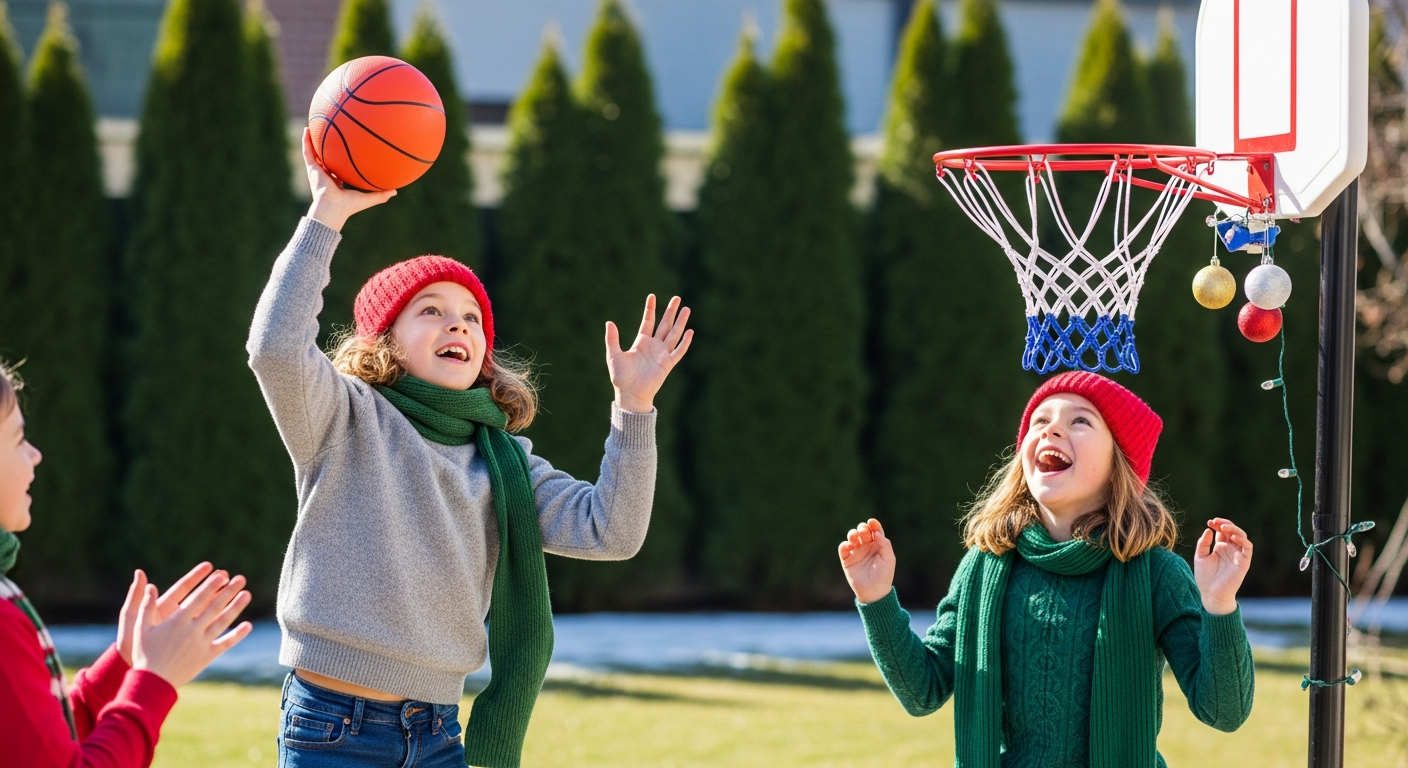
Table of Contents
- Introduction
- Why Christmas Basketball Games? More Than Just Fun
- Crafting the Festive Basketball Court: Setting the Scene
- Classic Games with a Christmas Twist
- Innovative Christmas-Themed Basketball Challenges
- Team-Based Holiday Hoops
- Simple Skill Builders with a Festive Sparkle
- Enhancing Communication Through Play: The Speech Blubs Approach
- Ready to Get Started? Your Child's Communication Journey Awaits!
- Conclusion
- Frequently Asked Questions
Introduction
As the holiday season twinkles into view, bringing with it a whirlwind of excitement and boundless energy from our little ones, many parents find themselves wondering how to channel that festive spirit into something both fun and enriching. While sugar plums dance in their heads, their feet might be itching for action! What if we could combine the magic of Christmas with the thrill of basketball, turning playtime into a powerful opportunity for growth, connection, and communication? These aren't just games; they're memorable experiences that blend physical activity with crucial developmental skills, wrapped up in a bow of holiday cheer. This post will guide you through a sleigh-load of creative, engaging Christmas basketball games perfect for kids of all ages and skill levels, transforming your court (or driveway) into a winter wonderland of active learning. We'll explore why these games are more than just a seasonal pastime, offering a chance to foster teamwork, build confidence, and enhance communication, making sure your family's holidays are filled with joyful shouts and healthy competition.

Why Christmas Basketball Games? More Than Just Fun
The holiday season often means a break from school routines, which can sometimes lead to increased screen time or restless energy. Incorporating active games like basketball offers a fantastic antidote, providing numerous benefits that extend far beyond physical exercise. These festive activities are an incredible way to keep children engaged, develop essential skills, and create lasting family memories.
Physical Well-being and Energy Release
Basketball is a dynamic sport that naturally encourages running, jumping, dribbling, and shooting – all excellent forms of physical activity. During a season often associated with treats and indoor gatherings, these games ensure children stay active, build stamina, improve coordination, and develop gross motor skills. Getting outside (or playing in a well-ventilated indoor space) to chase a ball under crisp winter air is a refreshing way to burn off holiday excitement and promote healthy habits.
Fostering Teamwork and Social Skills
Many basketball games, even those designed for small groups, inherently teach collaboration. Children learn to pass, share the ball, take turns, and cheer for their teammates. These interactions are invaluable for developing social skills like cooperation, empathy, and sportsmanship. They learn to navigate friendly competition, celebrate successes together, and gracefully handle losses. These shared experiences build bonds and teach children how to be part of a group, skills that are vital in all aspects of life.
Building Confidence and Self-Expression
For many children, successfully dribbling the ball, making a shot, or even just participating in a game can be a huge confidence booster. These games offer opportunities for children to try new things, overcome challenges, and experience the satisfaction of achievement. As they gain proficiency, their self-esteem grows. This newfound confidence often translates into other areas of their lives, including their willingness to express themselves and communicate more openly.

Enhancing Communication Skills Through Play
Perhaps one of the most significant, yet often overlooked, benefits of interactive games like festive basketball is their impact on communication. When children play, they are constantly communicating – verbally and non-verbally. They listen to instructions, ask questions, explain strategies to teammates, cheer each other on, and express emotions like excitement or frustration. This active engagement creates a natural, low-pressure environment for practicing receptive and expressive language.
At Speech Blubs, we believe that empowering children to "speak their minds and hearts" is paramount. Our company was born from the personal experiences of our founders, who all grew up with speech problems and created the tool they wished they had. We are committed to providing an immediate, effective, and joyful solution for the 1 in 4 children who need speech support, blending scientific principles with play into one-of-a-kind "smart screen time" experiences. Just as these games encourage dynamic interaction, our app offers a powerful tool for family connection, acting as a screen-free alternative to passive viewing experiences like cartoons. We teach complex communication skills through our unique "video modeling" methodology, where children learn by watching and imitating their peers. Engaging in a game like "Reindeer vs. Elves" requires listening intently to commands and responding quickly, much like how Speech Blubs prompts children to imitate sounds and words from their peers, building crucial auditory processing and response skills.
Crafting the Festive Basketball Court: Setting the Scene
Before diving into the games, setting a festive atmosphere can elevate the experience and make it even more magical for the kids. A little creativity goes a long way in transforming a regular basketball court into a holiday haven.
Decorating for the Holidays
- Twinkling Lights: String fairy lights around the hoop, backboard, or along the edges of the playing area. Battery-operated options are safe and versatile for outdoor use.
- Ribbons and Garlands: Adorn the net with red and green ribbons or hang lightweight holiday garlands around the perimeter. Just ensure they don't interfere with gameplay or pose a tripping hazard.
- Themed Markers: Use cones or chalk to mark boundaries, but pick ones that are holiday colors (red, green, silver, gold) or decorate them with festive stickers. You could even use small, non-breakable holiday ornaments as markers for certain spots (away from where players might trip).
- Snowflakes (Real or Artificial): If you're lucky enough to have real snow, embrace it! If not, cut out large paper snowflakes and tape them to fences or nearby walls.
Safety First, Always
- Clear the Area: Ensure the playing space is free of any obstacles, loose items, or slippery patches (ice or wet leaves).
- Appropriate Footwear: Remind everyone to wear sneakers or athletic shoes with good grip.
- Warm-up: Before jumping into competitive play, lead a quick warm-up session to get muscles ready and prevent injuries.
- Hydration: Keep water bottles handy, even in colder weather, as physical activity still leads to dehydration.
The Soundtrack of the Season
What's a holiday celebration without music? Create a festive playlist featuring classic Christmas carols, upbeat holiday pop songs, or instrumental tunes. Music can boost energy, lighten the mood, and add to the overall joyous atmosphere. Just make sure the volume is appropriate so players can still hear instructions and communicate with each other.
Classic Games with a Christmas Twist
Let's take some beloved basketball games and infuse them with holiday cheer, making them even more engaging for young players.
1. S-A-N-T-A (Holiday H-O-R-S-E)
This classic game is perfect for individual skill development and friendly competition.
- How to Play: Players take turns attempting a shot from anywhere on the court. If the first player makes the shot, the next player must attempt the exact same shot from the exact same spot. If they miss, they earn a letter: S. The game continues with players attempting the previous player's successful shot. If they miss, they get the next letter (A, N, T, A). The first player to spell "S-A-N-T-A" loses. If a player misses their initial shot, no one gets a letter, and the next player starts a new shot.
- Christmas Twist:
- Themed Shots: Introduce "Rudolph's Rebound Shot" (a bank shot), "Elf Alley-Oop" (a self-tossed layup), "Snowman Swish" (a shot that doesn't touch the rim), or "Jingle Bell Jump Shot."
- Holiday Penalties: Instead of just missing, maybe a player who misses a shot has to do a "Santa Shuffle" (quick feet drill) or sing a line from a Christmas carol before their next turn.
- Communication Focus: This game encourages players to clearly verbalize where they are shooting from ("I'm going to try a shot from the North Pole line!"), describe their shot ("It's a bounce shot off the backboard!"), and politely observe others' turns. Just like how we encourage children to vocalize and imitate sounds in Speech Blubs' Animal Kingdom section, this game gets them using language in playful, interactive contexts.
2. Candy Cane Knockout
A fast-paced game that tests shooting accuracy under pressure.
- How to Play: Hang several candy canes, lollipops, or other treats from the basketball net before practice. Players line up at the free-throw line with two basketballs. The first two players shoot. If the first player makes a basket, they pass the ball to the next player in line and go to the back. If the second player makes a basket before the first player does, the first player is "knocked out." The goal is to make a basket to stay in the game and to knock off candy canes. Coaches should ensure players are aiming for the basket first, not just the candy. If a candy cane is knocked off without a successful basket, rehang it. Players get to keep the candy they knock off after practice.
- Christmas Twist: The candy canes themselves are the twist! Using different colored candy canes could even add a bonus point system if a specific color is knocked down.
- Communication Focus: Players need to understand complex rules, listen for instructions, and verbally acknowledge when they're "out." The pressure of the game can also lead to excited shouts or encouraging words, fostering expressive language in a high-energy setting.
3. North Pole Journey (Around the World)
A fun way to practice shooting from different angles.
- How to Play: Players line up at a designated starting spot. They take turns shooting from various marked spots around the basket (e.g., along the baseline, wing, free-throw line, opposite wing). If a player makes the shot, they advance to the next spot. If they miss, they can choose to try again from the same spot (often with a limited number of retries) or pass their turn. The first player to successfully make a shot from all designated "world" spots wins.
- Christmas Twist: Label the shooting spots with North Pole landmarks: "Elf Workshop Alley-oop," "Reindeer Stable Shot," "Santa's Sleigh Shot," "Gingerbread House Gaze."
- Communication Focus: This game encourages players to use descriptive language for locations, sequential thinking (which spot is next?), and friendly motivation. It's a great opportunity for parents to use spatial vocabulary ("Shoot from behind the Elf Workshop," "Move to the right towards the Reindeer Stable").
Innovative Christmas-Themed Basketball Challenges
Let's explore some more unique games that blend basketball skills with a strong holiday theme.
4. Jingle Bell Grab
A high-energy dribbling and awareness game.
- How to Play: Each player wears a flag (like in flag football) with a jingle bell attached to the end, tucked into their waistband. Each player also has a basketball. On the whistle, players dribble their balls around a designated court area while simultaneously trying to grab other players' jingle bells. They must maintain control of their own ball while attempting to grab flags. If a player loses their flag, they are out of the round. The last player with their jingle bell wins. As players are eliminated, reduce the playing area to increase intensity.
- Christmas Twist: This game is already wonderfully festive with the jingle bells! Use red and green flags for extra holiday flair.
- Communication Focus: This game is less about verbal communication during the chaos of play but heavily relies on understanding and following detailed rules before starting. It also promotes non-verbal communication through body language, evasion, and strategic movement. Afterward, players can describe their strategies or what made them successful, enhancing narrative and descriptive language skills.
5. Snowflake Dribble Dash (Dribble Knockout)
A game of ball-handling and agility.
- How to Play: All players dribble their own basketballs within a defined boundary. The goal is to knock other players' balls out of bounds while protecting their own. Players can only use their hands, not feet. If a player's ball goes out of bounds, or if they stop dribbling, they are out. The last player dribbling within the boundary wins. Introduce "sideline defenders" (eliminated players) who can try to knock balls away from outside the boundary.
- Christmas Twist: Imagine avoiding "snowflakes" (other players) trying to melt your ball. Call the boundary "The North Pole Perimeter."
- Communication Focus: This game requires careful listening to the rules and understanding the concept of "out." It offers opportunities for children to learn to express frustration constructively and celebrate their own and others' successes respectfully. Maintaining focus and self-control, crucial for effective communication, is also a key aspect.
6. Santa's Speed Shot Challenge (Lightning)
A fast-paced shooting game under pressure.
- How to Play: All players form a single line at the free-throw line (adjust distance for younger players). The first two players have basketballs. The first player shoots. Immediately, the second player shoots. If the first player makes their shot, they rebound, pass the ball to the next person in line, and go to the end of the line. If they miss their shot, they must keep shooting (often from closer for layups) until they make it. If the second player makes their shot before the first player makes theirs (even if the first player is on a layup attempt), the first player is eliminated. The last player remaining wins.
- Christmas Twist: Call players "Santa's Elves" who are racing to deliver presents (shots) to children.
- Communication Focus: This game demands quick thinking and communication under pressure. Players might call out "Next!" or "My turn!" It also teaches the sequence of events and the importance of paying attention to the player in front of you. Verbal encouragement for those still in the game also strengthens positive peer interaction.
7. Reindeer vs. Elves (Army Navy)
A fun, active game that tests listening skills and reaction time.
- How to Play: Players start with their own basketballs on one side of the court, the "safe zone" (e.g., the baseline). The coach or parent stands in the middle. The goal is to get to the opposite safe zone without being "called out." The coach yells "Reindeer!" or "Elves!" (designating which safe zone players should move towards). Players dribble their balls towards the called safe zone. If a player is the last one to cross into the zone, they are out. The coach can switch calls quickly, or yell "Freeze!" at any moment, requiring players to stop until "All Clear!" is called, followed by a new destination.
- Christmas Twist: "Army" becomes "Reindeer Stable," and "Navy" becomes "Elf Workshop." The coach calls out "Reindeer!" or "Elves!"
- Communication Focus: This game is a fantastic exercise in auditory processing, following multi-step commands, and quick verbal reactions. Children learn to distinguish between different words and act upon them swiftly. It's a great way to practice active listening in a playful context. For a child who might be hesitant to speak up in a group during a game of 'Reindeer vs. Elves,' Speech Blubs offers a safe, engaging space to practice foundational sounds and words. Imagine a shy 3-year-old 'late talker' who loves animals. Our Animal Kingdom section uses peer video modeling to help them imitate 'moo' or 'baa,' building confidence that can then spill over into verbal participation in family games.
Team-Based Holiday Hoops
For larger groups, team games can foster greater collaboration and strategic thinking.
8. Present Delivery Challenge (3-2-1)
A team shooting game focused on strategy and accuracy.
- How to Play: Divide players into two teams (minimally 4 players, 2 per team). Each team lines up at the 3-point line with one ball. For 3 minutes, players take turns shooting one shot, rebounding, and passing to the next teammate. Scoring is: layups (1-2 feet from hoop) = 1 point; 3 feet to free-throw line = 2 points; free-throw line to 3-point line = 3 points. Teams keep track of their own score. The team with the most points after 3 minutes wins. Emphasize making shots rather than just shooting for higher points.
- Christmas Twist: Teams are "Santa's Sleigh" vs. "Mrs. Claus' Cookies." Points are "small gifts," "medium gifts," and "big gifts."
- Communication Focus: This game promotes verbal strategizing ("Who's good at layups?," "Let's aim for the 2-point zone!"), encouragement among teammates, and collective problem-solving. It's a great way to practice negotiating and reaching consensus in a fun, competitive environment.
9. North Pole Games (Mini Olympics)
A relay race challenging various basketball skills.
- How to Play: Divide players into equal teams. Each team lines up at a starting point with one basketball. Teams go through a series of timed skill exercises, with each player completing a segment before the next teammate goes. Examples: speed dribble down and back, back pedal (no ball) down and back, high skips (no ball) down and back, sprint (no ball) down and back. The team that completes all exercises first and sits down wins. Vary skills for different age groups.
- Christmas Twist: Rename exercises: "Elf Scuttle Dribble," "Snowman Sprint," "Reindeer Gallop Back-Pedal."
- Communication Focus: Clear instructions from the coach are paramount, and teammates must verbally encourage each other, especially during the more challenging segments. It's a fantastic opportunity to practice sequencing (what skill comes next?) and to celebrate team effort, regardless of the individual outcome.
Simple Skill Builders with a Festive Sparkle
Even simple drills can become engaging games with a holiday touch.
10. Christmas Cookie Catch (Popcorn)
A game of focus, reaction, and hand-eye coordination.
- How to Play: Players stand in a circle or triangle, without a basketball. One person stands in the middle with a basketball. The middle player tosses the ball to an outside player. The outside player must clap once and then catch the ball to stay in the game. If they successfully clap and catch, they pass the ball back to the middle player. If they drop the pass, forget to clap, or clap when the ball isn't passed to them, they are out. The last player standing wins.
- Christmas Twist: Imagine catching a "Christmas Cookie" before it falls!
- Communication Focus: This game relies heavily on listening for one's name or a direct pass, quick auditory processing, and non-verbal cues. Explaining the rules clearly at the start and discussing what went wrong (or right) after each round helps children articulate their observations.
11. Jingle Clap Challenge
An individual skill-building game that gets progressively harder.
- How to Play: Each player has their own basketball and ample space. Players start by throwing the ball in the air, clapping once, and catching it. If successful, they try for two claps before catching, then three, and so on. If a player fails to clap the required number of times or drops the ball, they must start back at one clap. The winner is the person who can achieve the most claps successfully without dropping the ball within a set time, or simply to beat their own personal best.
- Christmas Twist: Each clap is a "jingle," and players are trying to make as many "jingles" as possible.
- Communication Focus: This game encourages self-monitoring and counting. Players can verbally count their claps, track their progress, and express their determination. It’s also a great way to practice patience and perseverance, fundamental traits for any learning process.
Enhancing Communication Through Play: The Speech Blubs Approach
While these Christmas basketball games are incredibly fun and beneficial, we at Speech Blubs understand that some children may need additional support to truly "speak their minds and hearts." We believe in a holistic approach to child development, where playful physical activity, social interaction, and targeted communication support all work together.
Our unique app was created by founders who personally experienced speech challenges, so we truly understand the journey. We’ve designed Speech Blubs to be an immediate, effective, and joyful solution for children, blending scientific principles with engaging play. We are committed to fostering not just speech, but a lifelong love for communication.
Our core methodology, "video modeling," is where children learn by watching and imitating their peers. This natural, non-intimidating approach has been shown to be highly effective. Imagine a child who enjoys the social interaction of basketball but struggles with verbalizing their thoughts. Speech Blubs offers a safe, engaging space to practice fundamental sounds, words, and sentences, building their confidence in a low-pressure environment. These skills can then be transferred to real-world interactions on the basketball court or during family gatherings.
For a parent whose child might be a "late talker" and needs extra encouragement to use expressive language, Speech Blubs can be a powerful supplement. For example, after a game of "Reindeer vs. Elves," a child might have difficulty recounting their favorite moment or explaining a rule they found confusing. Our app provides structured activities that strengthen vocabulary, sentence formation, and narrative skills, giving them the tools to share their experiences more easily. We aim to foster a love for communication, build confidence, reduce frustration, develop key foundational skills, and create joyful family learning moments.
To learn more about the science behind our approach and how it has placed us in the top tier of speech apps worldwide, visit our research page. You can also see what other parents are saying about their child's success and confidence growth by checking out our testimonials.
Ready to Get Started? Your Child's Communication Journey Awaits!
Integrating fun, active games like our Christmas basketball suggestions with targeted communication support from Speech Blubs provides a powerful dual approach to your child's development. We make it easy and affordable to get started.
We offer two simple subscription plans:
- Monthly Plan: For just $14.99 per month, you can access our core features and begin your child's communication journey.
- Yearly Plan: This is our most popular and recommended option, offering significant savings and exclusive benefits! At $59.99 per year, it breaks down to just $4.99 per month – a savings of 66% compared to the monthly plan.
Choosing the Yearly Plan gives you access to a suite of high-value features that are not included in the Monthly plan:
- A 7-day free trial: Experience the full Speech Blubs app before committing.
- The extra Reading Blubs app: Double the fun and learning with our complementary reading app.
- Early access to new updates: Be the first to try out exciting new features and content.
- 24-hour support response time: Get quick assistance whenever you need it.
We believe in transparency and providing the best value for your family. The Yearly Plan is designed to give your child the most comprehensive and continuous support possible, ensuring they have consistent access to the engaging tools they need to thrive.
Unsure if your child could benefit from Speech Blubs? Take our quick 3-minute preliminary screener to get a simple assessment and a jumpstart on your 7-day free trial when you choose the Yearly plan. It's a great way to understand your child's needs and how Speech Blubs can fit into your family's routine.
Conclusion
The holiday season is a precious time for family connection, joy, and growth. By integrating festive basketball games into your celebrations, you're not just providing entertainment; you're fostering physical health, social skills, and crucial communication abilities in a fun, memorable way. These Christmas-themed activities create a vibrant environment where children can build confidence, learn teamwork, and express themselves freely. And for those moments when your child might need a little extra support to find their voice, Speech Blubs stands ready as a powerful partner, blending scientific methods with joyful play to empower them to "speak their minds and hearts."
Don't let this holiday season pass without creating these incredible, active memories and laying the groundwork for stronger communication skills. Ready to bring the magic of meaningful communication and development home?
Take the first step today! We encourage you to choose the Yearly plan to unlock your 7-day free trial and gain access to the full suite of features, including the Reading Blubs app and priority support.
Download Speech Blubs on the App Store or Google Play to begin your 7-day free trial and get started! Alternatively, you can create your account and begin your free trial today through our website. Let's make this holiday season a time of joyful shouts, confident voices, and endless possibilities for your child!
Frequently Asked Questions
Q1: What age group are these Christmas basketball games suitable for?
A1: Most of these games can be adapted for children aged 3 and up. For younger children, simplify rules, use a lower hoop, or allow them to use a smaller, softer ball. Older children and even adults can enjoy the competitive aspect by increasing the difficulty, introducing more complex rules, or extending the playing area. The key is to adjust the intensity and complexity to match the developmental stage and skill level of the participants.
Q2: How can I adapt these games for children with different skill levels?
A2: Adaptations are crucial for inclusive play. For less experienced players, allow closer shooting distances, extra turns, or simpler dribbling requirements. More advanced players can be challenged with dominant-hand-only dribbling, specific shot types, or narrower boundaries. The goal is to ensure everyone feels engaged and has opportunities for success, fostering a positive experience for all participants.
Q3: How can Speech Blubs enhance my child's communication alongside these games?
A3: Speech Blubs complements active play by providing a structured, engaging environment for language development. While games encourage real-time interaction, Speech Blubs strengthens foundational skills like imitation, vocabulary acquisition, and sentence formation through its unique video modeling approach. This combination helps build confidence in communication that children can then apply in social settings, making them more likely to participate verbally during games and everyday interactions.
Q4: What's the best way to get started with Speech Blubs?
A4: The best way to get started with Speech Blubs is to opt for our Yearly Plan. This plan includes a 7-day free trial, granting you full access to the app's features, including the extra Reading Blubs app, early updates, and 24-hour support. You can download Speech Blubs on the App Store or Google Play, or create an account directly on our website to begin your trial and unlock comprehensive support for your child's communication journey.
About the author