
Festive Kid Christmas Games: Boosting Speech & Joy
 By Speech Blubs Team•Dec 24, 2025•19 min.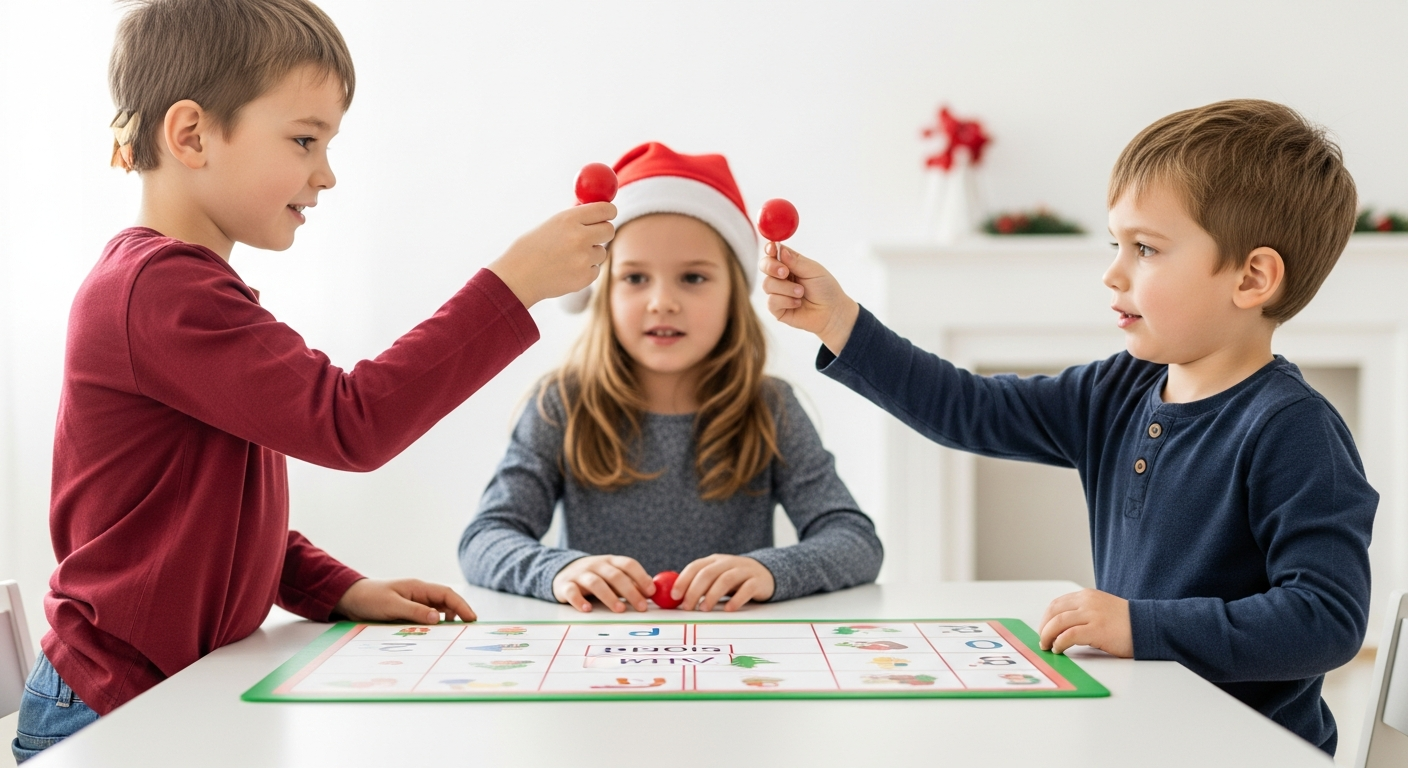
Table of Contents
- Why Christmas Games Spark Communication Development
- Speech Blubs: Your Partner in Holiday Communication
- Engaging Kid Christmas Games for Every Age and Stage
- Amplifying Holiday Learning with Speech Blubs
- Your Journey to Joyful Communication: Choose Speech Blubs
- Conclusion
- Frequently Asked Questions about Kid Christmas Games & Speech
The holiday season arrives like a sprinkle of magic, transforming our homes into havens of warmth, wonder, and endless possibilities for connection. For families with young children, this special time offers more than just twinkling lights and festive treats; it’s an incredible opportunity to foster growth, strengthen bonds, and, perhaps most importantly, spark a love for communication. While gift-giving and carols often take center stage, we believe that simple, engaging Christmas games can be powerful tools, turning everyday play into exceptional learning experiences for speech and language development.
This isn't just about keeping kids entertained; it's about leveraging the inherent joy and togetherness of Christmas to build foundational communication skills. This blog post will explore a sleigh-full of kid Christmas games, tailored for various age groups, and reveal how each activity can become a delightful springboard for language growth. We'll also show you how Speech Blubs seamlessly integrates into your festive fun, providing an immediate, effective, and joyful solution for the 1 in 4 children who need speech support. This holiday season, let's transform festive play into powerful communication practice, creating joyful memories and building essential language skills, with Speech Blubs as your supportive partner.

Why Christmas Games Spark Communication Development
Play is the universal language of childhood, and it’s especially potent when it comes to learning. During the Christmas season, the heightened excitement, new sensory experiences, and increased social interactions create an ideal environment for children to explore and develop their speech and language abilities.
The Power of Play for Language Growth
Engaging in games provides a natural, low-pressure setting for children to practice vital communication skills. Think about it:
- Social Interaction: Games inherently involve turn-taking, sharing, and reacting to others, which are crucial for developing social communication (pragmatics).
- Vocabulary Expansion: From naming holiday-themed objects to describing actions and feelings, Christmas games introduce a rich tapestry of new words.
- Following Directions: Many games require listening carefully and executing multi-step commands, strengthening auditory comprehension.
- Emotional Expression: Winning, losing, collaborating—games evoke a range of emotions, offering opportunities to discuss feelings and use expressive language.
- Problem-Solving: Deciphering clues, strategizing, or simply figuring out how to play a new game all involve critical thinking and the language used to articulate those thoughts.
At Speech Blubs, we deeply understand this power of play. Our entire approach is built on blending scientific principles with play, creating one-of-a-kind "smart screen time" experiences that are far from passive viewing. We believe that joyful engagement is the key to unlocking a child's potential to "speak their minds and hearts."
Speech Blubs: Your Partner in Holiday Communication
Our mission at Speech Blubs is deeply personal. Our founders grew up with speech problems, leading them to create the very tool they wished they had. This personal connection fuels our commitment to providing an immediate, effective, and joyful solution for every child on their communication journey. We know that finding effective ways to support your child's speech can be challenging, especially amidst the busy holiday season. That's why we’ve designed Speech Blubs to be a supportive, engaging resource for families.

We employ a unique "video modeling" methodology, where children learn by watching and imitating their peers. This approach leverages the power of mirror neurons, making learning natural and highly effective. Instead of passive screen time, Speech Blubs offers an interactive experience that encourages active participation, fostering crucial skills like imitation, articulation, and vocabulary development. It’s a powerful tool for family connection, providing parents and caregivers with fun activities to do alongside their child. When you use Speech Blubs, you're not just getting an app; you're joining a community dedicated to empowering children. To learn more about our innovative approach, you can always visit the Speech Blubs homepage.
Engaging Kid Christmas Games for Every Age and Stage
Let's dive into some wonderful kid Christmas games that will not only bring cheer but also boost your child's communication skills this holiday season. We’ve designed these activities to be fun, flexible, and easy to adapt to your child's individual needs.
For Our Youngest Communicators (Toddlers & Preschoolers)
For little ones just beginning their speech journey, the focus is on basic vocabulary, sound imitation, and understanding simple directions. These games create a stimulating environment without overwhelming them.
1. "Santa Says" (Holiday Simon Says)
This festive twist on a classic game is perfect for developing listening skills and following commands.
- How to Play: One person is "Santa" and gives commands, but children only follow them if Santa first says "Santa says." For example, "Santa says touch your red nose!" or "Santa says hop like an elf!" If Santa just says, "Touch your toes!" without "Santa says," players should not do it. Those who do are out, or for a more inclusive version, they just get a friendly reminder.
- Speech & Language Benefits:
- Listening Comprehension: Children practice carefully listening to and processing commands.
- Following Directions: It enhances the ability to follow 1-2 step instructions.
- Vocabulary: Focus on body parts ("nose," "head," "feet"), action verbs ("hop," "spin," "clap"), and descriptive words ("red," "sparkly").
- Articulation: Practicing sounds within words like "Santa" (/s/), "says" (/s/), "red" (/r/), "jump" (/j/).
- Adaptations for Speech Goals:
- For very young children, start with simple, single-word commands like "Santa says jump!" or "Santa says clap!" Use gestures alongside the words.
- For children working on specific sounds, incorporate words with those sounds into the commands. For example, if they're working on /s/, use "Santa says sit down."
- Scenario Example: If your 3-year-old is a late talker struggling with action verbs like "jump" or "clap," playing "Santa Says" can be incredibly motivating. After an exciting round, you can seamlessly transition to the "Actions" section within Speech Blubs, where they'll see peers performing and modeling these very actions, reinforcing their learning in a fun, visual way.
- Ready to boost those action words? Download Speech Blubs on the App Store and explore our interactive sections.
2. Christmas Sensory Bin Adventure
Sensory bins are fantastic for engaging multiple senses and sparking descriptive language.
- How to Play: Fill a bin with festive, safe items: cotton balls (snow), cinnamon sticks, pinecones, jingle bells, small plastic ornaments, red and green pom-poms, cookie cutters, and child-safe tongs or scoops. Let your child explore, touch, sort, and play with the items.
- Speech & Language Benefits:
- Descriptive Vocabulary: Encourage words like "soft," "prickly," "shiny," "cold," "warm," "smelly," "big," "small," "red," "green."
- Asking & Answering Questions: "What is that?" "How does it feel?" "Can you find something soft?"
- Prepositions: "Put the bell in the scoop," "Take the pinecone out."
- Action Verbs: "Pour," "scoop," "mix," "feel," "shake."
- Adaptations for Speech Goals:
- For children with limited vocabulary, name each item as they touch it. Emphasize the initial sound: "P-p-pinecone."
- Focus on comparing and contrasting items: "Is this big or small?"
- Encourage narrative by asking, "What are you making?" or "Tell me about your snow scene."
3. Festive Gift Wrap & Unwrap Fun
This simple activity leverages the excitement of presents for language practice.
- How to Play: Provide small, empty boxes or toys, wrapping paper scraps, tape, and ribbons. Guide your child through the process of wrapping a "gift." Then, let them practice unwrapping. You can even wrap a favorite toy and then "unwrap" it together.
- Speech & Language Benefits:
- Action Verbs: "Wrap," "unwrap," "tear," "cut," "stick," "tape," "tie."
- Prepositions: "On," "in," "under," "over," "around."
- Requesting: "More tape, please," "Help me," "Open."
- Colors & Shapes: Identify the colors of paper and ribbons, and shapes of boxes.
- Adaptations for Speech Goals:
- Model repetitive phrases: "Wrap, wrap, wrap!" or "Open, open, open!"
- Ask "wh-" questions: "What's inside?" "Who is this gift for?"
4. Holiday Object Bingo
A visual game that reinforces vocabulary and encourages vocalization.
- How to Play: Create simple Bingo cards with pictures of Christmas items (Santa, reindeer, tree, present, star, candy cane). You can draw them or print them from online templates. Call out the names of the items, and children mark them on their cards. The first to get a line shouts "Bingo!"
- Speech & Language Benefits:
- Object Identification & Naming: Children learn to identify and vocally label various holiday items.
- Auditory Discrimination: Differentiating between similar-sounding words.
- Turn-Taking: Practicing waiting for their turn and listening to the caller.
- Vocalization: Encouraging children to say the names of the items as they mark them.
- Adaptations for Speech Goals:
- For children with few words, have them point to the item instead of naming it, and you provide the label.
- Focus on initial sounds: "S-s-santa!"
- Use cards with real photos for better recognition.
- If your child loves interactive visual games, explore the vast library of categories in Speech Blubs designed to build vocabulary and improve articulation. Get Speech Blubs on Google Play and start playing!
For Developing Speakers (Elementary School Age)
Children in elementary school are expanding their vocabulary, forming longer sentences, and engaging in more complex social interactions. These games challenge them to use language creatively and strategically.
5. Christmas Charades & Pictionary
These visual games are fantastic for expressive and receptive language skills.
- How to Play: Write down holiday-themed words or phrases on slips of paper (e.g., "decorate the tree," "singing carols," "Santa Claus," "opening presents," "gingerbread man"). For charades, players act out the word without speaking. For Pictionary, they draw it. Teams guess the word within a time limit.
- Speech & Language Benefits:
- Vocabulary: Reinforces holiday words, action verbs, and descriptive adjectives.
- Expressive Language: Children think about how to convey concepts non-verbally or through drawing, then use language to guess.
- Inferencing & Problem-Solving: Guessing requires making connections and using context clues.
- Turn-Taking & Social Cues: Observing body language and understanding social communication.
- Adaptations for Speech Goals:
- For children struggling with expressive language, offer prompts or categories.
- Focus on articulating guesses clearly.
- Scenario Example: A child working on expressing emotions might act out "excited to open presents." This helps them connect physical actions with feelings and build confidence in conveying meaning. The "Emotions" section in Speech Blubs can then reinforce facial expressions and associated vocabulary, empowering them to "speak their minds and hearts" more fully.
6. The Great Candy Cane Hunt
A sweet twist on an Easter egg hunt, perfect for practicing spatial concepts and descriptive language.
- How to Play: Hide candy canes around a room or yard. Give each child a small bag or basket. Provide clues or directions as they search. For example, "Look under the sofa," or "Is there one behind the curtain?"
- Speech & Language Benefits:
- Prepositions/Spatial Concepts: "Under," "over," "behind," "next to," "on top of," "inside."
- Counting: Children count the candy canes they find.
- Descriptive Language: Encouraging them to describe where they found a candy cane.
- Question Formulation: "Where should I look next?" "Did you see one?"
- Adaptations for Speech Goals:
- For children learning new prepositions, emphasize the word as you give the clue and have them repeat it.
- Make it a team effort, requiring communication to find all the candy canes.
- Unsure about your child's communication progress? Take our quick 3-minute preliminary screener to get a simple assessment and a free 7-day trial of Speech Blubs. It’s a great first step!
7. Holiday Story Starters & Chain Stories
Encourage imagination and narrative skills with these engaging storytelling games.
- How to Play: Start a holiday story with a sentence like, "One snowy Christmas Eve, an elf accidentally spilled glitter all over Santa's sleigh..." Then, each person adds a sentence or two to continue the story. For younger kids, use visual prompts like pictures of Christmas items.
- Speech & Language Benefits:
- Narrative Skills: Developing the ability to create a coherent story with a beginning, middle, and end.
- Sequencing: Understanding the order of events.
- Vocabulary Expansion: Introducing new words to describe characters, settings, and plot twists.
- Sentence Structure: Practicing forming grammatically correct and complex sentences.
- Adaptations for Speech Goals:
- Provide a visual story web or a list of "who, what, where, when, why" prompts to help structure their contributions.
- Encourage the use of transition words like "then," "next," "after that."
8. DIY Ornament Storytelling Challenge
Combine crafting with creative expression for a unique communication boost.
- How to Play: Provide simple craft supplies (cardboard cutouts, glitter, glue, markers, yarn, small pom-poms) and challenge each child to create a unique Christmas ornament. As they create, ask them to tell a story about their ornament: "What is it?" "Who would it belong to?" "What's its Christmas adventure?"
- Speech & Language Benefits:
- Descriptive Language: Explaining the materials, colors, and design choices.
- Explanatory Language: Describing the steps they took to create the ornament.
- Narrative & Imaginative Play: Inventing a story or background for their creation.
- Asking & Answering Questions: Engaging in conversation about their project.
- Adaptations for Speech Goals:
- Model descriptive sentences: "I am using the shiny red glitter."
- Help them articulate their choices: "Why did you choose that color?"
- We've seen countless families transform everyday moments into significant speech breakthroughs with our app. Don't just take our word for it—read inspiring parent testimonials and see the difference Speech Blubs has made.
For Confident Communicators (Pre-Teens & Older Kids)
For older children, games can focus on more complex language skills like argumentation, critical thinking, abstract concepts, and nuanced social communication.
9. Christmas Movie Trivia Challenge
Test holiday movie knowledge and expressive language skills.
- How to Play: Prepare a list of trivia questions about popular Christmas movies (e.g., "What is the name of the Grinch's dog?"). Divide into teams or play individually. Players must clearly articulate their answers.
- Speech & Language Benefits:
- Information Retrieval: Accessing and recalling specific facts.
- Expressive Language: Formulating clear and concise answers.
- Turn-Taking & Negotiation: Deciding who answers on a team, or waiting for their turn.
- Argumentation (for harder questions): Discussing why a particular answer might be correct, using persuasive language.
- Adaptations for Speech Goals:
- For children who struggle with quick recall, offer multiple-choice options.
- Encourage detailed explanations: "Why do you think that's the answer?"
- Scenario Example: A pre-teen practicing how to justify their answers and explain their reasoning will find this game invaluable. It builds confidence in expressing ideas under pressure. Speech Blubs, with its focus on clear articulation and expressive language activities, can be a great complement to further develop that confident voice.
10. Family Carol Karaoke Showdown
Singing is a fantastic, joyful way to practice articulation and rhythm.
- How to Play: Set up a karaoke machine (or just use YouTube lyrics on a screen) and sing classic Christmas carols. Encourage dramatic performances! You can even assign points for articulation, enthusiasm, or staying on pitch.
- Speech & Language Benefits:
- Articulation Practice: Singing naturally encourages clear pronunciation, as lyrics need to be understood.
- Rhythm & Intonation: Developing an awareness of speech rhythm and the rise and fall of voice.
- Breath Control: Important for sustained speech.
- Auditory Memory: Remembering lyrics and melodies.
- Social Participation: Overcoming shyness to perform in front of others.
- Adaptations for Speech Goals:
- Focus on specific sounds within songs: "Jingle Bells, Jingle Bells" for /b/ sounds.
- For children with difficulty, start with simple, repetitive songs.
11. The "Gift-Wrapping Gauntlet" Challenge
This team challenge fosters problem-solving and communicative negotiation.
- How to Play: Divide players into teams. Provide each team with an oddly shaped item (e.g., a stuffed animal, a ball, a small plant), wrapping paper, tape, and ribbon. Challenge them to wrap the item perfectly within a time limit, but with a twist: one team member is blindfolded, and the others can only give verbal instructions, not touch the wrapping materials or the item.
- Speech & Language Benefits:
- Following Multi-Step Instructions: The blindfolded person must carefully listen.
- Giving Clear Instructions: The non-blindfolded team members must use precise, descriptive language.
- Negotiation & Problem-Solving: Teams must communicate to overcome wrapping challenges.
- Descriptive Language: Using words like "long," "short," "tight," "loose," "corner," "edge."
- Adaptations for Speech Goals:
- Rotate roles so everyone gets a chance to give and receive instructions.
- Encourage asking clarifying questions: "Do you mean the long side or the short side?"
- Our app's methodology is backed by science, utilizing advanced video modeling techniques that place us in the top tier of speech apps worldwide. To delve deeper into the research supporting our engaging activities, explore the science behind Speech Blubs.
Amplifying Holiday Learning with Speech Blubs
While these kid Christmas games are fantastic on their own, Speech Blubs can significantly amplify their impact, creating a holistic and powerful approach to communication development. We believe in "smart screen time" – an active, engaging alternative to passive viewing experiences like cartoons.
Imagine this: after a lively game of "Santa Says" focusing on action words, your child can jump into Speech Blubs' "Actions" category. There, they'll see real children, their peers, demonstrating those very actions through our unique video modeling. This visual and auditory imitation not only reinforces what they learned during play but also activates mirror neurons, making the learning process incredibly effective and natural.
Speech Blubs offers:
- Reinforcement: What children learn through festive games can be reinforced and generalized through our interactive activities.
- Targeted Practice: Our app provides focused exercises for specific sounds, words, and sentences, ensuring consistent practice.
- Motivation: The engaging, peer-led video content keeps children motivated and eager to participate.
- Convenience: On busy holiday days, Speech Blubs offers a convenient way to integrate valuable speech practice without extensive setup.
We're committed to helping children "speak their minds and hearts," and our app is designed to be a powerful supplement to a child's overall development plan. Whether your child is working on articulation, vocabulary, or social communication skills, Speech Blubs is a tool that supports confidence building, reduces frustration, and creates joyful family learning moments. Begin your journey to clearer communication and confidence today! Start your 7-day free trial today.
Your Journey to Joyful Communication: Choose Speech Blubs
This Christmas, give the gift of confident communication. These festive kid Christmas games provide a wonderful foundation for speech and language development, fostering a love for communication and creating unforgettable family memories. When you combine the magic of holiday play with the proven methodology of Speech Blubs, you unlock an unparalleled opportunity for your child to thrive.
We designed Speech Blubs to be accessible and effective, born from the personal experiences of our founders who wanted to provide the tool they wished they had. We continuously strive to make it easy for families to support their child's speech journey.
Here’s a look at our plans:
- Monthly Plan: Priced at $14.99 per month.
- Yearly Plan: The best value at just $59.99 per year, which breaks down to an incredible $4.99 per month. That's a 66% savings compared to the monthly plan!
The Yearly plan is truly the best choice for your family, offering exceptional value and exclusive features that enhance your experience:
- 7-Day Free Trial: Only available with the Yearly plan, allowing you to explore all our features before committing.
- Extra Reading Blubs App: Unlock the Reading Blubs app, a fantastic complement for literacy development, exclusively with the Yearly plan.
- Early Access to New Updates: Get first access to our latest features and content.
- 24-Hour Support Response Time: Enjoy priority support when you need it most.
The Monthly plan does not include these valuable benefits. To fully experience the power of Speech Blubs and Reading Blubs, gain early access, and receive priority support, we highly recommend choosing the Yearly plan. It's the most comprehensive and cost-effective way to empower your child's communication journey.
Ready to embark on a festive and enriching communication adventure with your child? Create your Speech Blubs account today and make sure to select the Yearly plan to get your free trial and unlock all the amazing features!
Conclusion
The Christmas season is a precious time for creating cherished memories, and by intentionally weaving speech-boosting kid Christmas games into your celebrations, you’re doing so much more than just having fun. You’re building the crucial foundations of confident communication, reducing potential frustrations, and empowering your child to "speak their minds and hearts." From playful charades to imaginative storytelling, each game becomes an opportunity for growth.
Speech Blubs is here to support you every step of the way, offering a scientifically-backed, joyful, and interactive platform that transforms screen time into smart learning time. This holiday, embrace the spirit of giving by giving your child the gift of clear, joyful communication. Download Speech Blubs today, select the Yearly plan for the best value and benefits, and watch your child's confidence soar!
Frequently Asked Questions about Kid Christmas Games & Speech
1. How can I make these Christmas games beneficial for my child's speech development?
The key is active engagement and adaptation. For younger children, focus on naming objects, imitating sounds, and following simple directions. For older children, encourage descriptive language, storytelling, and turn-taking. Model clear speech, ask open-ended questions, and create an encouraging environment where mistakes are opportunities for learning. Most importantly, participate with your child; your interaction is invaluable.
2. What if my child isn't interested in playing structured games?
That's perfectly normal! Many children prefer free play. You can integrate speech goals into less structured activities. For example, while decorating the Christmas tree, describe the ornaments ("sparkly," "round," "heavy"). During baking, talk about the ingredients ("sticky dough," "sweet cookies") and actions ("mix," "pour"). Speech Blubs can also be a great tool, as its video modeling format is highly engaging and doesn't always feel like a "game" in the traditional sense.
3. How does Speech Blubs fit into our holiday game time?
Speech Blubs complements holiday games beautifully! After a game like "Candy Cane Hunt," you could use the app's "Prepositions" section to reinforce concepts like "under" or "behind." If your child enjoyed "Christmas Charades," explore the "Emotions" or "Actions" categories in Speech Blubs to expand their vocabulary and understanding of non-verbal cues. It's a fantastic way to extend learning and practice in an engaging, "smart screen time" environment that feels like a natural extension of play.
4. When should I consider professional help for my child's speech?
Every child develops at their own pace, but if you have concerns about your child's speech or language development, it's always best to consult with a pediatrician or a speech-language pathologist. Common indicators might include not meeting age-appropriate milestones, difficulty being understood by others, or significant frustration when trying to communicate. Early intervention is often key. As a starting point, you can take our quick 3-minute preliminary screener to get a simple assessment and a free 7-day trial of Speech Blubs, which can help guide your next steps.
About the author