
Festive Paper Crafts: Kids' Christmas Fun
 By Speech Blubs Team•Dec 22, 2025•19 min.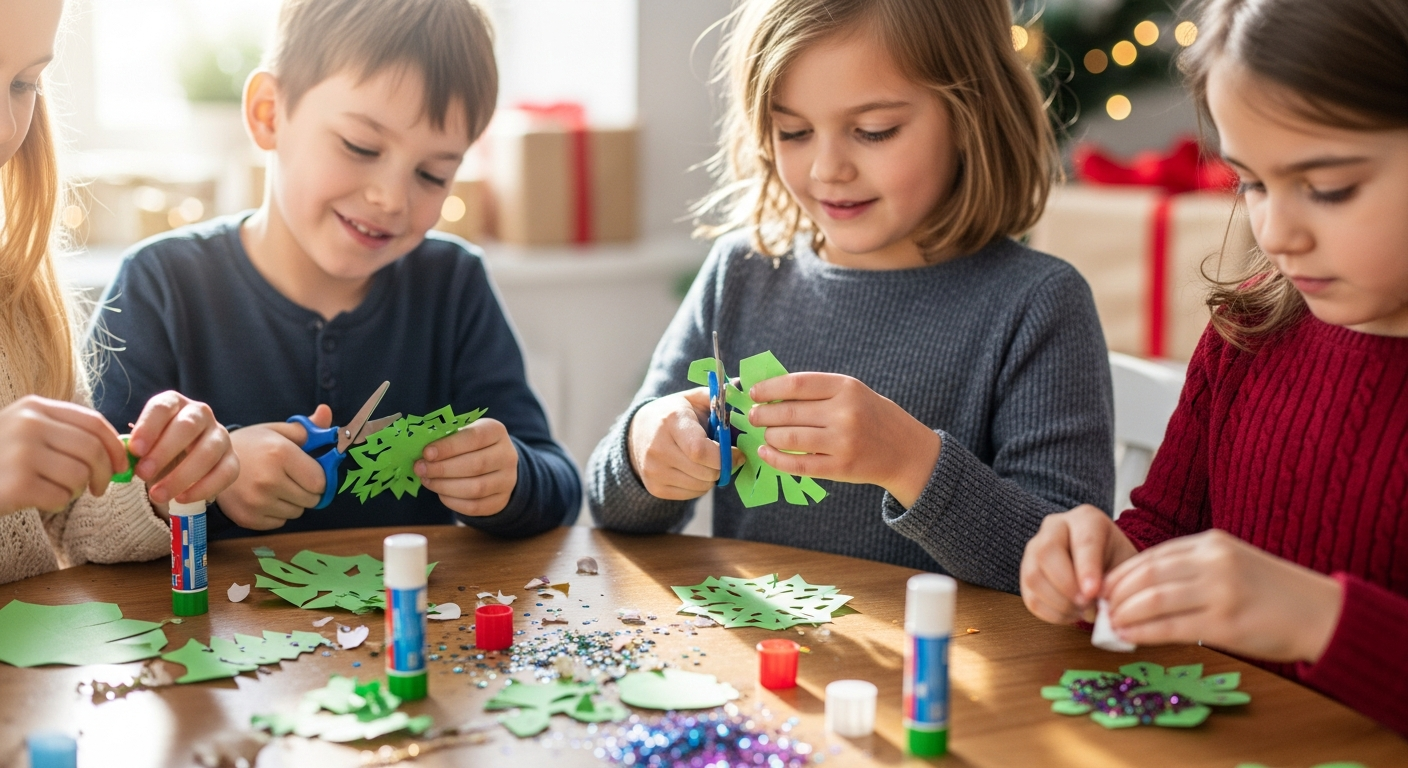
Table of Contents
- Introduction
- The Magic of Paper Crafts for Child Development
- Essential Materials for Your Christmas Paper Craft Stash
- Delightful Christmas Paper Crafts for Kids (Ages 2-10+)
- Integrating Speech Blubs into Your Family's Holiday Traditions
- Maximizing the Experience: Tips for Parents
- Conclusion
- Frequently Asked Questions
Introduction
As the days grow shorter and a special sparkle fills the air, many families eagerly anticipate the magic of the holiday season. While visions of sugar plums might dance in children’s heads, the reality often involves a flurry of activities, some joyful, some a little overwhelming. But what if we told you that amidst the hustle and bustle, there's a simple, heartwarming activity that not only sparks creativity but also provides incredible opportunities for your child's development, especially their communication skills? That activity is Christmas paper crafting! Far from just a way to pass the time, engaging in festive paper crafts offers a treasure trove of benefits, from refining fine motor skills to expanding vocabulary and fostering meaningful family connections. In this post, we’ll dive deep into the world of Christmas paper crafts for kids, exploring delightful projects and showing how these joyful moments naturally support your child's journey to speaking their minds and hearts, often with the thoughtful support of tools like Speech Blubs.

The Magic of Paper Crafts for Child Development
Engaging in paper crafts is more than just a fun holiday tradition; it's a powerful developmental tool. When children fold, cut, glue, and decorate, they're not just making a pretty ornament – they're building a foundation for crucial cognitive, motor, and linguistic abilities.
Fine Motor Skill Enhancement
Paper crafts are a fantastic workout for little hands. Holding scissors, manipulating small pieces of paper, tracing lines, and carefully applying glue all require precision and control. These actions strengthen the small muscles in the fingers and hands, which are essential for tasks like writing, buttoning clothes, and self-feeding. For a child who might be struggling with pencil grasp or general dexterity, the playful, low-pressure environment of crafting can make these exercises enjoyable and motivating. Imagine a child meticulously cutting out the intricate lines of a paper snowflake; they are developing hand-eye coordination and bilateral integration, using both hands effectively together.
Boosting Creativity and Imagination
The blank canvas of a piece of paper invites endless possibilities. When given simple materials like construction paper, glitter, and glue, children transform these into snowmen, reindeer, Santa hats, or whatever their festive imagination conjures. This process nurtures their ability to think creatively, solve problems (how do I make this paper stand up?), and express themselves uniquely. There's no single "right" way to make a paper chain, and each child's creation will be a unique reflection of their inner world. This freedom of expression is crucial for developing self-confidence and a sense of accomplishment.
Cognitive and Problem-Solving Skills
Following instructions, understanding sequences ("first we fold, then we cut"), recognizing shapes, and planning out a design all engage a child's cognitive abilities. Simple crafts can introduce concepts like symmetry, patterns, and cause-and-effect (if I cut here, what happens?). For instance, creating a paper chain requires understanding repetition and spatial reasoning. These are foundational skills that support learning in school and everyday life.

Language and Communication Opportunities
Perhaps one of the most overlooked benefits of crafting is the rich language environment it creates. As children engage in paper crafts, they are naturally exposed to and encouraged to use a wide range of vocabulary. Think about the words involved: "fold," "cut," "glue," "red," "green," "sparkly," "star," "tree," "round," "square," "big," "small," "under," "over," "sticky," "smooth," "rough." Parents and caregivers can narrate actions, ask open-ended questions, and describe textures and colors, turning a craft session into an impromptu speech and language lesson.
For a child who is a late talker or struggling with specific sounds, a crafting session becomes a low-stakes, high-engagement setting for practice. If a child is making a paper Santa and struggling with the "s" sound, you can gently prompt them to say "Santa," "sticky tape," or "scissors" as you work together. If a child enjoys making animal crafts but struggles with animal sounds or names, our "Animal Kingdom" section in Speech Blubs offers a fun, motivating way to practice "moo," "baa," "roar," and more, using our unique video modeling where they imitate peers. This kind of focused practice, combined with the natural conversation during crafts, creates a powerful learning synergy.
At Speech Blubs, our mission is to empower children to speak their minds and hearts, and we know firsthand the challenges families face. Our founders all grew up with speech problems, leading them to create the immediate, effective, and joyful tool they wished they had. We are committed to helping the 1 in 4 children who need speech support, blending scientific principles with play to create one-of-a-kind "smart screen time" experiences. We believe in providing a screen-free alternative to passive viewing experiences, like cartoons, and a powerful tool for family connection, just like crafting does. For insights into our scientific methodology and how we leverage concepts like video modeling to help children learn effectively, you can explore our research page.
Essential Materials for Your Christmas Paper Craft Stash
Before we dive into specific crafts, let’s gather our basic supplies. Most of these are readily available and can be reused for many projects, making paper crafting an affordable and sustainable holiday activity.
- Construction Paper: A variety of colors, especially festive reds, greens, whites, golds, and silvers.
- Cardstock: Thicker paper for more durable crafts like cards or ornaments.
- Safety Scissors: Child-friendly scissors are a must for tiny hands.
- Glue Sticks and Liquid Glue: Glue sticks are great for less mess, while liquid glue can be better for heavier embellishments.
- Crayons, Markers, Colored Pencils: For drawing and coloring details.
- Glitter and Glitter Glue: A holiday staple!
- Cotton Balls: For fluffy snow or Santa's beard.
- Ribbon, Yarn, String: For hanging ornaments or adding decorative touches.
- Googly Eyes: Always a hit for bringing characters to life.
- Stickers: Christmas-themed stickers can add instant festive cheer.
- Popsicle Sticks: For puppet crafts or structural support.
- Paper Plates: Versatile for many round crafts.
Having these materials on hand means you’re always ready for an impromptu crafting session, turning a potentially frustrating moment into an opportunity for creative play and communication.
Delightful Christmas Paper Crafts for Kids (Ages 2-10+)
Here’s a collection of festive paper crafts, ranging from simple projects for toddlers to more involved creations for older children, each offering unique developmental and linguistic benefits.
1. Paper Plate Santa Claus
Age Group: 2-6 years Skills Developed: Following instructions, shape recognition (circle), gluing, sensory exploration (cotton balls), color identification. Language Focus: "Red," "white," "circle," "cut," "glue," "fuzzy," "beard," "hat," "face," "eyes," "nose," "mouth."
How to Make:
- Take a plain paper plate. This will be Santa's face.
- Help your child paint or color the top half of the plate red for Santa's hat.
- Cut out a triangle from red construction paper and glue it to the top of the plate as the hat.
- Glue cotton balls along the bottom edge of the hat and on the tip.
- Glue cotton balls around the bottom half of the plate to create Santa’s beard.
- Add googly eyes and draw a nose and mouth.
- Speech Blubs Connection: As you work, describe each step. "First, we need the red hat." "Now, let's put the fuzzy cotton on for Santa's beard." For a child working on consonant sounds like /f/ or /b/, pointing out "fuzzy" and "beard" multiple times provides natural repetition. For children focusing on early vocabulary, practicing words like "red," "white," "cut," and "glue" throughout the activity reinforces their understanding and use. Our "Early Words" section can complement this by showing children peers saying and doing these actions.
2. Handprint Reindeer Cards
Age Group: 2-8 years Skills Developed: Tracing, cutting, gluing, hand-eye coordination, personal expression. Language Focus: "Brown," "hand," "print," "finger," "antlers," "nose," "eyes," "card," "gift," "love," "family."
How to Make:
- Fold a piece of cardstock in half to create a card.
- Help your child trace their hand on brown construction paper twice. These will be the reindeer's antlers.
- Cut out the handprints.
- Glue the two handprints onto the front of the card, slightly angled upwards, resembling antlers.
- Draw a reindeer face between the antlers, adding googly eyes and a bright red nose (pom-pom or paper).
- Write a festive message inside the card.
- Speech Blubs Connection: This craft encourages describing body parts ("hand," "fingers") and actions ("trace," "cut," "glue"). When making the card for a family member, talk about who will receive it. "Grandma will love this reindeer card!" For children who benefit from seeing and imitating actions, our "Actions" section in Speech Blubs can help reinforce words like "trace" or "cut" through video modeling.
3. Paper Chain Countdown
Age Group: 3-10+ years Skills Developed: Fine motor skills, counting, sequencing, color recognition, pattern creation. Language Focus: "Link," "chain," "strip," "long," "short," "count," "day," "Christmas," "glue," "tape," numbers (one, two, three...).
How to Make:
- Cut strips of construction paper (e.g., 1 inch wide by 8-10 inches long) in various Christmas colors.
- Form the first strip into a loop and glue or tape the ends together.
- Thread the next strip through the first loop, form another loop, and glue/tape.
- Continue until you have a chain with one link for each day until Christmas (e.g., 24 links for December 1st to 24th).
- Hang the chain and remove one link each day to count down.
- Speech Blubs Connection: This activity is fantastic for practicing numbers and counting. "How many more links do we need? Let's count them!" "Which color link should we add next?" For children struggling with sequencing or number concepts, this tangible countdown makes abstract ideas concrete. Our "Numbers" section can be used before or after the activity to reinforce numeral recognition and counting skills. If a child is a "late talker" and enjoys repetitive tasks, the repetitive nature of making links provides ample opportunity to practice simple words like "link" or "glue" with adult support.
4. Paper Snowflakes
Age Group: 4-10+ years (with adult help for younger children) Skills Developed: Fine motor skills, symmetry, spatial reasoning, creativity. Language Focus: "Fold," "cut," "triangle," "square," "pattern," "symmetrical," "snowflake," "design," "open," "surprise."
How to Make:
- Start with a square piece of paper.
- Fold it diagonally in half to make a triangle.
- Fold the triangle in half again.
- Fold it into thirds (this is the trickiest part, an adult might need to help).
- Cut various shapes and patterns into the folded edges.
- Carefully unfold to reveal your unique snowflake!
- Speech Blubs Connection: Discuss the process: "We need to fold the paper again." "What kind of shape should we cut?" The "surprise" of unfolding the snowflake creates a moment for expressive language. For children working on following multi-step directions, breaking down the folding and cutting instructions into simple, actionable chunks ("Fold it once," "Now cut a little piece off the side") is excellent practice. Speech Blubs’ "Actions" section, where children imitate different movements and their corresponding words, can be a great precursor to help them understand and execute verbs like "fold" and "cut."
5. Toilet Paper Roll Reindeer
Age Group: 3-8 years Skills Developed: Recycling, cutting, gluing, decorating, imaginative play. Language Focus: "Roll," "brown," "antlers," "nose," "googly eyes," "pipe cleaner," "stick," "stand," "Santa," "sleigh."
How to Make:
- Paint or color a toilet paper roll brown.
- Glue googly eyes onto the roll.
- Add a red pom-pom or a small red circle of paper for the nose.
- Cut small antler shapes from brown construction paper and glue them to the top inside of the roll, or use bent pipe cleaners.
- You can add a small jingle bell or ribbon.
- Speech Blubs Connection: This craft encourages describing attributes ("brown," "round," "shiny" for the eyes) and parts ("nose," "antlers," "ears"). Create multiple reindeer and give them names, prompting imaginative play and narrative skills. "This is Rudolph! What does Rudolph say?" For children who enjoy character play, our "What Am I?" section or "Animals" activities can inspire new vocabulary and sounds to associate with their paper reindeer friends.
6. Paper Bag Puppets (Christmas Characters)
Age Group: 3-7 years Skills Developed: Storytelling, imaginative play, fine motor skills, character creation. Language Focus: Character names (Santa, Elf, Reindeer), actions ("talk," "sing," "jump"), emotions, descriptive words.
How to Make:
- Provide plain paper bags (lunch bag size).
- Let children choose a Christmas character (Santa, elf, reindeer, snowman).
- Provide construction paper, cotton balls, googly eyes, markers, and other embellishments.
- Help them cut out shapes and glue them onto the bag to create their character. The bottom flap of the bag can be the mouth, making it a functional puppet.
- Speech Blubs Connection: Once the puppets are made, encourage children to put on a "show." This is a fantastic way to practice dialogue, storytelling, and turn-taking in conversation. For a parent whose 3-year-old "late talker" loves animals, creating a reindeer puppet opens up opportunities to practice animal sounds and names. For children who struggle with initiating conversation or expressing emotions, the puppets can act as a safe "voice" to explore these areas. Speech Blubs’ "Guess the Word" or "My Face" sections can help children practice recognizing and producing words for facial features and emotions, which they can then apply to their puppets.
7. Christmas Tree Cone
Age Group: 4-8 years Skills Developed: Geometric shapes (cone), decorating, spatial awareness, sequencing. Language Focus: "Cone," "green," "decorate," "star," "ornament," "glitter," "pointy," "tall," "bottom," "top."
How to Make:
- Cut a large semicircle from green cardstock.
- Form the semicircle into a cone shape and glue the edges together.
- Provide various small decorations: glitter, sequins, small paper cutouts (stars, circles), pom-poms.
- Let the child glue these "ornaments" onto their paper tree.
- Cut out a star for the top.
- Speech Blubs Connection: This craft is rich in descriptive vocabulary and directional words. "Let's put the star on the top!" "Can you find a round ornament?" For children who need practice with spatial prepositions, this activity provides a natural context. Our "In-On-Under" activity within Speech Blubs helps children master these prepositions through engaging video modeling, which can then be reinforced during crafting as they place decorations "on" or "under" parts of the tree.
Integrating Speech Blubs into Your Family's Holiday Traditions
While these crafts provide incredible opportunities for natural language development, sometimes children need an extra boost, or a more structured, yet still playful, approach. This is where Speech Blubs shines as a complementary tool during the festive season and beyond.
Imagine your child is making a Christmas paper craft, and you notice they are struggling with specific sounds or words. Instead of creating frustration, you can seamlessly transition to a Speech Blubs activity. For example:
- Difficulty with Action Verbs: While cutting and gluing, if your child hesitates with "cut" or "fold," you can guide them to the "Actions" section in Speech Blubs. Here, they watch real children demonstrate these actions and imitate them, strengthening their understanding and verbalization in a fun, video-modeling environment.
- Expanding Holiday Vocabulary: Many Christmas crafts introduce new words like "ornament," "sleigh," "gingerbread." Our app's diverse sections, like "Early Words" or specific seasonal content (when available), can reinforce these words through engaging games and peer-to-peer imitation. This is particularly effective for children who thrive on visual learning.
- Developing Social Communication: Holiday gatherings often involve talking to relatives. Creating puppets or cards can be a great way to practice greetings or simple questions. Speech Blubs also includes activities focused on social scenarios and emotions, which can help children build confidence in interacting with others, preparing them to "speak their minds and hearts" with everyone they meet during the holidays.
We believe that our approach, born from our founders' personal experiences with speech problems, offers an invaluable resource. We offer an immediate, effective, and joyful solution for the 1 in 4 children who need speech support, providing a "smart screen time" alternative that blends scientific principles with play. We focus on interaction, not passive viewing, making it a powerful tool for family connection, much like shared crafting time. Our unique "video modeling" methodology, where children learn by watching and imitating their peers, is backed by extensive research, placing us in the top tier of speech apps worldwide for effectiveness and engagement. You can learn more about how we help thousands of families every day by reading testimonials from other parents.
Unsure if Speech Blubs is right for your child? We’ve made it easy to find out. Take our quick 3-minute preliminary screener. It involves 9 simple questions and provides an immediate assessment and next-steps plan. This is a great way to understand your child's communication development and see how Speech Blubs can support their unique needs, all while offering you a free 7-day trial.
Maximizing the Experience: Tips for Parents
- Set Realistic Expectations: Not every craft will be a masterpiece, and that's okay! Focus on the process and the time spent together, not the perfect outcome. The goal is engagement and learning, not flawless art.
- Incorporate Music: Play some cheerful Christmas carols in the background to set a festive mood. Music can also help regulate mood and energy levels, making for a more pleasant crafting experience.
- Narrate and Ask Questions: Be your child's language model. Describe what you're doing, what they're doing, and ask open-ended questions: "What color paper do you want next?" "How does the glitter feel?" "Tell me about your reindeer."
- Let Them Lead: Offer choices and allow your child to make decisions about their craft. This fosters independence and creativity.
- Display Their Creations: Proudly showcase their artwork! This boosts self-esteem and provides tangible evidence of their efforts. Hang their paper ornaments on the tree, tape their snowflakes to a window, or display their cards on the mantel.
- Clean Up Together: Involve your child in the clean-up process, teaching responsibility and reinforcing organizational skills. Use this time for more language practice: "Let's put the scissors away." "Time to wipe up the glue."
Conclusion
Christmas paper crafts for kids offer a beautiful blend of festive fun and invaluable developmental opportunities. From enhancing fine motor skills and sparking creativity to building confidence and fostering rich language development, these simple projects create lasting memories and significant growth. As you gather your paper and glue this holiday season, remember that each snip, fold, and stick is a step in your child's journey towards expressing themselves fully.
For those moments when you want to give your child an additional boost in their communication journey, remember that Speech Blubs is here to support you. We are dedicated to providing an immediate, effective, and joyful solution, backed by science and designed to make learning to speak fun and engaging. Ready to empower your child to speak their minds and hearts?
Unlock a world of interactive learning and accelerate your child's communication skills. Download Speech Blubs on the App Store or get it on Google Play today!
For the best value and access to all our premium features, choose our Yearly plan. At just $59.99 per year, you save 66% compared to the Monthly plan ($14.99/month), which breaks down to an incredible $4.99/month. The Yearly plan also includes a 7-day free trial, our extra Reading Blubs app, early access to new updates, and 24-hour support response time. The Monthly plan does not offer these comprehensive benefits. Start your child's journey to confident communication and joyful learning by choosing the Yearly plan and claiming your 7-day free trial today!
Frequently Asked Questions
Q1: What age range are Christmas paper crafts suitable for?
Christmas paper crafts are wonderfully versatile and can be adapted for almost any age! Simple crafts like tearing paper for a collage or gluing large cotton balls for a Santa beard are great for toddlers (ages 2-3). Preschoolers (ages 3-5) can handle basic cutting and more complex gluing. School-aged children (6-10+) can follow multi-step instructions, use scissors with more precision, and create intricate designs like paper snowflakes or elaborate cards. The key is to choose projects appropriate for your child's developmental stage and to provide adult supervision and assistance as needed.
Q2: How do Christmas paper crafts specifically help with speech development?
Paper crafts create a rich, natural language environment. As children engage, they are constantly exposed to new vocabulary (e.g., "fold," "cut," "sparkly," "tree," "snowflake"), action verbs, and descriptive words. Parents can narrate the steps, ask open-ended questions, and encourage children to describe their creations. This interaction naturally promotes language comprehension, expressive language, and turn-taking skills. For children working on specific sounds or words, crafts provide a low-pressure, motivating context for practice. For instance, making a paper reindeer offers multiple chances to practice the "r" sound in "reindeer" or "red."
Q3: What if my child isn't interested in crafting?
It's common for children to have varying interests. If your child isn't immediately enthusiastic, try to make the activity short, simple, and child-led. Offer a choice of materials or just one small step to start. Focus on the playful aspect rather than the end product. Sometimes, integrating elements they love, like their favorite characters or colors, can spark interest. If they prefer other activities, that's perfectly fine too; the goal is to find engaging ways to connect and foster development. Remember that the interaction and conversation surrounding any shared activity are what truly boost language skills.
Q4: Is Speech Blubs a replacement for professional speech therapy?
Speech Blubs is a powerful, engaging, and scientifically-backed tool designed to supplement and support a child's speech and language development journey, but it is not intended to replace professional speech therapy. We provide an immediate and joyful solution for families, offering "smart screen time" experiences rooted in video modeling and play. For children with significant speech delays or disorders, professional evaluation and therapy from a certified Speech-Language Pathologist are crucial. Speech Blubs can be an excellent resource to use in conjunction with professional guidance, reinforcing skills learned in therapy and providing consistent, fun practice at home. You can start with our preliminary screener to get an initial assessment and guidance.
About the author