
Fourth of July Toddler Craft: 15 Fun Ways to Boost Speech
 By Speech Blubs Team•Feb 23, 2026•14 min.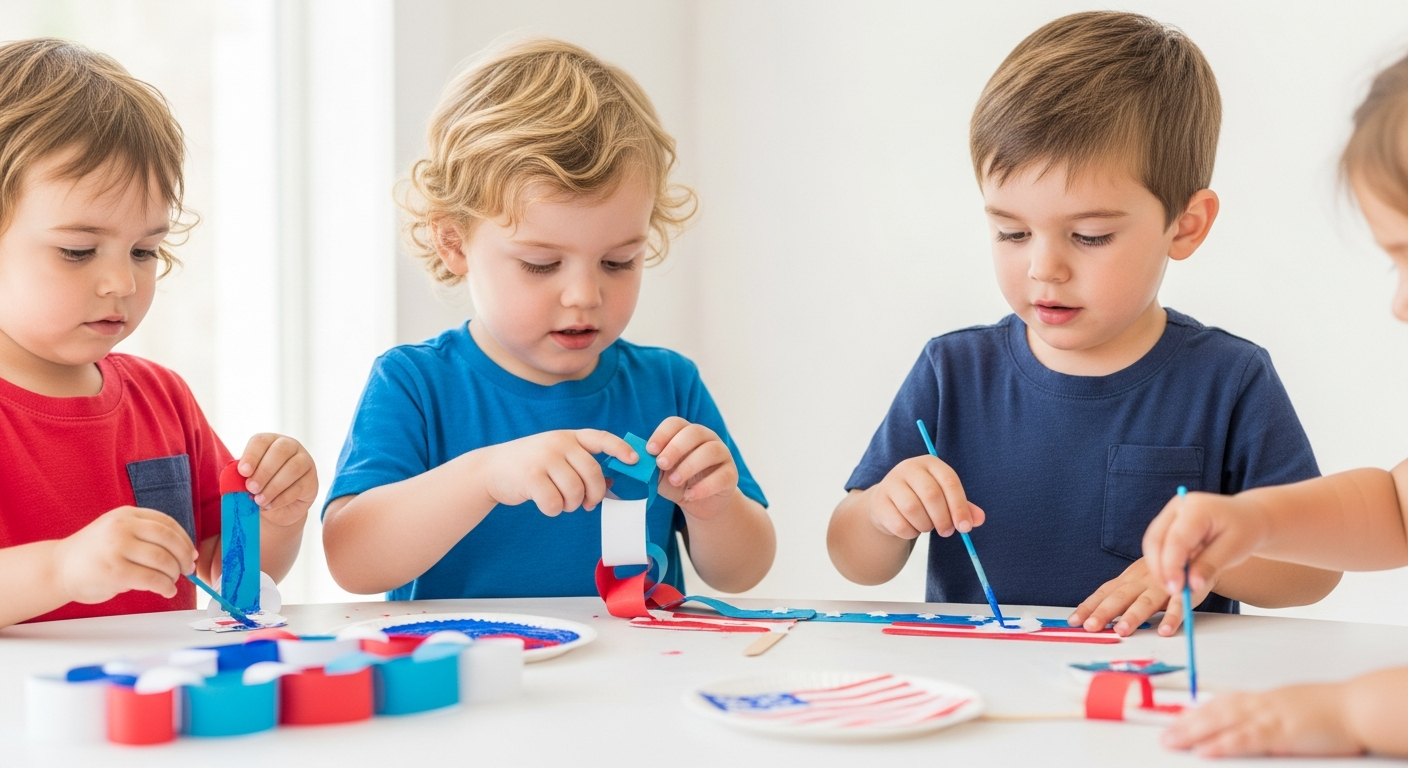
Table of Contents
- Introduction
- Why Crafting is a Secret Weapon for Speech
- 1. Patriotic Handprint Flags (Sensory Play)
- 2. Star-Spangled Sensory Bin
- 3. Firework Salt Painting (Art Meets Science)
- 4. TP Roll Firework Stamps
- 5. DIY Fourth of July Crowns
- 6. Red, White, and Blue Collage
- 7. Fingerprint American Flag
- 8. Glitter Glue Fireworks
- 9. USA Fizzy Ice (A Science Experiment)
- 10. Patriotic Pasta Necklaces
- 11. Fourth of July Color by Code
- 12. Paper Plate Flag Windsocks
- 13. Patriotic Lava Lamps
- 14. Q-Tip Firework Points
- 15. Make Patriotic Pretzels!
- Making the Most of Holiday Learning
- The Speech Blubs Difference: Plans and Pricing
- Practical Tips for Your Fourth of July Crafting
- Conclusion
- Frequently Asked Questions
Introduction
Picture this: It is the Fourth of July, the grill is sizzling, the sun is shining, and your toddler is currently trying to use a condiment bottle as a megaphone. We have all been there! Holidays are wonderful, but they can also be overwhelming for little ones who thrive on routine. As parents and experts at Speech Blubs, we know that these high-energy days are actually the perfect opportunity to sneak in some high-quality learning. When your child is engaged in a tactile, colorful fourth of July toddler craft, they aren’t just making a mess—they are building the foundations of communication.

The purpose of this guide is to provide you with a curated list of patriotic activities that do more than just decorate your fridge. We will explore crafts that target fine motor skills, sensory processing, and, most importantly, speech development. Whether your child is a "late talker" or simply expanding their vocabulary, these activities provide a bridge between play and progress. Our mission at Speech Blubs is to empower children to "speak their minds and hearts," and there is no better time to start than during a joyful family celebration.
By the end of this article, you will have a toolkit of easy-to-implement ideas that turn holiday downtime into "smart screen time" supplements and hands-on learning moments. We believe that when science meets play, magic happens.
Why Crafting is a Secret Weapon for Speech
Before we dive into the glitter and glue, let’s talk about the "why." At Speech Blubs, we are deeply committed to providing an immediate, effective, and joyful solution for the 1 in 4 children who need speech support. Our company was born from the personal experiences of our founders, who all grew up with speech challenges themselves. They created the tool they wished they had—one that prioritizes joy over clinical repetition.
When a child engages in a fourth of July toddler craft, they are practicing what we call "functional communication." They have to ask for the "blue" paint, say "more" sparkles, or exclaim "look!" at their finished product. This is much more effective than rote memorization. Our unique approach utilizes video modeling methodology, where children learn by watching and imitating their peers. You can mirror this at home by modeling the words for the craft materials before your child uses them.
Key Takeaway: Crafting isn't just about the end product; it’s about the "pivotal phrases" (like "on," "off," "up," "down") that your child uses during the process.
1. Patriotic Handprint Flags (Sensory Play)
This is a classic for a reason. Handprint crafts are excellent sensory experiences. For a child who might be hesitant to touch different textures, the feeling of cold, wet paint can be a big step in sensory integration.

Materials:
- Non-toxic red, white, and blue paint
- White construction paper
- Foam brushes
Speech Strategy: As you paint your child’s palm blue, narrate the sensation. "Ooh, it's cold! Blue paint on your hand." Encourage them to say "Press!" as they put their hand on the paper. This helps them connect an action with a specific, punchy verb. If your child is using our app, they might recognize these simple action words from our "Daily Woods" section.
2. Star-Spangled Sensory Bin
Sensory bins are a powerhouse for fine motor development. They keep toddlers engaged for much longer than a standard toy, providing a screen-free alternative to passive viewing.
Materials:
- Dried rice (dyed red and blue with food coloring)
- Star-shaped cookie cutters
- Small scoops and plastic cups
Speech Strategy: Use this bin to practice "spatial" words. "The star is in the rice!" "Now it is out!" If you are unsure if your child is meeting their developmental milestones in these areas, you can take our quick 3-minute preliminary screener to get a simple assessment and a next-steps plan.
3. Firework Salt Painting (Art Meets Science)
This craft is mesmerizing. Watching the color travel through the salt is like magic, and it’s a great way to work on "descriptive" vocabulary.
Materials:
- Black cardstock
- School glue
- Table salt
- Watercolors and a dropper
How-To:
- Draw "firework" bursts with glue.
- Let your toddler shake salt over the glue (great for "Shake, shake, shake!" practice).
- Drop liquid watercolor onto the salt and watch it spread.
Practical Scenario: For a parent whose 3-year-old "late talker" is fascinated by cause-and-effect, this activity is gold. As the paint spreads, you can model words like "Wow!" "Look!" or "Bright!" This mimics our peer-led video modeling, where your child sees the excitement of communication in action.
4. TP Roll Firework Stamps
Don't throw away those toilet paper rolls! They make the perfect DIY stamps for a fourth of July toddler craft.
Materials:
- Empty TP rolls
- Scissors
- Red and blue paint
How-To: Cut slits into one end of the roll and fan them out. Your child can dip the "fringe" into paint and stamp it onto paper to create firework bursts. This is a fantastic way to practice the "B" sound with "Boom!" or the "P" sound with "Pop!"
5. DIY Fourth of July Crowns
Toddlers love to dress up. Creating a crown gives them a sense of pride and a "prop" for imaginative play.
Materials:
- Blue construction paper strips
- Red and white star stickers
- Tape
Speech Strategy: Have your child "request" the stickers. Instead of giving them the whole sheet, hold it and wait for them to point or say "star." This "communication temptation" is a core principle we use at Speech Blubs to encourage toddlers to use their words to get what they want. You can see how this works in practice by reading our parent success stories and testimonials.
6. Red, White, and Blue Collage
Collages are great for building hand strength, which is a precursor to writing.
Materials:
- Scraps of red, white, and blue paper, fabric, or ribbon
- Glue sticks
- A large piece of cardboard
How-To: Encourage your child to "rip and tear" the paper. Ripping paper is actually a complex fine motor skill! As they glue pieces down, talk about the different textures: "Soft ribbon," "Rough paper," "Sticky glue."
7. Fingerprint American Flag
Keepsakes like this are wonderful to look back on. This craft focuses on precision and "pointing," which is a major communication milestone.
Materials:
- White paper
- Blue and red paint
How-To: Paint a small blue square in the corner. Then, have your child use their index finger to make red "stripe" dots. This "isolated finger pointing" is something we encourage in our app interactions to help kids develop the coordination needed for gestures.
8. Glitter Glue Fireworks
Glitter glue is a sensory delight (and much less messy than loose glitter!).
Materials:
- Black construction paper
- Red, silver, and blue glitter glue
How-To: Help your child squeeze the bottles to make starburst shapes. Squeezing is excellent for strengthening the small muscles in the hand. While they work, you can sing simple songs or use the "Smart Timer" feature on your phone to keep the activity focused and fun.
9. USA Fizzy Ice (A Science Experiment)
This is a "cool" way to beat the July heat while practicing speech.
Materials:
- Ice cubes (frozen with red and blue food coloring)
- A tray
- Vinegar in a spray bottle or dropper
- Baking soda
How-To: Sprinkle baking soda over the colored ice. Have your child spray or drop vinegar onto it. The fizzing sound is a perfect prompt for the "S" sound (Ssssss!). "Listen! It’s fizzing!"
10. Patriotic Pasta Necklaces
Stringing pasta is a high-level fine motor task that requires focus and bilateral coordination (using both sides of the body).
Materials:
- Penne or rigatoni pasta
- Red and blue food coloring/vinegar mix (to dye the pasta)
- Yarn or string
How-To: Once the pasta is dyed and dry, show your child how to "poke" the string through. Use the words "through," "pull," and "long." If your child is a fan of our "Yummy Time" section in the app, they will love "cooking" up this jewelry!
11. Fourth of July Color by Code
For older toddlers and preschoolers, a simple color-by-number or color-by-shape activity builds cognitive mapping skills.
Speech Strategy: "Find the number one. What color is one? Red!" This helps with color identification and following multi-step directions. If you want to jumpstart this journey, you can download Speech Blubs on the App Store to explore our color-themed activities.
12. Paper Plate Flag Windsocks
These look beautiful hanging on a porch and provide a visual "reward" when the wind blows.
Materials:
- Paper plates (cut in half)
- Blue paint
- Red and white streamers or crepe paper
- Glue and string
How-To: Paint the plate half blue. Glue streamers to the straight edge. Hang it up and say, "Look, it’s flying!" or "Wave bye-bye to the flag!"
13. Patriotic Lava Lamps
This is a mesmerizing "calm down" jar that you can use long after the holiday is over.
Materials:
- A clear plastic bottle
- Water and vegetable oil
- Red or blue food coloring
- Alka-Seltzer tablets (adult use only!)
How-To: Fill the bottle with oil and a bit of water. Add drops of food coloring. Drop in a piece of the tablet and watch the bubbles rise. This is a great time to practice "Up" and "Down."
14. Q-Tip Firework Points
Using a Q-tip instead of a brush requires a different type of grip (the "pincer grasp"), which is vital for later pencil control.
Materials:
- Black paper
- Q-tips
- Bright neon or metallic paint
How-To: Dot the paint in a circle to create a firework. You can model the "D-D-D" sound for "Dot" as you work. This type of repetitive sound play is exactly how we help children build phonemic awareness.
15. Make Patriotic Pretzels!
Cooking is a craft you can eat! It’s the ultimate multi-sensory experience.
Materials:
- Large pretzel rods
- Melted white chocolate
- Red and blue sprinkles
How-To: Dip the pretzel in chocolate and then "Shake" the sprinkles on. This is a great way to practice the "Mmmm" sound for "Yummy!" To get started with more interactive learning, download Speech Blubs on Google Play today.
Making the Most of Holiday Learning
At Speech Blubs, we don't just provide an app; we provide a toolkit for family connection. We know that the best learning happens when parents and children play together. While our app uses high-tech video modeling to trigger "mirror neurons" in a child's brain (the neurons that fire when we watch someone else perform an action), the "homework" happens in these real-world moments.
Smart Screen Time vs. Passive Viewing
Many parents feel guilty about screen time, but there is a big difference between a child staring blankly at a cartoon and a child actively participating with Speech Blubs. Our app is a "smart screen time" experience. It asks the child to participate, to mimic, and to engage. Think of it as a digital version of the crafts we just discussed—an interactive tool designed to foster a love for communication and build confidence.
Setting Realistic Expectations
It’s important to remember that every child develops at their own pace. We are not here to suggest that one craft session or one week with an app will result in a child giving public speeches. Instead, we focus on the process: reducing frustration by giving them the tools to express basic needs, developing foundational mouth movements, and creating joyful family learning moments. Whether you are using our resources to supplement professional therapy or just looking for a head start, the goal is progress, not perfection.
The Speech Blubs Difference: Plans and Pricing
We believe in transparency because we want to build a long-term relationship with your family. We offer two main ways to join our community:
- The Monthly Plan: At $14.99 per month, this is a great way to test the waters and see how your child responds to our peer-led video modeling.
- The Yearly Plan: This is our best value at $59.99 per year, which breaks down to just $4.99 per month.
We always recommend the Yearly plan because it is designed for consistent, long-term growth. When you choose the Yearly plan, you receive:
- A 7-day free trial to explore everything we have to offer.
- The Reading Blubs app, which helps transition speech skills into early literacy.
- Early access to all new updates and content.
- 24-hour support response time from our dedicated team.
The Monthly plan does not include the Reading Blubs app or the free trial, so the Yearly plan truly offers the full suite of features your child needs to thrive. Ready to get started? Create your account and begin your 7-day free trial today.
Practical Tips for Your Fourth of July Crafting
- Follow Their Lead: If your toddler is more interested in the feeling of the glue than making a flag, let them! The goal is engagement, not a perfect Pinterest result.
- Narrate Everything: Become a sports commentator for your child's life. "You're picking up the red paper! Now you're putting it on the glue. Sticky!"
- Use the App as a Warm-Up: Spend 10 minutes on the Speech Blubs homepage or in the app looking at "colors" or "shapes" before you start your craft. This primes their brain for the vocabulary they are about to use.
- Keep it Short: Toddlers have short attention spans. It’s okay if a craft only lasts 5 minutes. Those are 5 minutes of high-quality interaction!
Conclusion
The Fourth of July is a time for celebration, and what better way to celebrate than by helping your child find their voice? Through a simple fourth of July toddler craft, you are providing more than just holiday fun; you are giving them the building blocks of language. From the "Boom!" of a TP roll stamp to the "Sticky!" feeling of a collage, every moment is an opportunity to learn.
At Speech Blubs, we are honored to be a part of your journey. Our founders started this company to ensure that no child feels left behind in their ability to "speak their minds and hearts." We invite you to join our community of over 5 million parents who have discovered the power of joyful, peer-led learning.
Take the first step today. We recommend downloading the app and selecting the Yearly plan to take full advantage of our 7-day free trial, the Reading Blubs app, and our latest updates. Let's make this holiday the start of a wonderful new chapter in your child's development.
Download Speech Blubs on the App Store or Google Play to begin your journey!
Frequently Asked Questions
1. What if my toddler just wants to eat the craft materials?
This is very common! Always use non-toxic, child-safe paints and glue. If your child is in a heavy "mouthing" phase, focus on edible crafts like the Patriotic Pretzels or a red, white, and blue fruit salad. You can still practice speech by naming the fruits (strawberry, blueberry) as you go!
2. How do these crafts actually help with speech delay?
Crafts encourage "joint attention"—the ability of a child to focus on an object with another person. This is a foundational skill for communication. Additionally, the sensory input and fine motor movements required for crafting stimulate areas of the brain that are also responsible for speech and language processing.
3. Can Speech Blubs replace traditional speech therapy?
Speech Blubs is designed to be a powerful supplement to a child's overall development plan and, when applicable, professional therapy. It’s a tool that provides "smart screen time" at home to reinforce the skills they are learning in their everyday environment. It provides a joyful, peer-led experience that keeps children motivated between therapy sessions.
4. Why is the Yearly plan better than the Monthly plan?
Consistency is key in child development. The Yearly plan not only saves you 66% compared to the monthly price, but it also includes the Reading Blubs app and a 7-day free trial. This ensures you have all the tools necessary for a comprehensive approach to your child's speech and literacy journey.
About the author