
Fun and Easy Construction Paper Toddler Crafts for Home
 By Speech Blubs Team•Feb 20, 2026•15 min.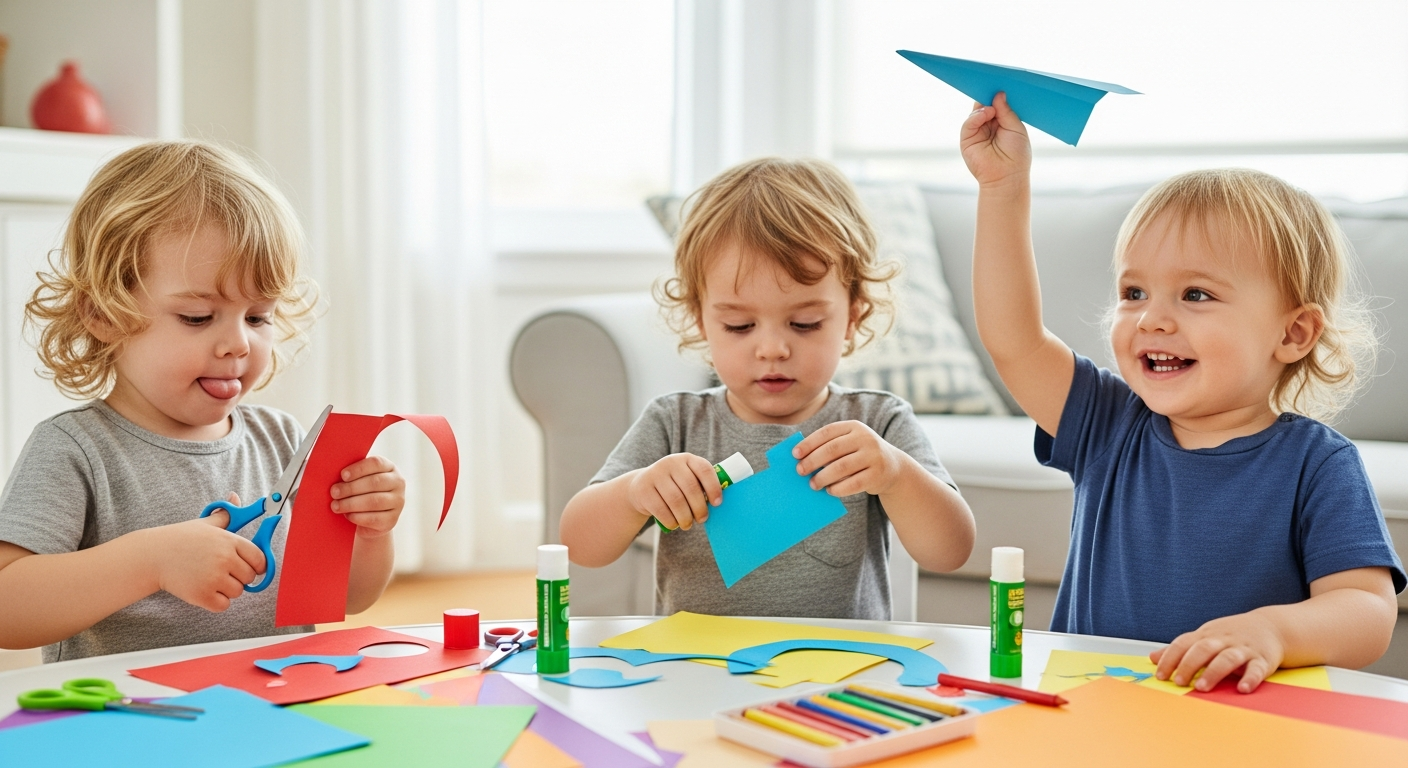
Table of Contents
- Introduction
- The Power of Simple Crafting in Child Development
- Getting Started: The Basic Toolkit
- Creative Construction Paper Animal Crafts
- Exploring Patterns with Paper Strips and Weaving
- The Art of the Mosaic: Sensory and Tactile Play
- Wearable Crafts: Roleplay and Confidence
- Loops, Coils, and 3D Creations
- Why Speech Blubs is Your Partner in Play
- Tips for a Stress-Free Crafting Session
- Conclusion
- Frequently Asked Questions
Introduction
Have you ever looked at a stack of vibrant construction paper and seen more than just school supplies? To a toddler, that stack is a gateway to a world of lions, rainbows, and wearable crowns. We’ve all been there: it’s a rainy Tuesday afternoon, the toy bin has lost its luster, and the "toddler boredom" whine is beginning to escalate. You want to engage your child in something meaningful, but you don’t have the energy for a high-maintenance project involving glitter cannons or expensive kits. This is where the humble sheet of construction paper becomes your best friend.
At Speech Blubs, we believe that the simplest moments often hold the greatest potential for development. Our mission is to empower children to "speak their minds and hearts," and while we provide a digital tool for speech support, we are huge advocates for offline, tactile play that builds the same foundational skills. In this post, we are going to dive deep into the world of construction paper toddler crafts. We will explore over 25 creative ideas, discuss the developmental benefits of "smart" crafting, and show you how these activities can seamlessly complement your child's speech and language journey. By the end of this article, you’ll have a toolkit of activities that foster a love for communication, build confidence, and create joyful family learning moments without the stress.

The Power of Simple Crafting in Child Development
Before we grab the glue sticks, it is important to understand why construction paper is such a powerhouse for toddlers. For a child who might be struggling with speech or a "late talker," crafting provides a low-pressure environment to practice communication.
Fine Motor Skills and Speech
There is a fascinating link between the fine motor skills used in crafting—pinching, tearing, and cutting—and the development of speech. The same areas of the brain that control hand movements are closely situated to the areas that control mouth movements. When your toddler works on a construction paper mosaic, they aren't just making art; they are firing up neural pathways that support the coordination needed for complex speech sounds.
Vocabulary Building
Every craft is a lesson in language. "Can you pass the yellow paper?" "Look how sticky the glue is!" "Should we make the snake long or short?" By narrating these actions, we provide a rich linguistic environment. This mimics our approach at Speech Blubs, where we use video modeling to help children see and hear peers using words in context.
Building Confidence and Reducing Frustration
For the 1 in 4 children who need speech support, communication can sometimes feel like a chore. Crafting offers an immediate, tangible result. When a toddler finishes a paper crown, they feel a sense of "I did it!" This confidence often spills over into their willingness to try new words or sounds. We frame our app as a powerful supplement to these real-world wins, focusing on the joy of the process rather than just the outcome.
Getting Started: The Basic Toolkit
You don’t need a professional art studio to enjoy construction paper toddler crafts. In fact, keeping it simple is the key to longevity.
- Construction Paper: A multi-color pack is essential.
- Child-Safe Scissors: Great for those approaching the preschool years.
- Glue Sticks: Much less messy than liquid glue for tiny hands.
- Washable Markers or Crayons: For adding those finishing touches.
- Googly Eyes: A toddler favorite that brings any paper creature to life.
If you are unsure where your child stands in their developmental milestones, we invite you to take our quick 3-minute preliminary screener. It consists of 9 simple questions and provides an assessment and a next-steps plan, along with a free 7-day trial to get you started.

Creative Construction Paper Animal Crafts
Animals are a universal favorite for toddlers. They offer a fantastic opportunity to practice "animal sounds," which are often the building blocks of early speech.
1. The Easy Paper Twirl Snake
This is a classic for a reason. Simply cut a large circle out of green or brown construction paper. Start at the edge and cut in a spiral until you reach the center. Decorate with markers and add googly eyes to the "head" (the center of the spiral).
- Speech Connection: Practice the "Sssss" sound as the snake "slithers" through the air. For a child who loves animals, this pairs perfectly with the 'Animal Kingdom' section in our app.
2. Handprint Butterfly
Trace your child’s hands on two different colors of construction paper. These will be the wings. Cut a small oval for the body. Glue the hands to the sides of the oval.
- Why it works: It’s personalized! Toddlers love seeing their own hands turned into art. It builds a sense of self-awareness and body parts vocabulary.
3. Construction Paper Frog
Cut two long strips of green paper and a circle for the head. Loop the strips to create a "3D" body and attach the head on top. Add long, red paper "tongues" for extra fun.
- Scenario: For a parent whose 3-year-old is a "late talker" and loves the outdoors, making this frog while practicing the "Ribbit" sound mimics the video modeling seen in Speech Blubs, where children learn by watching and imitating.
4. Swirling Twirling Ladybugs
Cut two red circles and one slightly smaller black circle. Fold the red circles in half to create wings and glue them to the black base. Add black dots with markers.
- Tip: Use these to talk about colors and counting (1 dot, 2 dots, 3 dots!).
5. Paper Chain Snake
If the spiral snake is too tricky, try a paper chain. Create 10-12 loops and link them together. Add a face to the front loop.
- Developmental win: Linking loops is a fantastic bilateral coordination exercise, requiring both hands to work together.
Exploring Patterns with Paper Strips and Weaving
These crafts are excellent for older toddlers and preschoolers who are beginning to understand patterns and sequences.
6. Paper Chain Rainbow
Cut strips of red, orange, yellow, green, blue, and purple paper. Link them together in order.
- Educational Value: This teaches the sequence of the rainbow and encourages the use of color names.
7. Simple 3D Construction Paper Flowers
Cut several strips of bright paper. Fold them in half (don't crease) and glue the ends to a center circle. This creates a "loop" petal that pops off the page.
- Family Connection: Make a "bouquet" for a grandparent. It’s a wonderful way to teach the concept of giving and kindness.
8. Paper Weave Placemats
Take a large sheet of paper and fold it in half. Cut slits from the fold toward the edge, but don't go all the way through. Open it up and let your toddler weave contrasting strips of paper through the slits.
- Patience Building: This is a slower craft that rewards focus. If your child gets frustrated, remind them that it's about having fun together, not perfection.
9. Rainbow Unicorn Mane
Draw or print a unicorn head. Let your child glue long, thin strips of colorful paper to the back of the head to create a flowing mane. You can even "curl" the paper by wrapping it around a pencil.
10. Water Lily Art
Inspired by Monet, use torn strips of green and blue paper for the "water" and create a small 3D flower to sit on top.
- Speech Blubs Method: Just as we use peer-to-peer modeling to show children how to form sounds, you can model "tearing" and "gluing" to show your child how to create textures.
The Art of the Mosaic: Sensory and Tactile Play
Mosaics are perfect for toddlers because there is no "wrong" way to do them. They can be precise or beautifully chaotic.
11. Rainbow Mosaic
Draw a simple rainbow outline. Cut or tear small squares of colored paper and have your child glue them into the corresponding sections.
- Toddler Win: Tearing paper is incredibly satisfying for little hands and provides a great sensory experience.
12. Torn Paper Watermelon
Use a paper plate as a base (or a pink paper circle). Use green torn paper for the "rind" and black markers or small black paper "seeds" for the middle.
- Summer Fun: This is a great seasonal craft to discuss different foods and tastes.
13. Mosaic Mushroom
A classic red-and-white mushroom is easy to recognize. Use white torn paper for the spots on a red construction paper cap.
14. Seahorse Mosaic
Trace a seahorse shape on a piece of cardstock. Use different shades of blue and green paper to fill it in.
- Contextual Learning: Pair this with a trip to the local aquarium or a video about the ocean to reinforce new vocabulary.
15. The "Confetti" Masterpiece
Sometimes, the best craft is just "gluing paper on paper." Give your child a bowl of paper scraps and a glue stick and let their imagination run wild.
Wearable Crafts: Roleplay and Confidence
When a child can wear their art, the play continues long after the glue has dried. This encourages roleplay, which is vital for social-emotional development.
16. Paper Chain Jewelry
Make tiny paper chains to serve as necklaces or bracelets.
- Speech Practice: "Look at my necklace!" "It’s so pretty." Encourage your child to describe their "jewelry" to other family members.
17. Dinosaur Hat
Cut a long strip of paper to fit around your child’s head. Then, cut several triangles for "spikes" and glue them along a second strip that goes over the top of the head.
- Play Idea: Once the hat is on, practice "dinosaur roars" and "stomping."
18. Royal Crown
A simple zigzag cut across the top of a long strip of paper creates an instant crown. Let your child decorate it with paper "gems."
- Social Proof: We’ve seen thousands of parents share stories of how roleplaying with simple props helped their children find their voice. You can read our testimonials to see how play-based learning changes lives.
19. Animal Masks
Cut two holes for eyes in a paper plate or a sturdy piece of construction paper. Add ears (triangles for cats, circles for bears) and a nose.
- Interaction: Wear a mask yourself! Interactive play is the heart of speech development.
20. Superhero Cuffs
Use toilet paper rolls covered in construction paper or just wide strips of paper taped into circles. Add a "power symbol" (like a star or lightning bolt) to the front.
Loops, Coils, and 3D Creations
Moving into three dimensions helps toddlers understand space and volume, which are key cognitive milestones.
21. Quilled Paper Snail
Tightly roll a strip of paper around a pencil to create a "shell." Glue it to a flat paper body.
- Fine Motor Focus: The act of coiling requires precision and strengthens the muscles used for writing later in life.
22. Paper Loop Butterfly Body
While the wings are flat, use loops of paper for the butterfly’s body to make it stand out.
23. Quilling Heart Balloons
Create small paper coils and arrange them into a heart shape. Draw "strings" leading down from the hearts. This makes a beautiful card for a parent or teacher.
24. Paper Chain Caterpillar
Much like the snake, but shorter and perhaps with many "legs" (small strips of paper) glued to the sides. This is a great companion to "The Very Hungry Caterpillar."
25. 3D Spring Tree
Create a brown trunk and glue it to a blue background. For the leaves, use small, loosely coiled circles of pink or green paper to give the tree texture and depth.
Why Speech Blubs is Your Partner in Play
While we love the mess and the creativity of construction paper toddler crafts, we know that as a parent, you also want tools that are backed by science and proven to work. Speech Blubs was born from the personal experiences of our founders, who all grew up with speech problems. They created the tool they wished they had—one that blends scientific principles with play into one-of-a-kind "smart screen time" experiences.
Our unique approach focuses on video modeling. In the app, your child won't see abstract cartoons; they will see real children—their peers—demonstrating how to make sounds and say words. This triggers "mirror neurons" in the brain, making the child more likely to imitate the behavior. It’s the same way they learn to use a glue stick by watching you!
Choosing the Right Plan for Your Family
We want to be transparent and helpful as you decide how to support your child’s development. We offer two main paths:
- Monthly Plan: For $14.99 per month, you get full access to the Speech Blubs app and its vast library of activities.
- Yearly Plan (Best Value): For $59.99 per year, you save 66% (breaking down to just $4.99/month).
The Yearly plan is our most popular choice because it includes several exclusive benefits designed for long-term success:
- 7-Day Free Trial: Try everything before you commit.
- Reading Blubs App: An extra app included at no additional cost to help with early literacy.
- Early Access: Be the first to try new updates and features.
- Priority Support: A 24-hour support response time to ensure your journey is smooth.
Ready to get started? Create your account and begin your 7-day free trial today.
Tips for a Stress-Free Crafting Session
We want these construction paper toddler crafts to be a source of joy, not another item on your "to-do" list. Here are a few expert tips from our team:
- Focus on the Process, Not the Product: If your child wants to make a blue lion with ten eyes, let them! The goal is engagement and communication, not a Pinterest-perfect result.
- Narrate Everything: Use "self-talk" and "parallel talk." (e.g., "I am cutting the paper. Now you are gluing the paper!")
- Limit Supplies: Giving a toddler 20 colors at once can be overwhelming. Try offering a choice between two colors to empower them without causing a "choice-overload" meltdown.
- Incorporate "Smart Screen Time": Use Speech Blubs as a warm-up. Watch the "Animal Kingdom" section together, then put the phone away and recreate those animals with construction paper. This creates a powerful link between digital learning and physical play.
- Set Realistic Expectations: Some days, your toddler will craft for 30 minutes. Other days, they will be done in 30 seconds. Both are okay. We are building foundational skills, not training for a marathon.
Conclusion
Construction paper toddler crafts are more than just a way to pass the time; they are a vibrant, tactile extension of your child's developmental journey. By engaging in these simple activities, you are helping your child build fine motor strength, expand their vocabulary, and most importantly, find the confidence to "speak their minds and hearts." Whether you are tearing paper for a mosaic or linking loops for a rainbow chain, you are creating space for connection and growth.
At Speech Blubs, we are honored to be a part of that journey. Our app provides the "smart screen time" that supports these offline activities, providing a screen-free alternative to passive viewing and a powerful tool for family connection. We invite you to join our community of over 5 million parents who are making speech therapy fun and accessible.
To begin your journey, we recommend starting with the Yearly plan. It offers the best value, includes the Reading Blubs app, and gives you a full week to explore all the features for free. Download Speech Blubs on the App Store or Google Play to begin today. Let’s turn that stack of construction paper into a bridge to better communication!
Frequently Asked Questions
What age is best to start construction paper crafts with a toddler?
Most children can begin very simple paper activities, like tearing or sticking paper onto a contact sheet, around 18 months. By age 2 or 3, they can begin using glue sticks and eventually child-safe scissors with adult supervision. Always tailor the activity to your child's specific motor skills and interests.
How can crafting help if my child is a "late talker"?
Crafting provides a rich environment for "language modeling." As you work together, you can narrate actions, name colors, and describe textures. This helps the child associate words with physical actions. Additionally, the fine motor movements involved in crafting are neurologically linked to the areas of the brain responsible for speech.
Is construction paper safe for toddlers?
Yes, standard construction paper is non-toxic and safe for supervised play. However, always be mindful of small pieces of paper if your toddler is still in the "mouthing" phase, and always supervise the use of glue and scissors.
My toddler has a short attention span; how can I keep them engaged?
Keep activities short and focused. Instead of trying to build a complex 3D animal, start with just "decorating a sheet of paper." Let the child lead the activity. If they lose interest, it's okay to stop and come back to it later. Mixing crafting with interactive tools like Speech Blubs can also keep them motivated by connecting what they see on the screen to what they are holding in their hands.
About the author