
Fun and Easy Toddler Beading Activity Ideas
 By Speech Blubs Team•Feb 23, 2026•16 min.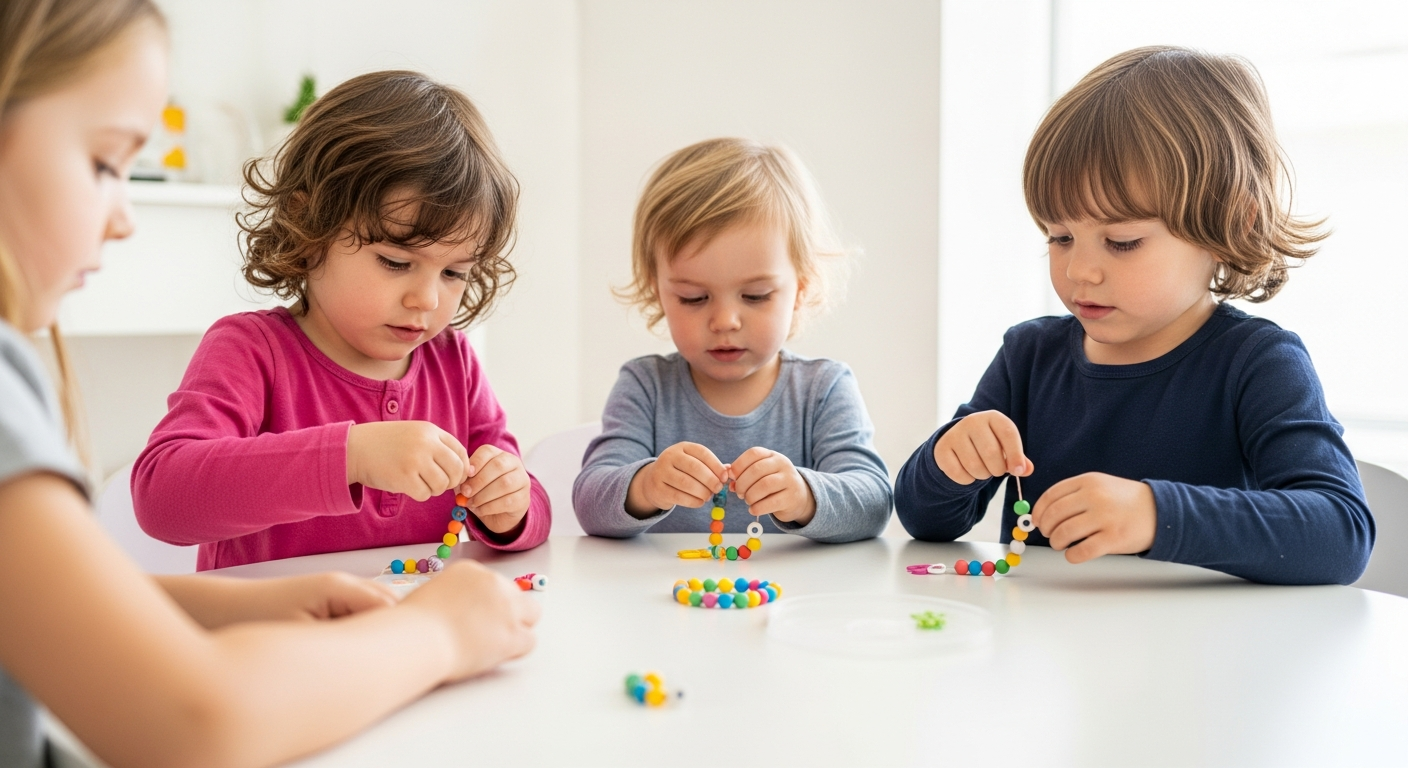
Table of Contents
- Introduction
- The Developmental Power of Beading
- Safety First: Selecting the Right Materials
- Activity 1: The Rainbow Hair Friend
- Activity 2: Color Sorting Skewers
- Activity 3: The Classic Jewelry Kit
- How Beading Supports Language Development
- Incorporating "Smart Screen Time" with Speech Blubs
- Troubleshooting Common Beading Frustrations
- Scaling the Challenge: From Sorting to Math
- Setting Realistic Expectations
- The Speech Blubs Methodology: Why It Works
- Creating Joyful Family Moments
- Pricing and Value Summary
- Conclusion
- FAQ
Introduction
Have you ever watched a toddler try to concentrate so hard that their tongue peeks out the corner of their mouth? That intense focus is a beautiful thing to witness, especially when they are working on a new skill. For many parents, finding an activity that captures that focus while simultaneously building essential developmental blocks can feel like a search for hidden treasure. One of the most effective, versatile, and joyful ways to engage your little one is through a toddler beading activity.
At Speech Blubs, our mission is to empower children to "speak their minds and hearts." We believe that development is a holistic journey where physical movement, cognitive processing, and language skills all grow together. Our founders, who navigated their own speech challenges as children, created our platform to be the tool they wished they had—a way to turn "screen time" into "smart screen time" that fosters real-world connection and confidence. Just as a toddler carefully slides a bead onto a string, they are also building the neurological pathways needed for complex communication.

In this post, we will explore why beading is such a powerhouse for child development, provide step-by-step guides for various beading activities, and show you how to pair these tactile experiences with the Speech Blubs app to create a well-rounded learning environment. Whether you are looking to improve your child's fine motor skills, teach them colors, or simply find a way to bond on a rainy afternoon, beading offers a world of possibilities. By the end of this guide, you will have a toolkit of activities designed to foster a love for learning and communication in your home.
The Developmental Power of Beading
Beading is far more than just a way to make a cute necklace; it is a multi-sensory workout for a growing brain. When your child picks up a small bead and attempts to thread it, they are engaging in a series of complex physical and cognitive tasks that prepare them for later milestones like writing, buttoning their clothes, and even speaking.
Fine Motor Skills and the Pincer Grasp
The most immediate benefit of a toddler beading activity is the development of fine motor skills. Specifically, beading encourages the "pincer grasp"—using the thumb and index finger to pick up small objects. This grasp is the foundation for holding a pencil and using scissors later in life.
By practicing the precise movements required to align a bead with a string, toddlers strengthen the small muscles in their hands and wrists. This physical strength and dexterity are crucial. If you are curious about where your child stands in their developmental journey, you can take our quick 3-minute preliminary screener. It involves just 9 simple questions and provides an assessment and next-steps plan to help you support your child's unique needs.
Bilateral Coordination
Bilateral coordination is the ability to use both sides of the body at the same time in a coordinated way. Think about the act of beading: one hand must hold the string steady while the other hand maneuvers the bead. This requires the left and right hemispheres of the brain to communicate effectively. This type of coordination is essential for many everyday tasks, from tying shoelaces to typing on a keyboard.

Visual Perception and Hand-Eye Coordination
When the brain makes sense of what the eyes see, we call it visual perception. During beading, your child must visually track the end of the string and the hole in the bead, then guide their hands to meet at exactly the right point. This builds hand-eye coordination and visual tracking abilities, which are vital pre-reading skills.
Key Takeaway: Beading isn't just about the finished product; it’s about the process of teaching the brain and body to work together in harmony.
Safety First: Selecting the Right Materials
Before we dive into the activities, we must address safety. Small beads can be a choking hazard, so adult supervision is mandatory for all toddler beading activities. Every child develops at a different pace, so choose materials based on your child's current stage rather than just their age.
For Younger Toddlers (Ages 18 Months – 2 Years)
If your child is still in the "mouth everything" phase, skip the plastic beads for now. Instead, try:
- Edible "Beads": Use O-shaped cereals or fruit loops.
- Large Objects: Use pasta shapes (like penne or rigatoni) or large wooden "lacing" beads.
- Stiff Bases: Instead of floppy string, use pipe cleaners or even dry spaghetti stuck into a ball of playdough.
For Older Toddlers and Preschoolers (Ages 3+)
Once your child can follow safety instructions and has better control, you can introduce:
- Pony Beads: These are classic, colorful, and have relatively large holes.
- Plastic or Cotton Cord: Ensure the ends are taped or dipped in wax to prevent fraying, which can lead to frustration.
- Pipe Cleaners: These remain a favorite because they hold their shape, making the "threading" part much easier for beginners.
Activity 1: The Rainbow Hair Friend
This is a fantastic activity that combines crafting with fine motor practice. It transforms beading into a fun character-building exercise!
Materials Needed:
- A sturdy piece of cardboard
- Scissors and a Sharpie
- A hole puncher
- Colorful pipe cleaners
- Pony beads in various colors
How to Set It Up:
- Create the Face: Cut a large circle out of the cardboard and draw a friendly face on it using your Sharpie.
- Add the "Hair" Holes: Use the hole puncher to make several holes along the top edge of the cardboard head.
- Attach the Hair: Thread a pipe cleaner through each hole and twist it to secure it. You now have a bald friend with long, colorful, wire hair!
- Start Beading: Invite your child to "style" the hair by sliding beads onto the pipe cleaners.
Why This Works: The rigid pipe cleaners provide a stable base, which reduces the frustration that comes with floppy string. It also allows you to incorporate color matching—"Can you give our friend some red hair clips?"
For a parent whose 3-year-old "late talker" loves animals, you can adapt this! Instead of a person, draw a lion and use the pipe cleaners as a mane. While you bead, you can use the Speech Blubs app to find the "Animal Kingdom" section. As your child adds beads to the lion’s mane, you can practice the "roar" or "grrr" sounds together, mirroring the peer models in our videos.
Activity 2: Color Sorting Skewers
This activity is perfect for teaching categorization and color recognition alongside motor skills.
Materials Needed:
- Playdough or a styrofoam block
- Wooden skewers (blunt the ends for safety) or long pipe cleaners
- Pony beads or painted pasta
How to Set It Up:
- The Base: Roll a thick log of playdough or use the styrofoam block as a base.
- The Spikes: Stick several skewers or pipe cleaners vertically into the base.
- The Challenge: Assign a color to each "spike." You can even paint the skewers to match the beads.
- The Play: Have your child sort the beads by color and thread them onto the corresponding spike.
This activity is highly structured and helps children who might get overwhelmed by a big pile of beads. It’s also a great way to introduce basic math. "Look, you have three blue beads on this one and only one on that one!"
Activity 3: The Classic Jewelry Kit
There is an immense sense of pride that comes with wearing something you made yourself. This is where the "jewelry making" aspect comes in.
Tips for Success:
- The Anchor: Always tie a large "stopper" bead at the end of the string or tape one end to the table. Nothing ruins a beading session faster than a dozen beads sliding off the other end of the string!
- The Right String: Use a slightly stiff elastic cord. It’s easier to handle than thread and makes the finished product easier to put on and take off.
- The Technique: Teach your child to hold the string about an inch from the end. This keeps it from "flopping" as they aim for the hole.
If you find your child is struggling with the coordination, don't worry. Our scientific methodology is based on video modeling—the idea that children learn best by watching other children. When they see a peer successfully complete a task or make a sound, their "mirror neurons" fire, making it easier for them to imitate the action. You can apply this to beading by sitting with them and doing it yourself, or by showing them videos of other kids crafting.
How Beading Supports Language Development
You might wonder, "How does putting beads on a string help my child talk?" At Speech Blubs, we focus on the foundational skills that lead to communication. Beading offers several "language rich" opportunities:
1. Following Directions
"First, pick up a green bead. Then, put it on the string." These simple, multi-step instructions are great for auditory processing.
2. Descriptive Vocabulary
During a toddler beading activity, you can use a wealth of descriptive words:
- Colors: Red, blue, sparkly, gold.
- Sizes: Big, tiny, long, short.
- Textures: Smooth, bumpy, rough, wooden.
- Prepositions: On, through, under, top, bottom.
3. Joint Attention
Joint attention is when two people focus on the same object or event. When you and your child are focused on the same bead, you are creating a shared experience—the perfect environment for language to bloom. You can use this time to narrate what they are doing. "I see you are choosing the shiny blue bead. You're pushing it through the string. Great job!"
Incorporating "Smart Screen Time" with Speech Blubs
We understand that parents are looking for effective ways to support their children's growth without relying on passive, mind-numbing cartoons. That’s why we created Speech Blubs. We provide a joyful, interactive solution that blends scientific principles with play.
While beading is a fantastic physical activity, Speech Blubs serves as a powerful supplement to foster the communication side of the equation. Our app features over 1,500 activities designed to get kids talking.
Why Choose the Yearly Plan?
To get the most out of Speech Blubs, we highly recommend our Yearly Plan. While our Monthly Plan is available for $14.99 per month, the Yearly Plan is the clear best choice for families committed to their child's progress.
At just $59.99 per year (which breaks down to only $4.99/month), the Yearly Plan offers:
- A 7-day free trial: Test out all the features risk-free.
- Reading Blubs: Our dedicated app for early literacy and reading skills.
- Early Access: Be the first to try new updates and activities.
- Priority Support: 24-hour response time for any questions you have.
The Monthly plan does not include the Reading Blubs app or the extended trial. By choosing the Yearly Plan, you are investing in a comprehensive toolset for your child's communication journey. Create your account and begin your 7-day free trial today.
Troubleshooting Common Beading Frustrations
It is perfectly normal for a toddler to get frustrated during their first few beading attempts. Here is how to help them through it:
- The String "Flops": If the string is too soft, the end will bend when the child tries to push it through. Try dipping the end of the string in some school glue and letting it dry, or wrap a small piece of clear tape around the tip to make a "needle" effect.
- Blocking the Hole: Many toddlers naturally want to hold the bead by covering the holes with their fingers. Show them how to hold the bead on the sides (the "waist") so the "tunnels" are clear.
- The "Runaway" Beads: Beads that roll away can lead to a meltdown. Use a cookie sheet or a tray with raised edges to keep the activity contained.
Scaling the Challenge: From Sorting to Math
Once your child has mastered the basic toddler beading activity, you can increase the difficulty to keep them engaged and learning.
Pattern Making
Start with a simple AB pattern (Red, Blue, Red, Blue). Once they grasp that, move to ABC patterns or AAB patterns. This is a foundational math skill that helps children understand sequences and predictability.
Counting and Simple Math
Ask your child to put a specific number of beads on the string. "Can you put five beads on your bracelet?" For older preschoolers, you can even introduce basic addition. "If you have two beads and I give you two more, how many will you have?"
Building Confidence through Success
The goal of these activities isn't to create a perfect piece of jewelry; it's to build a love for communication and confidence in their own abilities. As your child sees their progress, their frustration levels will drop, and their joy will increase.
Don't just take our word for it—see what other parents are saying about their child's success with Speech Blubs reviews. We are proud to have helped millions of families find the joy in communication.
Setting Realistic Expectations
As you embark on these activities, remember that every child's path is unique. While beading and using the Speech Blubs app are powerful tools, they are part of a larger developmental plan. We don't promise that your child will be giving public speeches in a month, but we do promise a tool that makes the process of learning to communicate joyful and effective.
Whether your child is a "late talker" or just looking for a fun way to boost their skills, focus on the small wins: the first time they thread a bead without help, the first time they mimic a new sound in the app, or the moment they proudly show you a pattern they created. These are the building blocks of a confident communicator.
The Speech Blubs Methodology: Why It Works
Our approach is rooted in the science of video modeling. When children use Speech Blubs, they aren't just watching a screen; they are interacting with peers.
- Watch: The child sees another child (the "Blub" peer) perform an action or say a word.
- Imitate: The app encourages the child to repeat the sound or action.
- Reward: Fun filters and stickers provide immediate, joyful feedback.
This methodology is perfect for pairing with physical activities like beading. You can use the app to learn the names of the colors or shapes you are using in your craft, bridging the gap between digital learning and physical play.
Creating Joyful Family Moments
At the heart of everything we do is the desire to foster family connection. A toddler beading activity is a quiet, focused time where you can sit on the floor with your child, put your phone away (unless you're using Speech Blubs together!), and simply be present.
In a world that often feels rushed, these moments of slow, tactile play are precious. They allow you to listen to your child's thoughts, encourage their efforts, and celebrate their growth.
Pricing and Value Summary
Ready to take the next step? Here is a quick look at how you can join the Speech Blubs family:
FeatureMonthly PlanYearly Plan (Best Value!)
Price
$14.99/month
$59.99/year ($4.99/month)
Free Trial
None
7-Day Free Trial
Speech Blubs App
Included
Included
Reading Blubs App
Not Included
Included
Early Access
Not Included
Included
Priority Support
Standard
24-Hour Response
By choosing the Yearly Plan, you save 66% compared to the monthly cost and gain access to our full suite of educational tools. It is the most effective way to provide your child with consistent, high-quality support.
Conclusion
A toddler beading activity is more than just a way to pass the time; it is a vital developmental tool that builds fine motor skills, bilateral coordination, and the cognitive foundations for language and math. By choosing the right materials, setting up engaging scenarios like the "Rainbow Hair Friend," and providing plenty of encouragement, you are helping your child build the confidence they need to explore the world.
At Speech Blubs, we are honored to be a part of your parenting journey. We believe in providing "smart screen time" that acts as a bridge to real-world engagement and family connection. Our mission is to ensure every child has the tools they need to speak their minds and hearts, and we are committed to providing an immediate, effective, and joyful solution for families everywhere.
Ready to jumpstart your child's developmental journey? Download Speech Blubs on the App Store or get it on Google Play to begin. Don't forget to select the Yearly Plan during sign-up to enjoy your 7-day free trial, access to Reading Blubs, and the best overall value for your family!
FAQ
1. At what age can my toddler start beading? Most toddlers can start with very basic beading activities around 18 to 24 months, using large items like O-shaped cereal or chunky wooden blocks on a stiff base like a pipe cleaner. Always supervise closely to ensure safety and prevent choking.
2. What are the best beads for a beginner? For beginners, pony beads are excellent because they have large holes and come in vibrant colors. If your child is very young, consider using "edible beads" like cereal or large pasta shapes to remove the risk of choking while they are still learning not to put toys in their mouths.
3. My child gets frustrated easily when beading. How can I help? Start with a rigid "string" like a pipe cleaner or a wooden skewer stuck in playdough. This removes the difficulty of managing a floppy string. You can also tape the end of the string to the table so they only have to focus on the bead hand. Remember to keep sessions short and fun!
4. How often should we do beading activities? There is no set rule, but incorporating fine motor play like beading for 10-15 minutes a few times a week can provide great benefits. It’s a wonderful "quiet time" activity to do before a nap or after a high-energy outdoor play session.
About the author