
Fun and Educational Toddler Building Activities
 By Speech Blubs Team•Feb 23, 2026•11 min.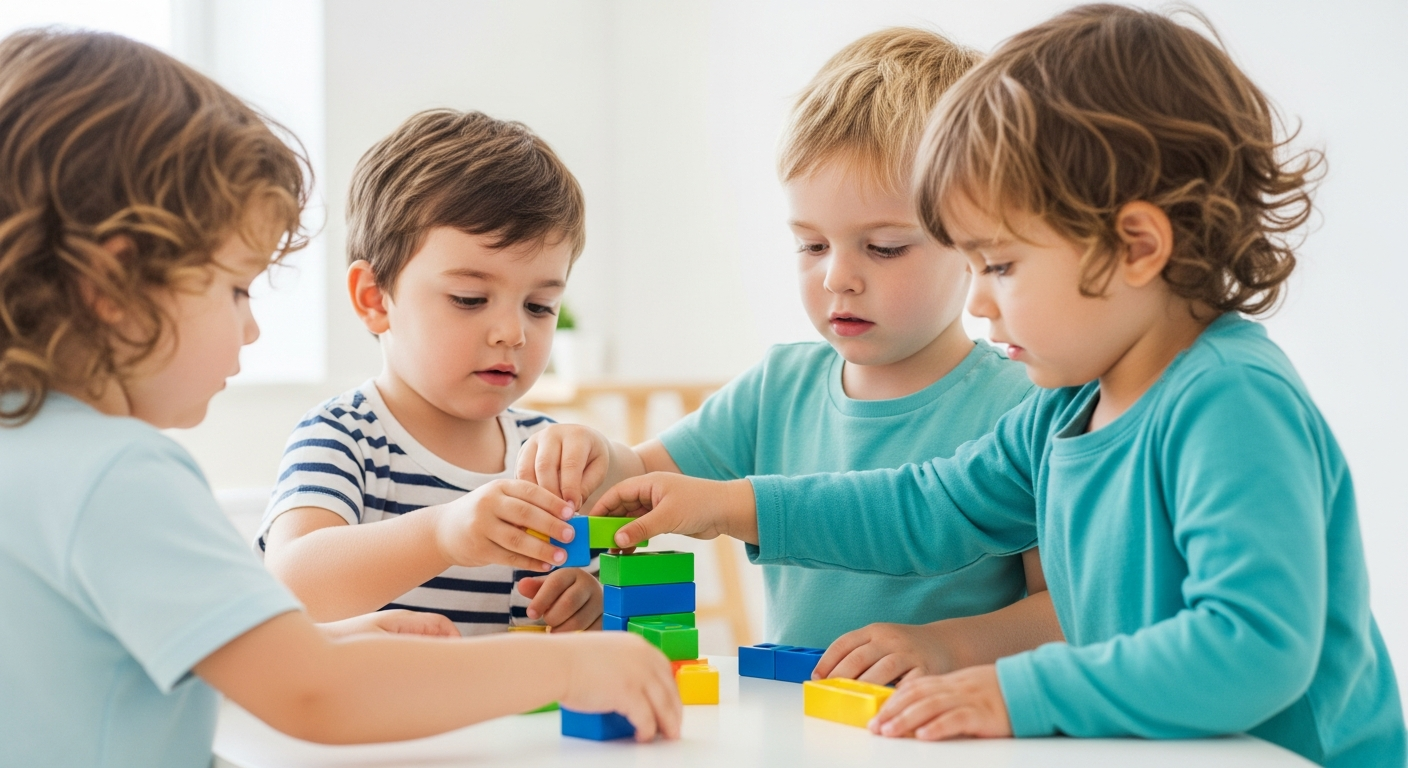
Table of Contents
- Introduction
- The Developmental Power of Building
- Classic Block Play with a Construction Twist
- Creative Sensory Building Bins
- Engineering with Household Items
- Edible Construction Projects
- Tips for Encouraging Open-Ended Play
- Bridging Physical Play and Digital Learning
- Choosing the Best Support for Your Child
- Frequently Asked Questions
- Conclusion
Introduction
Did you know that when a child successfully balances one block on top of another, they aren't just building a tower—they are building their brain? Research shows that early construction play is a fundamental precursor to spatial reasoning, mathematical logic, and even language development. As parents, we often watch our little ones knock down a stack of blocks with a giggle, but beneath that joyful crash lies a complex world of physics, problem-solving, and communication.
In this post, we will explore a wide variety of toddler building activities that you can do at home with everyday items. We’ll dive into why construction play is so vital for your child’s growth and how you can use these moments to foster a deep love for learning. We will also show you how to bridge the gap between physical play and digital learning using "smart screen time."
At Speech Blubs, our mission is to empower children to speak their minds and hearts. Our founders, who all grew up with speech challenges themselves, created the very tool they wished they had as kids. We believe that by combining hands-on toddler building activities with our scientifically-backed video modeling approach, we can help the 1 in 4 children who need speech support find their voice through play.

The Developmental Power of Building
Building is about more than just blocks. It is a multi-sensory experience that touches every corner of a child’s development. When your toddler reaches for a cup to stack, they are engaging their gross motor skills. When they carefully pinch a small piece of cardboard, they are refining their fine motor skills.
From a cognitive perspective, building introduces the concept of cause and effect. "If I put this heavy block on top of that small one, what happens?" This early experimentation is the "scientific method" in its most basic, beautiful form. Furthermore, building activities are inherently social and communicative. Whether they are asking for "more" blocks or describing their "big" tower, they are practicing the foundational skills of conversation.
Our unique approach at Speech Blubs utilizes video modeling, a method where children learn by watching their peers. Just as a child might watch you stack blocks and then try it themselves, they watch children in our app perform speech exercises and feel motivated to imitate them. This peer-to-peer connection is powerful because it builds confidence and reduces the frustration often associated with learning new skills.
Classic Block Play with a Construction Twist
The most traditional toddler building activities involve blocks, but you can elevate this experience by adding a thematic twist. Construction-themed play is incredibly engaging for toddlers because it mirrors the "big world" they see outside their windows.
The Indoor Construction Site
Transform a corner of your living room into a "work zone." You don’t need expensive sets; you just need a little imagination.
- Materials: Wooden blocks, plastic trucks, and maybe some yellow painter’s tape to mark off the "construction site."
- The Activity: Encourage your child to build "garages" for their cars or "houses" for their toy animals.
- Speech Connection: For a parent whose 3-year-old "late talker" loves animals, the "Animal Kingdom" section of our app offers a fun, motivating way to practice "moo" and "baa" sounds which can then be brought into the "barn" they just built.
Cardboard Box Architecture
Never underestimate the power of a delivery box. Large boxes can become houses, while smaller ones can be taped together to create sprawling towers. This is a fantastic way to practice spatial awareness as children figure out how to fit themselves or their toys inside the structures they create.

If you’re unsure where your child stands in their developmental milestones, we recommend taking our quick 3-minute preliminary screener. It involves 9 simple questions and provides an assessment and a next-steps plan to help you support your child's growth.
Creative Sensory Building Bins
Sensory play and building go hand-in-hand. By adding a "base" material like sand or beans, you add a layer of tactile feedback that makes the building process even more engaging.
The Kinetic Sand Quarry
Kinetic sand is a favorite among parents because it sticks to itself, making it perfect for building molds and towers that actually stay up.
- The Setup: Place kinetic sand in a shallow bin and provide small scoops, shovels, and plastic construction vehicles.
- The Goal: Encourage your child to "pave" roads or build "sand skyscrapers."
- Developmental Tip: Use this time to practice "action words" like dig, scoop, pour, and crash.
Oatmeal or Bean "Dirt" Site
If you want a taste-safe alternative for younger toddlers who are still exploring everything with their mouths, dried rolled oats or black beans make excellent "construction dirt." They provide a wonderful sound when poured into plastic cups or trucks, teaching children about volume and weight.
Building these small worlds is a great way to foster independence. To see how other families have used play-based strategies to help their children thrive, check out our parent testimonials.
Engineering with Household Items
You don’t need a toy store to find great materials for toddler building activities. Some of the best STEM (Science, Technology, Engineering, and Math) learning happens with items found in your pantry or recycling bin.
The 100-Cup Tower Challenge
Paper or plastic cups are incredibly lightweight and easy for small hands to stack. See how high your toddler can go!
- Why it works: It teaches balance and steady hands.
- Language Tip: Count the cups together as you stack them. This builds early numeracy skills alongside language.
Pool Noodle Structures
If you have old pool noodles lying around, you can slice them into "donuts" or "bricks."
- The Setup: Give your child the sliced noodle pieces and some toothpicks (with supervision) or plastic straws.
- The Activity: They can thread the noodles onto the straws or stack the foam pieces. The soft texture is a nice change from hard plastic or wood.
Shaving Cream "Mortar"
For a messy but memorable afternoon, use shaving cream as "glue" for building.
- The Activity: Give your child plastic blocks or even sponges and a bowl of shaving cream. They can "butter" the blocks with the cream to stick them together.
- The Benefit: This is a high-sensory activity that encourages children to explore different textures, which can be particularly helpful for sensory-seeking kids.
Edible Construction Projects
Who says you can't play with your food? Edible toddler building activities are a fantastic way to keep a child engaged at the kitchen table while also encouraging them to try new textures and healthy snacks.
Apple and Cheese Towers
- Materials: Small cubes of apples and cubes of mild cheese.
- The Goal: Use toothpicks (under close adult supervision) or simply stack the cubes to see how high they can go before they topple.
- Reward: The best part of this activity is that your child can eat their "building" once they are finished!
Marshmallow and Pretzel Stick Bridges
For older toddlers, marshmallows make excellent connectors.
- The Activity: Use large marshmallows as the "joints" and pretzel sticks as the "beams."
- The Speech Connection: As you build together, you can model words like sticky, crunchy, long, and short. This descriptive language helps expand your child’s vocabulary in a natural, low-pressure environment.
We understand that screen time is a concern for many parents. That’s why we’ve designed Speech Blubs to be a "smart screen time" experience—a screen-free alternative to passive viewing (like cartoons). Our app is meant to be a powerful tool for family connection, where you and your child interact with the peer-led videos together. Download Speech Blubs on the App Store or Google Play to start your journey.
Tips for Encouraging Open-Ended Play
When engaging in toddler building activities, it’s tempting to want to show your child the "right" way to build a house or a bridge. However, the most growth happens during open-ended play.
- Follow Their Lead: If your child wants to build a "sideways tower" on the floor instead of a vertical one, go with it! Ask them questions about their creation.
- Narrate the Action: Instead of asking too many questions, try "parallel talk." Describe what they are doing: "You are putting the red block on the blue one. Oh, look, it's getting so tall!"
- Encourage Resilience: When a tower falls, it’s an opportunity to teach emotional regulation. Instead of saying "It's okay," try "Oh no, it crashed! Should we try to build it again? Let's try a different base."
- Incorporate Peers: If your child doesn't have siblings or playmates nearby, use the children in the Speech Blubs app as their "digital playmates." Seeing another child succeed at a task is highly motivating.
Bridging Physical Play and Digital Learning
At Speech Blubs, we don't believe that technology should replace physical play. Instead, we see it as a supplement that can spark new ideas. For example, after playing with our "Early Words" section, your child might be inspired to go to their block corner and "re-enact" the sounds and words they just learned.
Our methodology is designed to foster a love for communication and build confidence. We don’t promise overnight miracles; we focus on the joyful process of learning. By creating "smart screen time" experiences, we help children transition from being passive observers to active participants in their own development.
Choosing the Best Support for Your Child
We know that every family has different needs, which is why we offer flexible options for accessing our tools. To get the most out of our resources, we recommend our Yearly plan.
Transparent Pricing for Families
- Monthly Plan: $14.99 per month. This is a great way to test the waters.
- Yearly Plan: $59.99 per year. This breaks down to just $4.99 per month, which is a 66% saving compared to the monthly option.
Why the Yearly Plan is the Clear Best Choice: The Yearly plan isn't just about the cost savings; it's about providing a comprehensive, long-term support system for your child. When you choose the Yearly plan, you receive:
- A 7-day free trial to explore everything we have to offer.
- Access to our Reading Blubs app, which helps transition your child from speaking to early literacy.
- Early access to all new updates and features.
- 24-hour support response time from our dedicated team.
The Monthly plan does not include these exclusive, high-value features. Ready to give your child the tools they need? Create your account and begin your 7-day free trial today.
Frequently Asked Questions
1. What are the best toddler building activities for speech delay?
For children with speech delays, focus on activities that require "functional language." Using blocks to build a "stop" sign or a "go" lane for cars allows you to practice these high-frequency words. Using our app's video modeling alongside these activities can help your child see the mouth movements needed to say the words they are using in play.
2. At what age should a toddler start building with blocks?
Most toddlers start stacking two blocks around 15 to 18 months. By age two, they may stack six or more. However, "building" can start even earlier with soft cloth blocks or by simply knocking down towers you build for them!
3. How do building activities help with STEM skills?
Building is the foundation of engineering. It teaches concepts like gravity, balance, symmetry, and geometry. When a toddler realizes a wider base makes a sturdier tower, they are learning the basics of structural engineering.
4. Can "screen time" really help with physical building play?
Yes, if it is "smart screen time." Interactive apps like Speech Blubs encourage children to vocalize and interact, which can then be carried over into their physical play. It acts as a prompt or an inspiration for the "real world" activities they do afterward.
Conclusion
Toddler building activities are a gateway to a world of discovery. Whether your child is stacking paper cups, molding kinetic sand, or "gluing" sponges together with shaving cream, they are doing the hard work of growing their minds and fine-tuning their communication skills. These moments of play are not just "time-fillers"; they are the building blocks of a confident, expressive future.
We invite you to join our community and see how we can support your child’s unique journey. By combining the physical joy of construction with the scientific methodology of our app, you can create a holistic environment for your child to thrive.
Don't wait to start building those vital skills. Download Speech Blubs on the App Store or Google Play today to begin. Remember to choose the Yearly plan to unlock your 7-day free trial, the Reading Blubs app, and the full suite of features designed to help your child "speak their mind and heart." Let’s make every play session a joyful learning moment together!
About the author