
Fun and Engaging Toddler Language Activities for Home
 By Speech Blubs Team•Feb 23, 2026•14 min.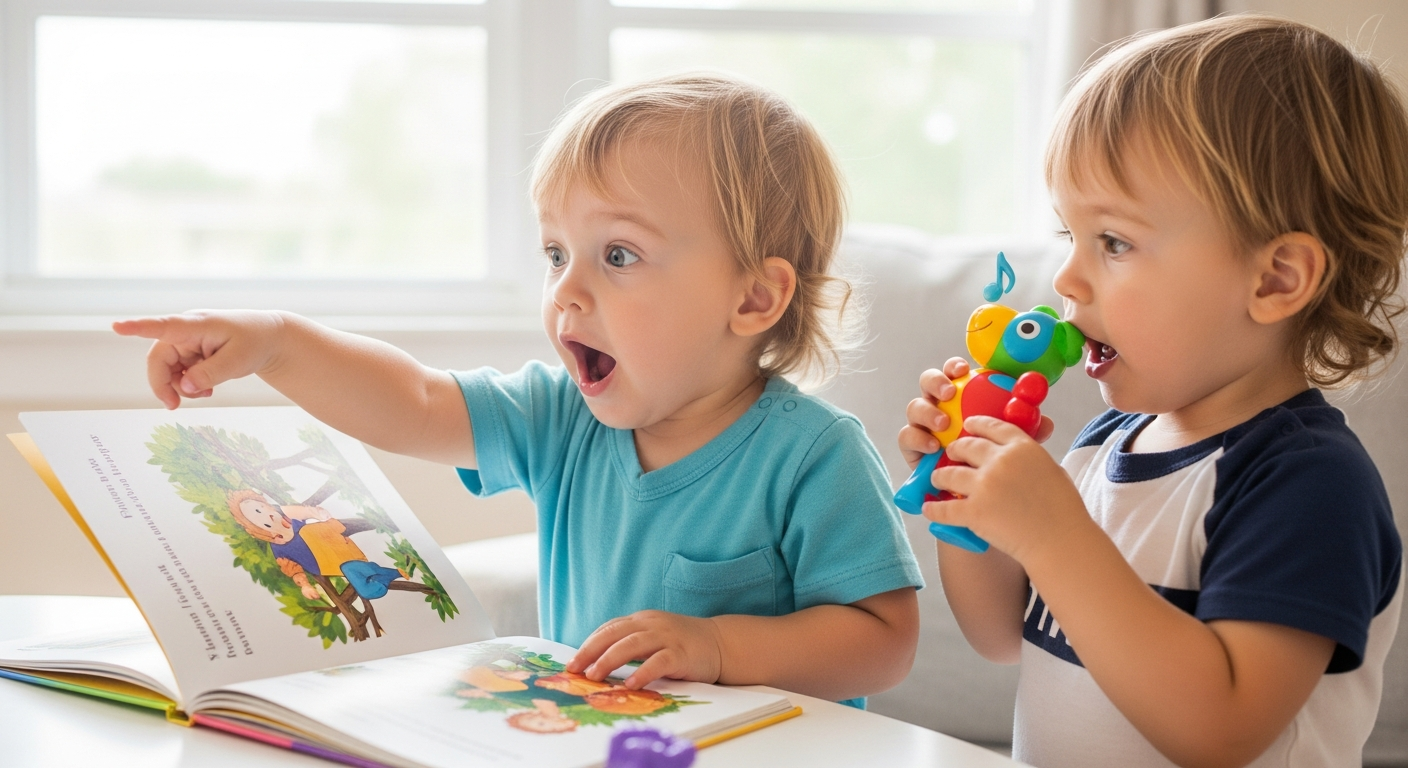
Table of Contents
- Introduction
- Understanding the Power of Play in Language
- 10 Toddler Language Activities for Every Day
- Why Speech Blubs is "Smart Screen Time"
- Setting Realistic Expectations
- Choosing the Right Plan for Your Family
- The Science of Peer Imitation
- Integrating Activities into Your Routine
- When to Seek Professional Guidance
- Conclusion
- Frequently Asked Questions
Introduction
Did you know that by the time a child turns three, their brain has reached approximately 80% of its adult volume? During these first few years, every "ba-ba," every pointed finger, and every wide-eyed stare is a building block for a lifetime of communication. At Speech Blubs, we believe that every child deserves the chance to speak their minds and hearts. Our company was born from a place of deep empathy; our founders all grew up with speech challenges themselves. They set out to create the exact tool they wished they had—a way to turn the frustration of a speech delay into a joyful, play-based journey of discovery.
If you are a parent wondering how to best support your little one’s journey into words, you are in the right place. Language development isn't just about flashcards or drills; it’s about connection, imitation, and, most importantly, fun. We understand the worry that can creep in when your toddler isn't hitting milestones at the same time as their peers. That’s why we’ve combined scientific principles with the magic of play to create "smart screen time" experiences that actually move the needle.

In this post, we will explore a variety of toddler language activities you can do at home to foster a love for communication and build foundational skills. We will dive into the importance of play, how to narrate your day, and how our unique video modeling methodology can help your child find their voice. Our goal is to provide you with a toolkit of practical, realistic strategies to create joyful family learning moments while reducing the frustration that often accompanies early speech hurdles.
Understanding the Power of Play in Language
For a toddler, play is work. It is the primary way they learn about the world, social structures, and the mechanics of language. When children play, they are in a low-pressure environment where they feel safe to experiment with sounds and meanings. This is a far cry from the passive viewing of traditional cartoons, which often lack the interactive element necessary for true language acquisition.
At Speech Blubs, we advocate for active engagement. Our methodology is rooted in the concept of peer-to-peer imitation. Science shows that children are far more likely to mimic another child than an adult. This is due to "mirror neurons"—specialized cells in the brain that fire both when an individual performs an action and when they observe someone else performing that same action. By watching other children (our "Blubers") model sounds and words, your toddler’s brain is literally practicing the movements needed for speech.
To see this science in action and understand how we rank at the top of the MARS scale for educational quality, you can read more about our research and methodology.
10 Toddler Language Activities for Every Day
1. The "Animal Sound" Symphony
Animals are often a toddler's first true interest. The sounds they make are perfect for early language development because they are "onomatopoeic"—they sound like what they are. Words like "moo," "baaa," and "woof" use simple consonant-vowel combinations that are easier for little mouths to form than complex multi-syllabic words.

How to do it: Use picture books, toy figures, or even just your imagination. Point to a cow and say, "The cow says... Moooo!" Wait for your child to try it. For a parent whose 3-year-old "late talker" loves animals, the "Animal Kingdom" section of our app offers a motivating way to practice these sounds through video modeling, where they see real kids making those same funny animal noises.
2. Narrating Your "Live" Life
One of the simplest yet most effective toddler language activities is "sportscasting." This means narrating your day as if you were an announcer on the radio. This provides a rich "language bath" for your child without demanding an immediate response, which lowers their anxiety.
How to do it: "I am picking up the blue cup. Now I am pouring the cold water. Glug, glug, glug!" By labeling your actions and the objects you use, you are building your child’s receptive vocabulary—the words they understand even before they can say them.
3. The Telephone Game
Pretend play is a massive milestone for two- and three-year-olds. Using a toy phone (or even a banana!) to "call" Grandma or a favorite character encourages the back-and-forth flow of conversation, known as turn-taking.
How to do it: Hand the phone to your child and say, "It’s for you! It’s the puppy!" Even if they only babble into the receiver, they are learning the social rhythm of talking: I speak, then I listen, then you speak.
4. Singing and Rhyming
The human brain is wired for rhythm and melody. Songs like "The Wheels on the Bus" or "Itsy Bitsy Spider" use repetition and melody to help children predict what word comes next. This helps with phonological awareness—the ability to hear the individual sounds in words.
How to do it: Sing slowly and pause at the end of a line to see if your child will fill in the blank. "The wheels on the bus go round and..." (wait for it) "...round!"
5. Building a "Language" Tower
Blocks aren't just for motor skills; they are incredible for teaching spatial concepts and "prepositions." Words like "up," "down," "on," and "under" are vital for following directions later in life.
How to do it: As you stack blocks, use descriptive language. "Put the red block on top. Oh no! It fell down!" If you want to take this further, download Speech Blubs on the App Store or Google Play to explore sections that focus specifically on these early concepts.
6. Interactive Reading (Not Just Reading to Them)
Reading with a toddler should be a dialogue, not a monologue. Instead of reading every word on the page, point to the pictures and ask questions.
How to do it: "Where is the ducky?" or "What color is his hat?" If your child points, they are communicating! Validate that by saying, "Yes! The yellow ducky is in the water." This "expansion" (adding a word to what they communicated) is a key technique used by speech-language pathologists.
7. Mirror Play
Toddlers are fascinated by their own reflections. Using a mirror is a great way to help them become aware of how their mouths move to produce different sounds.
How to do it: Sit in front of a mirror together and make silly faces. Stick out your tongue, blow bubbles, or make a wide "Ahhh" sound. This helps with "oral motor" awareness, which is the foundation for clear articulation.
8. The "I Spy" Sound Game
For older toddlers who are starting to recognize sounds, a simplified version of "I Spy" can help with phonetic recognition.
How to do it: "I spy with my little eye something that starts with the 'B-B-B' sound." (Point to a ball). This helps them associate the abstract sound with a concrete object.
9. Puppet Shows and Roleplay
Puppets allow children to step outside of themselves. Sometimes a child who is shy about speaking to an adult will chatter away to a fuzzy hand puppet.
How to do it: Use a puppet to ask simple questions. "Hi! I'm Hungry Henry. Can you give me a cookie?" This encourages the child to respond in a play-based, low-stakes scenario.
10. Household Chores as Learning Labs
Laundry, grocery shopping, and setting the table are all opportunities for labeling and categorization.
How to do it: "Find all the white socks," or "Put the big apples in the bag." This teaches toddlers to categorize information, which is a sophisticated cognitive skill that supports language structure.
Why Speech Blubs is "Smart Screen Time"
We know that "screen time" is a controversial topic for parents. However, there is a vast difference between "passive" screen time—where a child sits silently watching a cartoon—and "active" or "smart" screen time.
At Speech Blubs, we provide a tool for family connection. We encourage parents to sit with their children while using the app. Our video modeling technique isn't just about watching; it’s about doing. When your child sees a peer on the screen wearing a funny digital hat and making a "pop" sound, they are invited to join the fun. The app uses the front-facing camera to show your child their own face alongside the "Bluber," turning the screen into a digital mirror that encourages imitation.
"Our mission is to empower children to speak their minds and hearts by turning the learning process into a joyful game."
To see how this approach has helped thousands of families, you can read our parent testimonials and success stories.
Setting Realistic Expectations
It is important to remember that every child's timeline is unique. While these toddler language activities are powerful tools, they are part of a larger developmental journey. We don't promise that your child will be giving public speeches in a month. Instead, we focus on the small, beautiful wins: a new sound, a reduction in the frustration that leads to tantrums, and a blossoming of confidence.
Our app is designed to be a supplement to your child's overall development plan. If you are working with a professional speech-language pathologist (SLP), Speech Blubs is an excellent tool to use between sessions to keep the momentum going. If you are unsure if your child is on track, we offer a quick 3-minute preliminary screener. It involves 9 simple questions and provides you with an assessment and a next-steps plan to help you navigate your child's progress.
Choosing the Right Plan for Your Family
We are committed to being transparent about our pricing so you can make the best choice for your family’s needs. We offer two main paths:
- Monthly Subscription: $14.99 per month. This is a great way to test the waters and see how your child responds to the video modeling method.
- Yearly Subscription: $59.99 per year.
The Yearly plan is our best value, breaking down to just $4.99 per month. When you choose the Yearly plan, you save 66% compared to the monthly rate and gain access to exclusive features that aren't included in the monthly option:
- 7-Day Free Trial: You can explore everything we have to offer for a full week before being charged.
- Reading Blubs App: As your child progresses from sounds to words, our sister app, Reading Blubs, helps them transition into early literacy and phonics. This is included at no extra cost with the yearly subscription.
- Priority Support: You get 24-hour support response times and early access to all our new updates and features.
Ready to get started? Create your account and begin your 7-day free trial today.
The Science of Peer Imitation
Why do we use other children in our videos? It’s not just because they’re cute! It’s based on a psychological principle called "peer modeling." When a toddler sees someone who looks like them, speaks like them, and behaves like them, their level of engagement skyrockets. They think, "If that kid can do it, I can do it too!"
This reduces the "performance anxiety" that some children feel when an adult is hovering over them, repeatedly saying, "Say 'Apple.' Can you say 'Apple'?" In Speech Blubs, the child on the screen isn't a teacher; they are a playmate. This shift in dynamic is what makes our "smart screen time" so effective at fostering a love for communication. Our method has been vetted by experts and is designed to build foundational skills in a way that feels like a game, not a chore.
Integrating Activities into Your Routine
The key to success with toddler language activities is consistency, not intensity. You don't need to set aside an hour a day for "speech time." Instead, look for the "interstitial moments"—the five minutes while you're waiting for the bath to fill, or the ten minutes during a car ride.
- During Bath Time: Use bubbles to practice the "P-P-P" sound (Pop!).
- During Meal Time: Offer choices. "Do you want the banana or the yogurt?" This forces the child to attempt a word or a specific gesture rather than just pointing generally.
- During Bedtime: Reflect on the day. "Today we went to the park. We saw a... doggy!"
By weaving these activities into the fabric of your daily life, you are showing your child that language is a tool for sharing their world with you. This builds confidence and reduces the frustration that often comes when a child's thoughts move faster than their ability to express them.
When to Seek Professional Guidance
While home activities and apps are incredibly beneficial, they are not a replacement for professional intervention if a child has a significant delay or a physical speech impediment. As parents, we often have a "gut feeling" when something isn't quite right. Trust that feeling.
If your child is not meeting major milestones—such as using at least 50 words by age two or following simple two-step directions—it may be time to consult a pediatrician or an SLP. Early intervention is one of the most effective ways to ensure long-term success. You can start by using our 3-minute screener to get a better sense of where your child stands and what steps you should take next.
Conclusion
Language development is one of the most exciting journeys you will ever take with your child. From those first tentative babbles to the moment they can finally tell you about their dreams, every step is a milestone worth celebrating. By incorporating fun, engaging toddler language activities into your daily routine, you are doing more than just teaching words; you are building a bridge of connection between your heart and theirs.
At Speech Blubs, we are honored to be a part of that journey. Our mission is to provide you with the tools, the science, and the encouragement you need to help your child find their voice. Whether it’s through our video modeling app or the simple games you play on the living room floor, remember that your engagement is the most powerful catalyst for your child's growth.
Ready to boost your child's communication skills? Download Speech Blubs on Google Play or the App Store today. We highly recommend choosing the Yearly plan to take advantage of the 7-day free trial, the bonus Reading Blubs app, and the best long-term value for your family. Let’s start talking!
Frequently Asked Questions
1. What is the best age to start toddler language activities?
It is never too early to start! While toddlers (ages 1-3) are in a period of rapid language explosion, you can begin narrating, singing, and reading to your child from the day they are born. The earlier you establish a language-rich environment, the more comfortable your child will be with the rhythm and sounds of speech.
2. How much screen time is safe for a toddler?
The American Academy of Pediatrics (AAP) suggests limiting screen time for children under 18-24 months to high-quality programming that parents watch with them. At Speech Blubs, we focus on "smart screen time," which is interactive and designed for co-play. We recommend short, 10-15 minute sessions where you and your child engage with the app together, rather than long periods of passive viewing.
3. My child gets frustrated when I don't understand them. What should I do?
Frustration is a common part of the language-learning process. When your child is struggling, try to stay calm and empathetic. Use "forced choices" (e.g., "Do you want the milk or the juice?") to help them communicate without needing a complex sentence. Using the Speech Blubs app can also help by giving them a fun, low-pressure way to practice sounds, which can build the confidence they need to try speaking in real-world situations.
4. Does the yearly plan really include a reading app for free?
Yes! When you choose the Yearly subscription for $59.99, you get full access to Speech Blubs, a 7-day free trial, and our Reading Blubs app at no extra cost. This is a powerful combination because language and literacy are closely linked; as your child masters speaking, they will have the tools ready to begin their journey into reading.
About the author