
Fun Backyard Activities for Kids: Play, Learn, and Grow
 By Speech Blubs Team•Jan 13, 2026•19 min.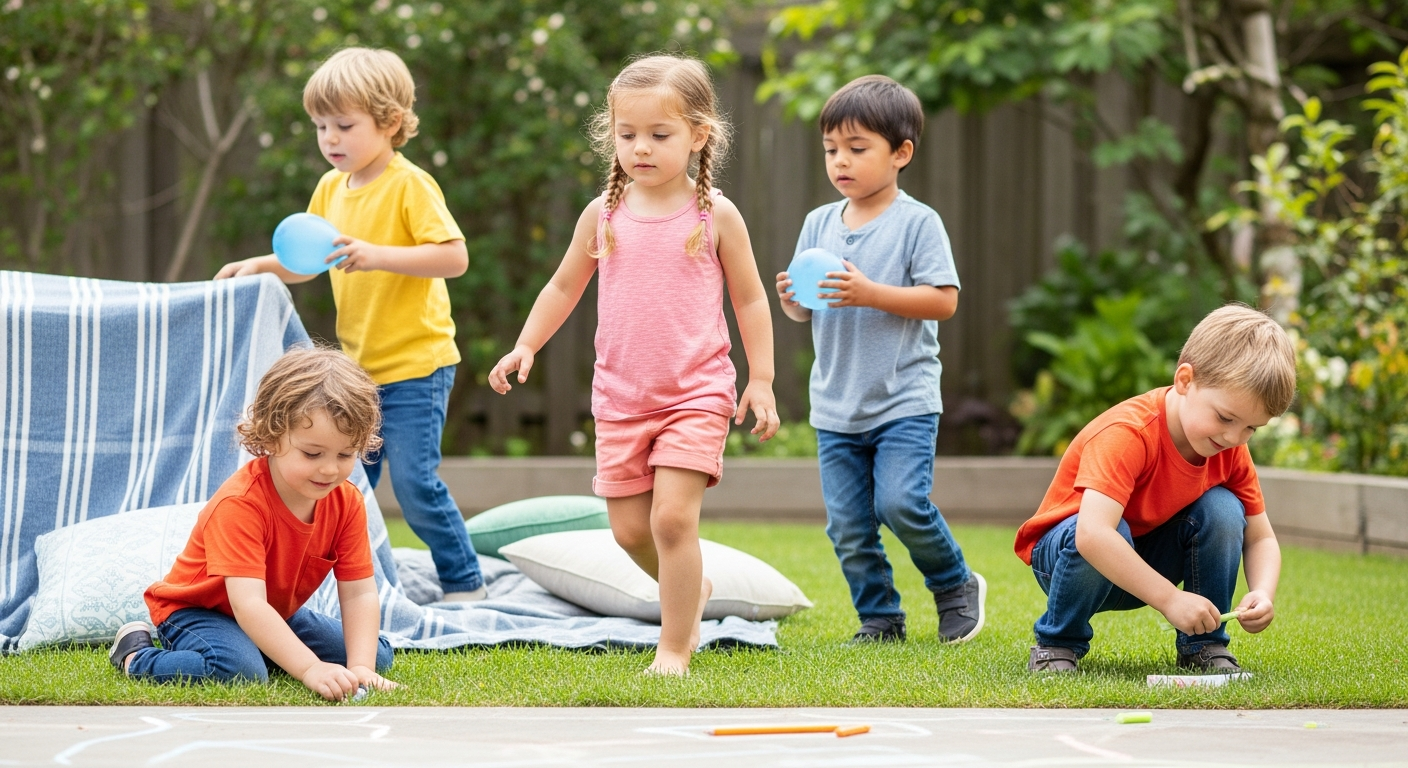
Table of Contents
- Introduction
- Why Outdoor Play Matters for Growing Minds and Bodies
- Backyard Adventures for Every Age and Stage
- Turning Play into Powerful Communication Opportunities
- Getting Started with Speech Blubs: Your Partner in Communication
- Conclusion
- FAQ
Does the familiar refrain, "I'm bored!" echo through your home more often than you'd like, especially when the weather is beautiful outside? We've all been there. In an age where screens often captivate attention, finding engaging ways to inspire outdoor play can feel like a challenge. Yet, stepping into your own backyard offers an incredible, readily available solution for sparking creativity, boosting physical activity, and fostering essential developmental skills. Your backyard isn't just a patch of grass; it's a dynamic playground, an open-air classroom, and a canvas for endless adventures.
This post will dive deep into a treasure trove of fun backyard activities for kids of all ages, offering ideas that range from simple, spontaneous moments to more elaborate, project-based play. We'll explore how these outdoor experiences contribute to holistic child development—from boosting physical coordination and problem-solving to nurturing imagination and crucial communication skills. Most importantly, we'll show you how to transform ordinary moments into extraordinary learning opportunities, empowering your child to speak their minds and hearts, both indoors and out.

Introduction
Imagine a place just steps from your back door, brimming with possibilities for discovery, laughter, and learning. It’s your backyard! For children, the outdoors is a natural laboratory, a place where dirt becomes magic, sticks become swords, and every rustle of leaves tells a story. Far from being just a space to run wild, the backyard offers a unique environment for cognitive, physical, and emotional growth that screen time simply cannot replicate. Getting kids outside isn't just about busting boredom; it's about fostering a deeper connection with the world around them, building resilience, and laying foundational stones for lifelong learning and communication.
This comprehensive guide is designed to equip parents and caregivers with a wealth of ideas to make the most of their outdoor space. We’ll journey through diverse categories of activities, highlighting how each one can be a catalyst for development. From sensory exploration for toddlers to creative challenges for older children, we'll ensure there's something for everyone. We’ll also explore how these engaging activities can be seamlessly integrated with targeted communication practice, and how tools like Speech Blubs can support and amplify the incredible learning happening right in your own yard.
Why Outdoor Play Matters for Growing Minds and Bodies
The benefits of outdoor play are profound and far-reaching, impacting every aspect of a child's development. It’s more than just fun; it's fundamental to healthy growth.
Physical Benefits: Building Stronger, More Coordinated Kids
When children play outside, they engage their entire bodies in ways that indoor environments often limit. Running, jumping, climbing, digging, and balancing all contribute to:
- Gross Motor Skills: Developing large muscle groups, coordination, and agility. Think about the intricate balance required to walk on an uneven log or the power needed to kick a ball across the yard.
- Fine Motor Skills: Activities like picking up tiny pebbles, threading beads onto sticks, or making mud pies refine dexterity and hand-eye coordination.
- Sensory Integration: Children encounter a rich tapestry of sensory input outdoors—the feel of grass between their toes, the scent of damp earth, the sound of birds, the sight of vibrant flowers. This natural immersion helps their brains process and organize sensory information more effectively.
- Bone and Muscle Strength: Sunlight exposure provides Vitamin D, crucial for bone health, while active play strengthens muscles and bones.
- Improved Sleep: Physical exertion during the day leads to better, more restful sleep at night, which is vital for growth and cognitive function.
Cognitive Benefits: Sparking Curiosity and Problem-Solving
The unstructured nature of outdoor play is a powerful catalyst for cognitive development:

- Creativity and Imagination: Without predefined rules or structures, children are free to invent games, create imaginary worlds, and use natural objects as props. A fallen branch becomes a wizard's staff, a pile of leaves transforms into a secret hideout.
- Problem-Solving Skills: Building a fort that can withstand a gentle breeze, figuring out how to move a heavy rock, or navigating an impromptu obstacle course all require critical thinking and spatial reasoning.
- Exploration and Discovery: The outdoors is a constant source of novelty. Children observe insects, experiment with water flow, and learn about cause and effect (e.g., what happens when I drop this rock in a puddle?).
- Attention and Focus: Studies suggest that spending time in nature can improve attention spans and reduce symptoms of ADHD.
Emotional and Social Benefits: Fostering Resilience and Connection
Outdoor play is equally vital for emotional and social well-being:
- Stress Reduction: The natural environment has a calming effect, helping to reduce anxiety and improve mood.
- Confidence Building: Mastering a new physical challenge, like climbing a small tree or successfully throwing a frisbee, builds self-esteem and a sense of accomplishment.
- Social Connection: Group games, collaborative fort-building, or simply sharing discoveries with a friend or parent strengthen social bonds and teach cooperation, negotiation, and empathy.
- Communication Skills: Describing what they see, explaining their game rules, or storytelling together naturally encourages language development. This is where tools like Speech Blubs, which emphasizes "smart screen time" experiences, can uniquely complement outdoor exploration. While passive viewing like cartoons offers little interaction, Speech Blubs provides a dynamic, screen-free alternative when used with adult co-play, helping children connect words to the wonders they discover in the backyard. Our mission at Speech Blubs is to empower children to speak their minds and hearts, and combining natural exploration with targeted speech support creates a truly holistic approach to development.
Backyard Adventures for Every Age and Stage
Let's dive into a wealth of engaging activities, categorizing them to help you find the perfect fit for your child's developmental stage and interests. Remember, the best backyard activities often involve simple materials and a willingness to get a little messy!
Sensory Explorations: Engaging All the Senses (Younger Kids & Beyond)
For toddlers and preschoolers, sensory play is fundamental to understanding the world. Even older children benefit from these calming and stimulating activities.
- Mud Pies and Nature Kitchen: Provide old pots, pans, spoons, and a generous supply of dirt and water. Kids can "cook" mud pies, decorate them with leaves, pebbles, and flowers, and experiment with different textures. This is fantastic for developing descriptive language ("slimy," "gritty," "squishy") and imaginative play.
- Water Play Extravaganza: A simple kiddie pool, a bucket of water, or even a running hose offers endless fun. Add sponges, cups, toy boats, and small plastic animals. Experiment with what floats and sinks. This is a wonderful opportunity to practice action verbs ("pour," "splash," "scoop") and prepositions ("in," "out," "under"). For a child working on early word acquisition, you might say, "Splash! Big splash!" or "Boat in water!"
- Nature Collections and Sorting: Arm your child with an empty egg carton or a small basket. Challenge them to collect different leaves, rocks, flowers, or seeds. Then, encourage them to sort their treasures by color, size, shape, or texture. This activity builds classification skills and expands vocabulary. For instance, "Can you find something smooth? How about something rough?"
- Listening Walks: Sit quietly in your backyard with your child. Close your eyes and identify all the sounds you hear: birds chirping, leaves rustling, a dog barking, a car passing. This sharpens auditory processing skills and encourages discussion about sounds. You can prompt, "What sound did you hear first?"
- Cloud Gazing and Storytelling: Lay on a blanket and look up at the clouds. What shapes do you see? Animals? People? This sparks imagination and narrative skills. Make up a story about the cloud animals you spot. This encourages imaginative language and helps children practice forming sentences to describe what they see.
- Bug Hunts with a Magnifying Glass: Turn over rocks, look under leaves, and observe the tiny creatures in your yard. What do they look like? How do they move? Discuss their characteristics and actions. This is excellent for observational skills and learning new vocabulary (e.g., "antennae," "exoskeleton," "crawl"). For a parent whose child loves animals and is a "late talker," the "Animal Kingdom" section in the Speech Blubs app offers a fun, motivating way to practice sounds and names like "buzz" for a bee or "wiggle" for a worm, creating a perfect bridge between outdoor discovery and targeted speech practice. Take our quick 3-minute preliminary screener to understand if your child could benefit from a structured approach to speech development.
Creative & Imaginative Play: Building Worlds and Stories
The backyard is the ultimate stage for creativity, allowing children to build, design, and role-play without limits.
- Fort Building: Whether it's an elaborate treehouse (permanent fixture idea!), a simple blanket fort draped over patio furniture, or a more natural fort made from collected sticks and branches, forts provide a private space for imaginative play. Kids can use Stick-lets connectors for more robust structures. Building a fort fosters collaboration and spatial reasoning.
- Nature Art:
- Land Art: Collect natural items like leaves, pebbles, flowers, and sticks to create temporary designs and pictures on the ground.
- Leaf and Tree Rubbings: Place leaves or bark under paper and rub crayons over them to reveal intricate textures.
- Nature Prints: Paint leaves or flowers and stamp them onto paper.
- Drawing in the Dirt: Use sticks to draw letters, shapes, or pictures in damp earth. This is a multisensory way to practice pre-writing skills.
- Outdoor Storytelling: Encourage your child to invent stories inspired by the natural elements around them. What adventures might a squirrel have? What happens when a tiny seed grows into a big flower? This develops narrative structure, vocabulary, and sequencing. For children developing their storytelling abilities, our app offers features that encourage description and sequence, making it a powerful supplement.
- Nature Weaving and Crowns: Use a simple cardboard loom or even just two sticks to weave grass, leaves, and flowers. Create "stick crowns" by painting sticks and attaching them to a headband. These activities enhance fine motor skills and creativity.
- Shadow Puppets: At dusk, use a flashlight to cast shadows of hands or nature objects onto a fence or wall, creating an impromptu puppet show. This encourages imaginative play and understanding of light.
Active & Movement Games: Burning Energy and Developing Coordination
The backyard is perfect for letting off steam and refining physical skills in a joyful way.
- DIY Obstacle Course: Use everyday items like hula hoops to jump through, logs to balance on, jump ropes to skip over, and patio cushions to crawl under. Time your child and encourage them to beat their own record. This builds gross motor skills, planning, and following directions.
- Classic Tag and Chase Games: Simple, timeless games like tag, hide-and-seek, or flashlight tag at night are fantastic for cardiovascular health, agility, and social interaction.
- Ball Games Galore: Keep a variety of balls on hand: a soccer ball for dribbling and kicking, a frisbee for throwing and catching, and a softer ball for a simple game of catch. These develop hand-eye coordination, timing, and teamwork.
- Water Fun: Running through sprinklers, playing with the hose, or having a water balloon toss are perfect for hot days. They provide sensory input and a refreshing way to be active.
- Climbing and Balancing: If you have a safe, sturdy tree, encourage supervised climbing. Alternatively, a low log or tree stump can serve as a balance beam, challenging stability and coordination.
- Hopscotch: Draw a hopscotch grid with chalk and practice hopping on one foot and then two. This improves balance and number recognition.
- Animal Walks: Challenge your child to move around the yard like different animals: waddle like a duck, hop like a frog, crawl like a bear. This is a fun way to engage core muscles and get creative with movement, and a great way to practice animal sounds and action words, which can then be reinforced using Speech Blubs.
Learning & Discovery: Cultivating Young Scientists and Explorers
Turn your backyard into an outdoor classroom where learning is hands-on and exciting.
- Gardening & Composting: Involve your children in planting seeds, watering plants, and harvesting vegetables or flowers. This teaches responsibility, patience, and introduces them to plant life cycles and new vocabulary. For older kids, start a simple compost bin to learn about decomposition and sustainability. Observing the growth of a plant from a tiny seed to a full-grown tomato can be a rich language experience, prompting questions and descriptions.
- Nature Scavenger Hunts: Create a list of items for your child to find: something red, a smooth rock, a curly leaf, a feather, a specific number of acorns. This encourages observation, classification, and following instructions. For an extra challenge, try a "rainbow hunt" for items of every color.
- Bird Watching and Identification: Set up a simple bird feeder. With binoculars and a basic bird guide, identify the different birds that visit your yard. Learn their names, colors, and the sounds they make. This fosters patience and appreciation for wildlife.
- Stargazing and Moon Tracking: On clear nights, lie out a blanket and look for constellations. Use a simple chart to identify them. Track the phases of the moon over a month, drawing what you see each night. This introduces concepts of astronomy and encourages quiet observation.
- Backyard Camping: Pitch a tent in your backyard for a night of "camping." Tell stories, use flashlights, and roast marshmallows over a small, safe fire pit (if permitted). This offers the thrill of an adventure with the comfort of home nearby.
- Outdoor Movie Night: Set up a projector and a white sheet against a wall or fence. Bring out blankets, pillows, and snacks for a unique cinematic experience under the stars.
- Map Making: Have your child draw a map of your backyard, including features like trees, flowerbeds, fences, and play structures. This develops spatial reasoning and drawing skills.
Turning Play into Powerful Communication Opportunities
Every single backyard activity is a golden opportunity to nurture your child's communication skills. At Speech Blubs, we believe that every child deserves to speak their minds and hearts, and natural play is one of the best ways to foster this. The key is adult involvement and thoughtful interaction.
Strategies for Language-Rich Outdoor Play:
- Narrate and Describe: Be your child's personal sportscaster. "Oh, you're running fast! The ball went under the swing!" or "Look at that shiny green leaf!" Use rich vocabulary.
- Ask Open-Ended Questions: Instead of "Do you like it?", ask "What do you like about it?" or "What should we do next?" Questions that require more than a "yes" or "no" answer encourage more complex sentence structures.
- Model Language: If your child points to a flower and says "Pretty," you can expand on that by saying, "Yes, that's a beautiful red flower! It smells sweet."
- Connect Actions to Words: As you dig, say "Dig, dig, dig!" As they jump, say "Jump high!" Repetition helps solidify the connection between words and actions.
- Follow Their Lead: Observe what captures your child's interest and build on it. If they're fascinated by ants, talk about ants! This makes learning relevant and engaging.
How Speech Blubs Enhances Backyard Adventures
While the backyard offers incredible, unstructured learning, sometimes children benefit from focused, targeted practice to develop specific speech sounds, vocabulary, or sentence structures. This is where Speech Blubs comes in as a powerful, complementary tool.
Imagine your child has just finished a bug hunt and is fascinated by ladybugs. You've talked about their red color and black spots. Afterwards, you can seamlessly transition to the Speech Blubs app. For a parent whose child is working on expanding their descriptive vocabulary and can say "bug," the "Amazing Animals" section offers engaging video modeling of peers saying "ladybug" and describing its features. This reinforces the words and concepts they encountered in their play, but in a structured, fun, and highly effective way.
Our app uses a unique "video modeling" methodology, where children learn by watching and imitating their peers. This approach leverages mirror neurons, making it an incredibly effective way to learn complex communication skills. It's a "smart screen time" experience that is active and engaging, unlike passive cartoons, and designed to be a powerful tool for family connection. The Speech Blubs app offers a screen-free alternative to passive viewing experiences and a powerful tool for family connection, ensuring that every moment can be a learning moment, both in the sun and during focused app time.
Getting Started with Speech Blubs: Your Partner in Communication
At Speech Blubs, our mission is born from personal experience. Our founders all grew up with speech problems and created the tool they wished they had: an immediate, effective, and joyful solution for the 1 in 4 children who need speech support. We blend scientific principles with play to create one-of-a-kind "smart screen time" experiences that are far removed from passive entertainment.
We are committed to providing a powerful supplement to your child's overall development plan. While we never promise guaranteed outcomes like "your child will be giving public speeches in a month," we absolutely focus on the immense benefits of the process: fostering a love for communication, building confidence, reducing frustration, developing key foundational skills, and creating joyful family learning moments. With Speech Blubs, you get:
- Expert-Designed Content: Activities crafted by speech therapists.
- Video Modeling: Children learn by imitating real kids, a scientifically proven method.
- Engaging Themes: From animals to vehicles, covering thousands of words and sounds.
- Interactive Learning: Our app responds to your child’s voice, providing positive reinforcement.
- Progress Tracking: See your child's progress and celebrate their milestones.
Choose Your Plan and Begin Your Journey
We believe in transparency and providing exceptional value. Speech Blubs offers two primary subscription plans to fit your family's needs:
- Monthly Plan: For $14.99 per month, you get access to our extensive library of speech activities.
- Yearly Plan: Our best value, at just $59.99 per year. This breaks down to an incredible $4.99 per month, allowing you to save 66% compared to the monthly plan!
The Yearly plan is truly the superior choice, offering not just significant savings but also exclusive, high-value features designed to maximize your child's learning journey:
- 7-Day Free Trial: Experience the full power of Speech Blubs before committing.
- The Extra Reading Blubs App: Unlock an additional app focused on early reading skills.
- Early Access to New Updates: Be among the first to explore new features and content.
- 24-Hour Support Response Time: Get quick assistance whenever you need it.
The Monthly plan does not include these additional benefits. To truly unlock your child's potential and gain access to the full suite of features and our 7-day free trial, we highly recommend choosing the Yearly plan.
Ready to transform your backyard into a language-rich playground and empower your child's communication journey? Download Speech Blubs on the App Store or Google Play to begin today. Our method, backed by extensive research, has placed us in the top tier of speech apps worldwide, with countless parents sharing their success stories.
Conclusion
Your backyard is a vibrant world waiting to be explored, a dynamic space where children can unleash their imagination, hone their motor skills, and build crucial communication foundations. By embracing these fun backyard activities for kids, you're not just filling time; you're investing in holistic development, fostering a love for learning, and creating cherished family memories. Every mud pie, every cloud shape, and every scavenger hunt item can be a stepping stone towards stronger language skills and greater confidence.
At Speech Blubs, we are honored to be a part of this journey, providing a valuable resource that complements the natural wonders of outdoor play. Our app offers targeted, engaging practice that reinforces the words and concepts children encounter in their everyday adventures, empowering them to "speak their minds and hearts."
Don't let another day go by without tapping into the incredible potential of your outdoor space. Take the first step towards a brighter, more communicative future for your child. Create your account and begin your 7-day free trial today. Remember to select the Yearly plan to unlock the free trial, exclusive features, and the best value for your family!
FAQ
Q1: How can I encourage my child to play outside if they prefer screens?
A1: Start small! Begin by bringing favorite indoor activities outside, like reading a book under a tree or drawing with chalk on the patio. Offer engaging, hands-on activities that directly appeal to their interests, such as a nature scavenger hunt for their favorite color or building a fort for their action figures. Lead by example by joining in the fun yourself. Remember, Speech Blubs offers "smart screen time" that is active and engaging, unlike passive viewing, making it a great transition for kids who are used to screens.
Q2: What if I have a small backyard or no yard at all?
A2: Even a small patio, balcony, or front porch can be transformed. Use container gardens, sensory bins, or a small water table. Consider activities that require minimal space, like cloud gazing, bird watching, or nature art with collected items. If space is truly limited, explore local parks, nature trails, or even an open field, which offer similar benefits to a backyard.
Q3: How do these backyard activities support speech and language development?
A3: Outdoor activities naturally provide a rich context for language. Children learn new vocabulary (e.g., "pinecone," "squishy," "climb"), practice descriptive words, understand prepositions (e.g., "over," "under," "behind"), develop narrative skills through imaginative play, and follow multi-step directions. Adult interaction—by narrating, asking open-ended questions, and modeling language—maximizes these benefits. Speech Blubs then offers a targeted way to practice these skills with engaging video modeling.
Q4: Is Speech Blubs a replacement for professional speech therapy?
A4: Speech Blubs is a powerful and effective supplement to a child's overall development plan and, when applicable, professional therapy. It is designed by speech therapists and uses scientifically backed methods like video modeling to provide consistent, engaging practice. However, it is not intended to replace personalized guidance from a certified speech-language pathologist, especially for children with significant speech delays or disorders. We encourage parents to use our quick 3-minute preliminary screener to assess their child's needs and determine appropriate next steps, which may include professional evaluation.
About the author