
Fun Beach Activities for Kids: Play, Learn, Connect
 By Speech Blubs Team•Jan 13, 2026•18 min.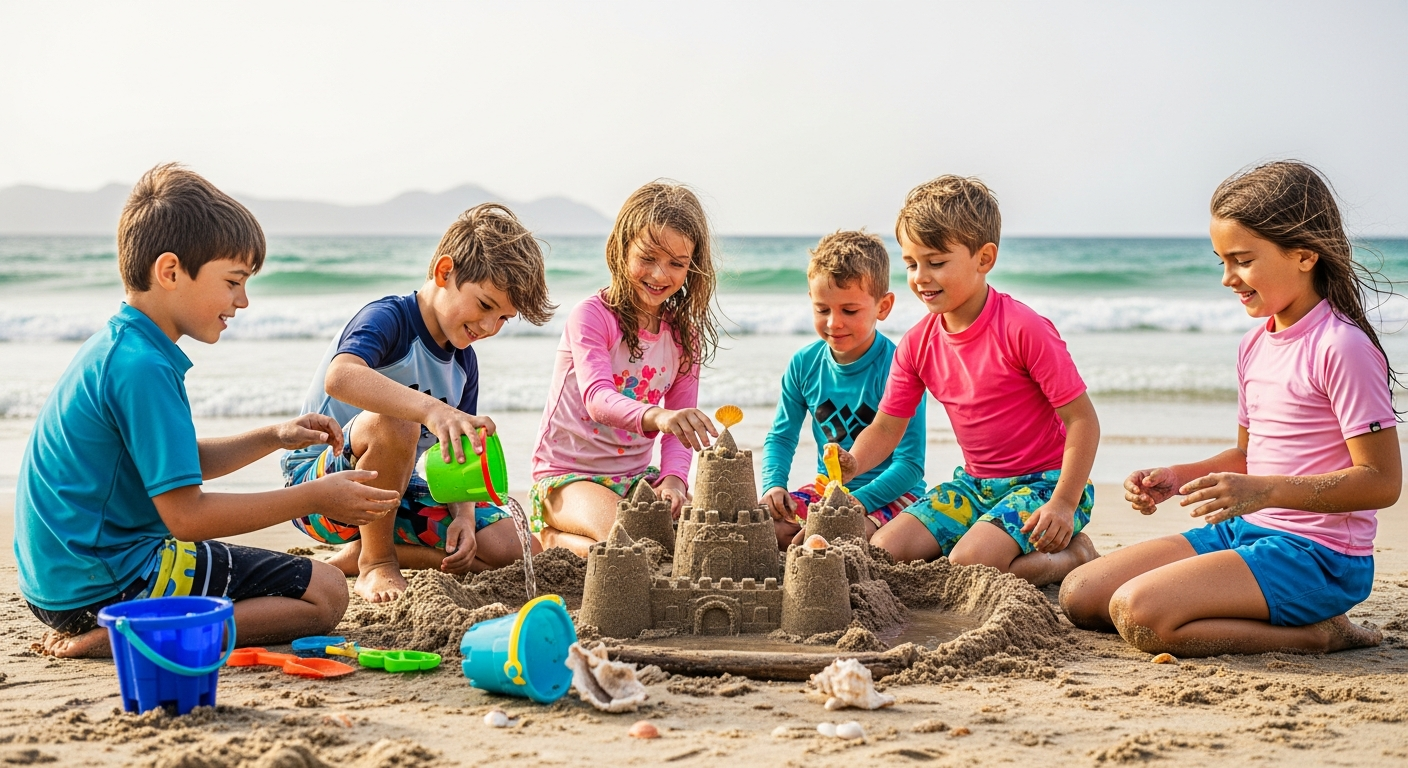
Table of Contents
- Introduction
- The Beach as a Natural Speech & Language Laboratory
- Classic Beach Fun with a Communication Twist
- Engaging Games for Active Bodies & Minds
- Creative & Imaginative Beach Play
- Water & Shoreline Adventures
- Mindful Moments & Quiet Exploration
- Elevating Beach Play with Speech Blubs
- Maximizing the Value of Your Speech Blubs Journey
- Preparing for Your Beach Adventure: Tips for Parents
- Conclusion
- Frequently Asked Questions
There’s a unique magic to the beach, isn't there? The rhythmic crash of waves, the endless expanse of sand, the shimmering horizon. For many of us, these moments become cherished childhood memories. But what if those joyful beach days could be more than just fun in the sun? What if they could also be dynamic classrooms, sparking imagination, nurturing curiosity, and building foundational communication skills?
The truth is, the beach is a natural, multi-sensory environment that offers unparalleled opportunities for children's holistic development. From the texture of the sand beneath their toes to the vastness of the ocean, every element invites exploration and interaction. This guide dives deep into a treasure trove of engaging, fun beach activities for kids that go beyond the usual sandcastles and splashing. We’ll explore how these simple pleasures can become powerful platforms for fostering creativity, building confidence, and, crucially, developing vital speech and language skills. Our mission at Speech Blubs is to empower children to speak their minds and hearts, and we believe that enriching real-world experiences, like a day at the beach, are perfectly complemented by smart, engaging learning tools. Let’s make your next family beach day an unforgettable adventure in play, learning, and connection.

Introduction
Ever found yourself at the beach, watching your child dig a hole or collect shells, and wondered how to turn that simple joy into something even more enriching? You’re not alone. While the beach is inherently stimulating, sometimes parents look for ways to maximize the learning and development opportunities it offers, particularly in fostering communication. This post is your comprehensive guide to transforming ordinary beach outings into extraordinary experiences that naturally boost your child’s speech, language, and social skills. We'll outline a diverse range of activities, from active games to creative crafts and mindful exploration, all designed to engage children of various ages and developmental stages. By the end, you'll be equipped with practical ideas and insights, ready to embark on beach adventures that are not only incredibly fun but also profoundly beneficial for your child's growth.
The Beach as a Natural Speech & Language Laboratory
Before we dive into specific activities, let's understand why the beach is such a fantastic place for language development. It’s a sensory rich environment – the feel of sand, the sound of waves, the sight of the horizon, the smell of salt air. This multi-sensory input naturally encourages children to observe, describe, and express themselves.
- Vocabulary Expansion: New sights (seashells, crabs, seaweed) and experiences (wading, digging, building) offer countless opportunities to introduce and reinforce new words.
- Descriptive Language: Encouraging children to describe what they see, feel, and hear helps them develop rich descriptive vocabulary and sentence structure.
- Turn-Taking & Social Skills: Collaborative activities naturally promote turn-taking, sharing, and problem-solving.
- Imaginative Play: The open-ended nature of the beach encourages imaginative scenarios, which are crucial for narrative development and creative expression.
- Gross & Fine Motor Skills: Digging, running, balancing, and manipulating small objects (shells, pebbles) all contribute to motor skill development, which is linked to overall cognitive and speech development.
At Speech Blubs, we understand the power of immersive learning. Our app leverages "video modeling," where children learn by watching and imitating their peers, much like they learn by observing and interacting with others during engaging beach play. This blend of real-world experiences and our scientifically-backed "smart screen time" creates a powerful pathway for language acquisition.

Classic Beach Fun with a Communication Twist
Some activities are beach staples for a reason. Here’s how to enhance them for speech and language growth.
Sandcastle Building & Sculpting: More Than Just Towers
This timeless activity is a goldmine for language. Instead of just "build a castle," encourage your child to narrate their process.
- Action Words: "Scoop," "pat," "pour," "dig," "decorate," "build," "flatten."
- Descriptive Language: "Tall," "wide," "bumpy," "smooth," "sparkly," "wet," "dry."
- Spatial Concepts: "On top," "underneath," "next to," "inside," "around."
- Imaginative Storytelling: "This is a castle for a king!" "The waves are trying to reach our moat!"
- Practical Scenario: For a parent whose child is just starting to string two words together, building a sandcastle can be a perfect opportunity to model and elicit phrases like "more sand," "big tower," or "my castle." You can even use different sized buckets to introduce "big" and "small."
Digging Tunnels and Rivers: Engineering & Exploration
Kids instinctively dig. Make it an interactive learning experience.
- Sequencing & Problem Solving: "First, we dig the hole, then we make the river, then the water flows in!" "Why isn't the water coming?" "What should we do?"
- Cause & Effect: "If we dig deeper, the water will come closer."
- Vocabulary: "Tunnel," "river," "stream," "bridge," "dam," "flow," "block," "deep," "shallow."
- Practical Scenario: If your child is fascinated by how the water interacts with the sand, encourage them to describe the "journey" of the water through their created channels. This helps develop narrative skills and strengthens understanding of prepositions like "through," "over," and "under."
Seashell & Rock Hunting: A Natural Scavenger Hunt
Transform a simple search into a focused exploration.
- Classification & Comparison: "Find a smooth shell." "Can you find a shell with stripes?" "Is this bigger or smaller than that one?"
- Descriptive Vocabulary: "Jagged," "spiral," "rough," "shiny," "fragile," "heavy," "light."
- Counting & Numbers: "How many shells did you find?" "Let's count the smooth rocks."
- Early Literacy: If your child is older, you can create a simple pictorial checklist of things to find.
- Practical Scenario: For children working on articulation, hunting for items that start with a specific sound ("s" for shell, "r" for rock) can be a playful way to practice. Then, they can describe their finds using target sounds.
Engaging Games for Active Bodies & Minds
Beyond static play, dynamic games offer fantastic opportunities for communication and social development.
Water Bucket Relays: Teamwork & Following Instructions
This is a high-energy game perfect for groups.
- Turn-Taking: Clearly define whose turn it is.
- Instruction Following: "Run to the water, fill your bucket, then run back."
- Action Verbs: "Run," "fill," "pour," "splash," "race."
- Encouragement & Sportsmanship: "Go team!" "You did it!"
- Practical Scenario: This game is excellent for children who need practice with multi-step directions. Break down the instructions into smaller chunks and model the actions if needed.
Beach Volleyball or Soccer: Strategic Thinking & Social Cues
Adapt these popular sports for the sandy arena.
- Directional Language: "Over here!" "To me!" "Kick it that way!"
- Teamwork & Cooperation: Discuss strategy, encourage passing, and celebrate together.
- Problem-Solving: "How can we get the ball to the goal?"
- Emotional Expression: Managing wins and losses, expressing excitement.
- Practical Scenario: For older children, introduce rules and roles to practice understanding and following complex social conventions. The open space of the beach allows for plenty of running and vocalizing without feeling confined.
Kite Flying: Observation & Descriptive Language
A windy day at the beach is perfect for this visually stunning activity.
- Observation: "Look how high it's going!" "What color is your kite?" "The wind is making it dance."
- Spatial Language: "Up," "down," "high," "low," "floating," "soaring."
- Cause & Effect: "The wind makes the kite fly." "If the wind stops, the kite will fall."
- Practical Scenario: Use this activity to introduce weather-related vocabulary (windy, breezy, gusty) and to discuss how things move in the air. For children working on early sentence structure, you can model phrases like "kite is high" or "wind blows kite."
Towel Tug-of-War: Strength & Team Commands
Simple, fun, and great for building upper body strength and communication.
- Action Verbs: "Pull," "push," "hold," "win," "lose."
- Encouragement: "Pull harder!" "We can do it!"
- Turn-Taking & Fair Play: Establish rules and discuss good sportsmanship.
- Practical Scenario: This is a great game for practicing vocalizations and short, directive commands in a playful, low-pressure setting.
Creative & Imaginative Beach Play
The beach is a blank canvas for imagination. Let your child lead the way.
Sand Mermaids & Beach Sculptures: Body Awareness & Storytelling
Instead of just building castles, use the body as a canvas.
- Body Parts Vocabulary: "Legs," "tail," "arms," "fins."
- Descriptive Language: Decorate with shells, seaweed, and pebbles, describing each item.
- Imaginative Play: "She's a beautiful mermaid queen!" "What adventures will she have?"
- Practical Scenario: This activity is wonderful for engaging children in dramatic play and developing narrative skills. Encourage them to create a story about their mermaid or creature.
Ocean Potion & Sand Kitchen: Role-Play & Sensory Exploration
Setting up a pretend lab or restaurant fosters rich imaginative scenarios.
- Role-Play Language: Taking orders, describing ingredients, making sounds for mixing.
- Sensory Vocabulary: "Slimy seaweed," "gritty sand," "bubbly water," "smooth pebbles."
- Sequence & Instructions: "First, add the sand, then the shells, then stir it all up!"
- Practical Scenario: This is perfect for children who thrive in imaginative play. For children who may be less vocal, offer simple choices or prompts, like "What are you cooking?" or "Do you want to add a shell or a rock?" This encourages them to use their voice in a comfortable context.
Nature Portraits & Sand Art: Creativity & Expressive Language
Collect natural elements and use the sand as a canvas.
- Descriptive & Abstract Language: "It looks like a happy face." "This seaweed makes good hair." "What emotion does your portrait show?"
- Fine Motor Skills: Arranging small items, drawing patterns.
- Color & Shape Recognition: "Find something green." "Can you make a circle with rocks?"
- Practical Scenario: For children who love visual arts, this provides a non-verbal outlet that can easily be translated into verbal descriptions. Ask them to describe their creation and the materials they used.
Water & Shoreline Adventures
The water's edge offers a unique set of activities.
Wading & Wave Jumping: Action Words & Sensory Awareness
Simple splashing can be a language-rich experience.
- Action Verbs: "Splash," "jump," "kick," "run," "wade."
- Sensory Descriptors: "Cold," "warm," "bubbly," "foamy," "wet."
- Anticipation & Reaction: "Here comes a big wave!" "Uh oh, splash!"
- Practical Scenario: This is fantastic for targeting action words and eliciting exclamations. For children with limited vocabulary, model the words repeatedly and encourage imitation.
Float Races: Direction & Comparison
If the water is calm and supervised, a simple race with lightweight floats can be exciting.
- Directional Language: "Go!" "Faster!" "Which one is winning?" "It's going left!"
- Comparative Language: "My float is bigger." "Yours is faster."
- Prediction: "I think the yellow one will win."
- Safety Note: Always stay close to shore and ensure constant adult supervision, especially with younger children or if water conditions are not calm.
Tide Pool Exploration: Discovery & Observation
If your beach has tide pools, they are miniature ecosystems waiting to be explored.
- Vocabulary: "Crab," "sea anemone," "shellfish," "seaweed," "crevice," "pool."
- Observation Skills: "Look! A tiny crab!" "What is it doing?" "Where is it going?"
- Question Asking: Encourage curiosity and questions about marine life.
- Respect for Nature: Teach children to observe without disturbing the creatures.
- Practical Scenario: This activity naturally fosters a sense of wonder and provides tangible items for discussion. Use open-ended questions like "Tell me about what you see" to encourage more elaborate responses.
Mindful Moments & Quiet Exploration
Not all learning needs to be high-energy. Sometimes, quiet observation can be just as powerful.
Cloud Acting & Gazing: Imagination & Descriptive Language
Lie back and watch the sky together.
- Imaginative Language: "That cloud looks like a dragon!" "It's turning into a fluffy sheep."
- Descriptive Adjectives: "Fluffy," "wispy," "dark," "light," "fast," "slow."
- Questioning: "What do you see?" "How does it make you feel?"
- Practical Scenario: This is a wonderful way to wind down and encourage abstract thinking. It also provides a moment of calm and connection.
Sand Messages & Drawings: Early Literacy & Expression
The sand is an enormous, forgiving canvas for writing and drawing.
- Pre-Writing Skills: Practicing drawing shapes, letters, and simple words.
- Expressive Communication: Leaving messages for others, drawing feelings or stories.
- Name Recognition: Practicing writing their own name or family members' names.
- Practical Scenario: For children learning letters or sight words, writing them in the sand is a tactile and engaging way to reinforce learning.
Rock Balancing Challenge: Patience & Concentration
Finding smooth stones and stacking them into sculptures requires focus.
- Spatial Concepts: "On top," "next to," "under."
- Problem-Solving: "How can we make it stand?" "What happens if we put a big one on top?"
- Self-Talk: Encouraging children to verbalize their thoughts as they try to balance the rocks.
- Practical Scenario: This activity builds fine motor skills and patience, both of which support a child's overall ability to focus and engage in communication tasks.
Elevating Beach Play with Speech Blubs
While the beach offers incredible organic learning, we know that consistent, targeted support is often needed. That's where Speech Blubs comes in. Our app is designed to complement these real-world experiences, making learning fun and effective.
Imagine a child who loves animals and just had a fantastic time spotting seagulls and crabs at the beach. When you get home, their engagement can continue with our "Animal Kingdom" section, where they can practice animal sounds and names, building on their fresh memories. Our unique video modeling approach, where kids imitate their peers, is like a digital extension of the natural imitation they do during beach games, boosting their confidence to "speak their minds and hearts."
We built Speech Blubs from personal experience; our founders all grew up with speech problems and created the tool they wished they had. We are committed to providing an immediate, effective, and joyful solution for the 1 in 4 children who need speech support, blending scientific principles with play. This makes our app a one-of-a-kind "smart screen time" experience, a powerful tool for family connection, and a screen-free alternative to passive viewing. In fact, our scientific methodology has earned us a top-tier rating on the MARS scale for speech apps, as detailed in our research. You can also read countless testimonials from parents who have seen remarkable progress.
For a parent whose 3-year-old 'late talker' loves animals, the 'Animal Kingdom' section of Speech Blubs offers a fun, motivating way to practice 'moo' and 'baa' sounds, or name different beach creatures they might have seen, like "crab" or "fish." This direct link between real-world play and targeted app activities strengthens vocabulary and encourages expressive language. Similarly, after a game of "water bucket relay" at the beach, transitioning to Speech Blubs' "Action Words" section can reinforce verbs like "run," "splash," and "fill." The app’s interactive nature and engaging videos keep children motivated, translating their beach excitement into focused language practice.
Ready to see how Speech Blubs can make a difference for your child? Download Speech Blubs on the App Store or Google Play to get started with your 7-day free trial. If you’re unsure if your child could benefit, take our quick 3-minute preliminary screener to get a simple assessment and a personalized next-steps plan, which also includes a free 7-day trial.
Maximizing the Value of Your Speech Blubs Journey
To get the most out of Speech Blubs, we encourage parents to consider our Yearly plan. While a Monthly plan is available for $14.99 per month, our Yearly plan is an incredible value at just $59.99 per year, which breaks down to an amazing $4.99/month. You save 66% with the Yearly plan, and it comes packed with exclusive features that truly enhance your child's learning experience.
The Yearly plan includes:
- A 7-day free trial: Experience the full power of Speech Blubs before committing.
- The extra Reading Blubs app: Double the fun and learning with an additional app focused on early reading skills.
- Early access to new updates: Be the first to enjoy new features and content.
- 24-hour support response time: Get prompt assistance whenever you need it.
The Monthly plan does not include these valuable benefits. Choosing the Yearly plan ensures you unlock the full suite of tools designed to help your child thrive. Create your account and begin your 7-day free trial today by selecting the Yearly plan for the best value and full access!
Preparing for Your Beach Adventure: Tips for Parents
A successful beach day, especially one focused on learning, starts with preparation.
Essential Beach Bag Items
- Sun Protection: Sunscreen, hats, and rash guards are a must.
- Hydration: Plenty of water bottles.
- Snacks: Fuel for active play.
- Basic Tools: A bucket, shovel, and small rake for sand play.
- Natural Decor: A small bag or container for collecting shells, rocks, or unique driftwood.
- Optional Enhancements:
- Magnifying glass: For close-up observation of shells and sand.
- Spray bottle: For sand stencil art or just cooling off.
- Small notebook and pencil: For drawing observations or playing sand rubbings.
- Lightweight ball or frisbee: For active games.
Safety First
- Constant Supervision: Never leave children unattended near water.
- Swim Safety: Ensure children are wearing appropriate flotation devices if they are not strong swimmers.
- Designated Meeting Spot: For older children, establish a clear meeting point if you get separated.
- Check Conditions: Be aware of tide times, currents, and any potential marine hazards (e.g., jellyfish warnings).
Conclusion
The beach is more than just a place to relax; it's a dynamic, multi-sensory environment that serves as an incredible playground for learning and development. By incorporating these fun, intentional activities, you can transform a simple family outing into a powerful opportunity to foster your child’s speech, language, and social-emotional growth. From building towering sandcastles that spark narrative creation to hunting for shells that expand descriptive vocabulary, every moment holds potential. The joy of discovery, the thrill of imaginative play, and the warmth of family connection experienced at the beach lay a robust foundation for strong communication skills.
And when your sandy adventures wind down, remember that the learning doesn't have to stop. Speech Blubs is here to seamlessly extend that playful learning experience, offering scientifically-backed, engaging "smart screen time" that reinforces the skills practiced in the real world. Our app empowers children to "speak their minds and hearts" by providing a joyful, immediate, and effective solution for developing crucial language abilities.
Don't let these incredible opportunities for growth pass you by. Take the first step towards a future filled with clear communication and confident expression.
Ready to embark on this exciting journey? Download Speech Blubs on the App Store or Google Play today! To unlock the full suite of features, including a 7-day free trial, the bonus Reading Blubs app, and priority support, make sure to choose the Yearly plan at just $59.99 per year – that’s a 66% saving and the absolute best value for your family!
Frequently Asked Questions
Q1: What are the best beach activities for toddlers to help with language development?
A1: For toddlers, focus on sensory exploration and simple actions. Digging in the sand, splashing in shallow water, and collecting shells are fantastic. Narrate everything you're doing ("We are scooping sand!" "Look at the smooth shell!"). Use simple action words, descriptive adjectives, and model short phrases. "Ocean Potion" and "Sand Kitchen" are also great for encouraging early imaginative play and vocalizations.
Q2: How can I keep older kids engaged at the beach beyond just swimming?
A2: Older kids thrive on challenges and creativity. Introduce team games like water bucket relays, beach volleyball/soccer, or a competitive seashell hunt. Encourage creative projects like "Sand Mermaids," nature portraits, or designing intricate sand sculptures. Kite flying, rock balancing, and even a "beach clean-up" can also be very engaging and provide valuable learning experiences.
Q3: What should I pack for a beach day to maximize fun and learning?
A3: Beyond the usual sunscreen and snacks, pack a few key items. A sturdy bucket and shovel are essential for sand play. A small bag or container for collecting treasures encourages exploration. Consider bringing a magnifying glass for close observation, a spray bottle for creative sand art, or a lightweight ball/frisbee for active games. A small notebook and pencil can be great for drawing or shell rubbings.
Q4: How does Speech Blubs connect with these real-world beach activities?
A4: Speech Blubs complements real-world experiences by extending the learning in a fun, targeted way. For example, after an "Animal Kingdom" hunt at the beach, your child can practice animal sounds and names in the app, reinforcing new vocabulary. Our "video modeling" method, where children imitate peers, builds on the natural imitation they do during play. It provides consistent, engaging practice for the language skills sparked during your beach adventures, turning "smart screen time" into a powerful tool for developing communication and helping your child speak their minds and hearts.
About the author