
Fun Block Party Games for Kids
 By Speech Blubs Team•Jan 28, 2026•19 min.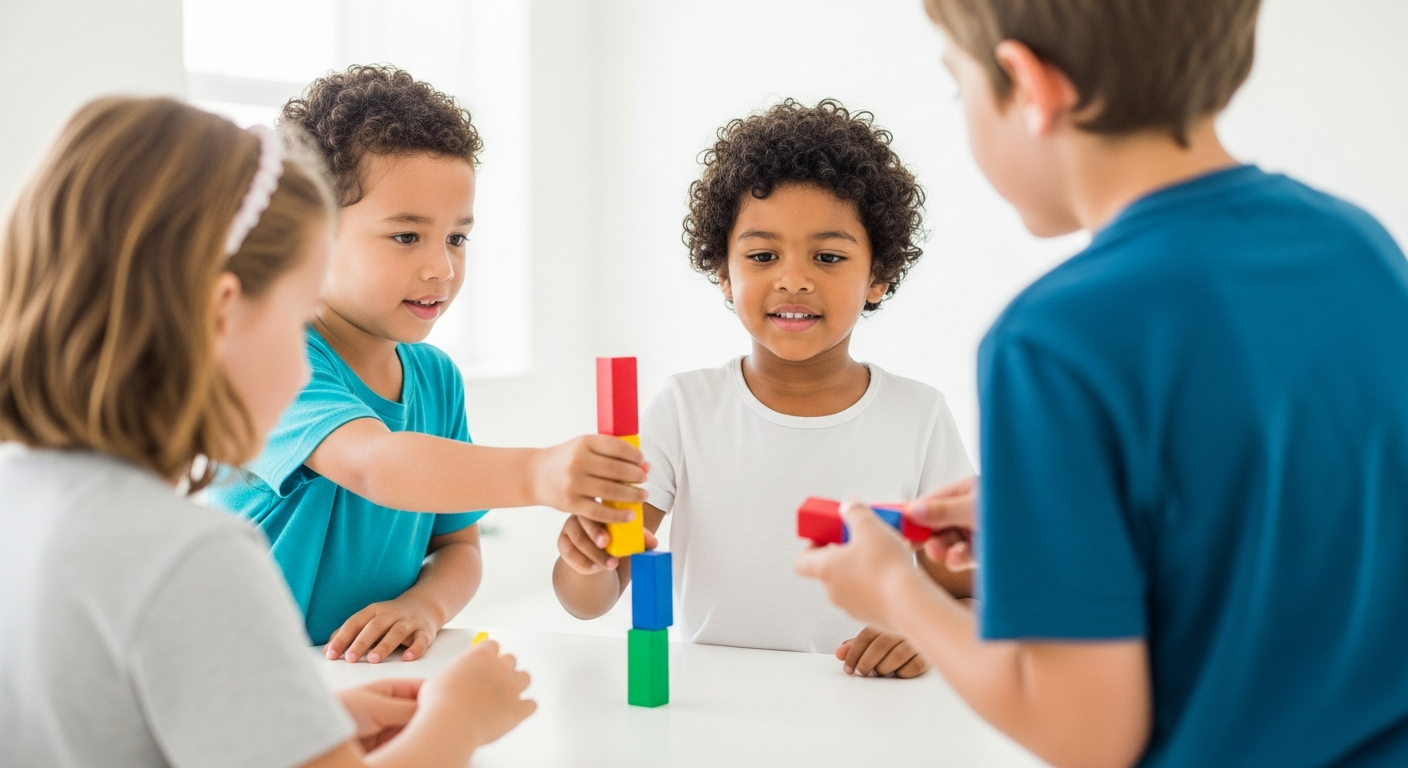
Table of Contents
- The Heart of the Neighborhood: Why Block Parties Matter for Kids' Development
- Planning Your Epic Kids' Block Party: Essential Tips for Success
- Classic Block Party Games with a Twist (Ages 3-6)
- Engaging Adventures for School-Aged Kids (Ages 7-10)
- Team Challenges and Creative Pursuits for Pre-Teens (Ages 11+)
- Beyond the Games: Fostering Community and Communication
- Conclusion
- FAQ
Introduction
Remember the magic of childhood summers? Laughter echoing down the street, popsicles melting on warm hands, and the pure joy of playing outside with friends until the streetlights came on. Those cherished memories often stem from simple, communal gatherings – the block party. More than just a social event, a well-orchestrated block party offers a vibrant playground for children to develop crucial life skills, from social interaction and problem-solving to emotional regulation and, most importantly, communication.
In an era where screens often dominate leisure time, creating opportunities for face-to-face play is more vital than ever. This blog post will explore a treasure trove of engaging block party games designed to bring kids together, foster essential developmental skills, and create unforgettable community memories. We'll dive into a variety of games suitable for all ages, emphasizing how these playful interactions are not just fun, but crucial for social, cognitive, and communicative growth. By the end, you'll have practical tips and a wealth of ideas to host memorable, skill-building block party events, ensuring every child can speak their minds and hearts, both on the street and in life.

The Heart of the Neighborhood: Why Block Parties Matter for Kids' Development
A block party is more than just an excuse to close off the street and share a meal; it's a dynamic hub for child development. The unstructured, free-form nature of outdoor play with a mix of ages and personalities offers unique benefits that structured activities sometimes miss.
Fostering Essential Skills Through Play
- Social Skills: Children learn to negotiate, share, take turns, resolve conflicts, and understand social cues in a natural, low-pressure environment. They interact with peers and adults from diverse backgrounds, broadening their perspective and empathy.
- Emotional Regulation: Games inevitably involve wins and losses, successes and frustrations. Children learn to manage these emotions, cope with disappointment, celebrate others' achievements, and build resilience.
- Cognitive Development: Many games require strategic thinking, problem-solving, following rules, and adapting to changing situations. From planning a route in a scavenger hunt to calculating turns in a stacking game, minds are constantly engaged.
- Gross and Fine Motor Skills: Running, jumping, throwing, catching, drawing, and building – block party games are a full-body workout that refines both large and small muscle movements, crucial for physical health and coordination.
- Communication Skills: This is where block parties truly shine as a developmental powerhouse. Every game, every interaction, is an opportunity to communicate. Children ask questions, give instructions, describe actions, express feelings, and listen actively. For a child who might be a "late talker" or struggling with expressive language, the playful context of a block party can reduce pressure and naturally encourage vocalizations and verbal attempts. Imitation is a powerful learning tool in these settings, much like our scientific "video modeling" methodology at Speech Blubs, where children learn by watching and imitating their peers. This direct, joyful interaction is a fantastic screen-free alternative to passive viewing, promoting genuine connection and skill-building.
Our mission at Speech Blubs is to empower children to "speak their minds and hearts," and we see block parties as an extension of this philosophy in the real world. They provide a rich, interactive environment where kids can confidently practice and expand their communicative abilities. To explore how we complement this real-world learning with engaging digital experiences, you can visit the Speech Blubs homepage.

Planning Your Epic Kids' Block Party: Essential Tips for Success
A successful block party, especially one centered around kids' games, requires a little forethought. Here's how to ensure it's a hit for everyone.
Safety First and Foremost
Always designate clear play zones, especially if your party is in the street. Ensure adequate adult supervision for all activities, particularly those involving water or physical challenges. Have a first-aid kit readily available and communicate any special needs or allergies among the children. Safety measures ensure everyone can relax and enjoy the fun.
Age-Appropriateness and Inclusivity
Consider the age range of the children attending. Toddlers and preschoolers need simpler, less competitive games, while school-aged children thrive on rules and challenges. Pre-teens might appreciate team-based activities or creative outlets. Plan a mix of activities to cater to different abilities and interests. Remember, the goal is participation and enjoyment, not just winning. Games that can be modified, or that naturally allow for various skill levels, are ideal.
- Practical Scenario: For a parent whose 3-year-old "late talker" thrives on visual cues and imitation, involving them in setting up a game like "Bubble Wrap Hopscotch" can be incredibly motivating. They can help lay out the squares, practice saying numbers, and mimic the hopping action. This tactile experience and simple numbering can encourage vocalizations and counting, building confidence before the main event. Similarly, a child who enjoys animals might be drawn to "Animal Kingdom" sections in our app, practicing sounds like "moo" or "baa," mirroring the imitative learning they do in real-world play.
Involving Kids in Planning
Let the children contribute! Ask them what games they'd like to play. Giving them a voice in the planning process increases their enthusiasm and ownership of the event. They might surprise you with creative ideas that resonate with their peers.
Classic Block Party Games with a Twist (Ages 3-6)
For the youngest attendees, the focus should be on sensory engagement, simple rules, and plenty of opportunities for movement and basic interaction.
Bubble Wrap Hopscotch
Give the classic game a delightful sensory twist! Cut large sheets of bubble wrap into squares (numbered 1-10) and lay them out as a hopscotch grid. The satisfying pop with each jump adds an element of surprise and fun.
- Developmental Benefits: This game is fantastic for gross motor skills, balance, coordination, and number recognition. Counting aloud as they hop encourages early mathematical concepts and vocalization. The anticipation of the "pop" can elicit squeals of delight and spontaneous speech.
- Communication Focus: Practice counting: "One, two, three, pop!" Give simple instructions: "Jump on the five!" Children can also describe the sound: "It's popping!"
Silly Sack Race
Potato sacks get a makeover! Decorate plain burlap sacks with colorful felt shapes or fabric paint before the party. Kids hop down a marked path to a finish line.
- Developmental Benefits: Excellent for gross motor skills, balance, and coordination. It teaches turn-taking and introduces the concept of friendly competition. The silliness of hopping often leads to genuine laughter and joy.
- Communication Focus: Encourages exclamations like "Go!", "Hop, hop, hop!", and "I won!" Children can describe the feeling: "It's tricky!" or "This is fast!" Following multi-step directions ("Get in the sack, go to the line, then hop!") builds listening comprehension.
Water Balloon Toss (Simplified)
On a warm day, water games are a must! For younger kids, simplify the toss. Instead of aiming for distance, use hula hoops on the ground, each assigned a point value. Kids simply try to toss the balloon into a hoop.
- Developmental Benefits: Improves hand-eye coordination, understanding cause and effect, and develops throwing skills. It's also a great way to cool down and involves minimal competition, focusing on participation.
- Communication Focus: Simple commands ("throw," "catch," "oops!"), color recognition ("throw the blue balloon!"), and counting points. Children can verbally express excitement or frustration in a playful context.
Giant Tic-Tac-Toe (Disk Tic-Tac-Toe)
Use a shower curtain liner and duct tape to create a large tic-tac-toe grid on the ground. Use flying disks (two different colors/designs for X's and O's) instead of markers.
- Developmental Benefits: Fosters strategic thinking, pattern recognition, and turn-taking. It's a great introduction to simple board games in a large, active format.
- Communication Focus: Encourages asking questions ("My turn?"), stating intentions ("I'll put my X here!"), and discussing strategy. It promotes problem-solving through verbal collaboration or gentle competition.
Kids' Bake-Off/Cookie Decorating Contest
Set up a decorating station with plain sugar cookies, frosting, sprinkles, and candies. Children can decorate their own edible masterpieces.
- Developmental Benefits: This activity hones fine motor skills, creativity, and following instructions. It's also a wonderful sensory experience with different textures and tastes.
- Communication Focus: Descriptive language ("sticky frosting," "colorful sprinkles," "sweet cookie"), asking for materials ("Can I have more blue sprinkles?"), and sharing ideas. For a child learning new descriptive adjectives, this offers a delicious opportunity to practice.
Outdoor Movie or Story Time
As the day winds down, set up a projector for an outdoor movie screening or gather everyone for a communal story time.
- Developmental Benefits: Encourages active listening, imagination, and a shared group experience. It provides a calming activity after energetic games.
- Communication Focus: Following a narrative, discussing characters and plot points (for older kids), and engaging in imaginative play inspired by the story. For a child who might struggle with attention during passive viewing, the communal aspect can enhance engagement.
We believe that learning to communicate should be an immediate, effective, and joyful solution for children, blending scientific principles with play. Just as these games provide a rich environment for natural language acquisition, our app, born from the personal experiences of our founders, offers targeted "smart screen time" experiences. Download Speech Blubs on the App Store or Google Play to explore more engaging activities that encourage communication development.
Engaging Adventures for School-Aged Kids (Ages 7-10)
For this age group, incorporate games that demand more strategy, teamwork, and problem-solving, fostering richer social and cognitive development.
Scavenger Hunt (Nature or Sweet)
Create a list of items for kids to find, either natural objects (pinecones, specific leaves, smooth stones) or hidden small toys/candies. Arm each child or team with a list and a bag.
- Developmental Benefits: Sharpens observation skills, problem-solving, teamwork (if in groups), and reading comprehension (for the list). It encourages exploration and a sense of adventure.
- Communication Focus: Following complex instructions, asking clarifying questions ("Is this what a dandelion looks like?"), describing finds ("I found a bumpy rock!"), and collaborating with teammates ("Where should we look next?"). This is a fantastic opportunity for children to use and understand prepositions and descriptive adjectives.
Outdoor Word Game
On large 8-inch squares of Masonite (available at home improvement stores), write letters of the alphabet (repeating common letters). Players start with a hand of letters and take turns spelling words on the ground, extending previous words like Scrabble.
- Developmental Benefits: Boosts literacy, vocabulary, spelling, and strategic thinking. It's a great way to make learning fun and active.
- Communication Focus: Encourages discussion about words, definitions, and spelling. Children learn to articulate their thoughts and defend their word choices. This interactive wordplay builds a strong foundation for both reading and verbal expression.
Toppling Tug-of-War (with Safety Emphasis)
A twist on the classic: players balance on upturned milk crates (or sturdy low stools) set apart and pull a rope, trying to unbalance their opponent. Always place gym mats or soft ground beneath for safety.
- Developmental Benefits: Promotes teamwork, physical coordination, and strategic communication. It introduces a higher level of physical challenge and friendly competition.
- Communication Focus: Requires clear team communication for strategy ("Pull now!", "Lean back!"), encouraging leadership and cooperation. It's a great way to practice giving and following dynamic instructions.
Frisbee Toss/Rocket Toss
Decorate metal cans (15 oz.) with colorful duct tape and arrange them in a pyramid. Kids toss rice-filled socks (rockets) or Frisbees to knock them down.
- Developmental Benefits: Improves aim, hand-eye coordination, and understanding simple scoring. It’s a game of skill and patience.
- Communication Focus: Counting scores, explaining rules, and encouraging teammates. Children can use comparative language: "That was a good throw!" or "You're closer!"
Build-Your-Own Boat Races
Provide materials like pool noodle sections, wooden skewers, and washi tape. Kids design and build their own small sailboats, then race them in a kiddie pool or long trough filled with water.
- Developmental Benefits: Sparks creativity, introduces basic engineering concepts, and hones fine motor skills. It fosters a sense of accomplishment and friendly competition.
- Communication Focus: Describing their design choices ("My sail is big to catch the wind!"), explaining how their boat works, and cheering on others. This allows for rich vocabulary related to construction and movement.
Charades or Kids' Talent Show
Organize a charades game where kids act out words or phrases, or host a talent show where they can showcase their unique skills (singing, dancing, jokes, magic).
- Developmental Benefits: Boosts expressive language (non-verbal and verbal), imagination, and performance skills. It's a fantastic confidence-builder and encourages supportive peer interaction.
- Communication Focus: In charades, children learn to interpret and convey messages non-verbally, then verbally explain their choices. A talent show encourages public speaking, clear articulation, and giving/receiving positive feedback.
For children who are actively refining their conversational skills, games like "Outdoor Word Game" and "Charades" are invaluable. They encourage complex verbal exchanges and creative expression. At Speech Blubs, we are committed to providing a "smart screen time" alternative that transforms passive viewing into active learning, mirroring the engagement of these interactive games.
Team Challenges and Creative Pursuits for Pre-Teens (Ages 11+)
As children enter pre-teen years, their cognitive abilities allow for more complex rules, strategic thinking, and a greater appreciation for collaborative challenges.
Wooden Block Stacking Game (Giant Jenga)
Cut 2x4-foot boards into many 10.5-inch pieces and sand them smooth. Stack them in alternating directions to create a giant Jenga tower. Players take turns removing blocks without toppling the tower.
- Developmental Benefits: Develops fine motor skills, strategic planning, patience, and spatial reasoning. It encourages quiet focus and careful decision-making.
- Communication Focus: Whispered strategies, discussions about which block to remove, and sharing observations ("That one feels loose!"). It teaches respectful turn-taking and how to handle tension in a group setting.
Outdoor Maze/Obstacle Course
Use cones, ropes, hula hoops, blankets, and natural elements (trees, bushes) to create a winding maze or a challenging obstacle course. Time participants or have them complete it in teams.
- Developmental Benefits: Enhances problem-solving, physical agility, and following multi-step instructions. It promotes teamwork and creative use of space.
- Communication Focus: Giving and receiving clear instructions ("Go under the rope, then jump over the tire!"), cheering on teammates, and describing challenges and solutions. This is an excellent activity for practicing spatial prepositions and sequential language.
Eating Contest or Competitive Bake-Off
Organize a fun, lighthearted eating contest (e.g., donut on a string, watermelon spitting) or a more involved bake-off where pre-teens can showcase their culinary skills and compete for "best taste" or "most creative."
- Developmental Benefits: Teaches sportsmanship, following rules, and handling wins/losses gracefully. For the bake-off, it develops cooking skills, creativity, and planning.
- Communication Focus: Discussing rules, providing constructive feedback (for the bake-off), and engaging in lively, good-natured banter. It promotes expressing opinions and making judgments respectfully.
Kickball Game or Group Grilling Area
A classic kickball game brings everyone together for team sports, promoting physical activity and cooperative play. Alternatively, set up a communal grilling area where families can cook and share food, fostering informal social interaction.
- Developmental Benefits: Team sports build gross motor skills, coordination, teamwork, and understanding rules. A grilling area encourages social interaction, sharing, and conversation in a relaxed setting.
- Communication Focus: In kickball, communication is key for strategy, calls, and cheers. In a grilling area, it's about casual conversation, sharing recipes, and building relationships, making it easier for shyer children to engage. For a pre-teen who might struggle with initiating conversations, participating in a group activity like preparing food or playing a team sport can provide a low-pressure way to engage peers, fostering interaction through shared activity rather than direct conversation.
Photo Booth or Karaoke Station
Set up a fun photo booth with props, or a karaoke machine for singing. These activities encourage creative expression and provide entertainment for a wide range of personalities.
- Developmental Benefits: Boosts self-expression, confidence, and social bonding through shared fun and memory-making.
- Communication Focus: Using descriptive language for props, giving and receiving compliments on photos or performances, and expressing excitement. Karaoke, in particular, encourages vocal projection and rhythm.
Unsure if your child could benefit from extra support in their communication journey? Take our quick 3-minute preliminary screener to get a simple assessment and a free 7-day trial. Our method, backed by extensive research, consistently ranks highly on the MARS scale, placing us in the top tier of speech apps worldwide. Learn more about the research behind Speech Blubs here.
Beyond the Games: Fostering Community and Communication
The success of a block party, and its lasting impact on children's development, extends beyond the games themselves. It’s about the environment created and the values reinforced.
The Power of Parent Modeling
Children learn by observing. When parents actively engage in play, listen to their children, and communicate openly with neighbors, they model positive social and communicative behaviors. This active participation reinforces the idea that communication is valuable and enjoyable. Our founders at Speech Blubs all grew up with speech problems and created the tool they wished they had – a tool that recognizes the profound impact of joyful, supported communication on a child's life. This personal connection drives our commitment to blending scientific principles with play.
Creating a Supportive Environment
Focus on celebrating effort and participation over just winning. Encourage kids to support each other, whether they're cheering on a friend in a sack race or offering a word of encouragement in a stacking game. A supportive atmosphere reduces pressure and makes children feel safe to try new things, make mistakes, and ultimately, speak their minds. This positive reinforcement is key to building confidence in their communication abilities.
Connecting Block Party Fun to Daily Language Development
The skills practiced at a block party aren't confined to a single afternoon. Encourage children to talk about their experiences, describe the games, and recount funny moments. This reflective conversation reinforces vocabulary, narrative skills, and memory. These real-world applications of language are profoundly impactful, complementing the structured, engaging activities found in our app.
At Speech Blubs, we provide an immediate, effective, and joyful solution for the 1 in 4 children who need speech support. We believe in providing "smart screen time" experiences that are powerful tools for family connection, not just passive entertainment. Our unique approach of teaching complex communication skills through "video modeling," where children learn by watching and imitating their peers, aligns perfectly with the natural imitative learning that occurs in a vibrant community gathering. You can see what other parents are saying about their child's success with Speech Blubs and how we help foster a love for communication and build confidence.
Ready to empower your child's communication journey? Create your Speech Blubs account today!
Conclusion
Block party games for kids offer an incredible opportunity to weave together community spirit, physical activity, and vital developmental learning. From the simplest bubble wrap hopscotch for toddlers to strategic word games for pre-teens, these activities are more than just fun; they are powerful platforms for building social skills, fostering emotional intelligence, and, most critically, nurturing robust communication abilities. By creating environments where children can play, interact, and express themselves freely, we help them build confidence and develop a lifelong love for speaking their minds and hearts.
Don't just imagine the smiles and connections; make them happen! Start your child’s journey toward clearer speech and greater confidence today, both in community play and with dedicated support.
Ready to unlock your child's full communication potential?
At Speech Blubs, we are dedicated to providing the best tools for your family. Choose our Yearly plan for unparalleled value and an enriched experience:
- Monthly Plan: Only $14.99 per month.
- Yearly Plan: Just $59.99 per year – that's a massive 66% saving, breaking down to only $4.99 per month!
The Yearly plan is the best choice, offering exclusive benefits:
- A 7-day free trial to experience everything Speech Blubs has to offer.
- Access to the extra Reading Blubs app to further enhance literacy skills.
- Early access to new updates and a swift 24-hour support response time.
The Monthly plan does not include these invaluable benefits. Make the smart choice for your child's development and your budget.
Download Speech Blubs from the App Store or the Google Play Store and select the Yearly plan to begin your free trial and unlock the full suite of features!
FAQ
How can block parties help with my child's speech development?
Block parties provide natural, low-pressure environments for children to practice communication skills. Through games, they engage in turn-taking, follow instructions, describe actions, ask questions, and express emotions. The varied social interactions with peers and adults encourage imitation and spontaneous speech, mirroring the benefits of our "video modeling" approach where children learn by watching and imitating.
What if my child is shy or hesitant to join games?
It's perfectly normal for some children to be hesitant. Encourage them gently, but don't force them. Start by involving them in setting up an activity, like decorating sacks for a race or helping lay out a giant tic-tac-toe grid. Offer quieter activities like a craft table or a story time area. Often, observing others having fun will eventually draw them in. Our app also provides a safe, engaging space for children to build confidence in communication at their own pace.
How do I get my neighbors involved in planning a block party?
Start by reaching out to a few key neighbors who you know might be interested. Suggest a quick coffee or an online group chat to brainstorm ideas. Delegate tasks, such as organizing games, food, or decorations, to spread the workload. A shared sense of community and collective effort makes the planning process much smoother and more enjoyable for everyone involved.
Can Speech Blubs really help my child "speak their mind and heart"?
Yes, our mission at Speech Blubs is precisely that. Born from the personal experiences of our founders who faced speech challenges, we've created a tool that blends scientific principles with joyful play. Through interactive "smart screen time" experiences like video modeling, we empower children to develop foundational speech and language skills, build confidence, and reduce communication frustration, ultimately helping them express themselves more clearly and confidently in all aspects of life.
About the author