
Fun Card Games for Kids: Boost Skills & Build Connections
 By Speech Blubs Team•Jan 19, 2026•19 min.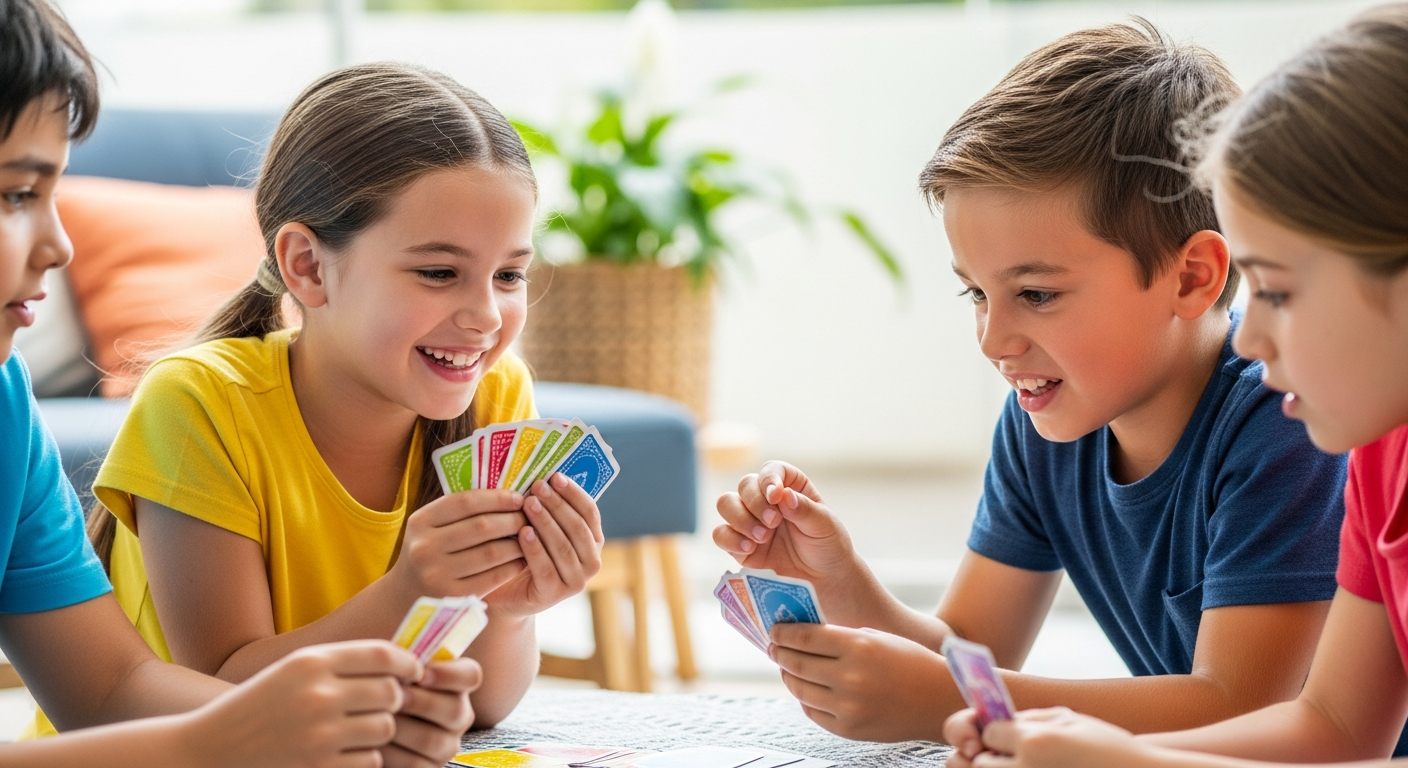
Table of Contents
- Introduction
- The Unbeatable Value of Card Games for Child Development
- Timeless Classics: Fun Card Games Every Kid Should Play
- Beyond the Basics: Expanding Your Card Game Repertoire
- Enhancing Learning with Speech Blubs: Beyond the Card Table
- Choosing the Right Card Game for Your Child
- Making Card Games Even More Engaging
- Unlock Full Potential with Speech Blubs: Our Value and Pricing
- Conclusion
- FAQ
Ever noticed how a simple deck of cards can magically transform a quiet afternoon into a chorus of giggles and excited shouts? In a world increasingly dominated by screens, the humble card game offers a powerful, screen-free antidote – a way to engage children's minds, foster vital developmental skills, and create truly joyful family moments. It’s more than just passing the time; it’s an opportunity for "smart screen time" that sparks conversation, hones cognitive abilities, and strengthens family bonds.
We believe that every child deserves to find their voice, not just through words, but through confident interaction and joyful play. That's why we're passionate about uncovering engaging activities that support holistic development. This comprehensive guide will explore a vibrant array of fun card games for kids, from timeless classics to exciting new discoveries, all designed to nurture essential skills like communication, critical thinking, and social interaction. We’ll delve into how these games can naturally enhance vocabulary, math concepts, and even emotional regulation, providing practical advice on selecting the perfect games for various ages and developmental stages. Get ready to shuffle up, deal some cards, and discover how playful learning can truly empower your child to speak their minds and hearts!

Introduction
Picture this: Rain is drumming against the window, boredom is setting in, and a sigh escapes your child’s lips, "There's nothing to do!" Before you reach for a tablet or turn on the TV, consider a simple, powerful alternative: a deck of cards. For generations, these unassuming rectangles of pasteboard have been the cornerstone of family fun, transforming dull moments into opportunities for laughter, learning, and connection. They are a timeless tool for "smart screen time," offering engagement that builds minds and relationships, a core principle we champion at Speech Blubs.
At Speech Blubs, our mission is to empower children to find their voice and express themselves confidently. Our founders, who personally experienced speech challenges in childhood, created the tool they wished they had—a joyful, effective solution for the 1 in 4 children who need speech support. We understand the profound impact that engaging, interactive play has on development, and card games perfectly align with our philosophy of blending scientific principles with play. This blog post isn't just a list of games; it's a guide to harnessing the power of play to boost your child's cognitive, social, and communicative development. We'll explore a wide variety of fun card games for kids, highlighting how each game naturally nurtures skills ranging from basic counting and turn-taking to complex strategy and expressive language. Get ready to deal in, discover new favorites, and create lasting memories with your little ones!
The Unbeatable Value of Card Games for Child Development
Before we dive into specific games, let’s talk about why card games are such a fantastic resource for children. Beyond mere entertainment, they are miniature classrooms disguised as fun. They provide a unique blend of benefits that support overall development, echoing our commitment at Speech Blubs to provide enriching experiences that help children grow.
Fostering Communication and Language Skills
Every card game, from the simplest matching game to a strategic rummy variant, is a goldmine for language development. Children learn new vocabulary, practice asking and answering questions, follow instructions, and articulate their thoughts.

- Turn-Taking and Conversation: Games naturally enforce turn-taking, a foundational skill for conversation. Children learn to wait, listen, and then speak when it’s their turn. They practice phrases like "Do you have any sevens?" or "I'll take one from the pile."
- Vocabulary Expansion: Whether it's the names of suits, ranks, or game-specific terms like "meld" or "discard," new words are constantly introduced and reinforced.
- Descriptive Language: Encouraging children to describe their moves, explain their strategy, or even talk about the cards they have (without revealing too much!) boosts their descriptive language skills.
- Emotional Expression: Winning, losing, bluffing – these all involve expressing emotions appropriately. Children learn to voice their excitement, frustration, or even their playful deceit in a controlled, safe environment.
For parents who see their child struggling with these communication basics, remember that even seemingly simple interactions during card games contribute significantly. If you're wondering if your child could benefit from more focused speech support, take our quick 3-minute preliminary screener. It offers a simple assessment and a personalized next-steps plan, often leading to a free 7-day trial of our app.
Sharpening Cognitive Abilities
Card games are workouts for the brain, engaging multiple cognitive functions simultaneously.
- Memory and Concentration: Games like Concentration or Memory directly target these skills, but even in complex games, players need to remember what cards have been played, what their opponents might have, and their own strategy.
- Problem-Solving and Strategy: Deciding which card to play, whom to ask, or how to form a "meld" all require strategic thinking and problem-solving. Children learn to anticipate moves and adapt their plans.
- Mathematical Concepts: Counting cards, recognizing numbers, understanding sequences, and even basic addition and subtraction are woven into many games.
- Logical Reasoning: Deductive reasoning comes into play when trying to figure out what cards an opponent might hold based on their actions.
Developing Social-Emotional Intelligence
Beyond the cards themselves, the interaction around the table teaches invaluable social lessons.
- Sportsmanship: Learning to win graciously and lose with dignity is a crucial life skill. Card games provide a safe space to practice this.
- Patience and Self-Regulation: Waiting for your turn, especially when you're eager to play a particular card, builds patience and impulse control.
- Teamwork and Cooperation: Games like Kemps emphasize partnering and working together towards a common goal.
- Empathy: Understanding that others also want to win and celebrating their successes (or commiserating their losses) fosters empathy.
At Speech Blubs, we believe in creating tools that support these holistic aspects of a child's growth. Our unique "video modeling" methodology, where children learn by watching and imitating their peers, taps into the natural human inclination to learn through social interaction. This approach, backed by scientific principles and recognized with a high MARS scale rating, ensures that learning is engaging and effective. You can learn more about our research and methodology here.
Timeless Classics: Fun Card Games Every Kid Should Play
Let's start with the tried-and-true games that have graced kitchen tables for generations. These classics are easy to learn and offer fantastic foundational learning.
Go Fish! (Ages 4+)
- Players: 2-6
- Skills: Number recognition, turn-taking, asking and answering questions, memory.
- How to Play: The dealer gives 5-7 cards to each player (more for fewer players). The rest form the "fish pond." Players take turns asking another player if they "have any [number/rank]s." If the player has them, they must hand them over. If not, they say "Go Fish!", and the asker draws a card from the pond. The goal is to collect "books" of four matching cards. The player with the most books wins.
- Why it's great: "Do you have any...?" and "Go Fish!" become staples of early communication, encouraging clear articulation and listening skills. For a child who might be hesitant to speak, these simple, repetitive phrases provide a comfortable starting point.
Crazy Eights (Ages 5+)
- Players: 2-4
- Skills: Matching (number/suit), strategic thinking, visual discrimination, sequencing.
- How to Play: Each player is dealt 5-7 cards. The rest of the deck is the draw pile, with one card turned face-up to start the discard pile. Players take turns playing a card that matches the rank or suit of the top card on the discard pile. Eights are wild and can be played on any card, allowing the player to choose the next suit. The first player to get rid of all their cards wins.
- Why it's great: This game introduces basic strategy and adaptability. When a child plays an Eight, they get to make a choice and verbally declare the new suit, exercising their decision-making and expressive language.
War (Ages 6+)
- Players: 2
- Skills: Number comparison, patience, understanding hierarchy, quick recognition.
- How to Play: Deal the entire deck evenly between two players, face down. Players simultaneously flip over their top card. The player with the higher card takes both. If the cards are of the same rank, it's "War!" Each player places three cards face down, then one face up. The player with the higher face-up card wins all the cards from that round. The goal is to collect all the cards.
- Why it's great: Simple to learn, War is excellent for reinforcing number values and the concept of "greater than/less than." The suspense of a "War!" situation helps children practice managing excitement and disappointment.
Old Maid (Ages 4+)
- Players: 3+
- Skills: Matching pairs, deduction, social interaction, dealing with winning/losing.
- How to Play: Remove one Queen from a standard deck. Deal all cards. Players secretly make pairs and lay them down. The player to the left of the dealer offers their hand face down to the next player, who draws one card. If it forms a pair, they lay it down. Play continues. The player left with the single "Old Maid" card loses.
- Why it's great: Teaches matching and the concept of "odd one out." It's a gentle introduction to social strategy (trying not to be left with the Old Maid) and handling the "loss" of being the Old Maid playfully.
Concentration / Memory (Ages 3+)
- Players: 2+
- Skills: Memory recall, visual recognition, turn-taking.
- How to Play: Lay out a set of pairs (e.g., all 13 ranks, 26 cards total, or fewer for younger children) face down in a grid. Players take turns flipping over two cards. If they match, the player keeps them and takes another turn. If not, they turn them back over, trying to remember their location. The player with the most pairs wins.
- Why it's great: Directly targets memory and attention. Encouraging children to verbalize what they see ("I see a Queen of Hearts, and a 5 of Spades...") helps connect visual information with spoken language.
Beyond the Basics: Expanding Your Card Game Repertoire
Once your child has mastered the classics, it's time to introduce more complex and strategic games that further challenge their growing minds.
Rummy (Ages 7+)
- Players: 2-6
- Skills: Pattern recognition, strategic planning, arithmetic, decision-making.
- How to Play: Players are dealt a hand (e.g., 10 cards for 2 players). The goal is to form "melds" (sets of three or four of a kind, or runs of three or more cards in sequence of the same suit). Players draw a card, then discard a card. They can lay down melds and add to existing melds. The first to "go out" (empty their hand) wins the round.
- Why it's great: Rummy involves more sophisticated planning and calculation. Children learn to hold onto cards that might form future melds, introducing the concept of delayed gratification and multi-step strategy.
Snap (Ages 6+)
- Players: 2+
- Skills: Quick reflexes, visual recognition, speed, pattern matching.
- How to Play: Deal all cards face down. Players take turns flipping their top card into a central pile. When two consecutive cards are identical in rank, the first player to shout "Snap!" takes both piles. The goal is to collect all the cards.
- Why it's great: A fast-paced game that boosts reaction time and pattern recognition. It's a great way to let off some energy while still engaging the brain.
I Doubt It (Ages 6+) / Baloney (BS)
- Players: 3-12
- Skills: Bluffing, deduction, reading social cues, memory of cards played.
- How to Play: Deal all cards. The player to the left of the dealer starts by placing 1-4 aces face down, declaring "one ace," "two aces," etc. The next player must play twos, then threes, and so on. Players don't have to play the actual card they declare – they can bluff! If someone suspects a bluff, they shout "I doubt it!" or "Baloney!" If the player was bluffing, they pick up the entire discard pile. If they weren't, the accuser picks it up. The goal is to be the first to get rid of all cards.
- Why it's great: This game introduces the concept of social strategy and reading subtle cues. It’s a fun way for kids to experiment with creative storytelling (even if it's a "lie" in the game) and to understand that sometimes what people say isn't always what's true, in a playful context.
Spoons (Ages 7+)
- Players: 3-13 (needs one fewer spoon than players)
- Skills: Quick reflexes, visual matching, attention, social observation.
- How to Play: Place spoons in the center of the table (one fewer than players). Each player receives four cards and tries to get four of a kind. The dealer draws a card from the deck, discards one, and passes it to the next player. This continues quickly around the table. As soon as a player gets four of a kind, they discreetly grab a spoon. Once one spoon is taken, all other players rush to grab a spoon. The player left without a spoon is out.
- Why it's great: A high-energy game that combines matching with quick reaction time. It encourages peripheral awareness and paying attention to others' actions, not just your own hand.
Enhancing Learning with Speech Blubs: Beyond the Card Table
While card games are incredible, we know that language and communication development is a multifaceted journey. At Speech Blubs, we offer a powerful, interactive tool that complements the learning gained from games, providing even more opportunities for growth.
- Interactive Video Modeling: Our app uses a unique video modeling approach, where children watch and imitate real peers speaking. This creates an engaging, motivating, and highly effective learning environment that taps into mirror neuron systems for natural speech acquisition. It’s a screen-free alternative to passive viewing, making screen time "smart screen time."
- Engaging Activities: Just like fun card games for kids, Speech Blubs provides a diverse range of activities, from learning new words in our "Animal Kingdom" section to practicing sounds and stories. For a child whose late talker loves animals, for example, the "Animal Kingdom" section offers a fun, motivating way to practice 'moo' and 'baa' sounds, or more complex animal names, reinforcing the expressive vocabulary they might use in a game of Go Fish!
- Building Confidence: Our app is designed to be joyful and encouraging, helping children build confidence in their communication abilities. This confidence translates directly to their willingness to participate more actively in games and conversations.
- Family Connection: We believe in fostering family connection. The app is designed for co-play, encouraging parents to participate alongside their children, much like sitting around a table for a card game. This shared experience creates powerful learning moments.
Ready to see the difference Speech Blubs can make? Download Speech Blubs on the Apple App Store or Google Play Store to begin your 7-day free trial.
Choosing the Right Card Game for Your Child
Selecting the best game depends on your child's age, developmental stage, and interests.
For Toddlers and Preschoolers (Ages 3-5)
Focus on games with simple rules, high visual appeal, and opportunities for basic matching and counting.
- Recommended Games: Concentration/Memory, Go Fish!, Old Maid (with fewer cards).
- Tips: Simplify rules further if needed. Emphasize turn-taking and celebrating small successes. Use cards with clear, large numbers or pictures.
For Early Elementary (Ages 6-8)
Introduce games that build on basic skills and incorporate simple strategy, number comparison, and more involved communication.
- Recommended Games: Crazy Eights, War, Snap, I Doubt It.
- Tips: Encourage them to explain their moves. Discuss simple strategies like "Why did you play that card?" This is a great age to build those crucial foundational skills that Speech Blubs also focuses on. We provide an immediate, effective, and joyful solution for children, blending scientific principles with play. Check out our homepage for more information.
For Older Elementary and Tweens (Ages 9-12+)
Challenge them with games that require more complex strategy, mathematical reasoning, and social deduction.
- Recommended Games: Rummy, Spoons, Golf Card Game (mentioned in research materials).
- Tips: Encourage deeper strategic thinking and problem-solving. These games are fantastic for practicing patience and sportsmanship in a competitive environment.
Remember, the goal isn't just to win, but to enjoy the process, foster a love for communication, build confidence, and create joyful family learning moments.
Making Card Games Even More Engaging
- Theme Nights: Dedicate a "Card Game Night" with snacks and fun background music.
- Tournament Style: For older kids, create a mini-tournament with a small, fun prize for the winner.
- Personalize the Rules: Feel free to adapt rules slightly to fit your family's dynamic or your child's specific learning needs.
- Be a Patient Guide: Especially when introducing new games, be patient. Model good sportsmanship and clear communication.
- Connect to Real-Life: Point out how the skills they use in card games (counting, planning, communication) are useful in other areas of life.
We often hear from parents about the breakthroughs their children achieve with our app. For example, a parent whose child used to struggle with expressing frustration during losses in games found that the confidence built through Speech Blubs’ positive reinforcement helped them navigate challenging game moments with greater calm and improved verbal expression. See what other parents are saying about their child's success with Speech Blubs by visiting our testimonials page.
Unlock Full Potential with Speech Blubs: Our Value and Pricing
We are dedicated to providing the tools you need to empower your child's communication journey. Speech Blubs is more than just an app; it's a comprehensive, interactive experience designed to make learning speech and language fun and effective. Our commitment to empowering children to "speak their minds and hearts" is reflected in every feature.
We offer two main subscription plans, giving you flexibility while ensuring you get the best value:
- Monthly Plan: For $14.99 per month, you get access to all core features of Speech Blubs. It's a great way to try out the app with a shorter commitment.
- Yearly Plan: At just $59.99 per year, this plan breaks down to an incredible value of only $4.99 per month. This is by far our best value, allowing you to save 66% compared to the monthly subscription.
The Yearly Plan isn't just more affordable; it's packed with exclusive, high-value features that supercharge your child's learning experience:
- 7-Day Free Trial: Only with the Yearly Plan do you get a full 7-day free trial to explore all the amazing features and see the difference Speech Blubs can make.
- Extra Reading Blubs App: Unlock the Reading Blubs app, a fantastic addition to help your child develop crucial early literacy skills, complementing their speech and language development.
- Early Access to New Updates: Be among the first to experience our latest features and content.
- 24-Hour Support Response Time: Get priority support for any questions or assistance you might need.
The Monthly plan does not include these incredible benefits. To get the most out of your Speech Blubs experience, with the free trial and the full suite of features, we highly recommend choosing the Yearly plan. It's the smart choice for maximizing your child's potential and making every moment of "smart screen time" count.
Conclusion
From the simple joy of Go Fish! to the strategic depths of Rummy, fun card games for kids offer an unparalleled opportunity for learning and connection. They are not merely distractions but powerful tools that foster communication, sharpen cognitive skills, and build essential social-emotional intelligence. Every shuffle, every deal, and every laugh shared around the card table contributes to a child’s holistic development, helping them grow into confident, articulate individuals.
At Speech Blubs, we deeply understand this journey. Our app was born from the personal experiences of our founders, who created the immediate, effective, and joyful solution they wished they had for speech support. By integrating engaging activities, our unique video modeling methodology, and a commitment to "smart screen time," we empower children to truly speak their minds and hearts.
So, gather your family, shuffle a deck, and dive into the wonderful world of card games. And when you're ready to amplify your child's communication journey even further, remember that Speech Blubs is here to help.
Ready to embark on this enriching adventure? Start your child's path to confident communication today! Create your account and begin your 7-day free trial by choosing our Yearly plan to unlock all the premium features, including the Reading Blubs app and priority support. Download Speech Blubs from the Apple App Store or Google Play Store and start creating joyful learning moments together.
FAQ
Q1: What are the best card games for a 3-year-old?
A1: For a 3-year-old, focus on simple games that promote matching, color recognition, and basic counting. Great choices include Concentration/Memory (using fewer cards), Go Fish! (with parental guidance on asking questions), and Old Maid. These games help with early number and shape identification, as well as crucial turn-taking skills.
Q2: How do card games help with a child's speech development?
A2: Card games significantly boost speech development by encouraging verbal interaction, vocabulary expansion, and turn-taking. Children practice asking and answering questions ("Do you have a king?"), following instructions, describing their cards, and expressing emotions in a structured setting. This active communication is vital for building confidence and fluency. Our app, Speech Blubs, further enhances these skills through interactive video modeling, complementing the social learning of card games.
Q3: What skills do card games teach beyond communication?
A3: Beyond communication, card games are fantastic for developing a wide range of skills. They foster memory and concentration (Concentration/Memory), strategic thinking and problem-solving (Crazy Eights, Rummy), mathematical concepts (counting, number comparison in War), and social-emotional skills like sportsmanship, patience, and adapting to wins and losses. They also provide valuable screen-free family bonding time.
Q4: Is there a way to assess if my child might need more speech support?
A4: Yes! If you're wondering whether your child could benefit from more targeted speech support, we offer a quick 3-minute preliminary screener. This easy-to-use tool asks 9 simple questions and provides an assessment along with a personalized next-steps plan. It's a great starting point for understanding your child's communication development and can lead to a free 7-day trial of the Speech Blubs app.
About the author