
Fun Easy Outdoor Games for Kids: Boost Language & Laughter
 By Speech Blubs Team•Jan 19, 2026•17 min.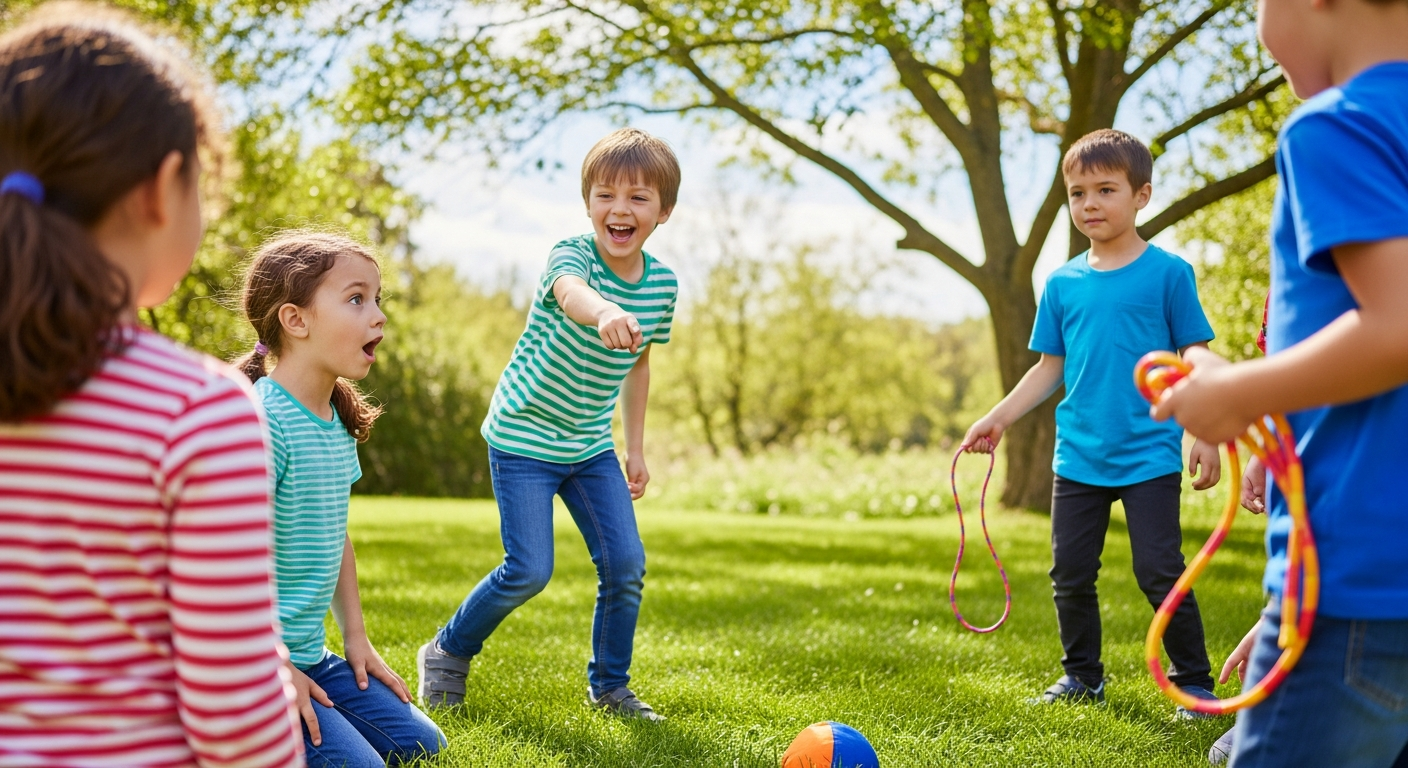
Table of Contents
- The Unbeatable Benefits of Outdoor Play for Child Development
- Fun Easy Outdoor Games for Kids (No Prep Needed!)
- Conclusion
- Frequently Asked Questions
Does the sound of "I'm bored!" echo through your home more often than you'd like? In an age brimming with screens and scheduled activities, sometimes the simplest, most profound adventures lie just beyond the back door. There's a magic to outdoor play – a freedom that ignites not just physical energy, but also a child's imagination, creativity, and, critically, their communication skills. At Speech Blubs, we passionately believe in empowering children to speak their minds and hearts, and we know that the natural playground of the outdoors is an incredible partner in that journey.
This post isn't about elaborate setups or expensive equipment. It’s a treasure trove of fun, easy outdoor games for kids that require little to no preparation, promising endless laughter and invaluable developmental benefits. We'll explore how these classic and creative games naturally foster the very foundational skills that children need for robust speech and language development, from imitation and turn-taking to vocabulary expansion and social communication. Our mission at Speech Blubs was born from our founders' personal experiences with speech challenges, leading them to create the joyful, scientifically-backed tool they wished they had. We’re committed to providing immediate, effective solutions for children needing speech support, blending scientific principles with play. And what better way to complement "smart screen time" with Speech Blubs than with dynamic, real-world interactions?

So, step outside with us! Let’s rediscover the joy of play, reduce frustration, build confidence, and create unforgettable family moments, all while nurturing your child's blossoming communication skills.
The Unbeatable Benefits of Outdoor Play for Child Development
Before we dive into the games, let's appreciate why simply being outside is a game-changer for kids, especially when it comes to their growing minds and voices. Outdoor play is a multisensory experience, activating different parts of a child's brain and body in ways that indoor environments often can't.
Holistic Development Through Fresh Air
- Gross Motor Skills: Running, jumping, climbing, and throwing are all vital for physical coordination, balance, and body awareness. This physical mastery can translate into better control over the muscles used for speech.
- Sensory Exploration: The smells of damp earth, the feel of grass underfoot, the sound of birdsong, the sight of a butterfly – these sensory inputs enrich a child's understanding of the world, providing context for new words and concepts.
- Problem-Solving & Creativity: Unstructured outdoor play encourages children to think on their feet, create their own rules, and imagine new scenarios. A stick isn't just a stick; it's a magic wand, a sword, or a fishing rod. This imaginative play is a cornerstone of narrative development.
- Social & Emotional Growth: Playing with others outdoors involves negotiation, sharing, conflict resolution, and empathy. These are crucial social cues and interactions that underpin effective communication.
Speech and Language Supercharge
For children learning to communicate, every outdoor interaction is a language lesson.
- Vocabulary Expansion: "Look at the fuzzy caterpillar!" "The wind is blowing the leaves!" "Can you find a smooth rock?" The natural world provides an endless array of objects, actions, and descriptors to name and discuss.
- Following Instructions: Games inherently involve rules and directions, strengthening a child's receptive language skills. "Run to the big tree," "Jump over the log," "Wait for your turn."
- Expressive Language & Narration: As children play, they often narrate their actions, ask questions, and tell stories. "I'm a pirate looking for treasure!" "He found me!" This internal and external monologue builds complex sentence structures and narrative skills.
- Imitation & Turn-Taking: Many games rely on watching others and then doing the same, mirroring the "video modeling" approach we use in Speech Blubs where children learn by watching and imitating their peers. Taking turns is fundamental for conversational flow.
- Auditory Processing: The varied sounds of the outdoors help children filter and focus on specific sounds, an important skill for distinguishing speech sounds.
At Speech Blubs, we design our app to provide a screen-free alternative to passive viewing, making screen time "smart screen time." Our unique video modeling methodology, where children learn by watching and imitating their peers, is scientifically backed and highly engaging. These outdoor games serve as a perfect real-world extension, providing authentic contexts for practicing and generalizing the skills learned in the app. For a parent whose 3-year-old "late talker" loves animals, our "Animal Kingdom" section offers a fun, motivating way to practice "moo" and "baa" sounds. Then, taking that outside on a nature walk to find animals and make their sounds solidifies that learning in a tangible, joyful way.

Ready to incorporate more language-rich play into your child's day? Take our quick 3-minute preliminary screener to get a simple assessment and a free 7-day trial, and see how Speech Blubs can support your family's communication journey.
Fun Easy Outdoor Games for Kids (No Prep Needed!)
Here are some of our favorite easy outdoor games that will get kids moving, thinking, and talking!
1. Classic Tag & Chase Games: Get Those Bodies (and Words) Moving!
These timeless favorites are fantastic for burning energy and building fundamental communication skills like turn-taking, following directions, and expressive language.
Tag (or "It," "Tig")
- How to Play: One person is "it" and chases the others, trying to tag them. The person tagged becomes the new "it." Simple, effective, and endlessly fun.
- Speech & Language Boost:
- Vocabulary: "Run," "chase," "fast," "slow," "caught," "safe."
- Turn-Taking: Clearly defined roles ("Who's it now?").
- Expressive Language: Kids will naturally shout "You're it!" or "You can't catch me!"
- Variations for Language: Try "Freeze Tag" (tagged players freeze until unfrozen by another player), which adds "freeze" and "unfreeze" to their vocabulary, or "Sock Tag" (each player tucks two socks into their waistband; everyone tries to grab socks while avoiding getting theirs grabbed). For a child working on action verbs, playing "Freeze Tag" can reinforce "run," "stop," and "move" in a physical context.
Red Light, Green Light
- How to Play: One person is the "stop light" at one end of the yard, facing away from the other players ("traffic"). When they call "Green Light!" and turn their back, the traffic players race forward. When they call "Red Light!" and turn around, all players must freeze. Anyone caught moving goes back to the start. The first to tag the "stop light" becomes the next "stop light."
- Speech & Language Boost:
- Receptive Language: Crucial for understanding "red light" (stop) and "green light" (go) commands.
- Impulse Control: Learning to wait and listen.
- Counting: The "stop light" can count to make it harder.
Duck, Duck, Goose
- How to Play: Players sit in a circle. One player walks around the outside, gently tapping heads and saying "Duck, duck, duck..." until they choose someone to tap and say "GOOSE!" The "Goose" then chases the first player around the circle, trying to tag them before they sit back in the "Goose's" spot.
- Speech & Language Boost:
- Repetition: The rhythmic "duck, duck, goose" is excellent for early phonological awareness and auditory memory.
- Naming: Children practice saying the names of others.
- Action Verbs: "Chase," "run," "sit."
- This is a fantastic game for little ones aged 5 and under, where the clear, repetitive language helps build confidence in sound production and simple sentences.
2. Ball & Movement Games: Developing Coordination and Concepts
These games often involve an object, adding an extra layer of coordination and opportunity for descriptive language and spatial concepts.
Spud
- How to Play: One player throws a ball high in the air, calling out another player's name (or number). That player must catch the ball while everyone else scatters. Once the ball is caught, the catcher yells "SPUD!" and everyone freezes. The catcher then takes four steps towards the nearest player, spelling out S-P-U-D, and tries to hit them with the ball (below the waist). If hit, that player gets an "S." If missed, the thrower gets an "S." The game continues until someone spells S-P-U-D and is out.
- Speech & Language Boost:
- Naming & Calling: Practice calling out names clearly.
- Counting & Spelling: Reinforces number and letter recognition.
- Spatial Concepts: "Closest," "farthest," "above," "below."
Hot Potato
- How to Play: Players sit in a circle and quickly pass a "hot potato" (any soft object) while music plays. When the music stops, whoever is holding the "potato" is out. The game continues until one player remains.
- Speech & Language Boost:
- Quick Responses: Encourages fast processing of auditory cues.
- Vocabulary: "Hot," "pass," "catch," "out."
- Rhythm & Music: Enhances auditory skills and appreciation for tempo.
- This is a low-energy game, perfect for winding down, but still rich in quick communication cues.
Hopscotch
- How to Play: Draw a hopscotch grid with chalk on a hard surface. Players toss a marker (stone, beanbag) into a square, then hop through the grid, skipping the marked square, picking up the marker on the way back. Rules vary, but typically involve hopping on one foot for single squares and two feet for double squares.
- Speech & Language Boost:
- Counting & Number Recognition: Players often call out numbers as they hop.
- Sequencing: Following the order of numbers and steps.
- Balance & Coordination: Important for overall motor planning, which impacts speech motor skills.
- For younger children, simply hopping and reciting the numbers they land on is great practice.
Horse (or P-I-G for shorter games)
- How to Play: With a basketball and hoop, players take turns shooting from different spots. If a player makes a shot, the next player must replicate it exactly. If they miss, they get a letter (H, then O, R, S, E). The first player to spell H-O-R-S-E is out.
- Speech & Language Boost:
- Sequential Memory: Remembering the previous shot's location and style.
- Descriptive Language: Explaining how to make a shot ("a lay-up from the left," "a bounce shot").
- Turn-Taking: Clearly defined turns and actions.
3. Creative & Imaginative Adventures: Building Narrative and Description
These activities naturally spark storytelling, descriptive language, and problem-solving skills, all critical for advanced communication.
Nature Scavenger Hunt
- How to Play: Give kids a list of items to find in nature (e.g., "a smooth rock," "a purple leaf," "something fuzzy," "a bird feather"). You can make it simpler for toddlers ("find something green") or more complex for older kids ("find something that starts with 'S'").
- Speech & Language Boost:
- Vocabulary: Naming objects, colors, textures, sizes, and locations.
- Categorization: Grouping similar items.
- Descriptive Language: Encouraging them to describe what they found and why it matches the clue. "I found a rough, gray rock."
- This is a perfect activity for expanding vocabulary and encouraging detailed descriptions, bridging the gap between simply identifying objects and truly describing them.
Mud Pies & Fairy Houses
- How to Play: Arm your kids with old baking tins, spoons, sticks, and natural elements (mud, leaves, pebbles, flowers). Let them create culinary masterpieces or tiny homes for magical creatures.
- Speech & Language Boost:
- Imaginative Play & Narrative: Encourages role-playing and storytelling. "This is a mud cake for the queen!" "The fairy lives in this tiny house with a leaf roof."
- Action Verbs: "Mix," "stir," "pour," "build," "decorate."
- Descriptive Language: "Squishy mud," "pretty flowers," "tiny pebbles."
- This is an ideal way to foster narrative skills, allowing children to create their own stories and characters.
Outdoor Painting (with leaves, squirt guns, or just themselves!)
- How to Play: Collect leaves to use as paintbrushes, or mix washable paint with water and put it in squirt guns to spray onto a large paper or old sheet. For ultimate mess-free-in-the-house fun, let kids paint themselves with washable tempera paint and then rinse off with the hose!
- Speech & Language Boost:
- Sensory Language: "Wet," "drippy," "colorful," "smooth," "rough."
- Color Recognition: Naming colors as they paint.
- Action Verbs: "Squirt," "mix," "spray," "paint," "wash."
- For parents with a child exploring cause and effect and action words, painting with a squirt gun offers a dynamic way to practice "spray," "mix," and "color" in an exciting context.
Obstacle Course
- How to Play: Use whatever you have: jump ropes, pool noodles, pillows, buckets, chairs, or simply natural elements like logs and rocks. Challenge kids to crawl under, jump over, step around, or balance on these obstacles.
- Speech & Language Boost:
- Prepositions: "Under," "over," "through," "around," "between."
- Sequencing: Explaining the steps of the course. "First, I crawl under the rope, then I jump over the log."
- Action Verbs: "Crawl," "jump," "step," "balance," "climb."
- This game naturally promotes both receptive and expressive language through following and giving multi-step instructions and describing movements.
4. Cooperative Communication Challenges: Building Social Skills
These games are excellent for fostering teamwork, negotiation, and understanding social cues.
Simon Says
- How to Play: One person is "Simon" and gives commands. Players only follow commands preceded by "Simon Says." If "Simon" gives a command without "Simon Says," and a player follows it, they're out. The last player remaining wins.
- Speech & Language Boost:
- Auditory Attention & Discrimination: Crucial for listening carefully to instructions.
- Following Multi-Step Commands: Players have to process the instruction and the "Simon Says" cue.
- Action Verbs: "Jump," "clap," "stomp," "touch your nose."
Musical Statues (or Freeze Dance)
- How to Play: Play music and everyone dances. When the music stops, everyone freezes like a statue. Anyone still moving is out.
- Speech & Language Boost:
- Auditory Processing: Responding to the start and stop of music.
- Vocabulary: "Dance," "freeze," "stop," "move."
- Body Awareness: Understanding how to control one's body.
Kick the Can
- How to Play: A combination of tag and hide-and-seek. One person is "it" and guards a can. Everyone else hides. "It" tries to find others and calls their name, then races back to the can. If "it" touches the can first, the found person goes to "jail." If a hidden player kicks the can before being tagged, all "jailed" players are freed.
- Speech & Language Boost:
- Spatial Awareness: Using prepositions like "behind," "under," "near."
- Strategic Communication: Kids will whisper and strategize.
- Naming: Calling out names.
- This is a fantastic game for competitive older kids, fostering strategic communication and quick thinking.
Tug of War
- How to Play: Divide into two teams, with a long, sturdy rope. Mark a center line on the ground. Each team pulls, trying to drag the opposing team over the center line.
- Speech & Language Boost:
- Teamwork & Negotiation: Encourages kids to work together and communicate strategies.
- Action Verbs: "Pull," "push," "strong," "together."
- Encouragement: Kids will naturally cheer for their team, boosting expressive language.
Maximize Your Child's Communication Journey with Speech Blubs
While outdoor games are incredible for fostering natural language development, sometimes children need a little extra, targeted support. That's where Speech Blubs comes in, providing a powerful, research-backed supplement to your child's overall development plan. Our app uses a unique "video modeling" approach where children learn by watching and imitating their peers, making learning engaging and effective. We empower children to "speak their minds and hearts," a mission born from our founders' personal experiences with speech challenges. We are committed to providing an immediate, effective, and joyful solution for the 1 in 4 children who need speech support.
We encourage you to explore the benefits of Speech Blubs today. Our plans are designed to fit your family's needs:
- Monthly Plan: $14.99 per month.
- Yearly Plan: Just $59.99 per year, which breaks down to an incredible value of only $4.99/month! That's a 66% savings compared to the monthly plan.
Choosing the Yearly plan isn't just about saving money; it unlocks a full suite of features designed for comprehensive development:
- 7-Day Free Trial: Try out all the amazing features before committing. (Not included in the Monthly plan).
- Reading Blubs App: Gain access to our additional Reading Blubs app, fostering early literacy skills. (Not included in the Monthly plan).
- Early Access & Priority Support: Enjoy early access to new updates and a lightning-fast 24-hour support response time. (Not included in the Monthly plan).
We believe in providing the best value and the most comprehensive support for your child's communication journey. To truly experience the full potential of Speech Blubs, we highly recommend our Yearly plan. It offers the full suite of features and the opportunity for consistent, long-term progress, creating joyful family learning moments.
Ready to see why Speech Blubs is trusted by parents and speech-language pathologists worldwide? Our method is backed by science, placing us in the top tier of speech apps globally. Download Speech Blubs on the Apple App Store or Google Play to begin, or create your account and begin your 7-day free trial today. See what other parents are saying about their child's success with Speech Blubs!
Conclusion
The great outdoors offers an unparalleled playground for our children's physical, cognitive, social, and linguistic growth. These fun, easy outdoor games for kids are more than just ways to pass the time; they are vital opportunities for developing strong communication foundations, boosting confidence, reducing frustration, and creating joyful family memories. By encouraging imitation, turn-taking, descriptive language, and imaginative play, these activities naturally complement the structured learning found in tools like Speech Blubs.
Remember, the goal isn't guaranteed public speeches in a month, but rather fostering a love for communication, building confidence one word and one game at a time, and making every interaction a positive learning experience. Whether you're chasing each other across the lawn or building imaginary worlds with mud and sticks, you're nurturing a complete child.
Embrace the sunshine, the fresh air, and the boundless energy of your children. And for targeted support and smart screen time that blends scientific principles with play, remember Speech Blubs is here to help your child find their voice.
Ready to get started? Download Speech Blubs on the App Store or Google Play and start your 7-day free trial. Remember to choose the Yearly plan for the best value and access to all our incredible features, including the Reading Blubs app and priority support! Visit our homepage to learn more.
Frequently Asked Questions
Q1: How does outdoor play specifically help with speech development?
A1: Outdoor play boosts speech development by providing rich sensory experiences that expand vocabulary (e.g., describing nature), offering natural contexts for following and giving instructions (e.g., game rules), encouraging imitation and turn-taking, and sparking imaginative play that builds narrative skills. The physical movement also supports overall motor planning, which is linked to speech motor control.
Q2: What if my child is shy or hesitant to play group games?
A2: That's perfectly normal! Start with one-on-one activities like a nature scavenger hunt or playing "Simon Says" with just you and your child. Model the language and actions yourself, and don't pressure them. Gradually introduce another child or two, keeping the atmosphere light and fun. Remember, building confidence is key, and Speech Blubs offers a safe, engaging environment for practice.
Q3: How can I make these games more educational for language learning?
A3: To boost language learning, actively engage with your child by asking open-ended questions ("What do you see?" "How does that feel?"), modeling descriptive language ("That's a shiny, rough leaf!"), narrating their actions ("You're running so fast!"), and extending their utterances ("Car! Yes, a red car is driving down the street."). You can also incorporate counting, colors, and prepositions into almost any outdoor activity.
Q4: How does Speech Blubs fit into a day filled with outdoor play?
A4: Speech Blubs is designed to complement, not replace, outdoor play and real-world interactions. Think of it as "smart screen time" that reinforces skills. After an outdoor adventure, your child might be excited to use the app to practice animal sounds they heard or action words they used while playing. Our video modeling helps them consolidate and generalize these concepts, preparing them for more confident communication in all environments. It's a powerful tool for consistency and targeted practice.
About the author