
Fun Flag Football Games for Kids
 By Speech Blubs Team•Jan 19, 2026•19 min.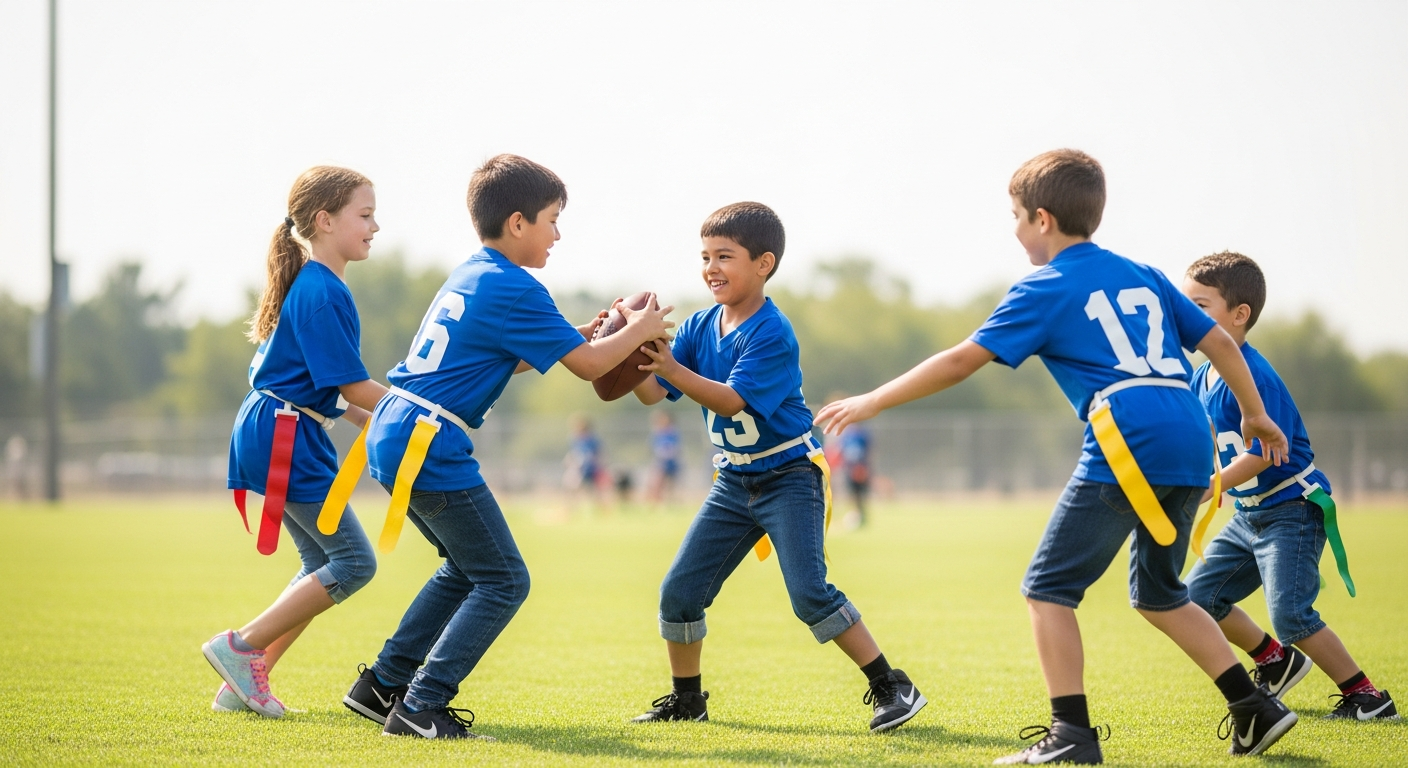
Table of Contents
- The Importance of Play: More Than Just a Game
- Laying the Foundation: Essential Skills for Young Flag Footballers
- Warm-Up Wonders: Getting Started with a Smile
- Skill-Building Superstars: Drills Disguised as Games
- Teamwork & Strategy Boosters: Mini-Games for Big Wins
- Beyond the Field: Nurturing Well-Rounded Kids
- Conclusion
- FAQ
Remember those endless summer days, chasing a ball with friends, feeling the wind in your hair as you laughed and played? For many parents, igniting that same spark of joy and active engagement in their children is a priority. Flag football offers a fantastic avenue for this – a dynamic, inclusive, and non-contact sport that teaches teamwork, strategy, and physical fitness in a thrilling environment. But how do you ensure that practices and playtime are not just about drills, but about genuine, unforgettable fun?
This post dives deep into a treasure trove of engaging and educational flag football games for kids, designed to build fundamental skills while keeping spirits high and energy flowing. We’ll explore everything from dynamic warm-ups to skill-specific challenges and exciting mini-scrimmages, ensuring every child, from the shyest beginner to the budding athlete, finds their moment to shine. Just as we at Speech Blubs believe in empowering children to "speak their minds and hearts" through joyful, play-based learning, we champion the power of fun to unlock potential on the flag football field. Get ready to transform your child's flag football experience into an adventure they’ll love!

The Importance of Play: More Than Just a Game
In the world of youth sports, the word "drill" can sometimes conjure images of repetitive, tedious tasks. While mastering fundamentals is crucial, especially in a sport like flag football where agility, throwing, catching, and flag-pulling are key, the how we teach these skills makes all the difference. For children, play is the most natural form of learning. When an activity is framed as a "game," it taps into their innate curiosity, competitive spirit, and desire for social interaction.
- Enhanced Engagement: Fun games keep children motivated and present. They’re less likely to get bored or disengage, meaning more active participation and more learning time.
- Skill Retention: When children learn through enjoyable experiences, they tend to remember the skills and concepts better. The positive emotional connection reinforces the learning process.
- Holistic Development: Beyond physical skills, engaging games foster social-emotional growth. Kids learn about teamwork, sportsmanship, resilience, and problem-solving in real-time scenarios.
- Building a Love for the Sport: Ultimately, if flag football is fun, kids will want to keep playing. This sustained interest is far more valuable than perfecting a single skill through monotonous repetition.
At Speech Blubs, we understand this principle deeply. Our founders, all of whom experienced speech challenges as children, created a tool they wished they had – a joyful, effective, and play-based solution. We blend scientific principles with the magic of play, offering a one-of-a-kind "smart screen time" experience that engages children and empowers them to communicate confidently. Similarly, these flag football games aim to create an environment where learning is seamless and joy is paramount.
Laying the Foundation: Essential Skills for Young Flag Footballers
Before diving into complex plays, young players need a solid grasp of basic movements and techniques. These form the building blocks for more advanced skills and ensure they can participate confidently and safely. Incorporating these fundamentals into game-like scenarios is key.

Running and Agility
Flag football demands constant movement, quick changes in direction, and bursts of speed. Players need to be able to run effectively both with and without the ball, evading defenders or pursuing an opponent.
- Forward and Backward Running: Basic sprints, but also backward jogging for defensive positioning.
- Lateral Shuffling: Moving side-to-side without crossing feet, crucial for defense and evasive maneuvers.
- Changing Direction: Cutting, pivoting, and accelerating quickly in a new direction.
Throwing and Catching
These are arguably the most iconic skills in football. Developing accuracy and hand-eye coordination for both throwing and receiving is vital.
- Proper Grip and Stance: Learning how to hold the football correctly for a stable throw.
- Arm Motion and Follow-Through: Developing a smooth throwing motion for distance and accuracy.
- Hand Position for Catching: Knowing when to form a "diamond" (fingers up) or "basket" (fingers down) for catches.
- Tracking the Ball: Keeping eyes on the ball from the moment it leaves the thrower's hand until it's secured.
Handoffs
While passing often dominates flag football, handoffs are crucial for specific offensive plays, especially for younger players whose throwing and catching accuracy might still be developing.
- Giving a Handoff: Presenting the ball securely in the receiver's target area.
- Receiving a Handoff: Positioning hands correctly to accept the ball and tuck it away securely.
Flag Pulling
The defining defensive skill in flag football, replacing tackling. Mastering this is essential for stopping offensive plays.
- Pursuit Angles: Learning to cut off the ball carrier's path.
- Targeting the Flags: Focusing on the flags, not the ball or the player's body.
- Quick Reaction: Pulling the flag swiftly and decisively.
Just as Speech Blubs provides a structured yet playful path to master communication fundamentals, breaking down these flag football skills into manageable, fun activities ensures every child builds a strong foundation.
Warm-Up Wonders: Getting Started with a Smile
Warm-ups are essential for preventing injuries and getting bodies ready for action, but they don't have to be boring. Here are some fun warm-up games that get muscles moving and minds engaged.
1. Cone Weave Sprint
Skills: Agility, coordination, speed. How to Play: Set up a line of 5-7 cones in a zigzag pattern, about 3-5 yards apart. Players, one at a time or in small groups, sprint through the cones, weaving in and out. Fun Factor: Turn it into a relay race! Divide players into teams and see which team can get all their members through the weave fastest. Add a "ball-carrying" element where they have to hold a mini-football while weaving.
2. Catch-and-Go Tag
Skills: Agility, hand-eye coordination, quick reaction. How to Play: Designate one or two players as "taggers." The other players spread out within a defined area. The taggers must throw a soft foam or flag football to a player, who must catch it. Once caught, that player becomes the new tagger. If a player drops the ball, they are "frozen" until another player tags them (without the ball) to unfreeze them. Fun Factor: Emphasize soft throws and good catching technique. The goal isn't to hit hard, but to make a catch. This mimics real-game scenarios of catching under pressure.
3. "Coach Says" (Football Edition)
Skills: Listening, body awareness, quick reactions. How to Play: Similar to "Simon Says." The coach calls out football-related actions (e.g., "Coach says run in place!" "Coach says pretend to throw a touchdown!"). Players only perform the action if "Coach Says" precedes it. If they perform an action without "Coach Says," or fail to perform one when instructed, they do a quick "burpee" or "star jump" and rejoin. Fun Factor: Incorporate silly or unexpected actions to keep them giggling. This helps build the group dynamic and gets them warmed up mentally and physically.
Skill-Building Superstars: Drills Disguised as Games
These games target specific flag football skills, making practice feel like play.
Passing & Catching Games
1. Target Practice Pro
Skills: Throwing accuracy, arm strength, hand-eye coordination. How to Play: Set up various targets at different distances – hula hoops on the ground, cones to knock over, or even designated "scoring zones" on a fence or wall. Players take turns throwing the football, trying to hit or land the ball in the targets. Assign different point values for different targets. Fun Factor: Introduce "special throws" like "spiral bonus" or "one-bounce catch" targets. Make it a team competition where teams accumulate points. For a parent whose child struggles with spatial awareness but loves a challenge, setting up visual targets can be incredibly motivating, much like the visual cues and interactive elements in Speech Blubs help children focus on specific sounds and words.
2. Passing Gauntlet (Modified)
Skills: Passing under pressure, accuracy, movement. How to Play: Two lines of players face each other, about 10-15 yards apart. One player from each line starts as a "passer." Other players from each line act as moving targets/receivers, running simple routes across the field between the two passers. The passers must throw the ball accurately to their moving targets without hitting the other passer or their targets. Fun Factor: Introduce a time limit for each passer to complete a certain number of successful passes. If a pass is dropped or intercepted, the passer has to do a silly dance before resuming. This game teaches valuable passing skills while also working on situational awareness.
3. Flag Football "Ultimate"
Skills: Passing, catching, teamwork, strategy, getting open. How to Play: Similar to Ultimate Frisbee but with a football. Two teams (e.g., 3v3 or 4v4) play on a large field with end zones. The player with the ball cannot run, only pivot (like in basketball). They have 10 seconds to pass the ball to a teammate. If the ball is dropped or intercepted, possession changes. A touchdown is scored by catching the ball in the end zone. Defensive players must stay an arm's length from the player with the ball. Fun Factor: This game is incredibly dynamic and encourages creative routes and communication. It's a fantastic way to practice all aspects of passing and catching in a fluid, game-like scenario. It also emphasizes communication, a core life skill that we help foster at Speech Blubs through our engaging programs, supporting children in expressing themselves clearly and confidently.
Agility & Evasion Games
1. Sharks vs. Minnows - Flag Pulling Edition
Skills: Flag pulling, evasive running, quick cuts. How to Play: Designate a playing area. One or two players start as "Sharks" in the middle, wearing flags. The rest are "Minnows" who start at one end zone, also wearing flags. The Minnows try to run from one end zone to the other without having their flags pulled by the Sharks. If a Minnow's flag is pulled, they become a Shark for the next round. The last Minnow standing wins. Fun Factor: This is a classic tag game with a flag football twist. It's high-energy and helps players practice both offensive evasion and defensive flag-pulling techniques. Vary the number of Sharks to adjust difficulty.
2. Speed Demon Dash
Skills: Speed, agility, changing direction quickly. How to Play: Set up a starting line and a finish line about 15-20 yards apart. Players line up at the start. On command, they sprint to the finish. But here's the twist: the coach calls out a direction or action mid-sprint (e.g., "Cut left!", "Spin!", "Crawl!", "Run backward 5 steps!"). Players must react instantly. Fun Factor: The unpredictability keeps players on their toes and mimics the need for quick decisions on the field. Reward creativity and effort, not just speed.
3. Spider Web Sprint
Skills: Agility, quick feet, spatial awareness. How to Play: Use cones or jump ropes to create a "spider web" pattern on the ground (a series of intersecting lines or squares). Players must navigate the web without touching the "web lines" (cones/ropes). Fun Factor: Make it a race or add a challenge: if they touch a line, they have to do 5 jumping jacks before continuing. This helps with footwork and agility, crucial for running backs and receivers alike.
Handoff & Offensive Play Games
1. Handoff Hustle Relay
Skills: Handoff technique, running, teamwork. How to Play: Divide players into two teams. Each team lines up in a single file line. The first player in line takes a football, runs a short distance (e.g., 10-15 yards), and hands it off to the next player in their line who has run up to meet them. The second player then sprints back to the starting point and hands off to the third, and so on. Fun Factor: Emphasize clean handoffs and proper ball security. Make it a relay race to add a competitive element. This also teaches players to create a "big window" with their arms for receiving the ball.
2. Blind Handoff Challenge
Skills: Handoff precision, communication, trust. How to Play: Pair players up. One player (the receiver) closes their eyes or wears a blindfold. The other player (the ball carrier) walks up to them and attempts a handoff. The receiver must rely on verbal cues ("ready," "ball!") and tactile sensation to accept the handoff. After a few tries, switch roles. Fun Factor: This game builds trust and communication, which are vital on the field. It also highlights the importance of a clear, firm handoff. While playful, it subtly reinforces communication skills, much like our video modeling app for Speech Blubs encourages children to use their voices effectively through imitation.
Defensive Dominators: Flag Pulling & Pursuing
1. Flag Tag Frenzy
Skills: Flag pulling, pursuit angles, quick reactions. How to Play: All players wear flags. Designate one or two players as "chasers." The goal of the chasers is to pull as many flags as possible within a time limit. Players whose flags are pulled sit out until the next round or do a quick exercise to rejoin. Fun Factor: It's pure, unadulterated tag, but with a specific objective – flags! This drill is a high-energy way to practice both evading and pulling flags. It's a great warm-up or cool-down game.
2. Swarm Defense Drill
Skills: Team defense, pursuit, containing the ball carrier. How to Play: Designate a single offensive player with the ball (and flags) and 3-4 defensive players. The offensive player tries to run across a designated zone. The defensive players must work together to "swarm" the ball carrier, closing off angles and pulling the flag. Emphasize that all defenders should pursue, like "bees swarming a hive." Fun Factor: This teaches defensive players to work as a unit, communicating and supporting each other. Rotate offensive and defensive roles frequently to keep everyone involved.
Teamwork & Strategy Boosters: Mini-Games for Big Wins
Once individual skills are developing, it's time to integrate them into more complex, team-oriented scenarios.
1. Mini-Scrimmage Blitz
Skills: All flag football skills, teamwork, strategic thinking. How to Play: Set up small-sided games (e.g., 3v3 or 4v4) on a condensed field. Use simplified rules to keep the focus on fluid play. Allow players to practice calling plays, making decisions, and working together. Fun Factor: This is where everything comes together. Coaches can pause play to offer tips or repeat a scenario. Encourage creative play and positive reinforcement. Sometimes, having slightly fewer defenders than offensive players can help build offensive confidence, especially in the passing game.
2. Two-Minute Drill Fun
Skills: Time management, quick plays, teamwork under pressure. How to Play: Split into two teams. One team starts on offense near their own goal line with a limited time (e.g., two minutes) to score a touchdown. If they score, they get points. If time runs out or they turn over the ball, the other team gets a turn. Fun Factor: The pressure of the clock adds an exciting element, mimicking real game situations. This encourages quick decision-making, effective communication, and understanding of offensive strategy.
Beyond the Field: Nurturing Well-Rounded Kids
Flag football offers incredible benefits for physical health, social interaction, and mental agility. Children learn resilience, experience the thrill of victory and the lessons of defeat, and build lasting friendships. This holistic development is something we profoundly believe in at Speech Blubs. Just as making a great catch or pulling a crucial flag builds confidence on the field, being able to communicate effectively builds confidence in all aspects of life.
The Power of Play-Based Learning
At Speech Blubs, our approach mirrors the joy and effectiveness of play we see in flag football. We know that children learn best when they are engaged and having fun. Our unique video modeling methodology, where children learn speech and language by watching and imitating their peers, is rooted in the science of mirror neurons and makes learning incredibly intuitive and enjoyable. It's a powerful supplement to traditional therapy, or a fantastic way to give any child a boost in their communication journey.
For a child who is full of energy and thrives in a physically active environment like flag football, sitting down for "lessons" can feel like a chore. Speech Blubs offers a dynamic, interactive experience that feels like a game. Imagine a child who loves mimicking their teammates' moves on the field; they will naturally gravitate to imitating the friendly faces in our app, transforming speech practice into an exciting adventure. Our mission is to empower children to confidently express themselves, whether that's celebrating a touchdown or clearly sharing their thoughts and feelings. We are committed to providing an immediate, effective, and joyful solution for the 1 in 4 children who need speech support.
A Smart Screen Time Solution for Family Connection
In an age dominated by screens, finding ways to make technology a positive, developmental tool is crucial. Speech Blubs offers a screen-free alternative to passive viewing (like cartoons), transforming screen time into "smart screen time" that fosters active learning and family connection. Our app encourages parent-child interaction, making speech practice a shared, joyful experience. You'll be right there, cheering them on as they master new sounds, just like you would on the sidelines of a flag football game.
Our company was born from the personal experiences of our founders, who all grew up with speech problems and created the tool they wished they had. This personal commitment, combined with our rigorous scientific methodology, ensures that we provide a high-quality, impactful experience. We pride ourselves on creating a powerful tool for family connection, turning everyday moments into opportunities for growth and communication. Curious to see what other parents are saying about their child's success? Explore our testimonials.
Joining the Speech Blubs Family Today!
Ready to empower your child's communication journey? We invite you to experience the engaging and effective world of Speech Blubs. We offer flexible plans designed to fit your family's needs:
- Monthly Plan: For just $14.99 per month, you can access our core features and begin your child's adventure in communication.
- Yearly Plan: This is our most popular and value-packed option! At only $59.99 per year, you save a significant 66% (breaking down to just $4.99/month). The Yearly plan isn't just cheaper; it also includes:
- A 7-day free trial to explore all the amazing features.
- The extra Reading Blubs app to further boost literacy skills.
- Early access to new updates and features.
- 24-hour support response time for any questions you may have.
The Monthly plan does not include these exclusive benefits, making the Yearly plan the clear best choice for comprehensive support and incredible value.
Unsure if your child could benefit from Speech Blubs? Take our quick 3-minute preliminary screener to get a simple assessment and a free 7-day trial, allowing you to experience the full Yearly plan benefits firsthand. It’s a great way to understand your child's communication needs and see how our app can help.
Conclusion
Creating a fun and engaging environment is the cornerstone of effective learning, whether it's on the flag football field or during speech practice. By transforming drills into exciting games, we not only build essential skills but also foster a lifelong love for the activity, instill confidence, and encourage vital social-emotional development. The joy and camaraderie experienced through fun flag football games for kids are invaluable, teaching them to work together, overcome challenges, and celebrate every victory, big or small.
Just as these games empower children to thrive physically and socially, Speech Blubs empowers them to find their voice and connect with the world around them. Our commitment to combining scientific principles with playful interaction means that every child can experience the confidence that comes with clear, joyful communication.
Ready to embark on an adventure that supports your child's holistic development? Download Speech Blubs on the App Store or Google Play today! To unlock the full suite of features, including a 7-day free trial and the Reading Blubs app, make sure to select the Yearly plan. Alternatively, you can create your account on our website and start your free trial now. Let's make learning and playing an exciting journey for your child!
FAQ
Q1: How old should kids be to start playing flag football games?
A1: Flag football is generally suitable for children as young as 5 or 6 years old. At this age, the focus is heavily on fun, basic motor skills, and simple concepts like running, throwing, and catching. As children mature, the games and drills can become more advanced, incorporating strategy and specific position-based skills. The emphasis should always be on age-appropriateness and enjoyment.
Q2: What are the key benefits of flag football for children beyond physical activity?
A2: Beyond physical fitness, flag football offers numerous benefits. It teaches teamwork, sportsmanship, and strategic thinking. Children learn to communicate on the field, make quick decisions, and adapt to changing situations. It also builds confidence, resilience, and problem-solving skills, all within a supportive, social environment.
Q3: How can I make flag football practice more fun for my child if they seem disengaged?
A3: If your child is disengaged, focus on incorporating more game-like drills, celebrating small successes, and allowing them choices in activities when appropriate. Keep practices short, dynamic, and varied. Emphasize positive reinforcement and make sure the atmosphere is encouraging, not overly competitive. Sometimes, a silly cheer or a unique team name can also boost spirits!
Q4: How does Speech Blubs support my child's overall development, beyond the field?
A4: Just as flag football builds physical and social confidence, Speech Blubs focuses on building communication confidence. Our app offers play-based activities and unique video modeling, where children learn by imitating peers, to develop speech and language skills. This empowers them to express themselves clearly and confidently in all areas of life, enhancing their social interactions and academic readiness. It's a powerful tool for fostering a love for communication, reducing frustration, and creating joyful family learning moments.
About the author