
Fun Fourth of July Toddler Crafts for Speech Development
 By Speech Blubs Team•Feb 23, 2026•15 min.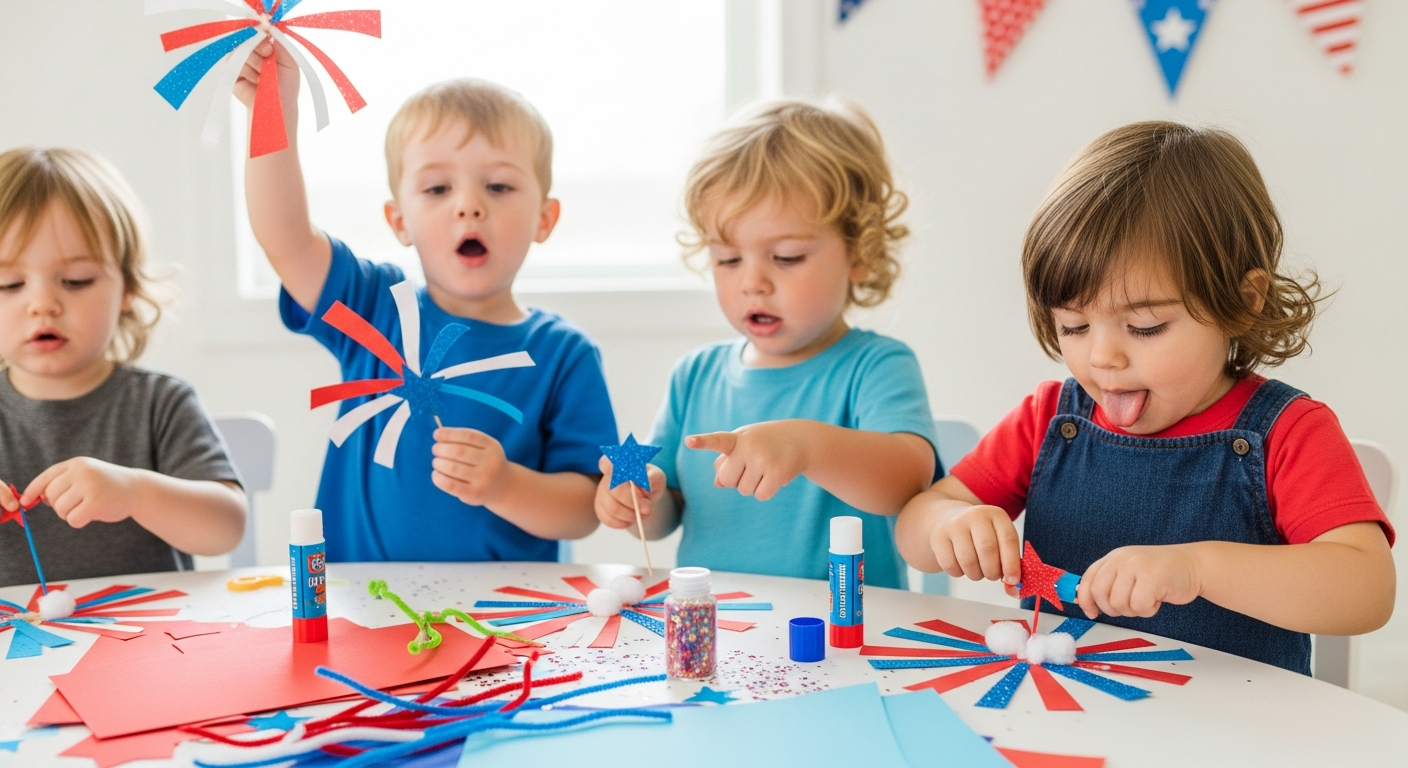
Table of Contents
- Introduction
- The Connection Between Crafting and Communication
- 1. Patriotic Handprint Flags: A Sensory Celebration
- 2. Firework Salt Painting: The Science of Sound
- 3. The Star-Spangled Sensory Bin
- 4. TP Roll Fireworks: Repetition and Routine
- 5. Red, White, and Blue Collage: Categorization Skills
- Making Memories with Speech Blubs
- Practical Scenarios: Connecting Play to Speech
- Safety and Success Tips for Toddler Crafting
- Conclusion
- Frequently Asked Questions
Introduction
Did you know that nearly one in four children will experience some form of speech or language delay during their early developmental years? While that statistic might feel overwhelming, it also highlights a beautiful opportunity for parents to step in with intentional, joyful play. As the Fourth of July approaches, the air fills with the smell of backyard barbecues and the anticipation of dazzling light shows. For a toddler, however, these big celebrations can sometimes be sensory overload. This is why we believe that incorporating fourth of July toddler crafts into your holiday routine is more than just a way to pass the time—it is a powerful way to build foundational communication skills in a comfortable, familiar environment.
At Speech Blubs, our mission is to empower every child to "speak their minds and hearts." We know this journey personally because our founders grew up with speech challenges themselves. They created the very tool they wished they had: a way to blend scientific principles with the pure joy of play. In this guide, we aren’t just giving you a list of DIY projects; we are providing a roadmap for "smart screen time" and hands-on activities that foster a love for communication. We will explore how simple materials like construction paper, salt, and paint can become the building blocks for new words, better confidence, and lasting family memories.

Our goal is to show you how to transform these patriotic activities into speech-rich moments. Whether your little one is a "late talker" or simply reaching new milestones, these crafts are designed to reduce frustration and create a bridge between artistic expression and verbal interaction. By the end of this post, you’ll have a full toolkit of festive ideas and a deeper understanding of how to support your child's unique voice.
The Connection Between Crafting and Communication
It might seem like a stretch to connect a glue stick to a spoken word, but in the world of child development, these two are intimately linked. When a child engages in fourth of July toddler crafts, they aren't just making a mess; they are practicing fine motor skills, which share a neurological "neighborhood" with the parts of the brain responsible for speech. As children learn to pinch a star sticker or squeeze a glue bottle, they are strengthening the neural pathways that will eventually help them control the small muscles in their mouths and tongues.
Furthermore, crafting is a naturally social activity. It provides a shared focus—what educators call "joint attention." When you and your toddler are both looking at the same red streamer, you are creating a perfect environment for language modeling. You might say, "Look, long red ribbon!" and your child, motivated by the fun, tries to imitate the sound. This is exactly why we use video modeling in our app. By watching other children perform actions and say words, your child feels a natural urge to join in.
Our approach at Speech Blubs is rooted in this "peer-to-peer" learning. We provide a screen-free alternative to passive cartoon viewing by encouraging active participation. When you pair a hands-on craft with our "smart screen time" experiences, you are reinforcing concepts in multiple ways. For example, you can watch the "Colors" section of the app to see children saying "red" and "blue," and then immediately transition to a patriotic painting activity. This multi-sensory approach makes learning stick.

1. Patriotic Handprint Flags: A Sensory Celebration
The American flag is an iconic symbol of the holiday, and creating a personalized version with your child’s handprint is a classic for a reason. This craft is particularly effective for children who are sensory-seekers or those who need a little extra encouragement to try new textures.
Materials Needed:
- Non-toxic washable paint (Red, White, and Blue)
- Large white construction paper or cardstock
- Foam brushes or even just your child’s fingers
- Wet wipes (for quick transitions!)
Speech-Rich Instructions:
Start by painting your child's palm and fingers with the blue paint. As you do this, narrate the sensation: "Ooh, it's cold! It's wet! Blue paint!" This introduces descriptive adjectives into their vocabulary. Press their hand onto the top-left corner of the paper. This handprint becomes the "stars" section of the flag.
Next, help your child dip their finger or a brush into the red paint to create the stripes. This is a great time to practice "stop" and "go" language. You can say, "Ready... set... GO!" as they draw a line, and "STOP!" when they reach the end. These foundational concepts are crucial for following directions and developing self-regulation.
Connecting to Speech Blubs:
For a parent whose 2-year-old is just starting to mimic environmental sounds, the "Early Sounds" section of Speech Blubs is a perfect companion to this craft. Before you start painting, you can use the app to practice the "p-p-p" sound for "paint" or the "f-f-f" sound for "flag." Seeing another child make these sounds on the screen makes the "work" of speech therapy feel like a game. If you're curious where your child stands, you can take our quick 3-minute preliminary screener to get a simple assessment and a free 7-day trial.
2. Firework Salt Painting: The Science of Sound
If you are looking for fourth of July toddler crafts that feel like magic, look no further than salt painting. This activity combines art with a bit of "wow" factor that keeps even the most active toddlers engaged.
Materials Needed:
- Black construction paper (to make the colors pop like night fireworks)
- White school glue (in a squeeze bottle)
- Table salt
- Watercolors and a very wet paintbrush or a dropper
Step-by-Step Engagement:
- The Squeeze: Help your child squeeze the glue onto the black paper in "burst" patterns. Squeezing the bottle is excellent for hand strength. Talk about the shapes: "Look at the circles! Big fireworks!"
- The Shake: Let your child pour a generous amount of salt over the wet glue. This is a great time to practice the "s" sound. "Sssss-salt is falling!" Shake off the excess.
- The Magic: Dip a brush into very watery red or blue paint and gently touch the salt. The color will "travel" along the salt lines. This is the perfect moment for "ooh" and "aah" sounds—imitation is the first step toward speech!
Why It Works for Speech:
Fireworks provide a natural opportunity to practice "onomatopoeia"—words that mimic sounds. As the color spreads, you can say "Boom!" "Pop!" or "Whiz!" These simple, explosive sounds are often the easiest for toddlers to master. Our scientific methodology emphasizes that imitation is driven by mirror neurons; when your child sees you (or a peer in the app) making a "boom" face, their brain is wired to try it too.
3. The Star-Spangled Sensory Bin
Sensory bins are a staple in speech therapy for a reason. They provide a low-pressure environment where children can explore and talk about what they find. For the Fourth of July, you can create a patriotic-themed bin that doubles as a vocabulary-building station.
How to Build Your Bin:
Fill a plastic container with a base of dried white rice or navy beans. You can even dye some of the rice red and blue using food coloring and a splash of vinegar. Add in star-shaped cookie cutters, small plastic flags (ensure they are age-appropriate and have no sharp points), and red and blue scoops.
Activities Within the Bin:
- Hide and Seek: Bury the stars in the rice. Ask your child, "Where is the star?" When they find it, celebrate with a big "Found it!"
- Counting: As they scoop the stars into a cup, count them together. "One star, two stars..."
- Texture Talk: Is the rice "bumpy"? Is the star "smooth"?
Using a sensory bin allows for "parallel play," where you sit alongside your child and narrate their actions. This reduces the pressure for them to "perform" and instead fosters a natural love for communication. To see how other families have used these types of play-based strategies to overcome speech delays, you can read what other parents are saying on our testimonials page.
4. TP Roll Fireworks: Repetition and Routine
Toddlers thrive on repetition. They love doing the same thing over and over because it helps them feel masterful. Using old toilet paper rolls as stamps for fourth of July toddler crafts is a budget-friendly way to practice repetitive speech patterns.
Materials Needed:
- Empty toilet paper rolls
- Scissors
- Red and blue paint
- Large sheets of paper
Instructions:
Cut several slits into one end of the toilet paper roll, about halfway up. Bend the strips outward so they look like a sunburst or a firework. Show your child how to dip the "fringed" end into the paint and stamp it onto the paper.
As they stamp, you can create a rhythm: "Dip and stamp. Dip and stamp." Rhythmic speech is a powerful tool for children who are working on their fluency and sentence structure. You can also vary the speed—"Fast stamps!" and "Slow stamps!"—to teach opposites.
Smart Screen Time Integration:
While your crafts are drying, it’s a great time to transition to a few minutes of focused learning. Download Speech Blubs on the App Store to explore our "Animal Kingdom" or "Toy Box" sections. If your child loved the "stamping" motion, they might enjoy seeing kids in the app interact with various toys and objects. This creates a holistic learning loop: they act, they watch, they listen, and eventually, they speak.
5. Red, White, and Blue Collage: Categorization Skills
Categorization is a higher-level cognitive skill that is essential for language development. It helps children organize the world around them. A patriotic collage is a simple way to practice this.
Instructions:
Provide your child with scraps of red, white, and blue paper, fabric, and stickers. On a large piece of poster board, draw three large circles—one labeled "Red," one "White," and one "Blue." Help your child glue the scraps into the corresponding circles.
As you work, ask questions that encourage choice-making: "Do you want the blue star or the red square?" Choice-making is an excellent way to reduce frustration in toddlers because it gives them a sense of control over their environment.
Making Memories with Speech Blubs
At Speech Blubs, we believe that every moment is a learning moment. Our company was born from a desire to provide an immediate, effective, and joyful solution for the millions of children who need speech support. We don't just want to "fix" a delay; we want to ignite a child's natural curiosity.
Our app is designed to be a powerful supplement to your child's overall development plan. While professional therapy is invaluable, the hours you spend at home crafting and playing are where the most significant progress often happens. By choosing our "smart screen time," you are opting for a tool that encourages your child to be an active participant rather than a passive observer.
Understanding Our Value and Pricing
We want to be transparent about how you can join our community. We offer two main paths:
- Monthly Plan: For $14.99 per month, you get full access to our library of speech-boosting activities.
- Yearly Plan: For $59.99 per year (which breaks down to just $4.99/month), you get the best possible value.
The Yearly Plan is the clear choice for families committed to their child's growth. When you choose the yearly option, you save 66% compared to the monthly rate. More importantly, the Yearly Plan includes:
- A 7-day free trial to ensure it's the right fit for your family.
- The Reading Blubs app, which helps transition speech skills into early literacy.
- Early access to all new updates and a 24-hour support response time.
The Monthly plan does not include the free trial or the extra Reading Blubs app, so we highly encourage parents to sign up on our web page for the yearly option to get the full suite of features and the best start for their child.
Practical Scenarios: Connecting Play to Speech
Let’s look at how these fourth of July toddler crafts might look in a real-life setting. Imagine you have a 3-year-old named Leo who loves anything that "goes." Leo is a "late talker" and often gets frustrated when he can't communicate his needs.
During the holiday weekend, Leo’s mom sets up the "TP Roll Firework" station. Instead of just letting him stamp in silence, she brings over her tablet and opens the Speech Blubs app. They watch the "Sound Blubs" section where a peer makes a "Pop!" sound. Leo watches intently. Then, they go back to the craft. Every time Leo stamps the paper, his mom says "Pop!" After a few minutes, Leo begins to whisper "pa... pa..." His mom beams and reinforces it: "Yes! Pop! Big firework pop!"
In this scenario, the frustration is replaced by a joyful family learning moment. The app provided the "video modeling" Leo needed to understand how to shape his mouth, and the craft provided the "motivating context" to practice the sound. This is the heart of what we do. We don't promise that your child will be giving public speeches in a month, but we do promise to provide the tools to build confidence and reduce the "communication gap" that causes so much stress for both parents and kids.
Safety and Success Tips for Toddler Crafting
When engaging in fourth of July toddler crafts, safety and realistic expectations are key. Here are a few tips to ensure your holiday is more "yay" and less "stress":
- Non-Toxic is a Must: Toddlers explore with their mouths. Always use paints and glues labeled as non-toxic and washable.
- Process Over Product: Your toddler's flag might not look like a flag. It might look like a purple smudge. That is okay! The goal is the conversation and the motor practice, not a masterpiece for the Louvre.
- Follow Their Lead: If your child loses interest after five minutes, don't force it. Move to a different activity or take a break with a fun video on the Speech Blubs homepage.
- Co-Play is Key: These activities are most effective when an adult is present to narrate, encourage, and model language. Your engagement is the most valuable part of the craft.
Conclusion
The Fourth of July is a time for celebration, and there is no better reason to celebrate than the progress your child is making every day. By engaging in these fourth of July toddler crafts, you are doing so much more than making decorations; you are fostering a love for communication, building foundational fine motor skills, and creating a world where your child feels heard and understood.
At Speech Blubs, we are honored to be a part of your journey. Whether you are using our app as a powerful supplement to professional therapy or as a way to jumpstart your child's early communication, we are here to support you with empathetic expertise. Our "smart screen time" is a bridge to real-world connection, designed to get your child off the screen and interacting with the world around them.
Ready to see the difference for yourself? We invite you to begin your journey today. Download Speech Blubs on the App Store or Google Play to begin. For the best experience and the most comprehensive tools—including the Reading Blubs app and our full library of features—make sure to select the Yearly Plan. It starts with a 7-day free trial, giving you a risk-free way to spark your child's voice this holiday season. Let’s make this Fourth of July the start of a new chapter in your child's communication story.
Frequently Asked Questions
1. Are these crafts suitable for children with sensory processing issues?
Yes! Many of these crafts, like the star-spangled sensory bin, are excellent for children with sensory sensitivities. They allow children to explore textures at their own pace. If a child is hesitant to touch paint, you can provide tools like sponges or even put the paint inside a sealed plastic bag for "mess-free" squish painting.
2. How can I encourage my "late talker" to participate in these activities?
Focus on "parallel play." Sit next to them and do the craft yourself, narrating your actions simply: "I am using blue. Now I am using red." Don't demand that they speak; instead, create a fun, low-pressure environment where they want to join the conversation. Using the video modeling in Speech Blubs can also provide that extra spark of motivation.
3. What if I don't have all the craft materials listed?
Don't worry! The best part about fourth of July toddler crafts is their flexibility. If you don't have rice for a sensory bin, use dried pasta or shredded paper. If you don't have blue paint, use blue crayons or markers. The speech-rich interaction is much more important than the specific materials used.
4. How long should a toddler spend on these activities?
Toddlers have short attention spans, typically ranging from 5 to 15 minutes. It’s perfectly normal if they want to switch activities quickly. You can do one small craft in the morning and another in the afternoon to keep things fresh and engaging without overwhelming them.
About the author