
Fun Games for Kids: Boost Skills & Build Bonds
 By Speech Blubs Team•Jan 19, 2026•22 min.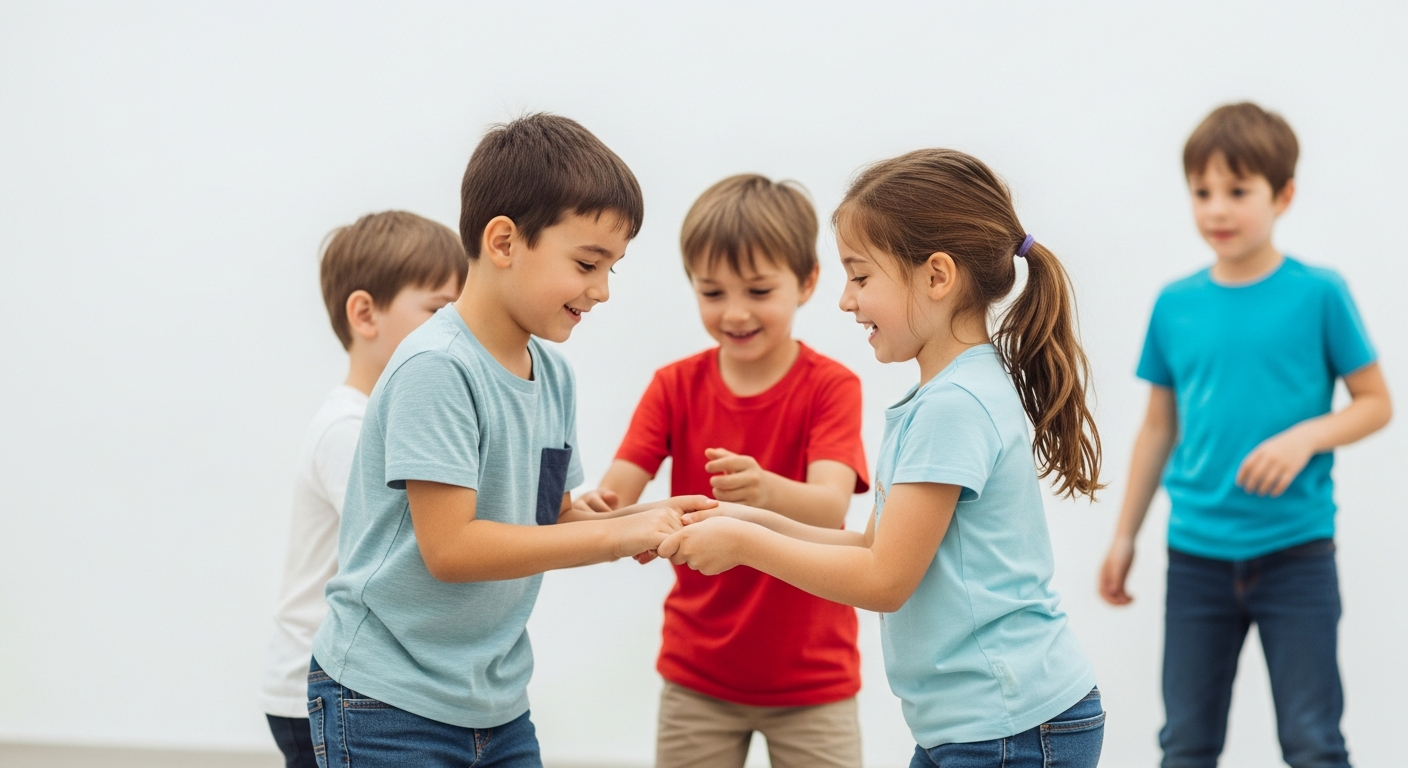
Table of Contents
- Introduction
- The Transformative Power of Group Play
- Choosing the Perfect Game: Considerations for Success
- Fantastic Indoor Group Games for Kids
- Exciting Outdoor Group Games for Active Kids
- Maximizing the Fun: Tips for Parents & Caregivers
- Speech Blubs: Your Partner in Communication Development
- Conclusion
- Frequently Asked Questions
Have you ever watched a group of children, bursting with energy and imagination, trying to decide what to play? The scene might start with a few excited shouts and a flurry of ideas, sometimes leading to pure magic, other times to a momentary lull. Group games are more than just a way to fill time; they are vibrant arenas where children spontaneously develop crucial life skills, from navigating social dynamics to expressing themselves clearly.
At Speech Blubs, we believe deeply in the transformative power of communication and play. Our mission is to empower children to speak their minds and hearts, and we understand that every interaction, every shared giggle, and every team effort in a game contributes to this journey. This post dives deep into a treasure trove of fun games for a group of kids, exploring how these activities boost social, cognitive, and communication skills, fostering joyful memories and stronger bonds. We'll outline practical, engaging games for various ages and settings, and show you how these play experiences beautifully complement the "smart screen time" we offer at Speech Blubs, creating a holistic approach to your child’s development.

Introduction
Picture this: a birthday party filled with laughter, a rainy afternoon transformed by creativity, or a family gathering where cousins connect over shared excitement. What do these scenes often have in common? Group games! These aren't just mere pastimes; they are the fertile ground where essential developmental seeds are sown. In a world increasingly dominated by individual screens, fostering environments for collective play is more crucial than ever.
This blog post is your comprehensive guide to unlocking the magic of group games. We'll explore a wide array of activities designed to captivate children of different ages and interests, whether they're indoors on a blustery day or soaking up the sun outside. Beyond just listing games, we'll delve into the incredible benefits each offers—from honing problem-solving abilities and nurturing empathy to enhancing verbal and non-verbal communication. We’ll also show how these vibrant, hands-on experiences perfectly align with our science-backed approach at Speech Blubs, where we provide an immediate, effective, and joyful solution for the 1 in 4 children who need speech support. By blending scientific principles with play, both in person and through our app, we're dedicated to helping every child build confidence and truly speak their mind and heart.
The Transformative Power of Group Play
Group games are a microcosm of life itself, offering children a safe and exciting space to experiment with social roles, communication strategies, and emotional responses. The benefits extend far beyond simple entertainment, laying foundational groundwork for a child's overall development.
Building Essential Social-Emotional Skills
When children engage in group play, they naturally encounter situations that demand patience, empathy, and cooperation. They learn to:
- Cooperate and Collaborate: Games like "Spaghetti Tower" or "Pipeline Challenge" require children to work together, pooling ideas and efforts to achieve a common goal. This teaches them the value of teamwork and compromise.
- Share and Take Turns: From passing objects in "Weasel in the Middle" to waiting for their cue in "Picture Book Story Time," children learn the importance of sharing resources and respecting the rhythm of group interaction.
- Negotiate and Resolve Conflict: Disagreements are inevitable in group settings, and games provide opportunities to practice finding solutions, articulating their perspectives, and understanding others'.
- Understand and Express Emotions: Winning and losing, frustration and triumph—group games evoke a spectrum of feelings. Children learn to manage their emotions, celebrate successes gracefully, and process disappointments constructively. This emotional intelligence is key to forming healthy relationships.
Enhancing Communication Abilities
Communication is at the heart of every successful group game. Children must listen, articulate, and interpret both verbal and non-verbal cues.

- Active Listening: Games like "Simon Says" or "Ready, Aim, Throw!" demand careful attention to instructions. Children learn to process auditory information quickly and accurately.
- Verbal Expression: Whether it’s describing a character in "Names in a Hat," explaining a strategy in "Capture the Flag," or contributing a line to a collaborative story, children practice articulating their thoughts and ideas.
- Non-Verbal Cues: In games like "Charades" or "Weasel in the Middle," children sharpen their ability to read facial expressions, body language, and gestures, becoming more attuned communicators.
- Asking and Answering Questions: Many games naturally prompt questions for clarification or strategy, encouraging children to seek information and provide clear responses.
For children who might be a bit shy or are still developing their communication skills, group games offer a lower-pressure environment than formal settings. Much like our unique video modeling methodology at Speech Blubs, where children learn by watching and imitating their peers in a playful context, these games provide natural opportunities for imitation and practice. Our founders, who all grew up with speech problems, created Speech Blubs to be the tool they wished they had—a joyful, effective solution blending scientific principles with play. This same spirit of learning through engaging interaction underpins the benefits of group games. Curious about our approach? You can learn more about the science behind our method on our research page.
Boosting Cognitive Development
Group games are mental workouts in disguise!
- Problem-Solving and Strategy: "Spaghetti Tower," "Pipeline Challenge," and "Capture the Flag" all require strategic thinking, planning, and adapting to new situations.
- Memory and Recall: Remembering rules, sequences, or specific roles in games like "Copy Cats" strengthens memory.
- Imagination and Creativity: "Three Props and a Play" or "Invent a Toy" ignite children's imaginations, encouraging them to think outside the box and create narratives or objects together.
- Critical Thinking: Debating game strategies, guessing in "What’s in the Bag," or figuring out "who has it" in "Weasel in the Middle" all engage critical thinking skills.
Fostering Physical Development
Many group games are wonderfully active, promoting healthy physical development.
- Gross Motor Skills: Running, jumping, chasing, and balancing in games like "Red Light, Green Light," "Blob Tag," or an "Obstacle Course" develop coordination, agility, and strength.
- Fine Motor Skills: Activities involving building, drawing, or manipulating small objects (like in "Invent a Toy") enhance fine motor control and dexterity.
- Spatial Awareness: Navigating a playing field, understanding personal space, and moving in relation to others are all critical for developing spatial awareness.
Cultivating Family Bonds and Joyful Memories
Beyond individual skill development, group games are powerful tools for strengthening family connections. When parents and caregivers join in, it sends a clear message of engagement and shared joy. These are the moments of genuine connection, laughter, and collective effort that become cherished family memories. At Speech Blubs, we are committed to providing a screen-free alternative to passive viewing and a powerful tool for family connection, ensuring that every interaction is meaningful and builds toward a child's confidence and communication.
Choosing the Perfect Game: Considerations for Success
Selecting the right game is key to ensuring fun and engagement for everyone. Keep these factors in mind:
- Age Appropriateness: Younger children need simpler rules, shorter game times, and less emphasis on competition. Older children thrive on more complex strategies and roles.
- Group Size: Some games are best for smaller groups (4-6 kids), while others shine with a large crowd (10+ kids).
- Setting (Indoor vs. Outdoor): Consider the space available, potential noise levels, and safety.
- Materials Needed: Do you have the props required, or can you easily substitute them?
- Energy Levels: Do you need a game to burn off energy, or one to calm down and focus?
Fantastic Indoor Group Games for Kids
Rainy days or cozy evenings don't mean an end to group fun! These indoor games for a group of kids are perfect for fostering creativity, laughter, and communication in a more confined space.
1. Three Props and a Play
- What You’ll Need: Five or more kids, a collection of random props (hats, scarves, stuffed animals, books, kitchen utensils).
- How to Play: Select three children to be the actors. The rest of the group chooses three distinct props and gives one to each actor. The actors must then spontaneously create and perform a short play, incorporating their given props into the story.
- Why It’s Beneficial: This game is a fantastic exercise in improvisation, storytelling, and imaginative play. It encourages quick thinking, creative expression, and collaborative narrative building. Children practice verbal fluency and confidence in front of an audience.
2. Weasel in the Middle
- What You’ll Need: A small, easily concealable object (e.g., a ball, an eraser, a block), a space for kids to sit in a circle.
- How to Play: Everyone sits in a circle, with one child designated as the "weasel" in the middle. The kids in the circle pass the hidden object around behind their backs. The weasel tries to guess who has the object by observing facial expressions and subtle movements. Once the weasel guesses correctly, they switch places with the child who had the object.
- Why It’s Beneficial: This game hones observation skills, encourages non-verbal communication, and teaches children to read subtle social cues. It's also great for practicing turn-taking and dealing with suspense. For a child learning to express emotions, trying to hide their excitement (or lack thereof) can be a fun way to explore emotional regulation.
3. Invent a Toy
- What You’ll Need: Building and/or craft materials (e.g., LEGOs, building blocks, construction paper, craft sticks, paper cups, pom-poms), child-safe scissors, glue, tape.
- How to Play: Divide children into small groups. Task each group with inventing and building a brand-new toy or game using the provided materials. Once their creation is complete, each group names their toy and takes turns presenting it, explaining what it is, how it works, and why other children would love to play with it.
- Why It’s Beneficial: This activity is a powerhouse for collaboration, problem-solving, and creative design. It encourages communication as children brainstorm, delegate tasks, and articulate their vision. Presenting their invention boosts public speaking confidence and descriptive language skills.
4. Freeze Dance
- What You’ll Need: Open space for dancing, music player.
- How to Play: Start the music and encourage everyone to dance freely. When the music suddenly stops, everyone must freeze in their current position like a statue. Anyone caught moving while the music is off is out (or takes a silly pose). Continue until one "Dancing King" or "Queen" remains.
- Why It’s Beneficial: A wonderful way to burn energy indoors, this game also develops listening skills, impulse control, and body awareness. It's a fantastic, low-pressure way to encourage expressive movement and joy.
5. Names in a Hat
- What You’ll Need: Slips of paper, pens, a hat or bowl.
- How to Play: Each player writes three names (e.g., famous people, movie characters, animals) on separate slips of paper and folds them. All slips go into a hat. Players take turns drawing a slip and describing the name without saying it aloud. Other players guess. Once a name is guessed, the next player draws.
- Why It’s Beneficial: This game is excellent for descriptive language, vocabulary expansion, and quick thinking. Children learn to choose effective clues and interpret partial information. For a child working on expressive language, games like "Names in a Hat" provide a natural, low-pressure way to practice describing concepts and building vocabulary, similar to how our "video modeling" in Speech Blubs shows children how to articulate sounds and words by imitating peers. You can explore more about how we integrate scientific principles into play by visiting our main homepage.
6. What's in the Bag
- What You’ll Need: An opaque bag, various common household objects (e.g., a spoon, a comb, a toy car, a piece of fruit).
- How to Play: Place several objects in the bag. One child reaches into the bag (without looking) and feels an object. They must describe what they feel—its shape, texture, size, weight—without revealing what it is. Other children guess based on the description.
- Why It’s Beneficial: This game sharpens sensory descriptive language and inferential reasoning. It encourages children to use a rich vocabulary to articulate tactile sensations, and for the guessers, it's an exercise in critical listening and deduction.
Exciting Outdoor Group Games for Active Kids
When the sun is shining and there's space to run, outdoor group games are unbeatable for active play and robust skill development. These are some of the best fun games for a group of kids who love to move!
1. Red Light, Green Light
- What You’ll Need: An open space, one child designated as the "stoplight."
- How to Play: One child stands at one end of the playing area, facing away from the others, who line up at the opposite end. The "stoplight" yells "Green Light!" and the players run towards them. At any moment, the "stoplight" can turn around and yell "Red Light!" Anyone caught moving while "Red Light" is called must return to the starting line. The first person to tag the "stoplight" becomes the new "stoplight."
- Why It’s Beneficial: This classic game teaches impulse control, listening skills, and quick reaction times. It’s also fantastic for gross motor development, including running, balance, and agility. Imagine a child who is typically quiet finding their voice during "Red Light, Green Light" by confidently calling out "red light!" or excitedly describing their strategy to avoid being caught. These moments are powerful for building confidence, much like the "smart screen time" we offer at Speech Blubs, which helps children vocalize and imitate in a supportive, engaging environment. If you're wondering how to further support your child's communication journey, consider taking our quick 3-minute preliminary screener to get a simple assessment and a free 7-day trial.
2. Capture the Flag
- What You’ll Need: Two flags (bandanas, towels), a large open space divided into two territories.
- How to Play: Divide kids into two teams. Each team hides its flag within its territory. The goal is to venture into the opposing team's territory, capture their flag, and bring it back to your own base without being tagged. If tagged in enemy territory, a player might be "frozen" until a teammate unfreezes them, or sent to a "jail" area.
- Why It’s Beneficial: A highly strategic and active game, "Capture the Flag" promotes teamwork, planning, negotiation, and quick decision-making. It’s an excellent workout for running, dodging, and spatial awareness, while also encouraging communication about strategy and alerting teammates.
3. Giants, Wizards, and Elves
- What You’ll Need: An open space, ideally with designated "safe zones" for each team.
- How to Play: This is a whole-body version of Rock, Paper, Scissors. Explain the rules: Giants conquer wizards (arms raised high), Wizards conquer elves (arms form a wizard hat), and Elves conquer giants (hands by ears, index fingers extended). Divide kids into two teams. Each team huddles to secretly decide if they will be giants, wizards, or elves. They then line up facing each other. On a count of three, both teams yell and pose as their chosen character. The team whose character conquers the other chases them to their safe zone. Tagged players join the opposing team.
- Why It’s Beneficial: This game teaches quick decision-making, strategic thinking, and teamwork. It’s active and involves clear communication through both shouting the character and performing the physical pose. It also fosters agility and quick reflexes.
4. Caterpillar Race
- What You’ll Need: A field or other open space, at least two groups of kids.
- How to Play: Divide the group into two or more teams. Each team forms a line, with every child placing their hands on the shoulders or waist of the person in front of them, creating a "caterpillar." On "Go!", the caterpillars race to a finish line. If a caterpillar breaks (kids let go of each other), they must return to the start and begin again.
- Why It’s Beneficial: This is a fantastic cooperative game that emphasizes physical coordination, communication (e.g., "slow down," "speed up"), and the importance of staying together as a team. It's a great exercise in rhythmic movement and shared effort.
5. Tag Variations (Blob Tag, Tunnel Tag, Band-Aid Tag)
- What You’ll Need: An open space.
- How to Play:
- Blob Tag: When the designated tagger tags someone, they join hands to form a "blob." The two must now chase other players while holding hands. When they tag another person, that person joins the blob, and so on. The blob grows, requiring more coordination.
- Tunnel Tag: Similar to freeze tag, but when a player is tagged, they "freeze" with their legs apart. To be unfrozen, another player must crawl through their legs, creating a "tunnel."
- Band-Aid Tag: When a child is tagged, they must place one hand on the spot where they were tagged. They must keep that hand there for the rest of the game. If tagged a second time, they place their other hand on the second spot. If tagged a third time, they are "out" and go to a designated "hospital" (sidelines) where they perform a silly action (e.g., five jumping jacks) to "get well" and rejoin the game.
- Why They’re Beneficial: These variations add layers of strategy and cooperation to a classic active game. They enhance motor skills, agility, and quick thinking, while also promoting communication and teamwork as players work to unfreeze or avoid being tagged.
6. Scavenger Hunt
- What You’ll Need: A list of items to find (with or without clues), a designated search area.
- How to Play: Provide children (individually or in teams) with a list of items to find within a specific area (e.g., backyard, park). Lists can be pictures for younger kids or written clues/riddles for older ones. The first team or individual to find all items wins.
- Why It’s Beneficial: Scavenger hunts are brilliant for problem-solving, observation skills, and reading comprehension (if clues are written). When played in teams, they encourage communication, cooperation, and delegation. It’s an engaging way to explore the environment.
Maximizing the Fun: Tips for Parents & Caregivers
To ensure these fun games for a group of kids are successful and enriching, adult involvement is key. Your role isn't just as a supervisor, but as a facilitator, role model, and enthusiastic participant.
- Explain Rules Clearly and Simply: Before starting, go over the rules in an age-appropriate way. For younger children, demonstrate the game rather than just explaining. Ask if anyone has questions to ensure understanding.
- Embrace Flexibility and Adaptability: Children often have wonderful ideas for modifying rules. Be open to adapting games to fit your group's needs, interests, and energy levels. The goal is engagement, not strict adherence to rules.
- Focus on Participation Over Perfection: Emphasize effort, teamwork, and good sportsmanship rather than just winning. Celebrate small victories and commendable efforts. This reduces pressure and encourages everyone to join in.
- Model Good Sportsmanship: Show children how to win graciously and lose with resilience. "Good game!" and "Better luck next time!" go a long way in teaching respectful interaction.
- Encourage Communication Throughout: Prompt children to talk about their strategies, cheer for teammates, or explain their actions. After a game, ask questions like, "What was your favorite part?" or "How did you work together?"
- Active Adult Involvement: Don't just watch—join in! Your participation signals that play is valuable and fun for everyone. It also allows you to gently guide interactions and ensure safety.
- Set Realistic Expectations: Not every game will be a roaring success, and that's okay. Some days, kids might just not be in the mood. The key is to offer variety and maintain a positive, playful attitude.
Speech Blubs: Your Partner in Communication Development
While hands-on group games provide invaluable real-world practice, we know that many children benefit from targeted, engaging support to build their communication skills. At Speech Blubs, we are deeply committed to empowering children to speak their minds and hearts. Our app offers a unique blend of scientific principles and play, providing a one-of-a-kind "smart screen time" experience that perfectly complements active, social play.
Our method, backed by extensive research, utilizes "video modeling" where children learn by watching and imitating their peers. This approach leverages mirror neurons in the brain, making speech development intuitive and incredibly effective. Unlike passive viewing experiences like cartoons, Speech Blubs provides an interactive, responsive environment that actively encourages vocalization and imitation.
Whether your child is a "late talker" struggling with first words, needs help with articulation, or is building their vocabulary, Speech Blubs offers a fun, immediate, and effective solution. Our founders created this tool based on their personal experiences, driven by a desire to help the 1 in 4 children who need speech support. It's a powerful supplement to a child's overall development plan and, when applicable, professional therapy.
Unlock the Full Potential with Speech Blubs: Our Pricing
We believe in transparency and providing exceptional value to families. Speech Blubs offers two primary subscription plans:
- Monthly Plan: For $14.99 per month, you get access to our core speech therapy content.
- Yearly Plan: For just $59.99 per year, this plan offers incredible savings, breaking down to just $4.99 per month – a 66% savings compared to the monthly plan!
Why the Yearly Plan is the Best Value:
The Yearly plan isn't just cheaper; it unlocks an entire suite of premium features designed to maximize your child's communication journey:
- 7-Day Free Trial: Experience the full power of Speech Blubs before committing. The Monthly plan does not include a free trial.
- Extra Reading Blubs App: Gain access to our award-winning sister app, Reading Blubs, designed to build early literacy skills, at no additional cost!
- Early Access to New Updates: Be the first to try out new features, games, and content as soon as they're released.
- 24-Hour Support Response Time: Get priority support for any questions or assistance you might need.
We strongly encourage parents to choose the Yearly plan to take advantage of the 7-day free trial and all the exclusive benefits that come with it. It’s the smart choice for long-term progress and the most comprehensive support for your child's speaking and learning journey. Ready to start your child's journey with smart screen time that genuinely helps them speak their mind and heart? Download Speech Blubs on the App Store or Google Play today!
Conclusion
The laughter, the shared effort, the triumphant shouts—these are the hallmarks of fun games for a group of kids. These activities are far more than just ways to pass the time; they are vital incubators for social, emotional, cognitive, and communication skills. From the simplest game of "Red Light, Green Light" to the collaborative challenge of "Invent a Toy," every moment of group play offers a rich opportunity for children to learn, grow, and connect with others. They build confidence, reduce frustration, develop foundational skills, and create joyful, lasting memories.
At Speech Blubs, we champion a holistic approach to child development, one that values both vibrant, hands-on play and purposeful, engaging digital learning. Our app is meticulously designed to empower children to speak their minds and hearts, complementing the rich experiences they gain through group games. By blending scientific methodologies with fun, we offer a "smart screen time" solution that actively encourages communication, builds confidence, and fosters a love for expression.
Don't let another day pass without experiencing the incredible joy and developmental benefits of group play. Start your child's communication journey today by integrating these fantastic games into your family routine. And for targeted, expert-designed support that truly makes a difference, join the Speech Blubs family. We invite you to experience the full potential of our app and empower your child's voice. Create your account and begin your 7-day free trial today and make sure to select the Yearly plan to get the best value and access to all our exclusive features, including the Reading Blubs app!
Frequently Asked Questions
Q1: Why are group games so important for kids' development?
Group games are incredibly important because they offer a dynamic environment for children to develop a wide range of skills simultaneously. They naturally foster social skills like cooperation, turn-taking, sharing, and conflict resolution. Cognitively, they encourage problem-solving, strategic thinking, and memory recall. Emotionally, children learn to manage wins and losses, build resilience, and express themselves appropriately. Crucially, they significantly enhance communication by requiring active listening, clear verbal expression, and interpretation of non-verbal cues.
Q2: How can I encourage a shy child to participate in group games?
Encouraging a shy child requires patience and a gentle approach. Start by involving them in smaller groups or games with fewer, simpler rules. Suggest roles that don't put them in the spotlight, like being part of a team rather than the sole leader. You can also play the game with them yourself first to build their confidence and understanding. Focus on participation and fun rather than winning, and celebrate their small contributions. Gradually, as they feel more comfortable and see others enjoying themselves, they are more likely to fully engage.
Q3: What age ranges are these games suitable for?
The games described here span a wide range, from preschool through elementary school years. Simpler games like "Freeze Dance," "Red Light, Green Light," or "What's in the Bag" are great for younger children (3-6 years old) due to their straightforward rules and focus on basic skills. More complex games like "Capture the Flag," "Spaghetti Tower," or "Giants, Wizards, and Elves" are better suited for school-aged children (6-12 years old) who can handle more intricate rules, strategy, and longer engagement times. Many games can also be adapted by simplifying or adding complexity to fit different age groups.
Q4: How does Speech Blubs fit with children playing active group games?
Speech Blubs perfectly complements active group play by providing targeted, "smart screen time" that reinforces and builds upon the communication skills children practice in games. While group games offer real-world social interaction, Speech Blubs provides a focused environment for speech articulation, vocabulary expansion, and expressive language through engaging "video modeling." Our app can help children develop the clarity and confidence to participate more fully in group activities, whether it's articulating their ideas during a game or understanding complex instructions. It's designed to be a powerful, joyful supplement that accelerates their communication journey, making them even more prepared and enthusiastic for social play.
About the author