
Fun Group Activities for Kids: Boost Skills & Build Bonds
 By Speech Blubs Team•Jan 13, 2026•17 min.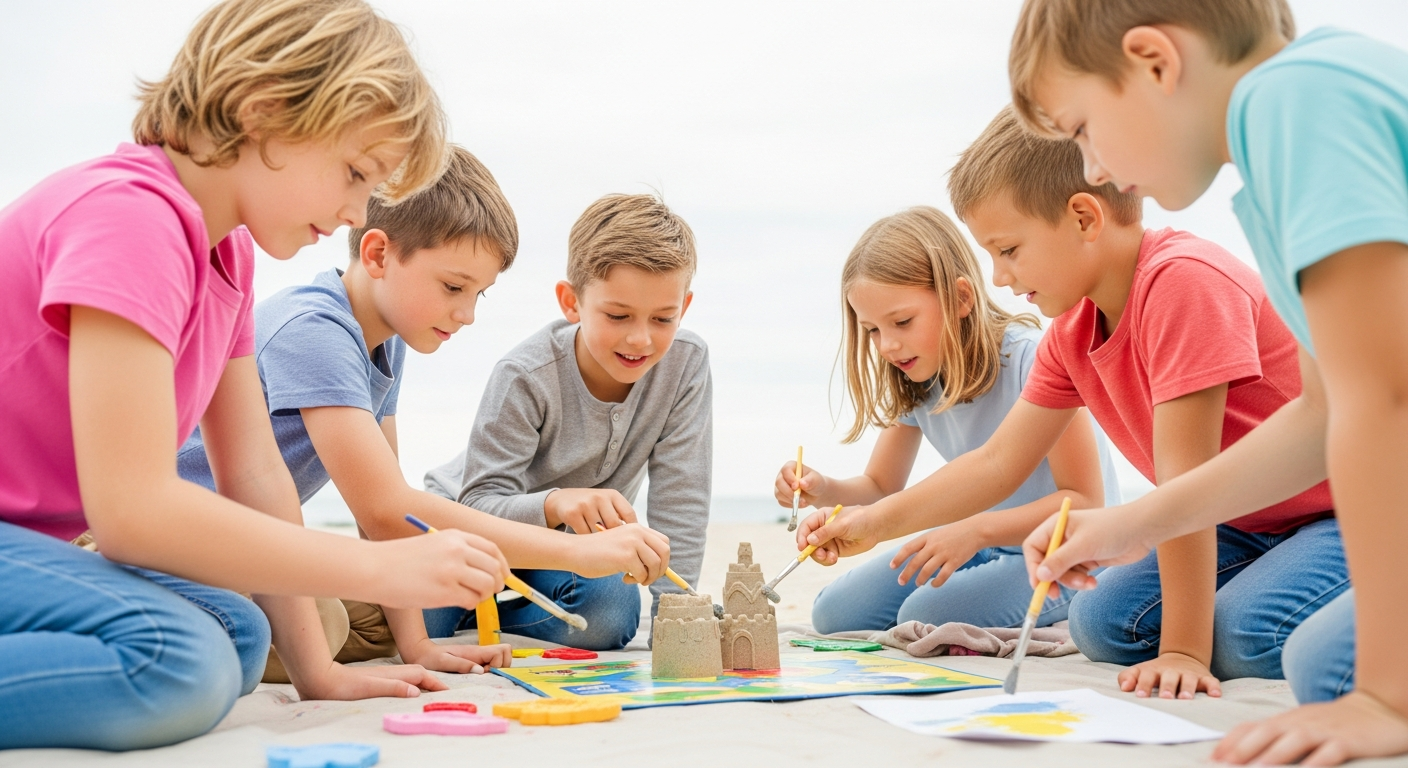
Table of Contents
- Why Fun Group Activities Matter for Every Child
- Foundational Skills Developed Through Group Play
- Types of Fun Group Activities for Kids
- Making Group Activities Inclusive for All Learners
- How Speech Blubs Elevates Group Play Readiness
- Conclusion
- Frequently Asked Questions
Have you ever watched a group of children deeply engaged in play, their laughter echoing, their minds whirring as they solve a tiny problem together, or simply share a joyful moment? It's a magical sight, but it's far more than just fun and games. In a world increasingly focused on individual screens, the power of collective play, especially through fun group activities, has never been more vital. These interactions are the bedrock upon which crucial life skills are built, shaping everything from how a child communicates to how they navigate complex social situations.
At Speech Blubs, we understand this profound connection deeply. Our mission is to empower children to "speak their minds and hearts," a journey that extends far beyond just words. It encompasses confidence, empathy, and the ability to truly connect with others. We believe that joyful, interactive experiences—whether through our scientifically-backed app or engaging group activities—are the most effective path to development. This post will delve into why fun group activities are so indispensable for your child's growth, exploring the rich tapestry of skills they cultivate, offering a treasure trove of engaging activity ideas, and demonstrating how Speech Blubs acts as a powerful catalyst, preparing your child to thrive in these vibrant social settings.

Why Fun Group Activities Matter for Every Child
Think about a child learning to ride a bike. They need balance, coordination, and the courage to try, fall, and try again. Group activities are much the same, but for their social, emotional, and cognitive "muscles." They provide a safe, dynamic playground where children can experiment with their budding abilities, learn from their peers, and grow in ways that isolated play simply can't replicate. It's about more than just having friends; it's about building the internal toolkit necessary for a lifetime of successful interactions.
One of the most significant benefits is the sheer joy and motivation these activities spark. When learning is disguised as play, children are more receptive, more persistent, and more likely to absorb complex lessons without even realizing it. This aligns perfectly with our philosophy at Speech Blubs, where we blend scientific principles with play into one-of-a-kind "smart screen time" experiences designed to be immediate, effective, and joyful.
Beyond Just Play: Holistic Development
Fun group activities offer a rich environment for children to develop holistically. Here’s a closer look at the key areas:
- Communication Skills: This isn't just about talking; it's about listening, understanding non-verbal cues, articulating thoughts clearly, and negotiating. In a group, children learn the rhythm of conversation and the art of expressing themselves so others can understand.
- Problem-Solving and Critical Thinking: Many group games involve challenges that require collaboration. Children learn to strategize, think creatively, and persevere when faced with obstacles, understanding that two (or more) heads are often better than one.
- Emotional Regulation and Empathy: Group dynamics naturally introduce scenarios where children need to manage their emotions—whether it's waiting for a turn, dealing with a loss, or understanding a friend's feelings. These interactions foster empathy and self-control, crucial components of emotional intelligence.
- Confidence Building: Contributing to a team, having ideas heard, and achieving a shared goal can significantly boost a child's self-esteem. It teaches them that their voice matters and that they are a valuable part of a larger whole.
- Social Inclusion and Friendship: Group activities break down barriers, allowing children to connect with peers they might not typically interact with. They foster a sense of belonging and create opportunities for new friendships to blossom, teaching children how to include others and feel included themselves.
The skills honed in these activities are not just for the playground; they are transferable to every aspect of life, from school to future careers, and importantly, to maintaining healthy relationships.

Foundational Skills Developed Through Group Play
Let's break down how fun group activities specifically nurture vital developmental areas.
Communication Skills (Verbal & Non-Verbal)
Effective communication is the cornerstone of all social interaction. In group settings, children naturally hone both their verbal and non-verbal communication abilities. They learn to take turns speaking, actively listen to others' ideas, express their own thoughts clearly, and interpret body language, gestures, and facial expressions.
For a child who might be working on articulation or expanding their vocabulary, a simple group game can be a powerful motivator. Imagine a child practicing animal sounds through our app's "Animal Kingdom" section, mimicking the video models. When they later join a game like "Animal Charades," they can confidently produce sounds like "moo" and "baa," not only reinforcing their speech practice but also experiencing the joy of being understood and contributing to the group. This positive reinforcement makes future communication efforts less daunting and more rewarding.
Our app's "video modeling" methodology is particularly effective here. Children learn by watching and imitating their peers, which is a powerful way to build confidence in vocalizing and communicating. It makes the transition to real-life group interactions much smoother, as they've already practiced expressing themselves in a low-pressure, engaging environment. We also prioritize screen-free alternatives to passive viewing, making our app a "smart screen time" experience that prepares children for active participation.
Social-Emotional Learning
Group activities are a masterclass in social-emotional development. Children learn the give-and-take of cooperation, the art of compromise, and the necessity of managing their own feelings while being sensitive to others.
- Empathy and Perspective-Taking: When children work together, they encounter different viewpoints and learn to understand how their actions affect others. Playing a game like "Emotion Charades" helps them recognize and express a range of feelings, crucial for understanding their peers.
- Cooperation and Conflict Resolution: Inevitably, disagreements arise. Group activities provide opportunities for children (with adult guidance) to practice constructive conflict resolution, learning to negotiate, share, and find solutions that work for everyone.
- Emotional Regulation: Waiting for a turn, dealing with the frustration of a game not going their way, or celebrating a shared victory all contribute to developing self-control and resilience.
Cognitive Development
The challenges embedded in many group games are excellent for boosting cognitive functions.
- Problem-Solving and Critical Thinking: Whether it's figuring out how to untangle a "Human Knot" without letting go, or strategizing to build the tallest "Marshmallow and Toothpick Challenge" tower, children engage their minds in creative and logical thought processes. For a child working on sequencing and following multi-step directions within Speech Blubs, applying those very skills to strategize during a collaborative building challenge provides meaningful real-world practice.
- Creativity and Imagination: Games like "Improvisational Stories" encourage children to think on their feet, weave narratives, and expand their imaginative horizons collectively.
- Memory and Attention: Many activities require remembering rules, sequences, or details about peers, sharpening memory and sustained attention.
Motor Skills
From running and jumping to manipulating small objects, group activities often involve significant physical engagement.
- Gross Motor Skills: Games like "Tug-of-War," "Hula Hoop Pass," or an "Obstacle Course" promote agility, balance, and coordination, all while burning off energy.
- Fine Motor Skills: Activities such as building with blocks, creating art together, or even carefully placing pieces in a board game enhance fine motor control and hand-eye coordination.
Types of Fun Group Activities for Kids
Here's a curated list of engaging group activities, categorized for different developmental focuses, complete with scenarios demonstrating how Speech Blubs can act as a preparatory tool.
Icebreaker & "Get to Know You" Games
These activities are perfect for helping children, especially those who might be a little shy or new to a group, feel comfortable and connected.
- Birthday Line-Up: Challenge children to line up in order of their birthdays without speaking, relying only on gestures and non-verbal cues. Then, try it with talking! It encourages non-verbal communication and gentle interaction.
- Common Denominator (or "Spiderweb"): In small groups, children find one thing they all have in common (e.g., "we all like pizza," "we all have a pet"). This promotes focused listening and discovering shared interests. The "Spiderweb" variation involves passing a ball of yarn, forming a web as each child shares something about themselves, visually representing their interconnectedness.
- "What's My Name?" Write names of famous characters or animals on sticky notes and place one on each child's forehead. Children mingle, asking yes/no questions to guess their identity. This boosts deductive reasoning and question-asking skills.
- Speech Blubs Scenario: For a child who is a "late talker" and needs practice with basic greetings and self-introduction, our app’s "My First Words" section offers fun, motivating exercises. Once they feel more confident with simple phrases and asking "What is...?", they can apply these skills directly in a "What's My Name?" game, making the experience less intimidating and more rewarding.
Cooperative Problem-Solving Challenges
These activities require teamwork, planning, and resilience.
- Human Knot: Small groups (5-10 kids) stand in a circle, reach in, and grab two different hands from people across from them. The challenge is to untangle themselves into a single circle without letting go. Expect lots of giggles and strategic thinking!
- Marshmallow and Toothpick Challenge: Divide children into teams and provide marshmallows and toothpicks. Challenge them to build the tallest, strongest, or most creative structure within a time limit. This teaches structural integrity and iterative design.
- Blind Polygon/Maze: With blindfolds or closed eyes, a group holds a rope in a closed loop and must form a specific shape (e.g., a perfect square or triangle). The "Blind Maze" variation involves navigating a simple rope maze while staying connected. These activities build trust, reliance on verbal instructions, and spatial reasoning.
- Speech Blubs Scenario: A child who has been working on following multi-step instructions and improving their auditory processing with Speech Blubs can bring those enhanced skills to a "Marshmallow and Toothpick Challenge." They’ll be better equipped to listen to their teammates' ideas, sequence building steps, and communicate their own suggestions effectively, leading to a stronger structure and greater pride in their collaborative effort.
Active Outdoor Group Games
Perfect for burning energy and fostering teamwork in the fresh air.
- Tug-of-War: A classic test of strength and collective effort. Ensure even teams and a safe playing area.
- Hula Hoop Pass: Children stand in a circle holding hands. A hula hoop is placed on one child's arm, and the goal is to pass it around the entire circle without anyone letting go of hands. This requires fluid movement and coordination.
- Obstacle Course (Blindfolded Partner): Set up a simple obstacle course. Children work in pairs; one is blindfolded, and the other guides them verbally through the course without touching. This is fantastic for developing clear verbal instructions and active listening.
- Tag Variations (Blob Tag, Tunnel Tag):
- Blob Tag: When tagged, players join hands with the tagger, forming a "blob" that chases others. The blob grows as more players are tagged, requiring coordinated movement.
- Tunnel Tag: A variation of freeze tag where a tagged player "freezes" with legs apart, forming a tunnel. Another player must crawl through the tunnel to unfreeze them.
- Speech Blubs Scenario: For a child who is developing their vocal volume and clarity, the focused practice of enunciating words and projecting their voice through Speech Blubs can make a huge difference. Imagine them confidently calling out directions to a blindfolded partner in an obstacle course, or shouting "Tag, you're it!" with newfound clarity in a game of Blob Tag. This practical application builds both physical and vocal confidence.
Creative & Imaginative Play
These activities ignite creativity, expand vocabulary, and encourage narrative skills.
- Improvisational Stories: Start a story with a few words, then each child adds a few words, building a collective narrative. Use picture cards for prompts to spark imagination. This fosters turn-taking and coherent storytelling.
- Play Pretend/Role-Playing: Set up a "restaurant," "doctor's office," or "school." Children adopt roles and interact within the scenario. This helps them understand social scripts, emotional responses, and different perspectives.
- Building Games (Collaborative Construction): Using blocks, LEGOs, or even natural materials outdoors, challenge groups to build something specific (e.g., "a castle," "a futuristic city"). This requires shared vision, negotiation, and division of labor.
- Speech Blubs Scenario: Our app is designed to expand vocabulary and help children form more complex sentences. A child who has gained proficiency in descriptive language and sentence structure through Speech Blubs can enrich "Improvisational Stories" with vivid details and elaborate plot twists. Their enhanced expressive language allows them to contribute more meaningfully and creatively to the group narrative.
Making Group Activities Inclusive for All Learners
Ensuring that all children can participate and feel successful is paramount.
- Adaptation is Key: Adjust rules to fit different developmental levels and needs. For example, use visual cues for children with auditory processing challenges, or simplify tasks for those with shorter attention spans.
- Positive Reinforcement: Celebrate effort and cooperation, not just winning. Acknowledge every child's contribution, no matter how small.
- Adult Facilitation and Modeling: Adults play a crucial role in setting the stage, explaining rules, modeling positive behaviors, and gently guiding interactions when conflicts arise. Your presence makes these activities a powerful tool for family connection, not just a way to pass the time.
How Speech Blubs Elevates Group Play Readiness
At Speech Blubs, we are deeply committed to empowering children to communicate effectively, which naturally prepares them for rich, engaging group interactions. Our company was born from the personal experiences of our founders, who all grew up with speech problems and created the tool they wished they had. We understand the frustration and isolation that can come with communication difficulties, and we are dedicated to providing an immediate, effective, and joyful solution for the 1 in 4 children who need speech support.
Our unique approach centers around video modeling, where children learn by watching and imitating their peers. This methodology is incredibly powerful because it activates mirror neurons in the brain, making learning intuitive and natural. Children see other kids just like them making sounds and words, which reduces anxiety and builds confidence – invaluable assets when entering a new group activity. This is "smart screen time" that actively engages your child, serving as a dynamic, screen-free alternative to passive viewing experiences like cartoons.
By engaging with Speech Blubs, children develop foundational communication skills that directly enhance their ability to participate in group activities. They gain:
- Improved Articulation: Clearer speech makes it easier for peers to understand them, fostering more successful interactions.
- Expanded Vocabulary: A broader range of words allows for richer storytelling, more effective problem-solving, and deeper conversations within a group.
- Enhanced Social Awareness: Our activities often involve recognizing emotions and social cues, translating directly into better understanding of group dynamics.
- Increased Confidence: Practicing and succeeding in speech within the app builds the self-assurance needed to speak up, share ideas, and lead during group play.
We believe in setting realistic expectations. While Speech Blubs is a powerful supplement to a child's overall development plan and, when applicable, professional therapy, it's not about guaranteeing overnight transformations into public speakers. Instead, our focus is on fostering a love for communication, building confidence, reducing frustration, developing key foundational skills, and creating joyful family learning moments. We are proud that our method is backed by science, placing us in the top tier of speech apps worldwide, as detailed on our research page. You can also read countless parent testimonials about their children's success and growing confidence with Speech Blubs.
Ready to see how Speech Blubs can empower your child for more confident group interactions? We offer flexible plans to suit your family's needs:
- Monthly Plan: For $14.99 per month, you can access our core features.
- Yearly Plan: This is our most popular and value-packed option at $59.99 per year, which breaks down to just $4.99 per month! That’s an incredible 66% savings compared to the monthly plan.
Choosing the Yearly plan unlocks exclusive benefits: a 7-day free trial to experience the app firsthand, access to our extra Reading Blubs app, early access to new updates, and 24-hour priority support response time. The Monthly plan does not include these valuable additions. We encourage you to choose the Yearly plan to get the free trial and the full suite of features designed to support your child's communication journey.
Unsure if your child could benefit? Take our quick 3-minute preliminary screener to get a simple assessment and a free 7-day trial.
Conclusion
Fun group activities for kids are more than just entertainment; they are essential classrooms for life. They foster vital communication, social-emotional, cognitive, and motor skills, transforming children into confident, empathetic, and capable individuals ready to navigate the world. By embracing cooperative play, we not only create joyful memories but also lay robust foundations for our children's future success and well-being.
At Speech Blubs, we are dedicated to complementing these invaluable experiences. Our scientifically-backed, play-based approach, utilizing unique video modeling, helps children develop the foundational speech and communication skills they need to fully engage, contribute, and shine in any group setting. We equip them not just with words, but with the confidence to speak their minds and hearts.
Don't wait to give your child the gift of confident communication and joyful interaction. Start their journey today! Download Speech Blubs on the Apple App Store or Google Play Store to begin your 7-day free trial. Remember to select the Yearly plan to unlock all exclusive features, including the Reading Blubs app, and save significantly while setting your child up for comprehensive developmental support.
Frequently Asked Questions
What age are these activities suitable for?
Many group activities can be adapted for a wide range of ages, from toddlers to school-aged children. The key is to adjust the complexity of rules, the duration, and the physical demands to match the developmental stage of the group. For younger children, focus on simple turn-taking and sensory experiences; for older children, introduce more strategic thinking and complex problem-solving.
How can I adapt these activities for shy children?
For shy children, the goal is gentle encouragement rather than forceful participation. Start with activities that allow for observation, like "Improvisational Stories" where they can listen before contributing. Pair them with a familiar or empathetic peer, and emphasize non-verbal roles initially (e.g., being the "spotter" in an obstacle course). Celebrate small contributions and create a supportive environment where they feel safe to gradually step out of their comfort zone.
How does Speech Blubs help with social and communication skills for group play?
Speech Blubs builds foundational communication skills that are vital for group play. Through our video modeling technique, children learn to articulate words clearly, expand their vocabulary, and understand social cues by imitating their peers. This practice helps reduce anxiety and builds confidence, making them more likely to speak up, share ideas, and engage meaningfully when participating in real-life group activities. Our app prepares them for the "how-to" of communication, so they can focus on the "what-to-say" in social settings.
What's the best way to get started with Speech Blubs?
The best way to get started with Speech Blubs is to download the app from the Apple App Store or Google Play and choose our Yearly plan. This gives you a 7-day free trial to explore all the features, including access to our Reading Blubs app, early updates, and 24-hour support. The Yearly plan also offers the best value, saving you 66% compared to the monthly subscription.
About the author