
Fun Hands-On Activities for Kids: Spark Joy & Learning
 By Speech Blubs Team•Jan 13, 2026•18 min.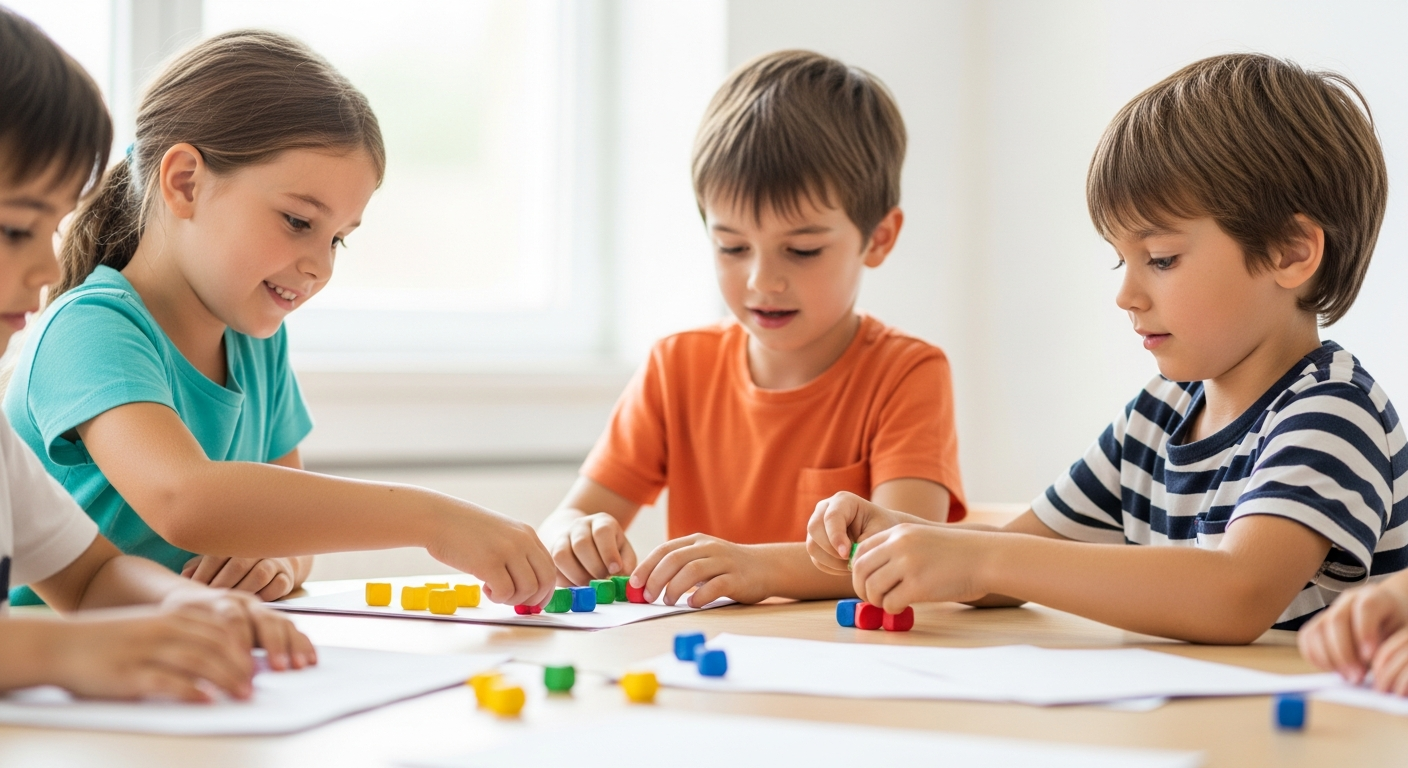
Table of Contents
- Why Hands-On Learning is Essential for Child Development
- Fun Hands-On Activities for Every Child (and How They Boost Communication)
- Integrating Hands-On Learning into Your Family Routine
- Empowering Communication with Speech Blubs: Our Unique Approach
- Conclusion
- Frequently Asked Questions
Ever feel like your child is glued to a screen, or that learning at home is a battle against boredom and disengagement? You're not alone. Many parents observe their children's eyes glaze over during traditional lessons, or find themselves struggling to capture their little ones' attention with static worksheets. The truth is, children are natural explorers. They thrive on interaction, discovery, and active participation. They need to experience knowledge, not just read about it.
This inherent curiosity is the key to unlocking a world of effective and joyful learning. This post isn't just about activities; it's about transforming how your child connects with the world, develops crucial skills, and builds a lifelong love for learning. We'll dive into the profound benefits of hands-on activities, share practical ideas for every age and interest, and show you how these engaging experiences naturally foster communication and language development. Ultimately, you’ll discover how to make every day an opportunity for meaningful growth, turning ordinary moments into extraordinary learning adventures, often with the support of innovative tools like Speech Blubs.

Why Hands-On Learning is Essential for Child Development
Beyond the Books: The Deep Impact of Active Engagement
Imagine trying to teach a child about apples simply by showing them a picture or reading a description. Now, picture them biting into a crisp apple, feeling its smooth skin, smelling its sweet aroma, and hearing the crunch. Which experience do you think will be more memorable and meaningful? This is the essence of hands-on learning: it transforms abstract concepts into tangible, multi-sensory experiences that resonate deeply with children.
Hands-on learning isn't just a fun diversion; it's a foundational pillar of child development. It directly engages multiple senses – touch, sight, sound, and movement – creating stronger neural pathways and deeper understanding. When children actively manipulate objects, build, experiment, and explore, they are doing much more than just playing. They are:
- Promoting critical thinking and problem-solving: They learn to observe, hypothesize, test, and analyze outcomes, fostering an inquisitive mindset.
- Building real-life connections: Abstract ideas become concrete and relatable, making learning relevant to their world.
- Boosting motivation and independence: Children feel like active participants in their education, not just passive recipients. This sense of agency fuels their desire to learn more.
- Fostering creativity and imagination: Whether they're building a fort or concocting a kitchen experiment, hands-on play sparks their imaginative thinking.
- Developing fine and gross motor skills: Activities like cutting, pasting, stacking, climbing, and sorting are crucial for physical coordination and dexterity.
For a child struggling with abstract number concepts, the idea of "five" might be confusing. But give them five blocks to count, five cookies to share, or five steps to jump, and suddenly "five" becomes real and understandable. This tangible interaction sparks curiosity and retention in ways traditional methods often can't.
At Speech Blubs, we recognize that true learning happens when children are active participants. This is why our approach is designed to be "smart screen time"—it's an interactive alternative to passive viewing, encouraging children to mimic and create, much like hands-on play. We believe in harnessing the power of engagement to unlock a child's full potential.

The Link Between Hands-On Play and Speech Development
The connection between hands-on activities and speech and language development is profound and often underestimated. Every time a child engages in hands-on play, they create natural opportunities for communication.
- Gross and Fine Motor Skills: Activities that build gross motor skills (like running through an obstacle course) or fine motor skills (like threading beads) might seem purely physical, but they lay crucial groundwork for speech. The same neurological pathways involved in coordinating movement are also vital for the complex motor planning required for articulation. As children refine their movements, they are simultaneously developing the control needed for speaking.
- Vocabulary Expansion: As children explore different textures, colors, shapes, and actions during play, they are naturally exposed to a rich vocabulary. Describing the "squishy" playdough, the "fast" car, or the "tall" tower encourages the use of descriptive language.
- Narrative Skills: Pretend play, like acting out a story with puppets or building a miniature world, is a powerful incubator for narrative development. Children practice sequencing events, developing characters, and expressing emotions through dialogue. This is how they learn to structure stories and articulate their thoughts.
- Social Interaction and Turn-Taking: Many hands-on activities are collaborative, requiring children to interact with peers or adults. This fosters essential social communication skills such as turn-taking, sharing, negotiating, and expressing needs and wants.
- Cause and Effect Language: Simple science experiments or building projects teach cause and effect. "If I push this, it falls!" or "When I add more water, it overflows." These observations naturally lead to verbalizing predictions, outcomes, and explanations.
- Sensory Integration: Engaging multiple senses through hands-on play helps children process and organize sensory information, which is fundamental for language comprehension and expression. A child who can confidently interact with various textures and sounds in their environment is often better equipped to process the nuanced sounds and rhythms of speech.
Consider a child who struggles with social interactions; they might find confidence in telling a story through puppets, practicing different voices and expressions without direct eye contact. This gradual exposure to communication builds their confidence, eventually translating into more direct conversational skills.
Our unique video modeling method at Speech Blubs, where children learn by watching and imitating their peers, taps into this natural human inclination to learn through action and observation. This scientific approach is what makes Speech Blubs so effective, earning us a high MARS scale rating, and aligning perfectly with the benefits of hands-on learning by making communication an active, engaging experience.
Fun Hands-On Activities for Every Child (and How They Boost Communication)
You don't need a perfectly stocked craft store or elaborate lesson plans to make hands-on learning happen. The magic lies in using everyday items and a sprinkle of imagination. Here are some categories of activities, each packed with communication-boosting potential:
Kitchen Adventures: Cooking, Baking, and Science
The kitchen is a treasure trove of learning opportunities, blending science, math, and practical life skills into one delicious experience.
- Baking Soda and Vinegar Volcano: This classic experiment is a fantastic introduction to chemical reactions.
- Communication benefits: Using words like "fizz," "erupt," "mix," "pour." Following multi-step instructions ("First, we add the baking soda, then the vinegar"). Describing observations ("It's bubbling!").
- Making Butter in a Jar: Simply shake heavy cream until it separates into butter and buttermilk.
- Communication benefits: Using action verbs like "shake," "churn," "separate." Describing textures ("creamy," "solid," "liquid"). Expressing patience ("Is it butter yet?").
- Measuring and Mixing: Involve your child in simple recipes like making cookies or pancakes.
- Communication benefits: Practicing numbers and fractions ("half a cup," "two spoons"). Vocabulary related to ingredients and actions ("flour," "sugar," "stir," "whisk"). Sequencing ("First, we mix the dry ingredients, then add the wet").
For a child learning to combine words, baking cookies provides natural opportunities to say "more flour," "mix it," or "taste good!" These simple utterances are significant steps in language development.
Nature Explorers: Outdoor Scavenger Hunts and Gardening
Step outside, and the world becomes an open-air classroom. Nature provides endless sensory input and opportunities for discovery.
- Nature Scavenger Hunt: Give your child a list (pictures for younger kids, words for older) of things to find: a smooth stone, a crinkly leaf, something red, a feather.
- Communication benefits: Descriptive language ("rough," "smooth," "tiny," "huge"). Classification ("This is a leaf, this is a stick"). Asking questions ("Where can we find something green?").
- Planting a Mini Garden: Whether it's herbs on a windowsill or vegetables in the backyard, gardening teaches patience and observation.
- Communication benefits: Learning new vocabulary ("seed," "soil," "sprout," "roots"). Sequencing ("First we dig, then we plant"). Predicting outcomes ("What will happen if we don't water it?").
- Cloud Gazing and Animal Spotting: Simply lie on the grass and talk about what you see.
- Communication benefits: Using imagination ("That cloud looks like a dinosaur!"). Asking open-ended questions ("What do you think that bird is doing?"). Describing observations and sharing imaginative ideas.
Just as children explore the world around them, Speech Blubs provides a rich environment for language exploration. Our 'Animal Kingdom' or 'Transportation' sections allow children to engage with new words and sounds in a visually stimulating and interactive way, fostering natural imitation and speech practice. Download Speech Blubs on the App Store or Google Play to see how!
Creative Corner: Art, Storytelling, and Building
Unleash your child's inner artist and architect with activities that encourage self-expression and construction.
- DIY Story Stones/Puppets: Draw simple characters or objects on smooth stones, or use socks and paper bags for puppets. Then, use them to tell stories.
- Communication benefits: Narrative skills (beginning, middle, end), character development, creating dialogue, expressing emotions. Encourages shy children to vocalize through a character.
- Building Forts and Obstacle Courses: Use blankets, pillows, and furniture to create a fort, or set up a simple obstacle course with tunnels to crawl through and pillows to jump over.
- Communication benefits: Collaborative problem-solving ("Where should this blanket go?"), spatial language ("under," "over," "through," "inside"), following multi-step directions, giving instructions.
- Art Meets Learning: Instead of just drawing, use art to illustrate concepts. Draw maps, create dioramas of historical events or book scenes, or illustrate a science process like the water cycle.
- Communication benefits: Visual expression tied to verbal explanation, comprehension of complex topics, retelling stories through images.
A child who struggles with social interactions might find confidence in telling a story through puppets, practicing different voices and expressions without direct eye contact, gradually building up to more direct communication.
Sensory Play for Language Growth
Sensory play engages children through touch, sight, sound, and sometimes even smell and taste, providing a rich foundation for language.
- Kinetic Sand or Play-Doh: These materials offer endless possibilities for shaping, squishing, and imaginative play.
- Communication benefits: Descriptive vocabulary ("squishy," "gritty," "smooth," "sticky"). Requesting tools ("I need the roller!"). Discussing imaginative scenarios ("Let's make a cake!").
- Water Play: A tub of water with various containers, sponges, and toys offers simple yet powerful sensory input.
- Communication benefits: Action verbs ("pour," "splash," "float," "sink"). Concepts like "empty" and "full." Asking and answering questions about cause and effect.
- Sensory Bins: Fill a bin with rice, beans, pasta, or pom-poms, and add scoops, cups, and small toys.
- Communication benefits: Naming objects, describing textures, imaginative play scenarios, sharing, and turn-taking.
The tactile and visual stimulation of sensory play perfectly complements the immersive learning experience of Speech Blubs. Our app offers diverse themes and sounds that engage children's senses, creating a multi-faceted approach to speech and language development.
Movement and Music: Get Those Wiggles Out
Physical activity and musical engagement are not only great for burning energy but also for developing rhythm, coordination, and verbal expression.
- Dance Party: Put on some upbeat music and let loose! Encourage free movement or try following simple dance moves.
- Communication benefits: Expressing emotions through movement, following rhythmic patterns, responding to music cues, learning action words ("jump," "spin," "clap").
- DIY Instruments: Create shakers with rice in jars, drums from pots and pans, or rubber band guitars from tissue boxes.
- Communication benefits: Exploring sounds, discussing pitch and volume, identifying instruments, singing songs, following a beat.
- ABC Hopscotch: Draw a hopscotch grid with letters or numbers using chalk. Call out a letter/number and have your child hop to it, then say a word that starts with that letter or count up from that number.
- Communication benefits: Letter and number recognition, phonological awareness, spelling practice, combining physical activity with verbal responses.
These activities are not just about keeping children busy; they are carefully designed pathways to richer communication, stronger cognitive skills, and a deeper connection with the world around them.
Integrating Hands-On Learning into Your Family Routine
It's easy to feel overwhelmed by the idea of adding more to your already packed schedule. However, integrating hands-on learning doesn't have to be an elaborate production. Small, consistent efforts make the biggest impact.
Making it Doable: Simple Tips for Busy Parents
- Start Small and Simple: You don't need Pinterest-perfect projects. Ten to fifteen minutes of focused, hands-on play can be incredibly effective. If you're studying fractions, bake muffins and discuss "half" or "quarter." If reading a book, encourage them to draw their favorite scene.
- Use Everyday Objects: Look around your home. Legos, blocks, dry pasta, measuring cups, old magazines, and even laundry can be turned into learning tools. Sorting laundry by color or size teaches classification. Comparing soup cans teaches concepts like "tall" and "short."
- Create a "Learning Box": Dedicate a bin or drawer to basic craft supplies (markers, tape, scissors, index cards, craft sticks, glue) and simple educational tools (magnifying glass, measuring tape). When inspiration strikes, or your child asks for an activity, you'll be ready.
- Embrace the Mess (and Manage It): Hands-on learning can get messy, and that's often where the best discoveries happen. Lay down a cheap shower curtain or old sheet for messy play, and involve your child in the cleanup process, which itself is a hands-on activity.
- Follow Your Child's Lead: Observe what truly excites your child. Do they love animals? Focus on nature-based activities or animal-themed crafts. Are they fascinated by how things work? Explore simple science experiments. When children are genuinely interested, their engagement and learning soar.
- Integrate into Chores: Cleaning, cooking, and tidying offer fantastic hands-on opportunities. Let them measure ingredients for dinner, sort toys, or help wipe down surfaces. These activities develop practical skills and vocabulary.
We understand the demands on parents. That's why Speech Blubs is designed for immediate, effective, and joyful use, fitting seamlessly into your routine. It’s a powerful tool for family connection, offering structured, engaging activities that promote speech and language in just a few minutes a day, complementing your hands-on efforts.
Overcoming Common Challenges (Time, Cost, Creativity)
It's easy to feel excited about hands-on learning until doubts creep in. Here's how to tackle those common worries:
- "I don't have enough time."
- Solution: Integrate learning into existing routines. Cooking dinner offers math and sequencing. A walk in the park can become a science lesson. Focus on quality over quantity; even 10-15 minutes of focused, interactive play can be incredibly impactful.
- "It costs too much."
- Solution: Most of the best hands-on activities use items you already have at home or can find for free in nature. Cardboard boxes, recyclables, leaves, stones, water, and sand are excellent resources. Libraries offer free books and often host craft events.
- "I'm not creative enough."
- Solution: Hands-on learning isn't about perfectly crafted, Pinterest-worthy projects. Simple activities are often the most effective. The goal is engagement and discovery, not artistic perfection. Start with open-ended materials and let your child's imagination guide the process.
For parents wondering if their child needs extra support in speech and language development, our quick 3-minute preliminary screener can provide an assessment and next-steps plan. It's a great, low-commitment way to explore if Speech Blubs is the right fit for your family and complements your hands-on efforts.
Empowering Communication with Speech Blubs: Our Unique Approach
At Speech Blubs, we believe every child deserves the chance to "speak their minds and hearts." This isn't just a mission statement; it's a deeply personal commitment. Our company was born from the personal experiences of our founders, who all grew up with speech problems and created the very tool they wished they had during their own developmental journeys. We understand the frustrations, the challenges, and the immense joy that comes with finding one's voice.
Born from Experience, Built on Science
Our commitment is to provide an immediate, effective, and joyful solution for the 1 in 4 children who need speech support. We achieve this by blending scientific principles with play, creating one-of-a-kind "smart screen time" experiences. Unlike passive viewing (like cartoons), Speech Blubs engages children actively, making them participants in their learning journey. It's a powerful tool for family connection, designed to be used with adult co-play and support, turning screen time into quality time.
Our unique approach is rooted in video modeling methodology, where children learn by watching and imitating their peers. This technique leverages the power of mirror neurons in the brain, which fire both when an individual performs an action and when they observe the same action performed by another. By watching real children articulate sounds and words, our users are naturally encouraged to imitate, helping them develop pronunciation, vocabulary, and communication skills in a fun, natural, and highly effective way. This method is backed by extensive research, placing us in the top tier of speech apps worldwide. Learn more about the science behind our method and its effectiveness.
Don't just take our word for it; see what other parents are saying about their child's success with Speech Blubs. Their stories are a testament to the real impact our app has on families every day.
The Value of Speech Blubs: Plans and Features
We believe in transparency and providing exceptional value to families. When you choose Speech Blubs, you're investing in a scientifically-backed, engaging tool designed to empower your child's communication journey.
Here’s a breakdown of our plans:
- Monthly Plan: For $14.99 per month, you get access to our core Speech Blubs app.
- Yearly Plan: Our most popular and highly recommended option is just $59.99 per year. This breaks down to an incredible value of just $4.99 per month, allowing you to save 66% compared to the monthly subscription!
The Yearly Plan is the clear best choice, offering significantly more value and features that support your child's comprehensive development. Choosing the Yearly plan includes:
- A 7-day free trial: Experience the full power of Speech Blubs before committing.
- The extra Reading Blubs app: A complete reading program to complement speech development.
- Early access to new updates: Be the first to enjoy new features and content.
- 24-hour support response time: Get prompt assistance whenever you need it.
The Monthly plan does not include these valuable benefits. For the best experience and the most comprehensive support for your child's learning journey, the Yearly plan is designed to deliver superior value and ensure long-term progress.
Conclusion
Hands-on learning is far more than just "playing around"; it's a profound and effective approach that transforms education into an engaging, memorable, and deeply personal journey. From kitchen science to outdoor explorations, and from creative arts to sensory play, these activities naturally spark curiosity, build confidence, and, crucially, foster critical communication skills. By inviting children to actively participate in their learning, we empower them to not only understand the world but also to articulate their thoughts, feelings, and discoveries within it.
The benefits of incorporating hands-on experiences into your child's daily life are boundless: a deeper love for learning, enhanced problem-solving abilities, reduced frustration, and stronger foundational skills that extend across all areas of development. When combined with innovative, scientifically-backed tools, like Speech Blubs, the potential for growth is truly limitless.
Ready to ignite your child's love for learning and communication? Experience the power of hands-on learning, both in everyday activities and with the interactive support of Speech Blubs. We invite you to begin your journey today! Choose our Yearly plan to get a 7-day free trial of Speech Blubs. This not only offers incredible savings but also exclusive access to the Reading Blubs app, early updates, and dedicated 24-hour support. It’s the smart choice for comprehensive, long-term support. Download Speech Blubs now on the Apple App Store or Google Play Store and empower your child to speak their mind and heart.
Frequently Asked Questions
Q1: What exactly is hands-on learning?
A1: Hands-on learning is an educational approach where children actively engage with materials, manipulate objects, and participate in direct experiences rather than passively listening or observing. It involves using multiple senses—touch, sight, sound, and movement—to explore concepts, solve problems, and build understanding. It makes learning tangible and relevant, fostering deeper comprehension and retention.
Q2: How does Speech Blubs fit into hands-on learning?
A2: Speech Blubs complements hands-on learning by providing an interactive, "smart screen time" experience that mirrors active engagement. Our video modeling method encourages children to actively imitate their peers, engaging their motor skills (of the mouth and face), auditory processing, and visual observation. This active participation promotes speech and language development in a dynamic, playful way, reinforcing the benefits of traditional hands-on activities by making communication itself a hands-on experience.
Q3: Is the Speech Blubs app suitable for all children?
A3: Speech Blubs is designed to support a wide range of children, including those with speech delays, autism, Down syndrome, or those who simply need a boost in their communication skills. Our method is built on scientific principles and makes learning engaging for children regardless of their developmental stage. It's an excellent supplementary tool for children already receiving professional therapy and a valuable resource for those seeking early intervention.
Q4: What's the best way to get started with Speech Blubs?
A4: The best way to get started with Speech Blubs is to opt for our Yearly plan, which includes a 7-day free trial. This allows you to explore the full suite of features, including the bonus Reading Blubs app, early access to updates, and 24-hour support, all while saving 66% compared to the monthly price. Simply create your account on our website or download Speech Blubs from the Apple App Store or Google Play Store to begin your free trial and unlock a world of communication possibilities.
About the author