
Fun Indoor Games for Kids: Beat Boredom & Boost Skills
 By Speech Blubs Team•Jan 19, 2026•17 min.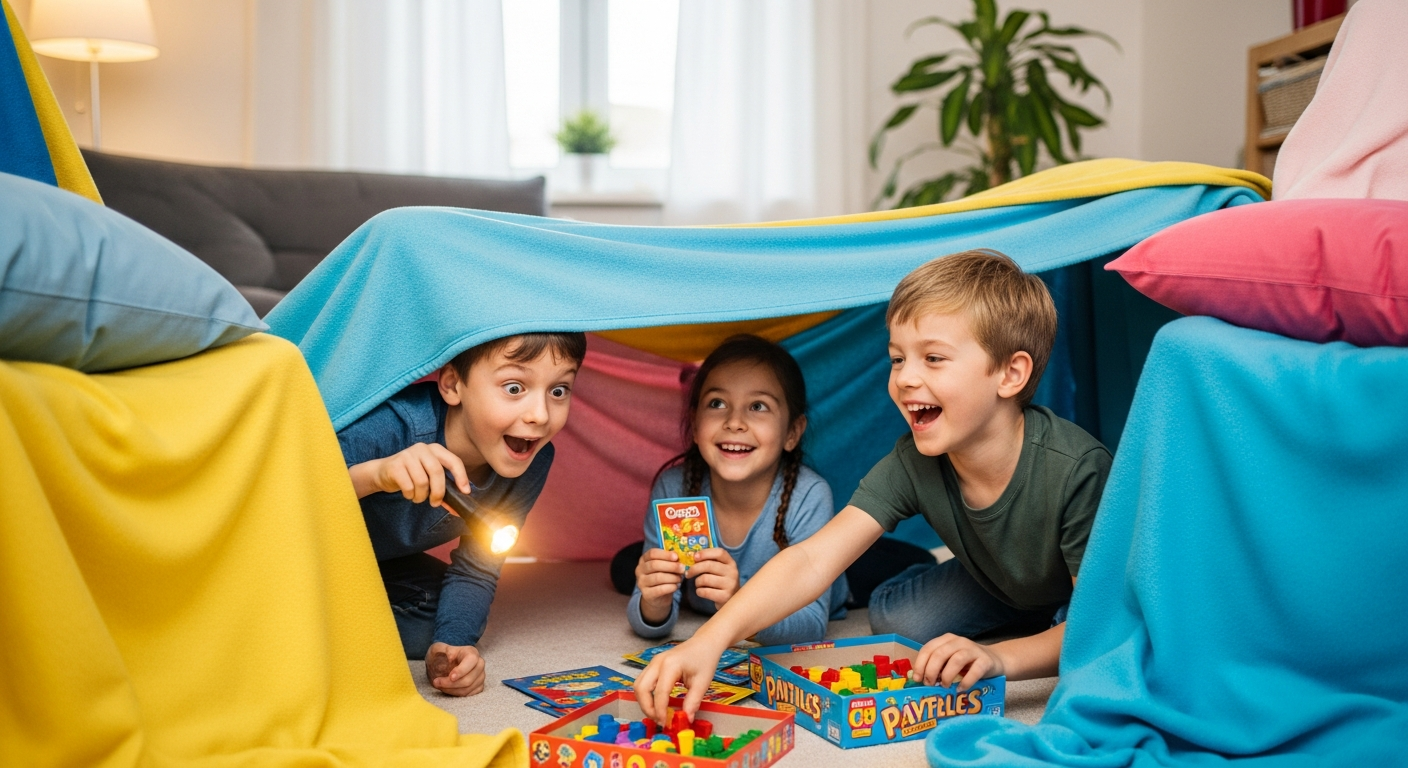
Table of Contents
- Introduction
- The Profound Power of Indoor Play: More Than Just Passing Time
- Active Indoor Games for Physical Fun
- Creative & Imaginative Indoor Games
- Cognitive & Problem-Solving Indoor Games
- Communication-Focused Indoor Games
- Making the Most of Indoor Play: Tips for Parents
- Conclusion
- FAQ
The familiar sound of "I'm bored!" can echo through any home, especially when outdoor adventures are off the table. Whether it’s a rainy afternoon, a snowy winter day, or simply a need for some calm indoor fun, finding engaging activities for children can feel like an endless quest. But what if these indoor moments could be more than just time fillers? What if they were powerful opportunities for learning, growth, and deeper family connection?
At Speech Blubs, we understand that every moment is a chance for development, and play is a child's natural language. Our mission is to empower children to speak their minds and hearts, and we believe that enriching indoor experiences are crucial for fostering communication skills, building confidence, and nurturing imagination. This comprehensive guide will explore a vibrant collection of fun indoor games for kids, demonstrating how simple activities can transform ordinary days into extraordinary adventures, all while supporting crucial developmental milestones. We’ll delve into games that encourage movement, spark creativity, challenge young minds, and most importantly, get your little ones talking, listening, and expressing themselves.

Introduction
Ever wonder how to keep the energy high and spirits bright when the weather outside is anything but? You're not alone. Many parents face the challenge of battling "cabin fever" and the allure of passive screen time when kids are stuck indoors. But instead of seeing these days as limitations, we can reframe them as golden opportunities. Engaging in structured and unstructured indoor play offers a wealth of benefits, from boosting physical coordination to fostering social-emotional intelligence and enhancing language development. This article will provide you with a treasure trove of over 30 unique, screen-free indoor game ideas, alongside practical tips and insights into how these activities can become powerful tools for learning and connection. We’ll also show you how our innovative tools, like the Speech Blubs app, can complement these activities, turning “screen time” into smart, interactive speech practice. Get ready to transform your living room into a hub of excitement, laughter, and meaningful growth!
The Profound Power of Indoor Play: More Than Just Passing Time
It's easy to dismiss play as mere recreation, but for children, it is the fundamental mechanism through which they understand the world, develop skills, and express themselves. Indoor play, in particular, offers a unique environment where imagination can thrive without external distractions, where safety is assured, and where parents can actively participate in their child's learning journey.
Beyond Boredom: Unpacking Developmental Benefits
When children engage in purposeful play, they are simultaneously nurturing a wide range of essential skills:
- Physical Development: Even indoors, children can jump, crawl, balance, and stretch, improving gross motor skills, coordination, balance, and proprioception (awareness of their body in space).
- Cognitive Development: Games often involve problem-solving, critical thinking, memory retention, and strategic planning. They learn cause and effect, classification, and sequencing.
- Social-Emotional Development: Playing with others teaches turn-taking, sharing, negotiation, empathy, and emotional regulation. It helps children understand social cues and build relationships.
- Creative Development: Imaginary play, role-playing, and constructing new worlds from everyday objects spark creativity, innovation, and flexible thinking.
- Communication & Language Skills: Perhaps most importantly for us at Speech Blubs, play provides a rich context for language acquisition and practice. Children narrate their actions, ask questions, respond to prompts, articulate ideas, and practice new words and sounds.
Speech Blubs' Approach to Smart Screen Time
While many of the activities we’ll discuss are screen-free, we recognize that managed, purposeful screen time can also be incredibly beneficial. This is where Speech Blubs comes in. We believe in "smart screen time" – an alternative to passive viewing that actively engages children in speech and language development. Our app was born from the personal experiences of our founders, who all grew up with speech problems and created the tool they wished they had. We combine scientific principles with play, using a unique "video modeling" methodology where children learn by watching and imitating their peers. This active engagement stimulates mirror neurons, making learning natural and effective. For parents seeking immediate, effective, and joyful solutions for the 1 in 4 children who need speech support, our app provides a powerful complement to traditional play.

For instance, while your child practices animal sounds during an animal walk, our Speech Blubs app offers dedicated sections like 'Animal Kingdom' where they can watch and imitate other children making those very sounds, reinforcing their learning in a fun, interactive way.
Active Indoor Games for Physical Fun
Just because you're inside doesn't mean movement has to stop! These games help kids burn off energy, improve coordination, and develop gross motor skills.
1. Obstacle Courses: Navigate and Conquer
Bring the playground inside! Obstacle courses are fantastic for challenging physical abilities and problem-solving.
- DIY Setup: Use pillows for stepping stones, blankets for tunnels, chairs to crawl under, and painter's tape for zig-zag balance beams.
- Creative Twists: Add a "lava pit" (the floor!), make them retrieve a "treasure" at the end, or incorporate animal walks into specific sections.
- Speech Blubs Connection: As your child navigates, narrate their actions ("You're crawling under the chair!" "Now you're stepping over the pillow!"). This spatial language is vital. For kids working on following multi-step directions, creating a simple obstacle course and giving sequential instructions ("First, crawl under the blanket, then jump over the pillow") is a wonderful activity. Our app supports this by providing clear, visual-verbal prompts for imitating speech, helping children associate words with actions.
2. Animal Walks & Races: Unleash the Inner Beast
Encourage imaginative movement while building strength and coordination.
- Variety is Key: Crab walk, bear crawl, frog jump, snake slither, penguin waddle. Challenge them to invent new animal movements.
- Make it a Race: Race a sibling, a parent, or even the clock.
- Speech Blubs Connection: This is a perfect opportunity to practice animal sounds and names. "Can you 'moo' like a cow while you crawl?" "Let's make a 'ribbit' sound as you frog jump!" The Speech Blubs 'Animal Kingdom' category is an excellent companion, offering video modeling of peers making these sounds, making the practice even more engaging and effective.
3. Balloon and Ball Games: Keep It Up!
A simple balloon can provide endless entertainment and improve visual tracking and hand-eye coordination.
- Balloon Volleyball: Use a piece of string or a rolled-up blanket as a "net." Make paddles from paper plates taped to plastic spoons for an added challenge.
- Target Toss: Throw soft objects (bean bags, rolled socks, stuffed animals) into a laundry basket or a taped target on the floor. Assign points for different targets.
- Speech Blubs Connection: These games naturally encourage interaction and verbal prompts: "My turn!" "Oops!" "You got it!" Practice counting points, giving directions, and encouraging teammates.
4. Dance Parties & Yoga Freeze: Groove and Balance
Music and movement are fantastic for expressing emotions and burning energy.
- Dance Party: Put on your child's favorite music and let loose! Share your favorite songs and ask about theirs to create a shared experience.
- Yoga Freeze Dance: Play music and dance. When the music stops, everyone strikes a yoga pose and holds it. This builds balance, focus, and body awareness.
- Speech Blubs Connection: Use music to encourage rhythmic speech patterns and imitation. For children working on imitating speech, the repetitive nature of songs and the clear, simple instructions of yoga poses can be very beneficial.
Creative & Imaginative Indoor Games
These activities tap into a child's natural inclination for storytelling and pretend play, fostering creativity and emotional expression.
1. Building Forts & Indoor Camping: Worlds of Their Own
Transform your living room into a magical hideaway.
- Construction Zone: Use blankets, pillows, couch cushions, and chairs to build a magnificent fort. Let your child lead the design.
- Indoor Camping: Set up a tent (if you have one) or simply build a fort big enough to crawl inside. Tell spooky stories with a flashlight, or "cook" s'mores on the stove for a full camping experience.
- Speech Blubs Connection: Fort building encourages negotiation ("Where should this blanket go?"), descriptive language ("This is a secret tunnel!"), and imaginative dialogue as they play out scenarios inside their new world.
2. Putting on a Play or Making a Movie: Lights, Camera, Action!
Kids are born storytellers and actors. Give them a stage!
- Story & Props: Help them brainstorm a story, create simple costumes from old clothes, and make props from household items.
- Performance Time: Stage a production for the family or record their "movie" on a phone to share with grandparents.
- Speech Blubs Connection: This activity is a goldmine for language development. Children practice character voices, dialogue, sequencing events, and expressing emotions through words. For children who are developing expressive language, even simple roles like making animal sounds or repeating a single phrase can be incredibly empowering. It reinforces the idea that their voice matters.
3. Action Storytime: Books Come to Life
Reading aloud is wonderful, but acting out stories takes engagement to a new level.
- Interactive Reading: As you read, encourage your child to act out parts of the story. If a character is jumping, they jump. If they are sleeping, they pretend to sleep.
- Sensory Engagement: This makes stories more memorable and connects words to physical actions.
- Speech Blubs Connection: This helps children connect verbs and actions, building a stronger vocabulary and understanding of narrative structure. "The bear growled!" (child growls). "The bunny hopped!" (child hops). This active participation can be a bridge to more complex verbal expression.
Cognitive & Problem-Solving Indoor Games
These games challenge young minds, encouraging critical thinking, memory, and strategic planning.
1. Scavenger Hunts: The Thrill of Discovery
Everyone loves a treasure hunt! Scavenger hunts can be easily customized for any age.
- Item List: Create a list of items for them to find. This can be concrete ("find a red block") or more abstract ("find something soft," "find something that makes noise").
- Clues: For older children, use riddles or simple drawings as clues.
- Speech Blubs Connection: Scavenger hunts are fantastic for practicing descriptive language, following directions, and asking clarifying questions. "Is it big or small?" "Where should I look?" For children working on vocabulary, parents can emphasize the names of the items and their attributes as they are found. Our preliminary screener is a type of "scavenger hunt" for parents seeking answers, offering a quick assessment to guide their next steps in supporting their child's communication journey. Take our quick 3-minute preliminary screener to get a simple assessment and a free 7-day trial.
2. Puzzles & Board Games: Piece by Piece Learning
These activities build problem-solving skills, patience, and social interaction.
- Jigsaw Puzzles: For younger kids, hide larger puzzle pieces around the room and have them retrieve one at a time to add to the puzzle. This combines movement with cognitive effort.
- Classic Board Games: Introduce age-appropriate board games like Candyland, Snakes and Ladders, or Chutes and Ladders. These teach turn-taking and simple counting.
- Speech Blubs Connection: Puzzles encourage spatial reasoning and vocabulary related to shapes, colors, and spatial relationships ("This piece goes here," "It's next to the blue one"). Board games are excellent for practicing social language: "My turn!" "You won!" "Roll the dice."
3. DIY Giant Game Board: Your Floor, Your Rules
Transform your living room floor into a life-sized game!
- Masking Tape Magic: Use masking tape to create a giant hopscotch grid, a race track for small cars, or a huge version of your favorite board game.
- Creative Play: Your child can become the game piece, hopping from square to square.
- Speech Blubs Connection: This activity is wonderful for counting, sequencing, and following rules. You can add "challenge squares" that require a verbal response, like "Say three words that start with 'B'" or "Describe your favorite animal."
Communication-Focused Indoor Games
These games specifically target various aspects of communication, making learning fun and natural.
1. Charades & "What Am I?": Guessing Games for Growth
These classic games encourage non-verbal and verbal communication, respectively.
- Animal Charades: Act out an animal and have others guess. This is great for non-verbal children or those learning emotional recognition.
- "What Am I?": Provide clues about an object or animal, and have your child guess. Start simple ("I am yellow and you eat me") and gradually increase complexity.
- Speech Blubs Connection: Charades builds foundational understanding of expressing ideas without words, a precursor to verbal communication. "What Am I?" directly builds vocabulary, descriptive language, and inferential reasoning. For children hesitant to speak, the act of making sounds or simple movements can be a low-pressure entry point into communication.
2. Copycat Mirror Game: Imitation for Learning
Imitation is a fundamental step in language development.
- Face-to-Face Fun: Stand facing your child and take turns copying each other's movements, facial expressions, and sounds.
- Sound Focus: Incorporate speech sounds. "Can you make an 'Mmm' sound?" "Now a 'Puh' sound!"
- Speech Blubs Connection: This mirrors our core methodology. At Speech Blubs, children learn through video modeling, watching and imitating their peers making sounds and words. This active imitation is backed by neuroscience, activating mirror neurons and making learning highly effective. Our app is rated in the top tier of speech apps worldwide, a testament to our research-backed methods. You can learn more about the science behind our approach on our Research page.
3. "Tell Me About It": Expanding Description
Encourage your child to elaborate and provide details.
- Object Description: Pick an object and ask your child to describe it using multiple senses or attributes (color, size, texture, what it does, where it's found).
- Event Narration: Ask them to describe their favorite part of the day, a recent trip, or a character in a book.
- Speech Blubs Connection: This game directly practices expressive language, expanding vocabulary, and sentence structure. For children working on forming longer sentences or using more adjectives, prompts like "Tell me more!" or "What else can you say about it?" are incredibly helpful.
Speech Blubs: Your Partner in Communication Development
We know that fostering communication skills is an ongoing journey, and sometimes parents need a dedicated tool to support this development. Speech Blubs is designed to be that tool. We are committed to providing an immediate, effective, and joyful solution for children, blending scientific principles with play into one-of-a-kind "smart screen time" experiences. We provide a screen-free alternative to passive viewing (like cartoons) and a powerful tool for family connection, where children learn by watching and imitating their peers. Many parents have seen remarkable progress; read their stories on our Testimonials page.
We believe in the power of play to unlock a child's potential. Whether it's through acting out a story, imitating animal sounds, or watching peers model speech in our app, every moment of engagement contributes to a child's ability to express themselves confidently.
Making the Most of Indoor Play: Tips for Parents
To truly make indoor play a success, a little preparation and a lot of presence can go a long way.
1. Embrace the Mess (Within Reason)
Creativity often comes with a bit of a mess. Designate a "play zone" where the mess can be contained, or involve your child in cleanup as part of the game. For instance, turn cleaning into a relay race: "Run, grab five blocks, put them in the bin, and tag me!"
2. Rotate Activities and Materials
Keep things fresh by rotating toys and activity ideas. Children are more engaged when there's an element of novelty. A simple box of craft supplies, once put away, feels exciting when rediscovered.
3. Join In the Fun!
Your involvement is key. Playing alongside your child shows them you value their world and strengthens your bond. Your narration, questions, and participation provide rich language models and social cues. Remember, our app works best with adult co-play and support, turning screen time into a shared, interactive learning experience.
4. Set Realistic Expectations
Every child develops at their own pace. Focus on the joy of the process, not just the outcome. Our goal at Speech Blubs is to foster a love for communication, build confidence, reduce frustration, develop key foundational skills, and create joyful family learning moments. We never promise guaranteed outcomes like "your child will be giving public speeches in a month." Instead, we aim to provide a powerful supplement to your child's overall development plan and, when applicable, professional therapy, helping them take meaningful steps forward.
Ready to add a powerful tool to your indoor play arsenal? You can download Speech Blubs on the App Store or Google Play to begin your journey.
Conclusion
When the doors close and the world outside beckons, the world inside your home truly opens up. These fun indoor games for kids offer far more than just a way to pass the time; they are vital pathways to physical dexterity, creative expression, cognitive growth, and profound communication development. By embracing imaginative play, encouraging active movement, and strategically incorporating "smart screen time" tools like Speech Blubs, you can transform ordinary indoor days into extraordinary adventures of learning and connection.
At Speech Blubs, we are dedicated to helping every child find their voice, and we believe that playful, engaging experiences are at the heart of that journey. We invite you to explore the endless possibilities of indoor play and witness your child's confidence and communication skills flourish.
Ready to bring the power of play-based learning and smart screen time into your home? Create your account and begin your 7-day free trial today! To get the most value and unlock all exclusive features, we highly recommend choosing our Yearly plan. While our Monthly plan is $14.99, the Yearly plan is an incredible deal at just $59.99 per year, which breaks down to only $4.99 a month—saving you a fantastic 66%! With the Yearly plan, you also get a 7-day free trial, the extra Reading Blubs app, early access to new updates, and 24-hour support response time. The Monthly plan does not include these invaluable benefits. Don't miss out on the full suite of tools designed to empower your child's communication journey. Choose the Yearly plan and start your free trial now!
FAQ
Q1: How can I encourage my child to try new indoor games if they always want to play with the same toys?
A1: Introducing novelty is key. Try rotating toys and activities every week or two so that familiar items feel new again. When introducing a new game, start by modeling it yourself with enthusiasm, or suggest a small, time-limited trial to lower resistance. You can also connect new games to their existing interests – if they love animals, suggest an animal-themed obstacle course or charades.
Q2: My child struggles with attention. How can I adapt these games to keep them engaged?
A2: For children with shorter attention spans, keep activities brief and varied. Break down games into smaller steps, offer choices, and allow for frequent transitions. Incorporate sensory elements (like a sensory bin or textured materials in an obstacle course). Active participation from a parent is also crucial; your presence and narration can help guide their focus. Remember that even short bursts of engagement are beneficial.
Q3: How does Speech Blubs fit into a day of indoor play?
A3: Speech Blubs is designed as "smart screen time," transforming passive viewing into active, engaging speech practice. You can integrate it naturally by using it to reinforce sounds or words related to a game you just played (e.g., after an animal walk, use the 'Animal Kingdom' section). It's a wonderful tool for a focused 10-15 minute session, offering a break from physical play while continuing to build communication skills through its video modeling technique, where children learn by imitating peers.
Q4: Are these indoor games suitable for different age groups?
A4: Absolutely! Most of these games are highly adaptable. For toddlers, simplify rules and focus on basic movements and sounds. For preschoolers, add more complex instructions, introduce simple counting, and encourage more elaborate imaginative play. For older children, increase the challenge with more intricate rules, strategic thinking, and advanced vocabulary. Many activities, like scavenger hunts or fort building, can be enjoyed by a wide range of ages by simply adjusting the complexity.
About the author