
Fun Indoor Games for Kids: Play, Learn & Grow
 By Speech Blubs Team•Jan 19, 2026•19 min.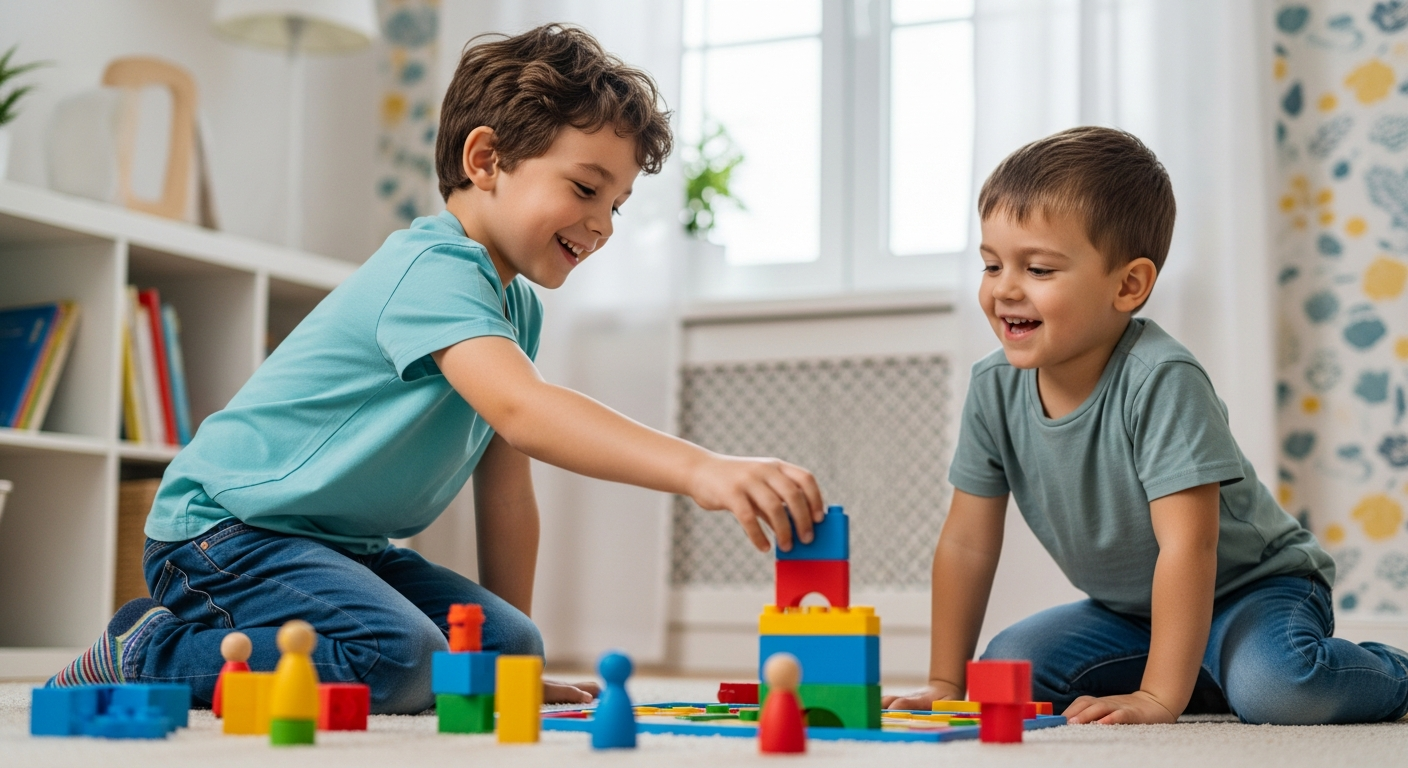
Table of Contents
- Introduction
- The Power of Play: More Than Just Fun
- Unleash Energy: Active Indoor Games
- Spark Imagination: Creative & Pretend Play
- Sharpen Minds & Tongues: Cognitive & Communication Games
- Sensory Exploration & Skill Building
- Beyond the Playroom: Empowering Communication with Speech Blubs
- Conclusion
- FAQ
Ever found yourself gazing out at a dreary, rainy afternoon or bundling up for another chilly winter day, wondering how on earth you'll keep the kids engaged and happy indoors? You're not alone. The challenge of turning 'stuck inside' into 'super fun adventure' is a familiar one for many parents. But what if those indoor moments weren't just about passing the time, but about actively fostering your child's development, building their confidence, and strengthening family bonds?
This post is your ultimate guide to transforming ordinary days indoors into extraordinary opportunities for growth and connection. We're diving deep into a treasure trove of fun indoor games to play with kids – activities that ignite imagination, encourage movement, sharpen minds, and, crucially, spark communication. From high-energy races to quiet creative corners, we'll explore how simple household items and a dash of creativity can unlock a world of learning. We'll also touch upon how cutting-edge tools like Speech Blubs can seamlessly integrate into your child's playful learning journey, turning screen time into "smart screen time" that empowers them to speak their minds and hearts.

Introduction
Life with little ones is a whirlwind of discovery, curiosity, and boundless energy. But when the weather turns sour, or a sniffle keeps everyone indoors, that energy can quickly morph into restlessness, boredom, and perhaps a touch of cabin fever. The allure of passive screen time often becomes the default, but we know deep down that our children benefit most from active, engaging experiences that stimulate their growing minds and bodies.
The truth is, indoor days don't have to be a battle against boredom or a surrender to endless cartoons. With a little planning and a lot of imagination, your home can become a vibrant playground and a powerful learning lab. The games and activities we're about to explore are more than just ways to pass the time; they are vital opportunities for your child to develop crucial physical, cognitive, social, emotional, and communication skills. These moments of shared play become building blocks for future learning, fostering a love for discovery and creating cherished family memories. At Speech Blubs, we wholeheartedly believe that every child deserves the chance to speak their minds and hearts, and play is often the first, most joyful classroom.
The Power of Play: More Than Just Fun
Before we dive into specific fun indoor games to play with kids, let's take a moment to appreciate why play is so profoundly important for child development. It’s far from just an idle pastime; play is a child’s natural way of learning about the world and their place in it.
Physical Development
Active indoor games help children develop gross motor skills like balance, coordination, strength, and agility, even in limited spaces. From hopping in a pillowcase race to crawling through an obstacle course, these activities build strong bodies and healthy habits. They also provide crucial proprioceptive input, which helps regulate the nervous system and body awareness.
Cognitive Growth
Many indoor games challenge children to think, problem-solve, strategize, and use their memory. Scavenger hunts require critical thinking, puzzles build logic, and imaginative play fuels creativity. These activities enhance attention spans, foster curiosity, and develop early math and literacy skills through fun, hands-on experiences.

Social and Emotional Learning
Playing with others, whether siblings or parents, teaches invaluable social skills such as sharing, taking turns, negotiation, empathy, and conflict resolution. Role-playing games allow children to explore different emotions and perspectives in a safe environment, helping them understand themselves and others better. The shared laughter and focused engagement of play strengthens family bonds and creates a sense of belonging.
Communication Enhancement
Perhaps most significantly, play is a powerful catalyst for communication development. Every game offers opportunities to expand vocabulary, practice listening skills, follow instructions, ask questions, tell stories, and express ideas. Whether it's describing a hidden object in an "I Spy" game or narrating a make-believe adventure, children are constantly refining their language abilities through play. At Speech Blubs, our mission is to empower children to "speak their minds and hearts," and we recognize that nurturing communication through joyful interaction is paramount. For a deeper understanding of how we blend scientific principles with play to support language development, explore our research page where we detail our highly-rated methodology.
Unleash Energy: Active Indoor Games
When the weather prevents outdoor play, the challenge is often channeling children's natural energy indoors. These active games are designed to get bodies moving, hearts pumping, and smiles spreading, all within the comfort and safety of your home.
1. The Mighty Obstacle Course
Transform your living room into an adventure zone! Use pillows for stepping stones, blankets draped over chairs for tunnels, a rolled-up rug as a balance beam, or masking tape on the floor for zigzags and lines to follow. Encourage crawling under, jumping over, weaving through, and balancing. Let your child help design the course – the creation is often as fun as the execution!
- Developmental Boost: Gross motor skills, motor planning, balance, following multi-step directions, problem-solving.
2. Energetic Animal Walks
Challenge your children to move like different animals across the room. Try a crab walk, bear crawl, frog jump, snake slither, or even invent walks for imaginary creatures! You can make it a race or a cooperative "journey."
- Developmental Boost: Strength, coordination, balance, imaginative play, body awareness. For parents whose little one is fascinated by animals, integrating animal sounds and actions found in sections of apps like Speech Blubs can reinforce the sounds they're making while crawling like a bear or hopping like a bunny.
3. Thrilling Relay Races
Set up simple relay races using household items.
- Spoon & Ball Race: Balance a small ball or a beanbag on a spoon and carefully walk/run to a finish line.
- Pillowcase Sack Race: Hop across the room inside a pillowcase.
- Cardboard Box Row: Sit in a large cardboard box and "row" across the floor using only arms and legs.
- Book Balance: Race while balancing a book on your head.
- Developmental Boost: Coordination, balance, speed, friendly competition, following rules.
4. Dance Party Extravaganza
Crank up the tunes and let loose! Music transcends language and is a fantastic way to burn energy. Take turns being the DJ, sharing favorite songs, or trying different dance styles. Add variations like "Freeze Dance" (freeze when the music stops) or "Yoga Freeze Dance" (strike a yoga pose when the music pauses).
- Developmental Boost: Gross motor skills, rhythm, self-expression, emotional release, coordination. Dancing is a wonderful way to encourage non-verbal communication and connect through shared joy.
5. Balloon Volleyball (or "Keep It Up")
A simple balloon can provide endless entertainment. The goal is to keep the balloon from touching the floor, hitting it gently from person to person. You can add a makeshift net with a piece of string or a rolled-up blanket. For an extra challenge, make "paddles" from paper plates taped to plastic spoons.
- Developmental Boost: Hand-eye coordination, visual tracking, motor planning, reaction time, teamwork.
6. Paper Plate Skating
On a smooth floor (hardwood or tile works best), place a paper plate under each foot and "skate" around! This is a surprisingly fun way to glide, slide, and burn off energy, making for great winter kindergarten games.
- Developmental Boost: Balance, core strength, coordination, imaginative play.
7. Indoor Track Adventure
Using masking tape, create an indoor track with squiggly lines, loops, and zig-zag paths. Challenge kids to walk, run, or balance along the tape. Add "stations" along the track with signs like "Hop five times" or "Spin around."
- Developmental Boost: Gross motor skills, balance, following instructions, spatial awareness.
8. Friendly Fitness Competitions
Involve the whole family in a mini-Olympics. Do push-ups, jumping jacks, planks, lunges, and somersaults. Measure long jumps with tape. Keep score and encourage kids to set personal bests.
- Developmental Boost: Physical fitness, goal setting, healthy competition, body awareness.
Spark Imagination: Creative & Pretend Play
Imagination is a superpower for children, and indoor time provides the perfect canvas for creative expression. These games fuel storytelling, role-playing, and hands-on creation.
1. Epic Fort Building & Indoor Camping
Gather blankets, pillows, couch cushions, and chairs to construct the most magnificent fort imaginable. Once built, turn it into an indoor camping trip! Tell spooky stories (not too scary!), read books by flashlight, and maybe even "cook" s'mores on the stove.
- Developmental Boost: Creativity, spatial reasoning, problem-solving, narrative skills, cooperative play, fine motor skills (for building).
2. Put On a Play or Make a Movie
Kids are natural storytellers. Help them brainstorm a simple story, create characters, and use household items for props and costumes. They can act out their favorite book, make up a brand-new adventure, or even film a short movie to share with family.
- Developmental Boost: Language development (dialogue, plot), emotional expression, social skills, confidence, creativity. For a child who loves imaginative play but struggles with verbalizing their ideas, engaging in pretend play with a parent can build confidence, and tools like Speech Blubs can provide a supportive way to practice specific character voices or descriptive words.
3. Action Storytime
Choose a favorite book and bring it to life! As you read, encourage your child to act out parts of the story. If a character rolls down a hill, have your child roll across the room. If someone climbs a tower, they can climb the stairs (safely!).
- Developmental Boost: Comprehension, physical movement, imaginative play, connection to literature.
4. Remote Control Freeze Game
Pretend you have a magic remote control for your child. Call out different "channels" for them to switch to – "zoo animal," "robot dance," "superhero," "weather reporter." Encourage them to change movements, facial expressions, and even voices. Add a "pause" or "freeze" button to practice impulse control.
- Developmental Boost: Emotional recognition, non-verbal communication, imitation, impulse control, creative movement.
5. Animal Charades
Act out different animals (hop like a bunny, waddle like a duck, stomp like a dinosaur) and have others guess. Take turns being the actor and the guesser.
- Developmental Boost: Non-verbal communication, imitation, vocabulary (animal names), social interaction.
6. Cardboard Box Adventure Course
Collect large cardboard boxes and transform them! They can become tunnels, forts, cars, spaceships, or even a multi-room "house." Use paint or markers to decorate.
- Developmental Boost: Creativity, spatial reasoning, imaginative play, fine motor skills (decorating).
Sharpen Minds & Tongues: Cognitive & Communication Games
These fun indoor games to play with kids are designed to engage young minds, boost problem-solving abilities, and, critically, enhance communication skills, from vocabulary expansion to following complex instructions.
1. Engaging Scavenger Hunts
Scavenger hunts are fantastic for all ages and incredibly versatile.
- Classic Hunt: Hide ordinary household items and provide a list (pictures for younger kids, words for older ones) for them to find.
- Color Quest: "Find five red things, three blue things."
- Alphabet Hunt: "Find something that starts with the letter 'B'."
- Sensory Hunt: "Find something soft, something rough, something shiny."
- Developmental Boost: Critical thinking, problem-solving, object recognition, vocabulary, counting, color and letter recognition. For parents of a child who is just starting to string words together, an "I Spy" game or a color-themed scavenger hunt can be a fantastic way to practice descriptive language. If you're unsure if your child could benefit from targeted communication support, take our quick 3-minute preliminary screener to get a simple assessment and a free 7-day trial.
2. Puzzle Power-Up
Jigsaw puzzles help kids learn to problem-solve, follow instructions, and see large jobs through to completion. For bigger puzzles, hide pieces around the room and make it a "tag-team puzzle" where each person finds a piece, adds it, and tags the next player.
- Developmental Boost: Problem-solving, fine motor skills, spatial reasoning, patience, focus, cooperative play.
3. Giant Game Board
Use masking tape to turn your floor into a giant game board for hopscotch, a race track, or even an oversized tic-tac-toe. Use cushions or stuffed animals as markers.
- Developmental Boost: Gross motor skills, number recognition, following rules, counting, strategic thinking.
4. Classic Childhood Games Reinvented
- Hide-and-Seek: A timeless favorite that encourages spatial awareness and anticipation.
- Simon Says: Perfect for listening skills and following instructions. Take turns being "Simon."
- I Spy: Great for descriptive language, color and shape recognition, and early phonics ("I spy with my little eye something that starts with 'B'").
- The Floor Is Lava: Designate safe spots (pillows, furniture) and avoid the "lava" floor.
- Developmental Boost: Listening skills, instruction following, spatial awareness, vocabulary, social interaction, quick thinking. These games are fantastic for encouraging interaction and building confidence in communication.
5. Quick-Thinking Word Games
- Alphabet Categories: Choose a letter (e.g., "A") and a category (e.g., "animals"). Everyone quickly names animals starting with "A."
- Tell Me a Story: Start a story with one sentence, and each person adds the next sentence, building a collaborative narrative.
- What Goes Where: Use everyday chores to teach sorting and organizing. For example, sorting laundry by color or putting toys on different shelves.
- Developmental Boost: Vocabulary expansion, categorization, creative thinking, narrative skills, listening, turn-taking. For children who are developing their storytelling abilities, actively participating in a shared narrative helps them connect words and ideas, a skill that Speech Blubs also strengthens through engaging, structured practice.
6. Head, Shoulders, Knees, Cone (or Object)
This game tests reactions and listening abilities. Players stand in a circle with a cone (or any small object) in the middle. The caller names body parts ("head," "shoulders," "knees"). When they say "cone," players race to grab it. The caller can try to trick players by saying body parts quickly or in unusual orders.
- Developmental Boost: Listening skills, reaction time, body part identification, impulse control.
7. Silent Ball
A surprisingly effective game for quiet focus. Players sit in a loose circle and pass a soft ball around without making a sound. If anyone talks or drops the ball, they're out.
- Developmental Boost: Focus, self-control, non-verbal communication, hand-eye coordination.
8. Zip Zap Zoom
Players stand in a circle. One person starts by sending an imaginary "ball of energy" to another player by saying "zip." That player then sends it to someone else with "zip." To change direction, a player says "zap." To send it across the circle, they say "zoom."
- Developmental Boost: Concentration, listening skills, quick thinking, social interaction.
Sensory Exploration & Skill Building
Engaging the senses and developing fine motor skills are crucial aspects of early childhood development, laying the groundwork for more complex learning.
1. Creative Kitchen Explorations
Involve your child in simple cooking or baking activities. Measuring ingredients, stirring, kneading, and decorating cookies are excellent for fine motor skills and sensory input. Try making smoothies, homemade popsicles, or "ice cream in a bag."
- Developmental Boost: Fine motor skills, measurement (early math), following recipes, sensory experience (textures, smells, tastes), vocabulary (ingredients, actions). This is also a fantastic way to engage picky eaters by letting them participate in the preparation process.
2. Amazing Sensory Bins
Fill a container with dry rice, pasta, beans, water beads, or even shredded paper. Add small toys, scoops, cups, and funnels. Sensory bins provide calming proprioceptive input and opportunities for open-ended play.
- Developmental Boost: Fine motor skills, sensory processing, imaginative play, language development (describing textures, actions). For more inspiration, check out our post on Sensory Bins for Toddlers: Our Favorite Ideas and Items.
3. Animal Yoga & Freeze Dance
Combine movement with mindfulness. There are many kid-friendly yoga poses inspired by animals (downward dog, cobra, tree pose). Incorporate a "Yoga Freeze Dance" where children strike a pose when the music stops.
- Developmental Boost: Flexibility, balance, strength, body awareness, stress reduction, focus.
4. Fine Motor Skill Games
Many simple indoor games target fine motor development.
- LEGOs or Building Blocks: Constructing towers, cars, or elaborate scenes.
- Marshmallow Sculptures: Using toothpicks and marshmallows to build structures.
- Connect 4, Uno, Kerplunk, Jenga: Classic board games that require precise movements and strategic thinking.
- Painting with Squirt Bottles: A fun twist on painting that strengthens hand muscles.
- Developmental Boost: Hand-eye coordination, dexterity, pincer grasp, problem-solving, creativity.
Beyond the Playroom: Empowering Communication with Speech Blubs
While all these fun indoor games to play with kids provide incredible developmental benefits, especially for communication, sometimes children need a little extra support to truly "speak their minds and hearts." This is where Speech Blubs comes in. Our company was born from the personal experiences of our founders, who all grew up with speech problems and created the tool they wished they had. We are committed to providing an immediate, effective, and joyful solution for the 1 in 4 children who need speech support.
We understand that parents are looking for engaging, screen-free alternatives to passive viewing like cartoons. That's why we’ve developed a powerful tool for family connection, blending scientific principles with play into one-of-a-kind "smart screen time" experiences. Our unique approach teaches complex communication skills through our "video modeling" methodology, where children learn by watching and imitating their peers. This natural, engaging method is backed by science and has helped countless children develop clearer speech, build confidence, and reduce communication frustration. Hear directly from families who have seen incredible progress by visiting our testimonials page.
For a parent whose 3-year-old 'late talker' loves animals, the 'Animal Kingdom' section offers a fun, motivating way to practice 'moo' and 'baa' sounds, or even complex animal names, reinforcing real-world communication skills they've been practicing in games like Animal Walks or Charades. This makes screen time truly productive and supportive of their overall development.
Unlocking Full Potential: Choose the Right Plan
We believe in transparency and providing exceptional value to every family. That's why we offer two convenient subscription plans, though one truly stands out as the best choice for comprehensive support and savings:
- Monthly Plan: Priced at $14.99 per month. This plan offers access to our core features, allowing you to experience the benefits of Speech Blubs on a month-to-month basis.
- Yearly Plan: For just $59.99 per year, which breaks down to an incredible $4.99 per month, this plan offers superior value. You save 66% compared to the monthly plan, making it the most cost-effective way to support your child’s speech journey.
But the savings are just the beginning. Our Yearly plan also includes exclusive, high-value features designed to give your child the ultimate learning experience:
- A 7-day free trial: Experience the full power of Speech Blubs before committing, risk-free.
- The extra Reading Blubs app: Double the fun and learning with our companion app focused on early reading skills.
- Early access to new updates: Be the first to try out exciting new content and features.
- 24-hour support response time: Get prompt assistance whenever you need it.
The Monthly plan does not include these invaluable benefits. For the most comprehensive, engaging, and cost-effective way to empower your child's communication, the Yearly plan is the clear best choice.
Ready to see the difference Speech Blubs can make? We invite you to try the Yearly plan with its generous 7-day free trial and unlock the full suite of features designed to help your child thrive.
- Download Speech Blubs on the Apple App Store
- Get Speech Blubs on the Google Play Store
- Alternatively, create your account and begin your 7-day free trial today on our website.
We're confident that Speech Blubs will become a beloved part of your family's learning and play routine, fostering a love for communication and building confidence one joyful interaction at a time.
Conclusion
Indoor days, once viewed as potential challenges, can truly become rich opportunities for growth, learning, and unforgettable family bonding. By embracing a diverse range of fun indoor games to play with kids, you're not just warding off boredom; you're actively nurturing your child's physical prowess, cognitive abilities, social-emotional intelligence, and, most importantly, their communication skills. From the wild adventures of an obstacle course to the quiet concentration of a puzzle, each activity contributes to a well-rounded and confident child.
Remember that the goal isn't perfection, but consistent, joyful engagement. These moments of shared play lay crucial foundations, building confidence, reducing frustration, and fostering a lifelong love for learning and connection. And as you embark on these playful journeys, know that innovative tools like Speech Blubs are here to complement your efforts, providing "smart screen time" that amplifies communication skills through engaging video modeling.
Ready to transform your next indoor day into an extraordinary adventure in communication and development? Choose the Yearly plan for the best value, unlock the 7-day free trial and exclusive features, and watch your child discover the joy of speaking their minds and hearts.
- Download Speech Blubs on the Apple App Store
- Find Speech Blubs on the Google Play Store
- Or, sign up for your free trial and account on our website today!
FAQ
Q1: How can I encourage my child to play indoor games instead of always wanting screen time?
A1: Start by actively joining in! Children are often more motivated when a parent or caregiver participates. Offer a variety of engaging options, set a positive tone, and make it clear that certain times are designated for active play. Incorporate their interests into games, like creating an animal-themed obstacle course for an animal lover. When you do allow screen time, make it "smart screen time" with apps like Speech Blubs that offer interactive learning.
Q2: My child has limited attention span. How can I keep them engaged in indoor games?
A2: Keep activities short and varied. Offer choices to give them a sense of control, and don't be afraid to switch games if interest wanes. Break down complex tasks into smaller, manageable steps. Celebrate small successes and focus on the process of playing rather than just the outcome. Introducing novelty, like a new twist on an old game or a fresh set of props, can also rekindle interest.
Q3: What if I don't have many fancy toys or equipment for these games?
A3: That's the beauty of many indoor games – they often require only simple household items! Pillows, blankets, masking tape, cardboard boxes, paper plates, and even socks can be transformed into amazing play props. Creativity is your best tool. Encourage your child to help gather and repurpose items, turning it into part of the fun.
Q4: How does Speech Blubs fit into a day of indoor play?
A4: Speech Blubs is designed to complement active play by providing engaging, interactive "smart screen time" that supports communication development. After a period of physical or imaginative play, using Speech Blubs can reinforce new vocabulary, practice sounds, or develop storytelling skills in a structured yet fun way. It's a powerful supplement to real-world interactions, leveraging our unique video modeling to help children learn speech and language by imitating their peers, fostering confidence and joy in communication.
About the author