
Fun Kid Birthday Games: Make Memories & Boost Skills
 By Speech Blubs Team•Jan 19, 2026•22 min.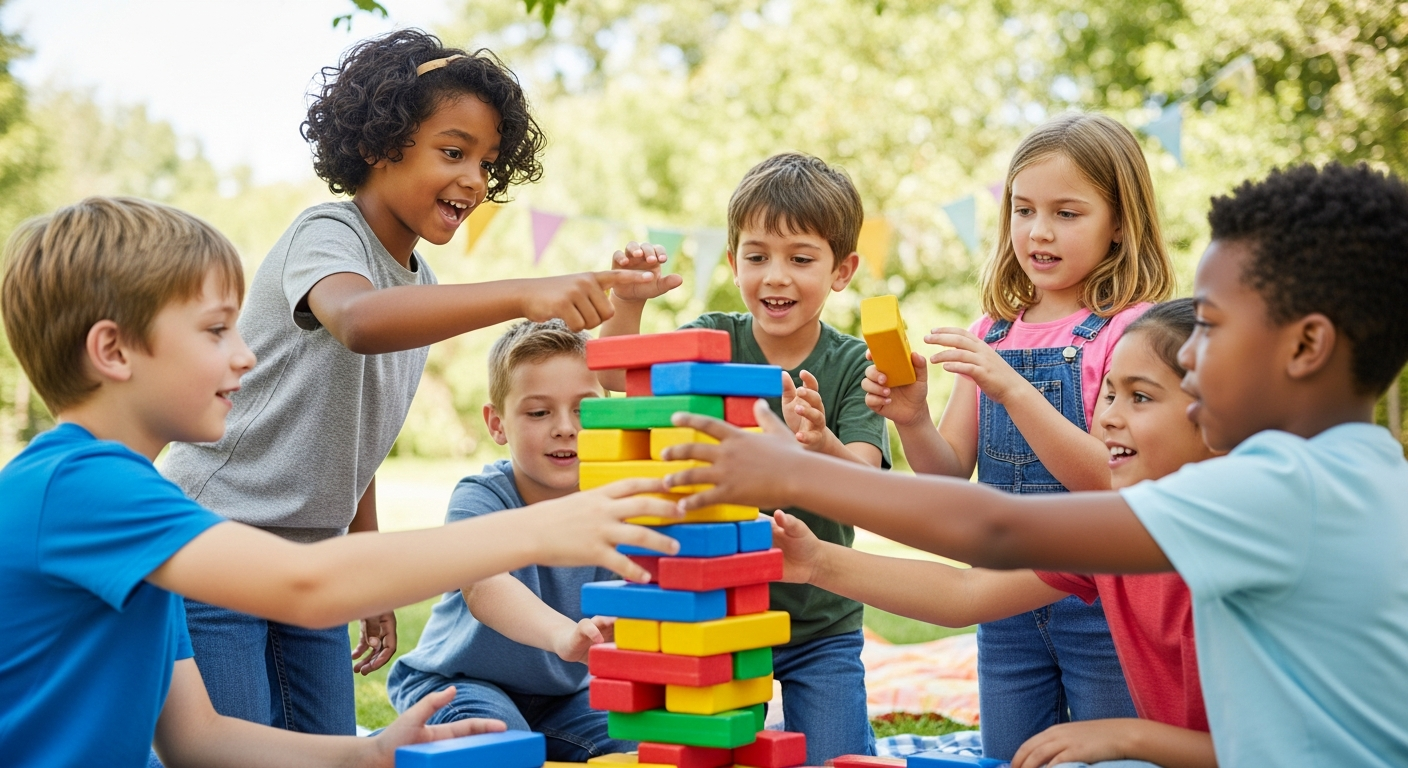
Table of Contents
- Introduction
- Beyond Just Fun: The Hidden Benefits of Birthday Games
- Icebreakers & Get-to-Know-You Games
- High-Energy Outdoor Games
- Creative & Imaginative Play Games
- Classic Party Games with a Twist
- Quieter Games for Wind-Down or Smaller Groups
- Making Every Game a Language-Rich Opportunity
- Speech Blubs: Your Partner in Communication Growth
- Conclusion
- FAQ
Introduction
There’s a unique magic to children’s birthday parties. The anticipation in their eyes, the burst of laughter, the sheer joy of celebrating another year – it’s a canvas for creating cherished memories. But what if these joyful celebrations could be more than just fun? What if every game played, every challenge overcome, also helped build crucial developmental skills, especially in communication? It’s a delightful secret many parents discover: the best birthday games don't just entertain; they educate, foster connection, and subtly nurture growth.
In this comprehensive guide, we'll dive deep into a treasure trove of fun kid birthday games suitable for various ages and party sizes. From energetic outdoor adventures to imaginative indoor quests and beloved classics with a twist, we’ll show you how to transform simple activities into powerful learning opportunities. We'll explore how these games enhance communication, social skills, and cognitive development, and how thoughtful integration of play can empower your child to "speak their minds and hearts." Get ready to plan a birthday bash that’s not only unforgettable but also incredibly enriching!

Beyond Just Fun: The Hidden Benefits of Birthday Games
Birthday parties are natural hubs of social interaction and play, which are fundamental for a child’s development. While the primary goal is often to simply have a good time, the games you choose can offer profound benefits that extend far beyond the party itself.
Fostering Communication Skills
Every game is an opportunity for language development. Children naturally use and expand their vocabulary when:
- Giving and following instructions: "Red light, green light!" "Simon says jump!"
- Expressing emotions: "I won!" "That was frustrating, but I’ll try again."
- Negotiating and cooperating: "Let's all push the parachute up!" "Can I have a turn?"
- Describing actions and objects: "I spy something round and red." "My boat is sailing fast!"
- Asking questions: "Where should I hide?" "What’s next?"
These real-time, dynamic interactions provide a rich environment for practicing speech in a low-pressure, motivating context. For instance, in a game like "Capture the Flag," children are constantly communicating strategy, warning teammates, and celebrating successes, all while building their expressive language skills. Similarly, even simple activities like "Keep It Up" with a balloon can prompt exclamations, counting, and collaborative communication, laying foundational groundwork for more complex interactions.
Cultivating Social-Emotional Learning
Games teach invaluable lessons about being part of a group:
- Turn-taking and sharing: Essential for polite conversation and cooperative play.
- Empathy and sportsmanship: Learning to win graciously and lose with resilience.
- Problem-solving: Working together to figure out clues in a scavenger hunt or how to get the balloon over the net.
- Self-regulation: Managing excitement, frustration, and waiting for one’s turn.
Think about "Sardines," a twist on hide-and-seek. It naturally encourages children to squeeze together and cooperate in hiding, building a sense of camaraderie and shared experience. These social dynamics are crucial for developing emotional intelligence and healthy relationships.

Enhancing Motor Skills
From gross motor movements like running and jumping in "Tag" or a "Silly Sack Race" to fine motor skills like tossing a beanbag in "Cornhole" or holding a pencil to write clues for an "Outdoor Word Game," birthday games engage the body in diverse ways. These physical activities are not only great for burning off energy but also for improving coordination, balance, and dexterity – all of which contribute to a child's overall physical and cognitive development.
Boosting Cognitive Abilities
Many games inherently involve cognitive challenges:
- Memory and recall: Remembering rules, clues, or sequences.
- Sequencing: Following a series of steps in an obstacle course.
- Pattern recognition: Identifying patterns in "Hopscotch" or "Disk Tic-Tac-Toe."
- Strategic thinking: Planning moves in "Capture the Flag" or "NERF Wars."
- Categorization: Grouping items found in a nature scavenger hunt.
Even a seemingly simple game like "Opposites" requires quick thinking and inhibitory control, strengthening executive functions. These cognitive workouts are seamlessly integrated into the fun, making learning feel like play.
At Speech Blubs, we understand the profound power of play in developing communication skills. Our mission is to empower children to "speak their minds and hearts" by blending scientific principles with joyful, engaging experiences. We believe that learning to communicate should be an adventure, full of discovery and connection, just like the best birthday games.
Icebreakers & Get-to-Know-You Games
The start of a party can sometimes be a little shy. These games are perfect for easing guests into the fun, encouraging interaction, and setting a positive tone.
1. I Spy
A classic for all ages, "I Spy" encourages descriptive language and attentive listening.
- How to Play: One person picks an object visible to everyone and says, "I spy with my little eye, something..." followed by a descriptive word (e.g., "green," "round," "bumpy"). Other players take turns guessing.
- Skill Boost: Expands vocabulary (colors, shapes, textures, functions), improves observational skills, and encourages asking clarifying questions.
- Language Tip: For younger children, keep descriptions simple. For older kids, encourage more complex descriptions like "I spy something that starts with the letter 'B' and is usually found in the kitchen." This activity is a fantastic, low-pressure way to practice descriptive language, much like how our "Guess the Sound" activities in Speech Blubs help children build their vocabulary through engaging auditory cues.
2. Follow the Leader with a Twist
This game is simple, gets everyone moving, and can be adapted for language practice.
- How to Play: The birthday child starts as the leader, performing various movements (walking backward, hopping, wiggling, making silly faces). Everyone else lines up behind and mimics their actions exactly.
- Skill Boost: Encourages observation, gross motor skills, and listening to commands.
- Language Tip: The leader can add silly sounds or words to their actions (e.g., "I'm a frog, ribbit ribbit, hopping!"). Each time a new leader takes over, they can announce their new action and accompanying sound, fostering expressive language in a playful way.
3. Parachute Play
A vibrant parachute (or even a large sheet) can create instant collaborative fun.
- How to Play: Kids hold the edges of the parachute, working together to make waves, raise it high, or shake objects placed on top.
- Skill Boost: Promotes teamwork, coordination, and following multi-step instructions ("Lift it up! Now down! Shake, shake, shake!").
- Language Tip: Narrate the actions: "We're making a big wave!" "The balls are flying!" Ask, "What color ball do you see?" or "What should we do next?"
High-Energy Outdoor Games
When the weather's good and the kids are buzzing with excitement, outdoor games are perfect for burning off energy and encouraging lively interaction.
4. Red Light, Green Light
A timeless classic for a reason!
- How to Play: One person is the "stoplight," facing away from the other players who line up at a starting point. The stoplight calls out "Green Light!" and players move forward. When the stoplight yells "Red Light!" and turns around, players must freeze. Anyone caught moving goes back to the start. The first to touch the stoplight wins.
- Skill Boost: Develops listening skills, impulse control, and gross motor coordination.
- Language Tip: The "stoplight" can use different tones for "green" (excitement) and "red" (firmness), enhancing auditory processing. Encourage players to shout "Go!" or "Freeze!" as they play, reinforcing these command words.
5. Capture the Flag
For older, more strategic players, this game is a fantastic team-builder.
- How to Play: Divide players into two teams. Each team has a "flag" (a bandana, towel, etc.) hidden in their territory. The goal is to capture the opposing team's flag and bring it back to your base without being tagged. Rules for tagging (frozen, out, join other team) can vary.
- Skill Boost: Encourages teamwork, strategic thinking, problem-solving, and constant verbal and non-verbal communication within teams.
- Language Tip: Before the game, have teams discuss strategy using descriptive language ("You go around the tree, I'll go through the bushes"). During play, shouting warnings ("Look out!") or calls for help ("Help me!") builds crucial expressive skills.
6. Tug-of-War
A simple yet effective test of strength and teamwork.
- How to Play: Two teams pull on opposite ends of a rope, trying to pull the center marker past a designated line.
- Skill Boost: Promotes teamwork, physical strength, and following simple instructions.
- Language Tip: Encourage cheers and chants ("Pull! Pull! Go team!"), fostering collective vocalizations and team spirit.
7. Silly Sack Race
Great for laughs and burning energy!
- How to Play: Kids stand in burlap sacks (or pillowcases for smaller children) and hop from a starting line to a finish line.
- Skill Boost: Enhances gross motor skills, balance, and coordination.
- Language Tip: Use descriptive words for the hopping: "You're hopping fast!" "What a big jump!" Narrate the race: "On your marks, get set, go!"
8. DIY Obstacle Course
Transform your backyard into an adventure zone!
- How to Play: Use household items like pillows, hula hoops, tunnels, ropes, and buckets to create a course. Kids complete each obstacle, racing against the clock or each other.
- Skill Boost: Improves motor planning, problem-solving, sequencing, and following multi-step directions.
- Language Tip: Have each child describe their strategy or what they are doing at each obstacle ("I'm crawling under the blanket!"). Use action words and prepositions: "Jump over the rope," "Crawl through the tunnel." For a child who loves animals, an obstacle course can be framed as an adventure, much like exploring our "Animal Kingdom" section in Speech Blubs, which offers a fun, motivating way to practice sounds like "moo" and "baa" while imagining different animal movements.
9. Water Games (Slip and Slide, Water Balloon Toss, Sprinkler Tag)
Perfect for summer birthdays!
- How to Play:
- Slip and Slide: A long plastic sheet with a hose running over it for slippery fun.
- Water Balloon Toss: Teams toss water balloons back and forth, stepping back after each successful catch until one team drops or breaks a balloon.
- Sprinkler Tag: One person is "it" and tries to tag others as they run through sprinklers.
- Skill Boost: Gross motor skills, hand-eye coordination (water balloon toss), sensory exploration.
- Language Tip: These games naturally elicit exclamations ("Splash!," "Whoosh!," "Brrr!"), descriptions of sensations ("It's cold!"), and shouts of joy. Count the successful tosses or the number of kids tagged.
10. NERF Wars
An exciting, active game for kids who love action.
- How to Play: Set up a "battlefield" with obstacles (cardboard boxes, outdoor furniture). Kids, armed with NERF blasters and darts, try to "tag" opponents. Establish clear rules for "out" and "re-spawn."
- Skill Boost: Encourages strategic thinking, teamwork, spatial awareness, and problem-solving.
- Language Tip: Promotes strategic communication ("I'll provide cover!," "He's behind the tree!"), action verbs ("shoot," "duck," "reload"), and positional words.
Creative & Imaginative Play Games
These games spark creativity, encourage storytelling, and provide rich opportunities for descriptive language.
11. Scavenger Hunt
A fantastic way to get kids exploring and problem-solving.
- How to Play: Create a list of objects for kids to find (nature items, specific toys, etc.) or a series of clues leading to a "treasure." Kids work individually or in teams.
- Skill Boost: Enhances observational skills, problem-solving, reading comprehension (if clues are written), and teamwork.
- Language Tip: Read clues aloud and encourage children to describe what they are looking for or what they have found. "I found a spiky pinecone!" "The next clue is under the bench!" This is a wonderful way to build vocabulary and descriptive language in context.
12. Charades
A classic game that relies on non-verbal communication and imaginative thinking.
- How to Play: Write down various words or phrases (animals, actions, movie titles) on slips of paper. One player silently acts out a word, and others guess.
- Skill Boost: Develops non-verbal communication, imaginative play, vocabulary, and deductive reasoning.
- Language Tip: When guessing, encourage full sentences ("Is it a cat?"). After a correct guess, discuss how the actions conveyed the word, reinforcing the connection between action and meaning.
13. Outdoor Word Game
For older children, this combines physical play with literacy.
- How to Play: Create large letter squares on Masonite or cardboard. Players start with a set number of letters and take turns spelling words on the ground, extending previous words.
- Skill Boost: Promotes letter recognition, spelling, vocabulary, and strategic thinking.
- Language Tip: As children place letters, encourage them to sound out words or explain their choices, building phonological awareness and verbal reasoning.
14. Build-Your-Own Boat Races
A hands-on activity that leads to imaginative races.
- How to Play: Provide materials like pool noodle sections, skewers, and washi tape for kids to design and build their own miniature boats. Then, race them in a kiddie pool or stream.
- Skill Boost: Fosters creativity, fine motor skills, problem-solving (designing a boat that floats), and a sense of accomplishment.
- Language Tip: Encourage children to describe their boat's design, name it, and narrate its race ("My boat is fast!"). Use comparative language ("Yours is bigger than mine!"). Like building these boats, learning to speak is a creative process, and at Speech Blubs, we encourage children to "speak their minds and hearts" by making communication a joyful creation.
15. Treasure Dig
A sensory and discovery-focused game.
- How to Play: Fill a sandbox or large bin with sand. Hide small toys (plastic animals, coins, gems) and provide shovels. Kids dig for buried treasure.
- Skill Boost: Fine motor skills, sensory exploration, and imaginative play.
- Language Tip: As kids find items, ask them to describe what they found, its color, shape, or what it might be used for. ("I found a shiny gold coin!").
Classic Party Games with a Twist
Sometimes the most beloved games are the simplest, offering consistent fun and opportunities for development.
16. Simon Says / Opposites
These games are excellent for listening and cognitive flexibility.
- How to Play:
- Simon Says: A leader gives instructions, but players only follow if the phrase "Simon says" precedes it.
- Opposites: The leader gives an instruction, and players must do the opposite action (e.g., "stand up" means "sit down").
- Skill Boost: Sharpens listening skills, encourages attention to detail, builds impulse control, and develops understanding of antonyms and commands.
- Language Tip: The leader can use a variety of verbs and adverbs to expand vocabulary. "Simon says slowly touch your nose!" "Opposites: loudly whisper!"
17. Hopscotch
A timeless game that promotes counting and coordination.
- How to Play: Draw a hopscotch grid with chalk. Players toss a marker into a square, hop through the grid (skipping the marked square), pick up the marker on the way back, and continue.
- Skill Boost: Improves gross motor skills, balance, number recognition, and sequencing.
- Language Tip: Count aloud the numbers in the squares or the number of hops. Describe the actions: "You're hopping on one foot!" "Now you're jumping with both feet!"
18. Keep It Up
Simple, cooperative fun with a balloon.
- How to Play: Players work together to keep a balloon from touching the ground, usually by batting it with their hands.
- Skill Boost: Encourages cooperation, hand-eye coordination, and active participation.
- Language Tip: Count how many times the balloon stays up. Use directional words ("Up! Down! Over there!"). Encourage cheers and simple directives to teammates.
19. Hide and Seek / Sardines
Classic games of stealth and discovery.
- How to Play:
- Hide and Seek: One person counts while others hide. The counter searches.
- Sardines: One person hides, and everyone else searches. When a player finds the hider, they join them in the hiding spot until everyone is squeezed in like sardines.
- Skill Boost: Develops spatial reasoning, problem-solving, patience, and auditory tracking.
- Language Tip: Use prepositions to describe hiding spots: "I hid behind the couch," "They are under the table." Ask questions about strategies: "Where do you think they are?"
20. Twister
A game that ties you in knots of laughter!
- How to Play: Players spin a wheel that dictates which hand or foot they place on a specific colored dot on the mat.
- Skill Boost: Improves body awareness, color recognition, balance, flexibility, and following multi-step directions.
- Language Tip: Call out the body parts and colors clearly. Encourage kids to name the colors and body parts as they play, reinforcing vocabulary.
Quieter Games for Wind-Down or Smaller Groups
Not every game needs to be high-energy. These options are great for smaller groups, winding down, or times when you need a calmer activity.
21. Truth or Dare (Age-Appropriate)
Ensure truths and dares are lighthearted and fun for the age group.
- How to Play: Write age-appropriate truths and dares on slips of paper. Players take turns choosing one.
- Skill Boost: Encourages social interaction, expressing thoughts (truths), imaginative play (dares), and understanding social boundaries.
- Language Tip: Promotes descriptive language when explaining a truth or describing a dare.
22. Wooden Block Stacking Game (Giant Jenga)
A game of steady hands and careful planning.
- How to Play: Use large wooden blocks (like a giant Jenga set). Players take turns removing one block from the tower and placing it on top, trying not to make the tower fall.
- Skill Boost: Develops fine motor skills, strategic thinking, patience, and spatial reasoning.
- Language Tip: Encourage players to articulate their strategy ("I'm going to take the middle one") or describe the tower's precarious state ("It's wobbly!").
23. Monkey in the Middle
A simple throwing and catching game.
- How to Play: One player is the "monkey" in the middle, while others stand in a circle and toss a ball over the monkey's head. The monkey tries to catch it.
- Skill Boost: Improves hand-eye coordination, throwing and catching skills, and turn-taking.
- Language Tip: Call out names before tossing the ball. Use directional words ("Over the monkey!", "Catch it!").
24. Freeze Dance
Gets kids moving, then requires stillness.
- How to Play: Play music and let kids dance freely. When the music stops, everyone must freeze like a statue. Anyone who moves is out.
- Skill Boost: Encourages listening skills, body awareness, and self-control.
- Language Tip: Talk about different dance moves ("You're twirling!", "That's a silly dance!") and describe the "statues" when the music stops. For moments when you need a structured, calming activity that still builds skills, Speech Blubs provides "smart screen time" that is an active alternative to passive viewing.
Making Every Game a Language-Rich Opportunity
The real magic happens when you, as a parent or caregiver, actively engage in the games, turning every moment into a chance for language development.
- Model Language: Narrate what’s happening. "I see the red ball!" "You're running so fast!" "The tower is getting tall!" Use new vocabulary naturally within context.
- Ask Open-Ended Questions: Instead of "Did you have fun?" try "What was your favorite part of the game?" or "What do you think will happen next?" Encourage more than a "yes" or "no" answer.
- Encourage Descriptions: When a child finds an item in a scavenger hunt, prompt them: "Tell me about what you found." "What does it feel like?"
- Use Actions and Gestures: Pair words with movements. Point to the "stop" sign when saying "Red Light." Use big gestures for "Up!" and "Down!" This multi-sensory approach helps solidify word meaning.
- Focus on Process, Not Just Outcome: Celebrate effort and participation, not just winning. "You worked so hard to keep that balloon up!" "I love how you helped your friend." This reduces pressure and encourages continued engagement.
This hands-on, communicative approach is at the core of Speech Blubs. We believe in harnessing the power of play and interaction to unlock a child's full communication potential. Our methodology is rooted in science, leveraging "video modeling" where children learn by watching and imitating their peers – a natural, effective, and joyful way to build speech and language skills. Our founders, all with personal experiences of speech challenges, created Speech Blubs to be the immediate, effective, and joyful solution they wished they had. It's not just an app; it's a powerful tool for family connection, highly rated for its scientific efficacy on the MARS scale. Discover the research behind Speech Blubs and see what other parents are saying about their child's incredible progress.
Speech Blubs: Your Partner in Communication Growth
While birthday games provide wonderful opportunities for incidental learning, sometimes children benefit from a more structured, yet equally engaging, approach to communication development. That's where Speech Blubs comes in. Our mission is to empower children to "speak their minds and hearts" by transforming screen time into "smart screen time" – a screen-free alternative to passive viewing that actively promotes speech and language skills.
Our unique "video modeling" methodology allows children to learn by observing and imitating their peers, leveraging the power of mirror neurons to facilitate natural communication development. It’s a playful and effective way to build vocabulary, articulation, and conversational skills, making learning feel like fun. We’re committed to providing an immediate, effective, and joyful solution for the 1 in 4 children who need speech support.
Transparent Pricing for Your Family
We believe in making high-quality speech support accessible. We offer two clear pricing plans:
- Monthly Plan: For just $14.99 per month, you get access to all core Speech Blubs features.
- Yearly Plan: Our best value, at only $59.99 per year. This breaks down to just $4.99 per month, meaning you save 66% compared to the monthly plan!
Unlock More with the Yearly Plan
Choosing the Yearly Plan isn't just about saving money; it’s about getting the full, enhanced Speech Blubs experience:
- 7-Day Free Trial: Only the Yearly plan includes a 7-day free trial, giving you a full week to explore all the amazing features and see the joy it brings to your child. The Monthly plan does not include a free trial.
- Extra Reading Blubs App: Get complimentary access to our Reading Blubs app, designed to complement your child’s learning journey.
- Early Access & Priority Support: Enjoy early access to new updates and a dedicated 24-hour support response time for any questions you may have.
We highly recommend the Yearly plan to get the complete suite of features and the incredible value it offers. Ready to empower your child's voice and give them the gift of confident communication? Download Speech Blubs now for a 7-day free trial on the App Store or Google Play! You can also create your account and begin your journey towards joyful communication today. Unsure if your child could benefit? Take our quick 3-minute preliminary screener to get a simple assessment and a free 7-day trial.
Conclusion
From the boisterous laughter of a sack race to the quiet concentration of a scavenger hunt, fun kid birthday games are more than just entertainment. They are vibrant arenas where children practice crucial communication skills, learn social-emotional lessons, hone motor abilities, and flex their cognitive muscles. By thoughtfully selecting games and engaging actively with your child during play, you transform every birthday celebration into a powerful opportunity for growth and connection.
Remember, the goal isn't just to entertain, but to enrich. Embrace the mess, cherish the giggles, and lean into the learning that naturally unfolds. With this guide, you’re equipped to plan an unforgettable party that leaves your child with not just amazing memories, but also a stronger voice and greater confidence.
Ready to transform playtime into powerful learning opportunities and further support your child's communication journey? Start your 7-day free trial today! Choose the Yearly plan to unlock all features, the extra Reading Blubs app, and superior value. Give your child the gift of confident communication – a gift that lasts a lifetime.
FAQ
Q1: What age group are these games suitable for?
A1: The games listed here cover a wide range of ages, from toddlers (e.g., "I Spy," "Pop the Bubbles") to early teens (e.g., "Capture the Flag," "NERF Wars"). Always consider the developmental stage and interests of the majority of your party guests. Many games can be adapted by simplifying rules or increasing complexity.
Q2: How can I encourage my shy child to participate in games?
A2: For a shy child, start with low-pressure, familiar games like "Follow the Leader" or "Parachute Play" where participation is less intimidating. Offer them a special role, like helping you set up or being the first "Simon" for "Simon Says." Pairing them with a confident friend or a trusted adult can also help. Focus on small successes and acknowledge their effort, rather than forcing them to join in every game.
Q3: How do birthday games help with speech development?
A3: Birthday games naturally create rich environments for speech development by encouraging children to use language for various purposes: following instructions, expressing emotions, asking questions, describing objects and actions, and negotiating with peers. The fun, interactive nature of games makes communication practice enjoyable and motivating, reinforcing vocabulary, articulation, and social communication skills in real-time contexts.
Q4: How can Speech Blubs further support my child's communication skills?
A4: Speech Blubs complements the benefits of traditional games by providing a structured, engaging, and science-backed approach to speech and language development. Through our unique "video modeling" method, children learn by imitating peers, which is highly effective. The app offers a wide range of activities targeting articulation, vocabulary, and social skills, making screen time productive and fun. It's a powerful supplement to your child's overall development plan and, when applicable, professional therapy, designed to empower them to "speak their minds and hearts." Visit our homepage to learn more.
About the author