
Fun Kid Card Games: Connect, Play, & Grow Together
 By Speech Blubs Team•Jan 19, 2026•26 min.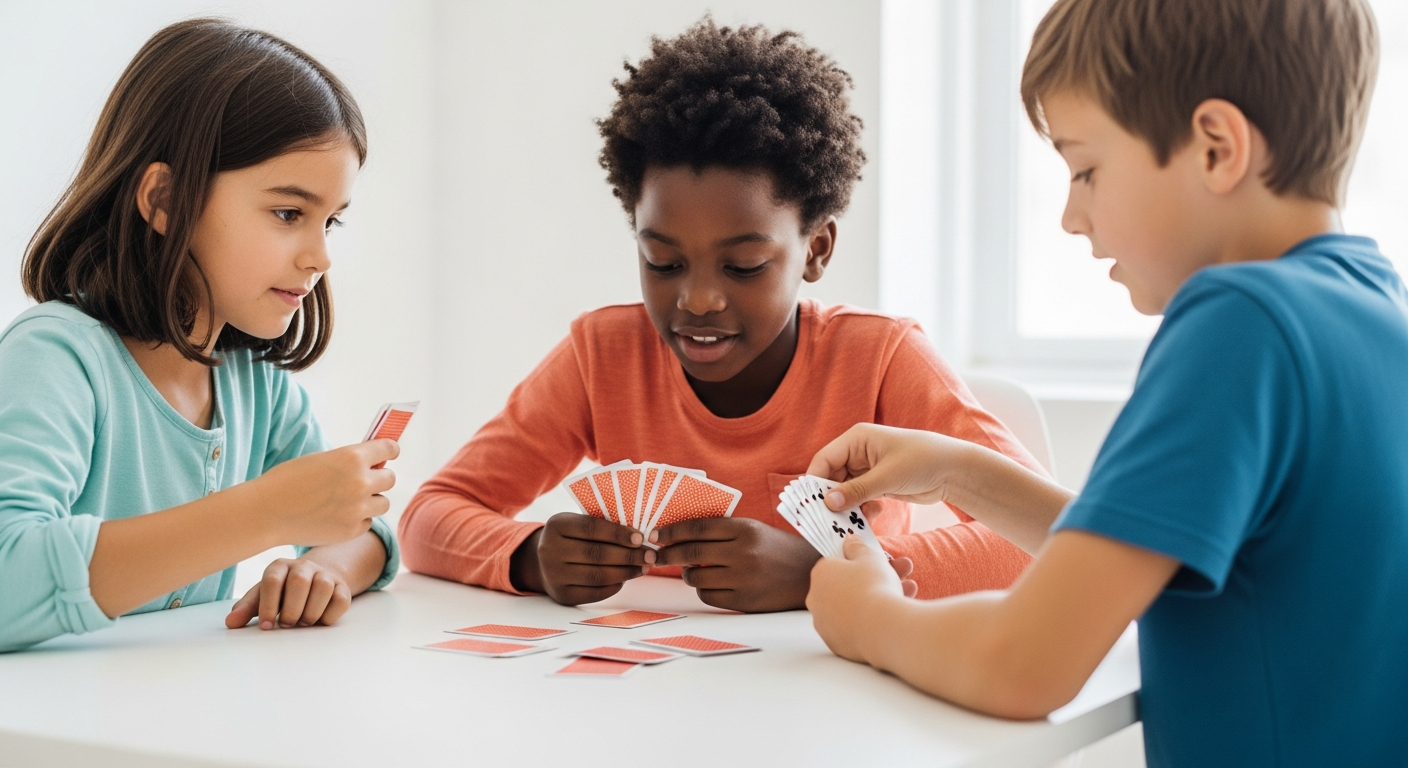
Table of Contents
- Introduction
- Why Card Games are Essential for Child Development
- Choosing the Right Card Game: Age-Appropriate Play
- Classic Fun Kid Card Games
- Less Common But Equally Fun Card Games
- Integrating Speech & Language Learning into Card Games
- Beyond the Cards: Speech Blubs as Your Communication Partner
- Unlock Your Child's Full Potential with Speech Blubs: Pricing & Value
- Conclusion
- FAQ
Imagine a quiet afternoon, a burst of unexpected laughter, or the concentrated furrow of a child's brow as they strategize their next move. This isn't a scene from a high-tech game console; it's the timeless magic of a simple deck of cards. In an age dominated by screens and digital distractions, the humble card game stands out as a powerful, screen-free antidote, offering a rich tapestry of learning, connection, and pure fun. Far from being just a pastime, these games are miniature classrooms, teaching everything from basic counting and pattern recognition to complex social skills and emotional regulation. At Speech Blubs, we believe in empowering children to "speak their minds and hearts," and we've found that the joy of a good card game perfectly complements our mission by fostering communication in natural, engaging ways. This post isn't just a list; it's your guide to unlocking endless hours of meaningful play with fun kid card games that build foundational skills and create cherished family memories.

Introduction
Have you ever noticed how quickly a child can become engrossed in a simple activity, especially when it involves shared attention and a clear goal? While the digital world offers many attractions, there's an unparalleled charm and educational value in the tangible interaction of a card game. From teaching number sequencing to fostering patience and the art of friendly competition, card games are a treasure trove of developmental benefits often overlooked. They offer a unique blend of cognitive challenge, social interaction, and emotional growth, all wrapped up in an accessible, portable package.
In this comprehensive guide, we'll dive deep into the world of fun kid card games. We'll explore why these classic activities are so vital for a child's development, offer age-appropriate recommendations, and provide detailed instructions for a variety of beloved and lesser-known games. Most importantly, we'll show you how to leverage these playtimes to enhance language skills and strengthen family bonds, perfectly aligning with our commitment at Speech Blubs to nurture every child's communication journey. Get ready to shuffle up, deal out, and discover a world of connection and learning, one card at a time.
Why Card Games are Essential for Child Development
A simple deck of cards holds an extraordinary power to stimulate various aspects of a child's growth. It's more than just a way to pass the time; it's a dynamic tool for learning and connection.
Beyond Entertainment: Language, Social, Cognitive Skills
Card games are multi-faceted developmental engines. On a cognitive level, children learn critical thinking, problem-solving, memory retention (think "Concentration"), and strategic planning. They practice numerical literacy, understanding sequences, matching patterns, and probability in a highly engaging context.
From a language perspective, card games are goldmines. Children naturally use descriptive language ("I have a red queen!"), ask questions ("Do you have any threes?"), give instructions, and narrate their actions. This active verbal engagement is crucial for vocabulary expansion, sentence formation, and conversational turn-taking – skills we at Speech Blubs are passionate about nurturing. For a child working on early word acquisition, a game like Go Fish becomes a fun opportunity to practice saying numbers and suits, repeatedly and joyfully.

Socially and emotionally, card games teach invaluable lessons. Children learn how to take turns, share, manage wins and losses gracefully, and understand non-verbal cues. They develop patience, sportsmanship, and the ability to follow rules. These interactions build empathy and provide opportunities for emotional expression, whether it's the excitement of winning or the frustration of losing, all within a safe, playful environment. This ability to articulate feelings and understand others is core to our mission to help children "speak their minds and hearts."
Screen-Free Fun & Family Connection
In an increasingly digital world, card games offer a refreshing screen-free alternative. They pull families away from individual devices and bring them together around a table, fostering genuine interaction and shared experiences. These moments of focused, face-to-face play are vital for strengthening family bonds and creating lasting memories. At Speech Blubs, we champion "smart screen time" that is interactive and educational, but we also deeply value and encourage activities that promote direct, personal connection. Card games are a perfect example of how play can be both simple and profoundly enriching for the entire family. They are a powerful tool for family connection, offering a screen-free alternative to passive viewing experiences.
Building Confidence & Emotional Regulation
Every successful play in a card game, every correctly identified pair, every strategic move, builds a child's confidence. They see their efforts lead to positive outcomes, reinforcing their self-esteem. Conversely, losing a game provides a safe space to learn about emotional regulation – understanding that it's okay to feel disappointed, but also how to cope with those feelings and try again. These experiences are fundamental for building resilience and a healthy self-concept.
The Power of Imitation in Learning
Card games often involve observing others, understanding their moves, and imitating strategies. This natural process of imitation is incredibly powerful for learning. It mirrors our unique "video modeling" methodology at Speech Blubs, where children learn complex communication skills by watching and imitating their peers. Just as a child observes an older sibling's strategy in "Rummy," our app uses the engaging power of real kids modeling speech and language in fun, interactive ways. This approach, backed by scientific principles, leverages mirror neurons to make learning intuitive and effective. Our method is backed by science, placing us in the top tier of speech apps worldwide.
Choosing the Right Card Game: Age-Appropriate Play
Selecting the perfect card game depends heavily on your child's age and developmental stage. Matching the game to their abilities ensures engagement and minimizes frustration.
Toddlers & Preschoolers (3-5 years): Simple Matching, Turn-Taking, Basic Vocabulary
For our youngest players, the focus is on foundational skills. Games that require simple matching, color recognition, and basic counting are ideal. The rules should be easy to grasp, and gameplay should be relatively quick to accommodate shorter attention spans. These games are excellent for practicing early vocabulary and the essential social skill of turn-taking.
Early Elementary (6-8 years): Counting, Simple Strategy, Social Rules
As children grow, they can handle slightly more complex rules and begin to develop basic strategies. Games involving sequential numbers, simple addition/subtraction, and a greater emphasis on memory will challenge them appropriately. This age group also benefits from games that reinforce social rules and sportsmanship.
Older Kids (9+ years): Complex Strategy, Bluffing, Problem-Solving
For pre-teens and older, games that involve more intricate strategies, critical thinking, and even an element of bluffing become highly engaging. These games encourage advanced problem-solving, deductive reasoning, and understanding subtle social cues, preparing them for more complex social interactions.
Classic Fun Kid Card Games
These are the timeless favorites that have graced kitchen tables for generations, each offering its own unique blend of fun and learning.
Go Fish!
- Age: 5+
- Players: 2-6
- Cards: Standard 52-card deck
- Skills: Asking questions, memory, number recognition, verbalizing requests.
- How to Play: The dealer gives each player 7 cards (or 5 for 4+ players). The rest form the "fish pond." Players take turns asking another player for specific cards (e.g., "Do you have any kings?"). If they do, those cards are handed over, and the asker gets another turn. If not, the player says "Go Fish!", and the asker draws from the pond. If the drawn card matches their request, they get another turn. The goal is to collect "books" of four matching cards. The first player to run out of single cards, or the one with the most books, wins.
- Language Boost: Perfect for practicing direct questions ("Do you have X?") and affirmative/negative answers ("Yes, I do!" / "No, Go Fish!"). It encourages clear articulation and active listening.
Crazy Eights
- Age: 5+
- Players: 2-4
- Cards: Standard 52-card deck
- Skills: Matching, planning, color/suit recognition, quick decision-making.
- How to Play: Each player is dealt 5-7 cards. The remaining deck is facedown, and one card is turned up to start the discard pile. Players take turns playing a card that matches the top card of the discard pile by either suit or number. If a player doesn't have a match, they draw cards from the deck until they can play. Eights are wild cards and can be played on any card, allowing the player to change the suit. The first player to empty their hand wins.
- Language Boost: Great for verbalizing choices ("I'm playing a red seven on your red two!"), identifying colors and numbers, and negotiating when an eight is played ("I'm changing it to spades!").
War
- Age: 6+
- Players: 2
- Cards: Standard 52-card deck
- Skills: Number comparison, hierarchy, turn-taking, basic counting.
- How to Play: All cards are dealt face down, evenly between two players. Players simultaneously turn over the top card of their piles. The player with the higher-ranking card takes both cards and adds them to the bottom of their pile. If cards of the same value are played, it's "War!" Each player then places two cards face down, followed by one card face up. The player with the higher face-up card wins all six cards. The game ends when one player collects all the cards.
- Language Boost: Simple comparisons ("My king is higher than your five!"), practicing number names, and expressing excitement or dismay.
Old Maid
- Age: 5+
- Players: 3+
- Cards: Standard 52-card deck (one queen removed, leaving one 'Old Maid')
- Skills: Matching, social interaction, dealing with uncertainty, light strategy.
- How to Play: Deal all cards. Players secretly make pairs from their hand and place them face up on the table. The player to the dealer's left offers their hand face down to the player on their left, who draws one card. If the drawn card makes a pair in their hand, they lay it down. They then offer their hand to the next player. The game continues until all pairs are made, and one player is left holding the single "Old Maid" card, losing the game.
- Language Boost: Encourages polite requests ("Pick a card, any card!"), identification of pairs, and understanding who is "left" with the card.
Concentration/Memory
- Age: 3+
- Players: 2+
- Cards: Standard 52-card deck (or a smaller subset for younger kids), ensuring an even number of cards.
- Skills: Memory, pattern recognition, visual discrimination, turn-taking.
- How to Play: Shuffle cards and spread them face down in a grid. Players take turns flipping over two cards. If the cards match, the player keeps the pair and gets another turn. If they don't match, they flip them back over, trying to remember where each card is. The player with the most pairs at the end wins.
- Language Boost: Describing cards ("It's the seven of hearts!"), spatial language ("It was in the top right!"), and verbalizing "match!" or "no match!"
Snap
- Age: 6+
- Players: 2+
- Cards: Standard 52-card deck (two decks for 3+ players)
- Skills: Speed, observation, impulse control, quick reflexes.
- How to Play: Deal all cards face down into individual piles. Players take turns turning over their top card and placing it face up beside their pile. If a player notices that the card just played matches the top card of any other face-up pile, they shout "Snap!" The first player to shout "Snap!" wins both matching piles and adds them to the bottom of their face-down pile. If two players shout "Snap!" simultaneously, those cards go into a "Snap Pool" in the center. The game continues until someone snaps a card matching the pool, winning all those cards. The winner is the player with all the cards.
- Language Boost: Practicing quick identification of numbers and suits, calling out "Snap!" clearly, and explaining why they snapped.
Rummy
- Age: 7+
- Players: 2-6
- Cards: Standard 52-card deck
- Skills: Pattern recognition, strategy, sequencing, planning, arithmetic.
- How to Play: Deal 10 cards to two players, 7 for three-four players, or 6 for five-six players. The rest form a face-down "stock" pile, with one card turned up to start the "discard" pile. The goal is to form "melds" (sets of 3-4 of a kind, or runs of 3+ cards of the same suit in order). Players draw one card (from stock or discard) and then discard one. Once a player has a meld, they can lay it down. They can also "lay off" cards onto existing melds. The first player to get rid of all their cards wins the round. The game is usually won by the first player to win a set number of rounds.
- Language Boost: Explaining strategy, naming card combinations ("I have a run of 3-4-5 of clubs!"), and asking about available cards.
I Doubt It (or "Bluff")
- Age: 6+
- Players: 3+ (6-12 ideal)
- Cards: Standard 52-card deck
- Skills: Bluffing, critical thinking, observation, social cues, memory.
- How to Play: Deal all cards as evenly as possible. The player to the left of the dealer starts by placing cards face down in the center, announcing they are "Aces" (e.g., "Two aces"). The next player places "Twos," then "Threes," and so on, cycling through the ranks. Players must announce the current rank, but they don't have to play those cards (this is where the bluffing comes in). If a player suspects someone is lying, they can call "I Doubt It!" If the player was indeed lying, they pick up the entire discard pile. If they were telling the truth, the accuser picks up the pile. The first player to get rid of all their cards wins.
- Language Boost: Practicing expressive language, using tone to convey honesty or deceit, and articulating suspicion. For a child working on social communication, this game is fantastic for learning to read facial expressions and vocal intonation.
Less Common But Equally Fun Card Games
Branch out from the classics with these engaging alternatives that offer fresh challenges and new ways to play.
Baloney (aka "BS")
- Age: 7+
- Players: 3-6
- Cards: Standard 52-card deck
- Skills: Bluffing, reading opponents, strategic deception, memory.
- How to Play: This game is identical to "I Doubt It" but often uses "Baloney!" as the call. It hones children's ability to bluff and detect when others are not being truthful, while also teaching them to manage their own "poker face."
Kemps
- Age: 8+
- Players: 4-10 (even number, played in teams of 2)
- Cards: Two standard 52-card decks
- Skills: Teamwork, non-verbal communication, observation, speed.
- How to Play: Players form teams of two, sitting opposite each other. Four cards are dealt face up in the center. Each player is dealt 4 cards. The goal is for a team to get one player to collect four of a kind without the other team realizing. Players simultaneously swap cards from their hand with the four communal cards, trying to get a set. Once a player has four of a kind, they must subtly signal their partner (without speaking). If a partner sees their teammate signal, they shout "Kemps!" to win the round. If an opposing team suspects a signal, they can shout "Cut!" If a signal was indeed given, the "Cut!" team wins. If not, the "Cut!" team loses. This game truly teaches the importance of teamwork and paying attention to subtle cues.
Speed Card Game
- Age: 6+
- Players: 2
- Cards: Standard 52-card deck
- Skills: Quick decision-making, sequencing, reflexes, card hierarchy.
- How to Play: Each player gets 20 cards face down. In the middle, two cards are dealt face up. Each player also has a "stock" pile of 5 cards. Players rapidly play cards from their hand onto the central piles, one higher or one lower than the current card. If a player runs out of moves, they play from their stock pile. The first player to play all their cards wins. It's a fast-paced game great for siblings who love to compete and helps kids quickly learn the order of cards.
Spoons
- Age: 7+
- Players: 3-13 (one less spoon than players)
- Cards: One standard 52-card deck per 4 players
- Skills: Observation, speed, matching, quick reflexes.
- How to Play: Place spoons in the center, one fewer than the number of players. Each player is dealt 4 cards. The goal is to collect four of a kind. The dealer takes one card from the deck, decides whether to keep it or pass it on. They discard one card to the left, and play continues rapidly around the table. As soon as a player gets four of a kind, they discreetly grab a spoon. Once one spoon is taken, all other players scramble to grab a spoon. The player left without a spoon is out. This game is intense and hilarious, like a card game version of musical chairs, and excellent for developing rapid observation skills.
Spit
- Age: 6+
- Players: 2
- Cards: Standard 52-card deck
- Skills: Speed, sequencing, quick reflexes, pattern recognition.
- How to Play: Very similar to Speed. The deck is divided equally. Each player sets up their tableau with five piles (1st pile has 1 card, 2nd has 2, etc., all face down except the top card of each pile). The remaining cards become two "Spit" piles. Players say "one, two, three, SPIT!" and simultaneously turn over the top card of their Spit piles. Players then quickly play cards from their tableau onto either Spit pile if it is one higher or one lower. The goal is to get rid of all tableau cards. The first player to do so collects the smaller Spit pile, reshuffles, and the game continues. This high-energy game is a blast for kids to yell out loud and encourages quick strategic thinking.
Golf Card Game
- Age: 8+
- Players: 2-4
- Cards: One or two standard 52-card decks (depending on players)
- Skills: Strategy, memory, risk assessment, numerical value comparison.
- How to Play: The goal is to get the lowest score over 9 or 18 "holes" (rounds). Each player is dealt 4 cards face down and arranges them in a 2x2 grid without looking. Two more cards are dealt face up to start the discard pile, the rest form the draw pile. On a turn, a player draws a card (from draw or discard pile). They can either swap it with one of their face-down cards (revealing the swapped card to all) or discard it. Cards have point values (Aces=1, 2s= -2, 3-9=face value, 10-K=10, Jokers= -5). The round ends when a player says "Knock" after their turn. All other players get one more turn. Points are tallied, and the lowest score wins. This game teaches kids about tactical play and numerical comparison in a fun, competitive format.
Garbage Card Game
- Age: 6+
- Players: 2-4
- Cards: Standard 52-card deck (two decks for 3-4 players)
- Skills: Sequencing, number recognition, patience, visual memory.
- How to Play: Each player is dealt 10 cards face down, arranged in two rows of five, representing cards 1 (Ace) through 10. The goal is to replace these face-down cards with the correct ascending sequence (Ace-10). The remaining cards form the draw pile. Players draw a card. If it's an Ace-10, they place it on its corresponding spot, flipping the face-down card there face up. This newly flipped card might then be placed in its own spot. If a King is drawn, it's wild and can replace any card. If a Queen or Jack is drawn, or a card for a spot already filled, it's discarded. The first player to complete their Ace-10 sequence wins.
Kings In The Corners
- Age: 8+
- Players: 2-4
- Cards: Standard 52-card deck
- Skills: Strategy, spatial reasoning, planning, quick thinking.
- How to Play: Each player is dealt 7 cards. Four cards are placed face up in a cross shape in the center of the table. These are the "base" cards. The goal is to get rid of all your cards. Players take turns playing cards from their hand onto the base cards, building downwards in alternating colors (e.g., a black 7 on a red 8). Kings can be played on any of the four "corner" spots (imagine diagonals from the cross). If a player can't make a move, they draw three cards. This game is highly strategic and involves thinking several steps ahead.
President Card Game (aka "Asshole")
- Age: 9+
- Players: 3-7
- Cards: Standard 52-card deck (multiple decks for more players)
- Skills: Strategy, hierarchy, tactical play, bluffing, understanding social status in a game.
- How to Play: The goal is to get rid of all your cards first. Cards rank from 3 (lowest) to 2 (highest). Players play cards in "tricks," playing singles, pairs, triples, or quadruples of the same rank, which must be higher than the previous play. If a player cannot play, they pass. Once all players pass, the trick ends, and the last player to play starts a new trick. The first player to empty their hand becomes the "President," the next the "Vice President," and so on, down to the "Asshole." In subsequent rounds, the Asshole must give their two best cards to the President, receiving their two worst cards in return. This game is excellent for teaching kids about strategic card management and the dynamics of "power" in a game.
Palace Card Game (aka "Sh*thead")
- Age: 8+
- Players: 2-4
- Cards: Standard 52-card deck
- Skills: Strategy, memory, planning, quick thinking, adapting to uncertainty.
- How to Play: Each player is dealt 3 face-down "palace" cards, 3 face-up "palace" cards on top of those, and 3 cards for their hand. The remaining deck is the draw pile. The goal is to be the first to get rid of all your cards. Players play cards from their hand onto a discard pile, matching or playing higher than the previous card. Certain cards have special powers (e.g., 7 makes next player play lower, 8 skips a turn, 10 clears the pile). If a player can't play, they pick up the entire discard pile. Once a player empties their hand, they play from their face-up palace cards. Then, they play from their face-down palace cards (blindly). This game combines luck, memory, and strategy, offering a challenging and highly replayable experience.
Integrating Speech & Language Learning into Card Games
Card games aren't just for fun; they are powerful platforms for speech and language development. Here's how you can consciously turn playtime into a learning opportunity:
Verbalizing Actions
Encourage your child to narrate their moves. Instead of just placing a card down, prompt them to say, "I'm putting down a red seven!" or "I'm drawing a card!" This simple act builds descriptive language and sentence structure.
Describing Cards
Ask questions that require descriptive answers. "What card is that?" "What color is it?" "What's on the king's face?" This helps expand vocabulary related to colors, numbers, suits, and even social concepts (like the 'king' having a crown).
Asking & Answering Questions
Games like "Go Fish" are perfect for this. Practice polite forms of asking ("Do you have any fives, please?") and answering clearly ("No, go fish!" or "Yes, here you go!"). This hones conversational turn-taking, a crucial aspect of communication.
Practicing Specific Sounds
If your child is working on particular speech sounds, you can subtly integrate them. For instance, if they're practicing the 'S' sound, draw attention to "spades" or "sevens." For the 'R' sound, focus on "red" cards or "rummy." Make it playful, not prescriptive.
Turn-Taking & Waiting
These are fundamental communication skills. Card games provide structured practice in waiting for one's turn and understanding the flow of conversation. You can model phrases like "My turn," "Your turn," and "I'm waiting patiently."
Emotional Vocabulary
Use the highs and lows of the game to discuss emotions. "Are you feeling frustrated because you can't make a pair?" "Are you excited because you got a King?" This helps children connect feelings with words, enhancing their emotional literacy. For a parent whose 3-year-old 'late talker' loves animals, the 'Animal Kingdom' section within the Speech Blubs app offers a fun, motivating way to practice 'moo' and 'baa' sounds through video modeling, mirroring the natural imitation fostered by card games.
Beyond the Cards: Speech Blubs as Your Communication Partner
While card games are incredible for nurturing communication in a screen-free environment, we understand that some children need a little extra support and targeted practice. That's where Speech Blubs comes in. At Speech Blubs, our mission is to empower children to "speak their minds and hearts." Our company was born from the personal experiences of our founders, who all grew up with speech problems and created the tool they wished they had.
We are committed to providing an immediate, effective, and joyful solution for the 1 in 4 children who need speech support. Our app blends scientific principles with play into one-of-a-kind "smart screen time" experiences. We provide a screen-free alternative to passive viewing (like cartoons) and a powerful tool for family connection, much like card games do, but with a focused speech therapy lens.
Our unique approach teaches complex communication skills through our "video modeling" methodology, where children learn by watching and imitating their peers. This active, engaging approach stimulates mirror neurons in the brain, making learning intuitive and fun. For a parent whose child struggles with articulation, the Speech Blubs app provides targeted exercises where real children demonstrate how to make specific sounds, encouraging imitation in a supportive, judgment-free space. This direct, engaging interaction, much like the dynamic of a good card game, keeps children motivated and makes learning feel like play. Learn more about Speech Blubs and our innovative approach.
Unlock Your Child's Full Potential with Speech Blubs: Pricing & Value
We're confident that Speech Blubs can be a valuable addition to your child's developmental journey, working hand-in-hand with fun, interactive play like card games. We want to be transparent about how you can access our award-winning app.
We offer two main subscription plans:
- Monthly Plan: Priced at $14.99 per month.
- Yearly Plan: Our best value at $59.99 per year, which breaks down to just $4.99 per month. That's a huge saving of 66%!
The Yearly Plan isn't just more affordable; it's packed with exclusive, high-value features designed to give your child the most comprehensive support:
- 7-Day Free Trial: Try before you commit and see the amazing progress your child can make.
- The extra Reading Blubs app: Double the fun, double the learning! Enhance literacy skills alongside speech development.
- Early access to new updates: Be the first to experience our latest features and content.
- 24-hour support response time: Get prompt assistance whenever you need it.
The Monthly Plan, unfortunately, does not include these fantastic benefits. We highly recommend choosing the Yearly plan to get the free trial and the full suite of features that will truly empower your child to speak their minds and hearts.
Ready to see the difference Speech Blubs can make? Start your 7-day free trial today by creating your account or Download Speech Blubs on the App Store or Get Speech Blubs on Google Play. For parents who are uncertain if their child could benefit from speech support, take our quick 3-minute preliminary screener to get a simple assessment and a free 7-day trial.
Conclusion
From the rapid-fire excitement of "Snap" to the strategic depths of "Rummy," fun kid card games offer an incredible, accessible, and screen-free pathway to a child's holistic development. They are more than just entertainment; they are vital tools for building language, cognitive, social, and emotional skills, all while fostering invaluable family connection. Every shuffle, deal, and play becomes an opportunity for learning, laughter, and lasting memories.
By integrating these games into your family routine, you're not just playing; you're actively nurturing your child's ability to communicate, strategize, and grow with confidence. And for those moments when your child needs targeted speech and language support, remember that Speech Blubs is here to complement these wonderful family activities with our engaging, scientifically-backed app.
Don't let another day pass without discovering the joy and developmental benefits of these simple yet powerful tools. We encourage you to shuffle up a deck, deal out some fun, and witness the incredible growth that unfolds. And when you're ready to amplify your child's communication journey with expert-designed "smart screen time," remember Speech Blubs. See what other parents are saying about their child's success with Speech Blubs.
Ready to empower your child's voice? Start your 7-day free trial today by creating your account! Remember to choose the Yearly Plan to unlock the free trial, our Reading Blubs app, early access to new features, and priority support for the best value and comprehensive experience. Download Speech Blubs on the App Store or Get Speech Blubs on Google Play and let the learning and laughter begin!
FAQ
Q1: What are the best card games for toddlers and preschoolers?
A1: For toddlers and preschoolers (ages 3-5), games like "Concentration/Memory" or very simplified versions of "Go Fish" are excellent. Focus on simple matching, color recognition, and basic counting. The key is short playtimes, easy rules, and plenty of verbal interaction to reinforce early vocabulary and turn-taking skills.
Q2: How can I make card games more educational for my child?
A2: Encourage verbalizing actions ("I'm playing a red king!"), describing cards (colors, numbers, suits), asking and answering questions, and discussing strategy or emotions during gameplay. You can also subtly reinforce specific speech sounds or vocabulary words your child is working on by drawing attention to cards or actions that contain those sounds or words.
Q3: How do card games help with language development?
A3: Card games naturally encourage speaking, listening, asking questions, giving instructions, and narrating actions. They provide a fun, low-pressure environment to practice turn-taking in conversation, expand vocabulary, improve sentence structure, and develop auditory processing skills. The interactive nature of card games makes language practice feel organic and engaging.
Q4: My child struggles with communication. Can Speech Blubs help alongside playing card games?
A4: Absolutely! Card games offer fantastic general communication practice, and Speech Blubs provides targeted, expert-designed support. Our app uses a unique "video modeling" method, where children learn by imitating their peers, making it an immediate, effective, and joyful solution for speech and language development. It’s a perfect complement to foster both structured learning and natural, interactive play, helping your child build confidence and speak their minds and hearts. Explore how Speech Blubs can support your child's unique needs.
About the author