
Fun Kids Games for Learning and Laughter
 By Speech Blubs Team•Jan 19, 2026•19 min.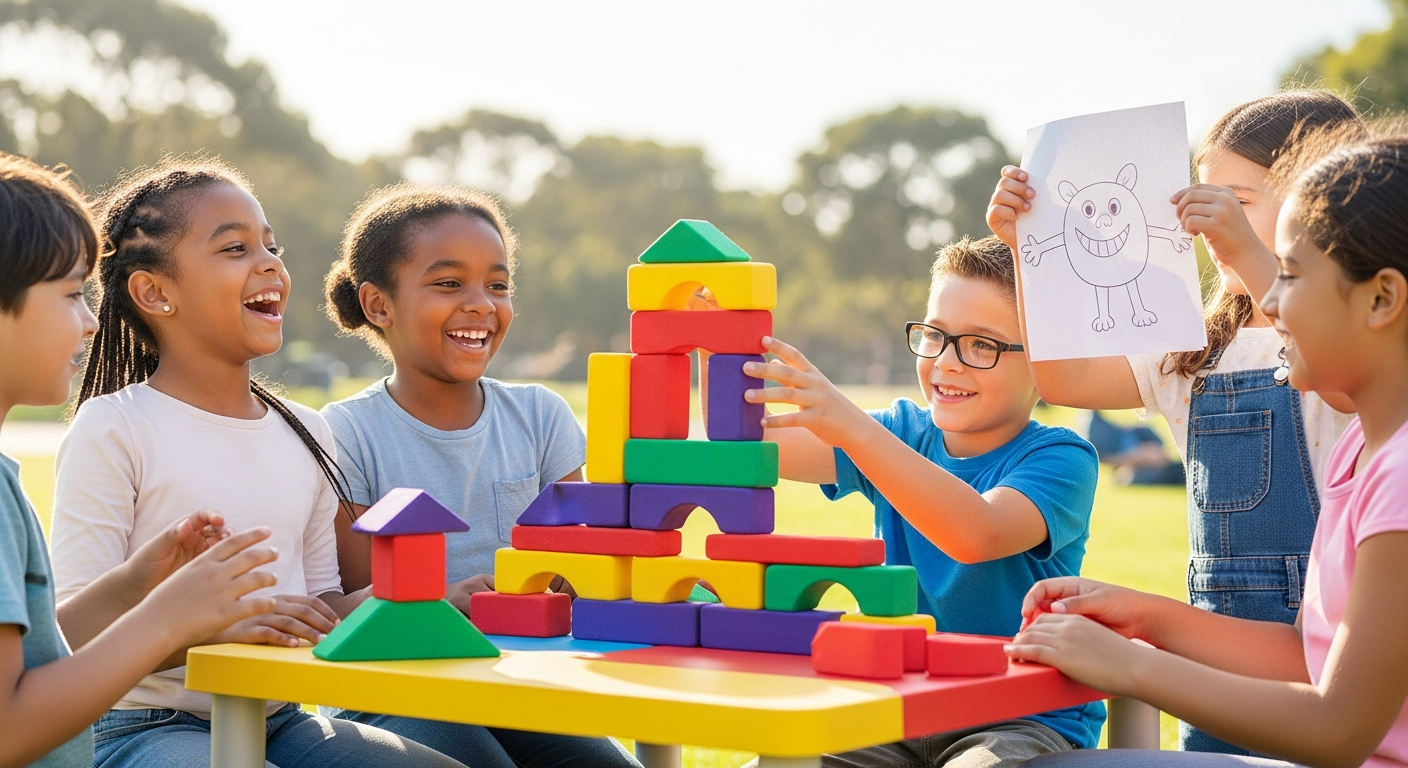
Table of Contents
- Introduction
- Beyond the Screen: Understanding the Power of Play
- The Magic of Fun Kids Games for Speech and Language Development
- Types of Fun Kids Games for Every Stage
- Integrating Speech Blubs into Your Playtime: A Smart Approach to Fun Kids Games
- Making Playtime Intentional: Tips for Parents
- Choosing the Right Tools: Understanding Speech Blubs Pricing and Value
- Ready to Transform Playtime?
- Frequently Asked Questions (FAQ)
Have you ever watched a child completely absorbed in play, perhaps building a towering block castle or pretending to be a valiant knight? In those moments of pure joy, it’s easy to see how much children thrive on fun. What might seem like simple entertainment to us is, in fact, their most profound pathway to learning, growth, and connection. This exploration delves into the incredible power of fun kids games – not just as time-fillers, but as vital tools for development, particularly in fostering robust speech and language skills. We’ll uncover how various types of playful activities contribute to a child’s holistic growth and how innovative tools, like Speech Blubs, can amplify these benefits, transforming screen time into "smart screen time" that truly helps children speak their minds and hearts.
Introduction
Imagine a world where every giggle, every chase, and every imaginative leap is a step towards clearer communication and stronger social bonds. This isn't just a dream; it's the reality that fun kids games create every day. Far from being mere distractions, games are the natural curriculum of childhood, offering rich environments for developing critical cognitive, social, emotional, and, crucially, linguistic skills. For parents keen on nurturing their child's communication abilities, understanding the mechanics of playful learning is paramount. This post will guide you through the diverse landscape of fun kids games, from the simplest backyard adventures to engaging digital experiences, revealing how each contributes to speech and language development. We'll also introduce you to Speech Blubs, an app born from personal experience and scientific insight, designed to make learning to communicate an immediate, effective, and joyful journey for every child. Our core message is clear: play isn't just fun; it's foundational, and with the right approach, it can unlock your child's full communication potential.

Beyond the Screen: Understanding the Power of Play
Before diving into specific types of fun kids games, it’s essential to grasp the profound importance of play itself. For children, play isn't a break from learning; it is learning. It's the primary way they explore the world, understand social dynamics, process emotions, and build a vast array of skills.
Think about it: when a child stacks blocks, they're learning about balance and problem-solving. When they share a toy, they're navigating social rules. When they invent a story with puppets, they're exercising their imagination and narrative abilities. This hands-on, self-directed exploration is critical for developing executive functions, creativity, emotional regulation, and most importantly for our discussion, communication skills.
Through play, children learn to:
- Express themselves: They use words, gestures, and sounds to communicate needs, desires, and ideas.
- Understand others: They listen, interpret cues, and respond appropriately in various social contexts.
- Problem-solve: They encounter challenges and use language to think through solutions or negotiate with peers.
- Build vocabulary: New experiences in play introduce new objects, actions, and concepts, all requiring new words.
- Practice articulation: Imitating sounds, repeating phrases, and singing songs during play strengthens the muscles involved in speech.
The benefits extend beyond just language. Play fosters curiosity, resilience, and a love for learning – qualities that serve a child throughout their entire life. Whether it’s unstructured free play or more structured game-playing, the underlying principle is the same: engagement, interaction, and enjoyment drive development forward.
The Magic of Fun Kids Games for Speech and Language Development
So, how do specific fun kids games directly contribute to building speech and language skills? The connection is wonderfully intuitive: when children are having fun, they are motivated, engaged, and receptive to learning. This optimal state makes them far more likely to absorb new words, practice sounds, and experiment with communication.

- Vocabulary Expansion: Every new game, toy, or activity introduces new words. A game about animals might teach "mane," "hooves," and "roar." A building game introduces "stack," "tall," "collapse," "rectangle." By experiencing these words in context, children internalize them much more effectively than through rote memorization.
- Articulation Practice: Many games naturally encourage the repetition of sounds or words. Chanting rhymes, imitating animal sounds, or even just calling out turns in a game provides valuable practice for forming specific sounds correctly. For a child who struggles with certain sounds, say the 's' sound, playing a game where they have to make "snake" sounds or say "silly songs" can turn a challenging exercise into an enjoyable one.
- Sentence Structure and Grammar: As children engage in imaginative play or interactive games, they naturally start to construct longer, more complex sentences to describe actions, explain rules, or tell stories. "The bear goes to sleep," becomes "The big, sleepy bear is going to his warm cave now." They learn about tenses ("I ran," "We will go"), prepositions ("under," "over"), and conjunctions ("and," "but") through practical application.
- Social Communication Skills: Games are miniature social ecosystems. They require turn-taking, listening, asking for clarification, negotiating, and expressing feelings – all crucial components of effective communication. Learning to wait for a turn, understand a friend’s facial expression, or ask, “Can I play?” are foundational social communication lessons.
- Problem-Solving and Critical Thinking: Many fun kids games involve challenges that require children to think strategically and communicate their thought process. "How do we get the ball in the hoop?" or "Which piece goes next?" These questions prompt internal and external dialogue, strengthening both cognitive and linguistic abilities.
Consider a parent whose 3-year-old child is a "late talker" and struggles with initiating conversation. While playing a simple "hide-and-seek" game, the parent narrates every action: "Mommy is counting! One, two, three... Where are you, sweetie? Are you behind the couch? Peek-a-boo! I found you!" This playful interaction, rich with descriptive language and question-asking, provides a natural, low-pressure environment for the child to absorb language and eventually, start responding. The magic is in the engagement, turning language acquisition into an irresistible game.
Types of Fun Kids Games for Every Stage
The world of fun kids games is vast and varied, offering endless opportunities for growth. Let's explore different categories and how they can be leveraged for speech and language development.
Sensory Play Games
Sensory play engages a child's senses – touch, smell, taste, sight, hearing, and movement. These activities are fantastic for encouraging descriptive language.
- Examples: Water tables, sandboxes, playdough, slime, rice bins, sensory bottles.
- Language Opportunities:
- Vocabulary: "Wet," "dry," "smooth," "gritty," "sticky," "squishy," "cold," "warm."
- Verbs: "Pour," "scoop," "mix," "pat," "squeeze," "sprinkle."
- Concepts: "Full," "empty," "more," "less," "heavy," "light."
- Relatable Scenario: A parent is at a water table with their toddler, who is hesitant to speak. The parent might say, "Splash! Listen to the water. It’s cold! Can you pour the water into the red cup? Wow, the water is moving fast!" This rich narration provides a running commentary of new vocabulary and verbs related to the sensory experience, inviting the child to eventually imitate or respond.
Imaginative & Pretend Play Games
These games allow children to step into different roles and create their own narratives, which is immensely beneficial for developing complex language skills.
- Examples: Dress-up, playing house, doctor's office, building a fort, superhero adventures, puppet shows.
- Language Opportunities:
- Narrative Skills: Creating stories, sequencing events, character development.
- Dialogue: Practicing conversations, expressing emotions through role-play.
- Vocabulary: Specific to roles (e.g., "stethoscope," "patient," "recipe," "ingredients").
- Social Scripts: Learning how people interact in different situations.
- Relatable Scenario: For a child who loves animals, a pretend vet clinic game offers a wealth of language practice. The parent acts as a sick dog, making sad "woof" sounds. The child, as the vet, might say, "What's wrong, puppy? Let's check your heart with the stethoscope. You need some medicine to feel better!" This scenario encourages question-asking, problem-solving language, and emotional expression.
Board Games & Card Games
Structured games introduce rules, turn-taking, and strategic thinking, fostering focused communication.
- Examples: Candyland, Chutes and Ladders, Memory, Uno Junior, simple matching games.
- Language Opportunities:
- Turn-taking: Explicitly practicing "my turn," "your turn."
- Following Instructions: "Move two spaces," "Draw a card."
- Describing: "I have the blue seven," "It's the cat card."
- Questioning: "What color is next?" "Did I win?"
- Relatable Scenario: A child is playing "Memory" with a parent. The child says, "I found a match! Two elephants!" The parent responds, "Great job! It's my turn now. I'm looking for the lion." This simple interaction reinforces vocabulary, counting, and the essential social skill of turn-taking in conversation.
Movement & Action Games
These active games combine physical activity with verbal cues, enhancing listening skills and vocabulary related to actions and body parts.
- Examples: Simon Says, Red Light Green Light, Follow the Leader, Tag, scavenger hunts.
- Language Opportunities:
- Following Commands: "Simon says touch your nose."
- Action Verbs: "Run," "jump," "hop," "crawl," "throw."
- Spatial Concepts: "Up," "down," "over," "under," "behind."
- Prepositions: "On," "in," "next to."
- Relatable Scenario: During a game of "Simon Says," a child who needs practice with listening comprehension benefits greatly. When "Simon says hop on one foot," the child listens, processes the instruction, and then performs the action, reinforcing the meaning of the verb "hop."
Interactive Storytelling Games
These games encourage creativity, narrative sequencing, and vocabulary development by building stories together.
- Examples: Using story cubes, creating stories from picture cards, "finish the sentence" games, campfire stories.
- Language Opportunities:
- Narrative Structure: Beginning, middle, end.
- Sequencing: "First," "next," "then," "finally."
- Descriptive Language: Elaborating on characters, settings, and events.
- Imagination and Creativity: Expanding their world through words.
- Relatable Scenario: A parent and child are taking turns adding sentences to a story based on a picture card showing a wizard. The child might start, "The friendly wizard had a sparkly hat." The parent continues, "He lived in a tall castle far, far away." This collaboration builds a narrative, expanding vocabulary and imagination simultaneously.
Digital Games (Smart Screen Time)
Not all screen time is created equal. While passive viewing like cartoons offers minimal language benefits, interactive digital games designed with educational goals can be powerful tools.
- Key Consideration: The best digital fun kids games are those that demand active participation, mimic real-world interactions, and encourage verbal responses, ideally with an adult alongside.
Integrating Speech Blubs into Your Playtime: A Smart Approach to Fun Kids Games
In our increasingly digital world, smart screen time offers incredible opportunities to supplement traditional play. At Speech Blubs, we understand the profound impact that fun, engaging, and scientifically-backed digital experiences can have on a child’s communication journey. Our mission is to empower children to "speak their minds and hearts," providing an immediate, effective, and joyful solution for the 1 in 4 children who need speech support. Our company was born from the personal experiences of our founders, who all grew up with speech problems and created the tool they wished they had.
We believe in blending scientific principles with play, creating one-of-a-kind "smart screen time" experiences. We are not about passive viewing; instead, we offer a screen-free alternative to passive viewing (like cartoons) by providing a powerful tool for family connection and active learning.
Our unique approach centers on video modeling, where children learn by watching and imitating their peers. This technique leverages mirror neurons in the brain, making imitation a natural and highly effective learning strategy. When a child sees another child demonstrating a sound or word, they are more motivated and better equipped to replicate it themselves. This makes Speech Blubs a fantastic addition to your collection of fun kids games. Our methods are backed by extensive research, consistently placing us in the top tier of speech apps worldwide.
Here's how Speech Blubs seamlessly integrates into and enhances your child's playtime:
- Interactive Learning Themes: Our app is packed with various sections designed around engaging themes, just like different types of fun kids games.
- For a parent whose 3-year-old "late talker" loves animals, the "Animal Kingdom" section offers a fun, motivating way to practice "moo" and "baa" sounds, learn animal names, and imitate the actions of their favorite creatures. The video models of children making these sounds provide an inspiring visual cue.
- If your child is working on specific articulation challenges, our "Sounds" section provides focused practice for individual phonemes. Watching other children clearly pronounce 's' or 'r' sounds makes the learning process feel like a collaborative game.
- For expanding vocabulary and understanding social roles, the "When I Grow Up" section allows children to explore different professions, mimicking the language and actions associated with them – much like imaginative pretend play, but with guided support.
- Active Participation, Not Passive Viewing: Unlike many apps or cartoons, Speech Blubs requires your child's active involvement. They are prompted to imitate, repeat, and interact, transforming screen time into a dynamic learning session. This active engagement is crucial for building neural pathways for speech.
- A Tool for Family Connection: While digital, Speech Blubs is designed to be a powerful tool for family bonding. Parents are encouraged to play alongside their children, participating in the imitation, celebrating successes, and extending the learning into real-world conversations. This co-play element is what truly makes Speech Blubs a meaningful part of your family’s collection of fun kids games.
- Building Confidence and Reducing Frustration: For children struggling with speech, communication can sometimes feel frustrating. Speech Blubs’ playful, supportive environment, combined with the successful imitation of peers, builds confidence and reduces the anxiety often associated with speech challenges. We focus on fostering a love for communication and developing key foundational skills.
- Realistic Expectations: While Speech Blubs is an incredibly powerful tool, we emphasize that it's a valuable supplement to a child's overall development plan and, when applicable, professional therapy. It’s about fostering a love for communication, building confidence, and creating joyful family learning moments, rather than guaranteeing overnight transformations. Many parents have shared their positive experiences, and you can read testimonials from other parents to see the difference we've made.
Are you ready to give your child the gift of clearer communication through engaging, fun kids games? Download Speech Blubs on the App Store or get it on Google Play and start your child's journey today!
Making Playtime Intentional: Tips for Parents
To maximize the speech and language benefits of any fun kids games, parental involvement is key. Here are some tips to make playtime even more impactful:
- Follow Your Child's Lead: Observe what captures your child's interest and join them in their play. When they are genuinely engaged, they are more receptive to learning and communication.
- Narrate Everything: Become your child's personal sportscaster! Describe what you see, what your child is doing, and what you are doing. "You're building a tall tower!" "Mommy is stirring the soup." This provides a constant stream of new vocabulary and language models.
- Ask Open-Ended Questions: Instead of "Is this blue?" (yes/no), ask "What color is this?" or "Tell me about your drawing." This encourages more elaborate responses and critical thinking.
- Expand on Their Utterances: If your child says "Car go," you can expand it to "Yes, the red car is going fast!" This models correct grammar and adds new vocabulary without correcting them directly.
- Be Patient and Supportive: Learning to communicate takes time. Celebrate every attempt, no matter how small, and create a stress-free environment where your child feels safe to experiment with sounds and words.
- Limit Passive Screen Time: While interactive apps like Speech Blubs offer "smart screen time," balance is crucial. Ensure a rich diet of varied fun kids games, both digital and traditional, and prioritize active engagement over passive consumption of content.
- Create a Language-Rich Environment: Talk, read, and sing to your child regularly. Exposure to a wide range of language forms the foundation for their own communication skills.
- Make it Fun, Always! The most important rule is that play should be enjoyable. When children are having fun, learning happens naturally and effortlessly.
Choosing the Right Tools: Understanding Speech Blubs Pricing and Value
We believe that every child deserves the opportunity to communicate confidently. That's why we’ve designed Speech Blubs to be an accessible and valuable resource for families. To ensure you get the most out of our engaging and effective speech games, it's important to understand our subscription options.
We offer two main plans:
- Monthly Plan: This plan is available for $14.99 per month.
- Yearly Plan: Our most popular and recommended option, the Yearly Plan, is priced at $59.99 per year. This breaks down to an incredible value of just $4.99 per month.
Why the Yearly Plan is the Best Choice:
The Yearly Plan isn't just significantly more affordable; it offers a suite of exclusive, high-value features that elevate your child's learning journey:
- Save 66% Annually: By choosing the Yearly Plan, you unlock substantial savings compared to the monthly option. This means more consistent, long-term support for your child's development at a fraction of the cost.
- 7-Day Free Trial: The Yearly Plan includes a full 7-day free trial. This allows you to experience the complete range of Speech Blubs features and see firsthand the positive impact it can have on your child's communication, completely risk-free. The Monthly Plan does not offer a free trial.
- The Extra Reading Blubs App: As a Yearly subscriber, you also gain access to our companion Reading Blubs app, providing an even richer educational experience focused on early literacy skills.
- Early Access to New Updates: Be among the first to explore new games, activities, and features as they're released, ensuring your child always has fresh, engaging content.
- 24-Hour Support Response Time: Enjoy peace of mind with prioritized customer support, ensuring any questions or concerns are addressed promptly.
The Monthly Plan, while flexible, does not include these exclusive benefits, nor does it offer a free trial. For the best value, the most comprehensive features, and the chance to try it out for free, the Yearly Plan is the clear superior choice.
Ready to embark on a joyful journey of communication with your child? We encourage you to choose the Yearly Plan to get your 7-day free trial and unlock the full suite of features today!
Ready to Transform Playtime?
The journey of helping a child find their voice is one of the most rewarding experiences for any parent. We've seen how fun kids games, from traditional imaginative play to interactive digital tools, are not just entertaining but are fundamental building blocks for speech and language development. They provide the context, motivation, and joy that make learning effortless and effective.
At Speech Blubs, we are honored to be a part of this journey. We’ve poured our personal experiences and scientific insights into creating an app that empowers children to communicate with confidence and clarity. Our video modeling methodology, combined with engaging activities, offers a unique and powerful way to transform screen time into smart, interactive learning that strengthens family bonds.
Every word learned, every sound mastered, and every confident conversation is a testament to the power of purposeful play. Don't let hesitation stand in the way of your child's communication potential. If you're wondering if Speech Blubs could benefit your child, take our quick 3-minute preliminary screener to get a simple assessment and a free 7-day trial.
It’s time to embrace the magic of fun kids games and witness the incredible growth they inspire. Take the first step towards a brighter, more communicative future for your child.
Ready to start your free 7-day trial and unlock a world of expressive communication?
Choose the Yearly plan for the best value and access to all premium features, including the Reading Blubs app!
- Download Speech Blubs on the App Store today!
- Get Speech Blubs on Google Play now!
- Alternatively, create your account and begin your 7-day free trial on our website!
Join the Speech Blubs family and let's help your child speak their mind and heart, one joyful game at a time! Explore more about our mission and approach on the main Speech Blubs website.
Frequently Asked Questions (FAQ)
Q1: What age range is Speech Blubs suitable for?
A1: Speech Blubs is designed for children aged 1 to 8 years old, catering to various developmental stages and communication needs. Our diverse range of activities and themes can be adapted to suit toddlers just starting to babble, preschoolers learning new words, and early elementary children refining their articulation and narrative skills.
Q2: How is Speech Blubs different from other educational apps or games?
A2: Speech Blubs stands out through its unique "video modeling" approach, where children learn by imitating real children on screen. This method is highly engaging and scientifically supported, leveraging mirror neurons to make learning natural and effective. Unlike many passive entertainment apps, Speech Blubs requires active participation, transforming screen time into "smart screen time" that promotes family connection and targeted speech and language development.
Q3: Do I need to supervise my child while they use Speech Blubs?
A3: While Speech Blubs is designed to be intuitive for children, we strongly recommend adult co-play and supervision. Engaging with your child during app use allows you to reinforce learning, provide encouragement, extend activities into real-world conversations, and ensure they are getting the maximum benefit from the interactive experience. It makes the app a tool for family bonding and shared learning.
Q4: Can Speech Blubs replace traditional speech therapy?
A4: Speech Blubs is a powerful supplemental tool for speech and language development and is not intended to replace professional speech therapy. It provides a fun, accessible way to practice skills at home and complements the guidance of a certified speech-language pathologist. If you have concerns about your child's development, we always recommend consulting with a professional. However, Speech Blubs can significantly enhance and accelerate progress made in therapy.
About the author