
Fun Kids Games to Play Outside: Boost Growth & Giggles
 By Speech Blubs Team•Jan 19, 2026•18 min.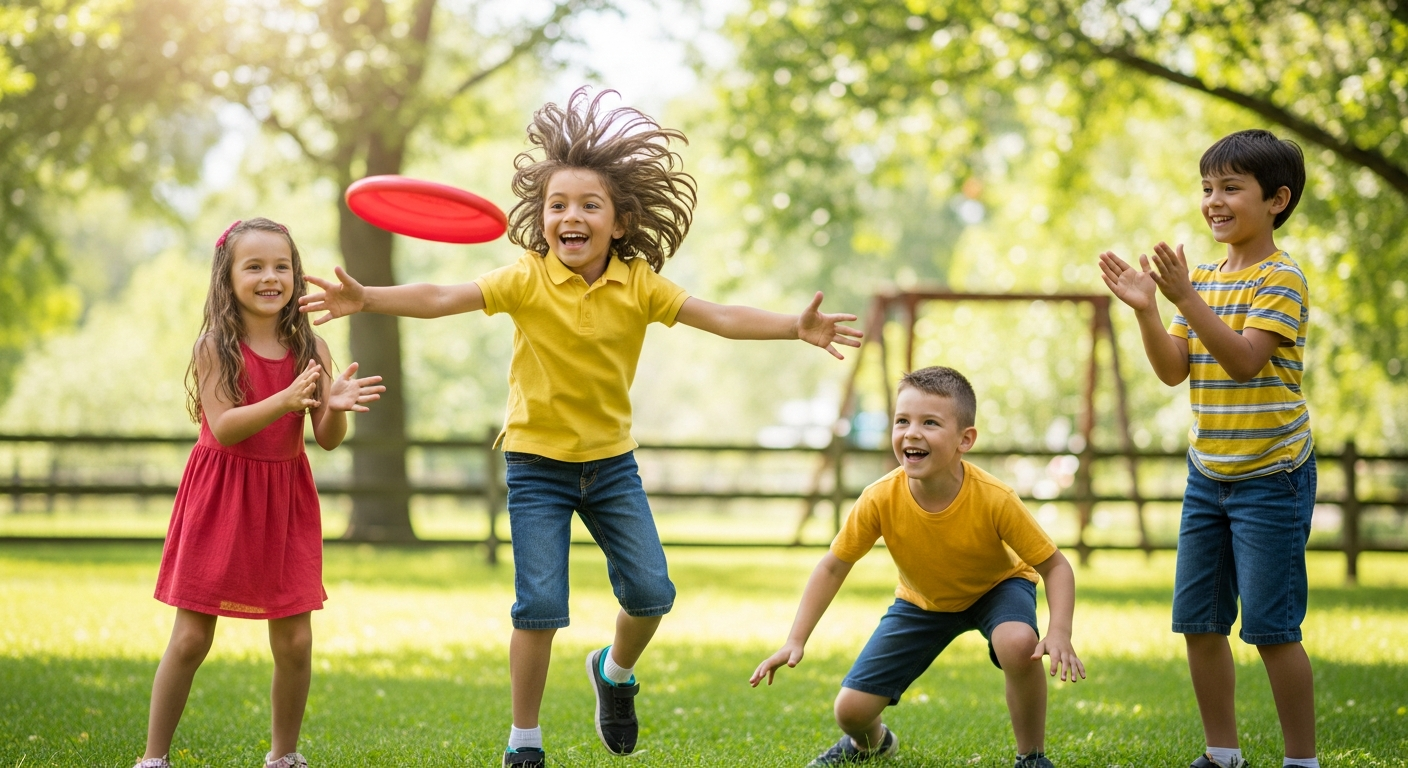
Table of Contents
- The Unrivaled Benefits of Outdoor Play
- Classic Outdoor Games for All Ages
- Team & Group Challenges for Growing Minds
- Simple Games with Minimal Props
- Integrating Speech & Language Practice into Every Playtime
- Unlock Your Child's Potential with Speech Blubs
- Conclusion
- Frequently Asked Questions (FAQ)
Do you ever find yourself reminiscing about endless summer days spent outdoors, where the only limit was the setting sun or your parents calling you in for dinner? The thrill of a high-stakes game of tag, the quiet concentration of hopscotch, or the joyful chaos of kick the can – these memories aren't just nostalgic; they highlight a fundamental truth about childhood: outdoor play is magical. In a world increasingly dominated by screens, reconnecting with the simple joy of playing outside offers children a powerful antidote, fostering not just physical health, but also crucial cognitive, social, and language development.
This post isn't just a list of games; it's an invitation to rediscover the profound benefits of outdoor play and how these simple activities are foundational to your child's holistic growth. We'll explore a variety of engaging, no-equipment-needed (or minimal-equipment) games that encourage laughter, learning, and lasting memories. We’ll also show you how these adventures seamlessly complement modern tools like Speech Blubs, which provides "smart screen time" experiences designed to empower children to speak their minds and hearts, building on the communication skills practiced during active play.

The Unrivaled Benefits of Outdoor Play
Outdoor play is far more than just burning off energy; it's a dynamic classroom without walls, offering a rich environment for children to develop across multiple domains.
Physical Development and Coordination
Running, jumping, climbing, and throwing are fundamental movements that strengthen large muscle groups (gross motor skills) and improve balance, agility, and coordination. When children play games like tag or an impromptu obstacle course, they’re not just having fun; they’re refining their ability to navigate space, react quickly, and control their bodies. This physical prowess builds a strong foundation for future athletic endeavors and everyday tasks. The varied terrain of the outdoors, from grassy fields to uneven sidewalks, also challenges their proprioception and spatial awareness in ways indoor environments rarely can.
Cognitive Growth and Problem-Solving
Outside, children encounter countless opportunities for critical thinking. A game of hide and seek requires strategic hiding spots and deductive reasoning. Building a fort demands planning, collaboration, and creative problem-solving. These activities aren't scripted; they evolve based on the environment and the players' imaginations. This unstructured play fosters creativity, adaptability, and the ability to think on their feet – skills that are invaluable in all areas of life. They learn to negotiate rules, resolve conflicts, and invent new variations of games, all contributing to robust cognitive flexibility.
Social-Emotional Learning and Connection
Outdoor games are inherently social. They teach children about turn-taking, sharing, negotiation, and cooperation. In a game like Capture the Flag or a team-based activity, children learn the importance of working together, communicating strategies, and celebrating collective successes (or navigating friendly losses). These interactions build empathy, self-regulation, and confidence. The sheer joy of shared laughter and friendly competition strengthens bonds and creates a sense of belonging. For a child who might be shy or struggling with social cues, the playful, low-pressure environment of an outdoor game can be an excellent way to practice interaction and build confidence, allowing them to truly open up and connect with others.

Language Development and Communication Skills
Perhaps one of the most overlooked benefits of outdoor play is its profound impact on language development. Every game, every interaction, is an opportunity for communication:
- Following Instructions: Games like "Simon Says" or "Red Light, Green Light" directly challenge a child's ability to listen carefully and follow multi-step commands, which is crucial for language comprehension.
- Descriptive Language: When searching in hide and seek, a child might say, "Is he behind the big green bush?" or "I think I saw her by the tall, spiky fence!" Encouraging children to describe what they see, hear, and do expands their vocabulary and expressive language skills.
- Negotiation and Explanation: Setting game rules, deciding who is "it," or explaining why a certain move was made all require clear, articulate language.
- Expressing Emotions: The ups and downs of play – excitement, frustration, joy – provide natural opportunities for children to verbalize their feelings and develop emotional literacy.
- Auditory Processing: Distinguishing between voices, recognizing cues, and understanding shouted instructions in a noisy outdoor environment sharpens auditory processing skills.
At Speech Blubs, we understand that language flourishes through interaction. Our mission is to empower children to "speak their minds and hearts," and we know that this journey is built on a foundation of rich, interactive experiences. Just as outdoor play encourages children to imitate actions and sounds from their peers, our app uses a unique "video modeling" methodology. Children learn by watching and imitating their peers, fostering communication skills in a joyful and engaging way, making it a perfect complement to the real-world interactions fostered through outdoor games.
Ready to see how Speech Blubs can support your child's communication journey? Download Speech Blubs on the App Store or Google Play today!
Classic Outdoor Games for All Ages
These timeless games require little to no equipment and have been bringing joy to generations of children.
Tag & Its Endless Variations
Tag (or "It"): The simplest classic. One person is "it" and chases others, trying to tag them. The person tagged becomes the new "it." This game is fantastic for gross motor skills, speed, and strategic thinking.
Freeze Tag: A twist where tagged players freeze in place, often with arms outstretched like a "T." Other non-frozen players can "unfreeze" them by touching them. This adds a layer of cooperation and quick decision-making.
Shadow Tag: Best played on a sunny day. Instead of tagging a person, the "it" player tags another person's shadow. This variation adds an extra cognitive challenge as players must be aware of their own shadow and those of others.
Cops and Robbers: Divide players into two teams. Cops try to tag robbers and send them to a designated "jail." Robbers can free their jailed teammates by tagging them. This game emphasizes teamwork, strategy, and negotiation.
Octopus: One player is the "octopus" in the middle of a play area. Other players line up on one side. The octopus calls out a command (e.g., "If you are wearing blue, swim!"), and those players try to run to the other side without being tagged. Tagged players become "seaweed," who can't move but can help the octopus tag others. It encourages listening and quick reactions.
Hide and Seek & Creative Hiding
Hide and Seek: One player is the "seeker" and counts with eyes closed while others hide. The seeker then searches for everyone. The last one found wins. This boosts patience, strategic thinking, and spatial awareness.
Sardines: A fun twist where only one person hides. Everyone else counts, then searches. When a player finds the hider, they hide with them. This continues until everyone is "sardined" into one hiding spot. It encourages quiet communication and problem-solving.
Kick the Can: A hybrid of hide and seek and tag. One player guards a "can" (or stick, pinecone, etc.) and counts while others hide. The "it" player hunts. If they find someone, they race back to the can. If "it" touches the can and calls the hider's name, the hider is "jailed." However, other hiders can "kick the can" to free all jailed players. This game is fantastic for strategic thinking, quick reflexes, and teamwork.
Timeless Listening and Movement Games
Hopscotch: Draw a grid of numbered squares with chalk (or sticks in dirt). Players toss a marker into a square and hop through the pattern, skipping the marker's square. This game develops balance, coordination, number recognition, and sequencing. For younger children, just hopping and calling out the numbers is a great start!
Simon Says: One player is "Simon" and gives commands, but only commands preceded by "Simon Says" should be followed. If "Simon" doesn't say "Simon Says," and a player performs the action, they're out. This game is a powerhouse for auditory processing, impulse control, and following multi-step directions. It’s a perfect scenario to practice those crucial early language skills!
Red Light, Green Light: One player is the "traffic light" and stands with their back to the others. When they call "Green Light!", players run towards them. When they call "Red Light!" and turn around, everyone must freeze. Anyone caught moving is sent back to the start. Excellent for listening, self-regulation, and quick reactions.
What Time is it, Mr. Wolf?: One child is Mr. Wolf, standing with their back to the others. The other players ask, "What time is it, Mr. Wolf?" Mr. Wolf replies with a time (e.g., "Three o'clock!"), and players take that many steps forward. This continues until Mr. Wolf shouts, "It's dinner time!" and chases the players back to the start. A great game for counting, sequencing, and dramatic play.
Duck, Duck, Goose: Players sit in a circle. One player walks around, tapping heads and saying "Duck, duck, duck..." until they tap someone and say "Goose!" The "goose" then chases the first player around the circle to try and tag them before they sit back down in the goose's spot. Simple, fun, and great for social interaction and following a predictable pattern.
Musical Statues / Freeze Dance: Play music and have everyone dance. When the music stops, everyone must freeze in place. Anyone caught moving is out. This game enhances listening skills, body awareness, and creative expression. If no music is available, someone can simply shout "Freeze!"
To further support your child’s communication development at home, try our quick 3-minute preliminary screener to get a simple assessment and a free 7-day trial of Speech Blubs.
Team & Group Challenges for Growing Minds
For larger groups or when you want to encourage deeper collaboration, these games are fantastic.
Strategic Team Play
Capture the Flag: Divide into two teams, each with a "flag" (a bandana, t-shirt, etc.) hidden in their territory. The goal is to capture the opposing team's flag while protecting your own. If tagged in enemy territory, you might go to "jail" until freed by a teammate. This game fosters advanced strategy, teamwork, negotiation, and communication. Children learn to plan, defend, and attack, all while coordinating with their peers.
Spud: Players scatter while one person throws a ball in the air, yelling another player's name (or number). That player catches the ball while others freeze. The catcher then takes four steps towards the closest player, spelling out S-P-U-D as they go. They then try to hit that player with the ball. If hit, the player gets a letter; if missed, the thrower gets a letter. First to spell SPUD is out. This game combines counting, quick thinking, and accuracy.
Tug of War: A classic test of strength and teamwork. Two teams hold opposite ends of a long, sturdy rope. A line is marked on the ground, and each team tries to pull the other team across the line. It's a fantastic way to teach cooperation and the power of collective effort, along with simple commands like "pull!" and "heave-ho!".
Inventive & Collaborative Adventures
Obstacle Course: Using natural elements (trees, hills) or household items (jump ropes, pool noodles, pillows, blankets), children can design and navigate their own obstacle course. This encourages immense creativity, problem-solving, and following multi-step directions. For a parent whose child loves creating, setting up an obstacle course offers endless opportunities for verbalizing actions ("I'm crawling under the blanket!"), describing challenges ("This rock is slippery!"), and giving instructions to others. This kind of active, imaginative play perfectly aligns with our mission at Speech Blubs to empower children to "speak their minds and hearts" by giving them tools to express their ideas and experiences.
Fort Building: Whether with branches, old sheets, cardboard boxes, or tarps, building a fort outdoors is the epitome of creative play. It sparks imagination, encourages collaborative language ("You hold that end, I'll tie this here!"), and requires negotiation and planning. The discussions and decisions made during fort building are rich opportunities for language practice and social skill development.
Simple Games with Minimal Props
Sometimes, all you have is a ball or just yourselves!
Hot Potato: With a soft ball or beanbag, players sit in a circle and quickly pass the "potato." When music stops (or someone yells "Hot Potato!"), the person holding it is out. Great for quick reflexes, turn-taking, and listening skills.
Rock, Paper, Scissors: A classic hand game for settling disputes or simply having fun. It teaches decision-making and simple verbalization, as well as understanding rules and outcomes.
Pooh Sticks: Find a bridge over a gentle stream. Each person drops a stick on one side of the bridge and then runs to the other side to see whose stick emerges first. A delightful game for observation, simple cause-and-effect language, and patience.
Limbo: Two people hold a stick (or broom, jump rope) horizontally, and others try to bend backward to pass under it without touching it. The stick is lowered after each round. This game improves flexibility, balance, and following instructions, often with accompanying chants or songs that further encourage language use.
Integrating Speech & Language Practice into Every Playtime
Every outdoor game can become an opportunity for language growth. As parents and caregivers, we are our children's first and most important language models.
- Model Clear Language: Describe what’s happening in detail. "Look at that fast red ball!" or "We're going to run quickly to the tree!"
- Ask Open-Ended Questions: Instead of "Did you have fun?", try "What was your favorite part of the game?" or "How did you feel when you were chasing?"
- Encourage Descriptive Words: Prompt your child to describe the setting, their actions, or their emotions. "What does that leaf feel like?" or "Can you describe your hiding spot?"
- Practice Following Directions: Deliberately give multi-step instructions during play, like "First, pick up the blue ball, then walk to the big rock."
- Work on Turn-Taking: Emphasize waiting for their turn, both in action and in conversation.
- Incorporate Specific Sounds/Words: If your child is working on a particular sound (e.g., 's' sound), you can casually integrate it: "Let's swing on the swing set!" or "Can you find something shiny?"
Sometimes, despite our best efforts with outdoor play and interaction, children need a little extra support with their speech and language development. This is where Speech Blubs comes in. Our company was born from the personal experiences of our founders, who all grew up with speech problems and created the tool they wished they had. We are committed to providing an immediate, effective, and joyful solution for the 1 in 4 children who need speech support, blending scientific principles with play into one-of-a-kind "smart screen time" experiences. We provide a screen-free alternative to passive viewing (like cartoons) and a powerful tool for family connection. Our unique approach of teaching complex communication skills through "video modeling," where children learn by watching and imitating their peers, is backed by extensive research and has earned us a high MARS scale rating, placing us in the top tier of speech apps worldwide.
For a parent whose 3-year-old "late talker" loves animals, the "Animal Kingdom" section in Speech Blubs offers a fun, motivating way to practice 'moo' and 'baa' sounds, or name different creatures, by watching real children demonstrate these sounds and words. Similarly, if your child is working on early vocabulary, our "Ready, Set, Go" section allows them to imitate words related to actions, enhancing both their expressive and receptive language in an interactive, non-passive environment. These interactive sessions are powerful supplements to the communication skills developed through active outdoor play, creating a comprehensive approach to language learning. Don't just take our word for it, see what other parents are saying about their child's success with Speech Blubs.
Unlock Your Child's Potential with Speech Blubs
Investing in your child's communication journey is one of the most impactful decisions you can make. At Speech Blubs, we make it accessible and engaging for every family.
We offer flexible plans to suit your needs:
- Monthly Plan: For just $14.99 per month, you can access our core features.
- Yearly Plan: Our best value at $59.99 per year, which breaks down to an incredible $4.99 per month. That's a 66% savings compared to the monthly plan!
Choosing the Yearly Plan not only gives you the best price but also unlocks exclusive, high-value features:
- A 7-day free trial: Experience the full potential of Speech Blubs before committing.
- The extra Reading Blubs app: Double the fun and learning with our complementary reading app.
- Early access to new updates: Be the first to try our latest features and content.
- 24-hour support response time: Get prompt assistance whenever you need it.
The Monthly Plan does not include these fantastic benefits, so we highly recommend the Yearly Plan to get the most out of your Speech Blubs experience and truly empower your child's communication development.
Ready to embark on a joyful journey of communication with your child? Create your account and begin your 7-day free trial today! You can also easily download Speech Blubs on the App Store or Google Play to get started.
Conclusion
Outdoor play, filled with fun kids games, is an irreplaceable component of a child’s development. It provides a vibrant, sensory-rich environment that nurtures physical health, sparks cognitive growth, builds essential social-emotional skills, and, crucially, lays a strong foundation for language and communication. From the simple thrill of tag to the strategic depths of Capture the Flag, these activities encourage children to experiment, interact, and articulate their thoughts and feelings.
By prioritizing outdoor adventures and integrating "smart screen time" with Speech Blubs, you’re providing a powerful, well-rounded approach to your child’s growth. Remember, our goal is not just to teach words, but to empower children to "speak their minds and hearts," connecting with the world around them with confidence and joy.
Don't let another day pass without experiencing the magic of outdoor play and the transformative power of purposeful learning. Take the first step towards unlocking your child’s full communication potential. Start your 7-day free trial of Speech Blubs today by signing up on our website or downloading the app, and remember to choose the Yearly Plan to access all the incredible features, including Reading Blubs and dedicated support!
Frequently Asked Questions (FAQ)
Q1: How can I encourage my child to play outside if they prefer screens?
A1: Start by joining them! Lead by example and introduce exciting outdoor games like "Red Light, Green Light" or a simple treasure hunt. Frame outdoor time as an adventure, not a chore. You can also try making a "yes" list of outdoor activities they can choose from, giving them agency. Gradually increase outdoor time, and consider using "smart screen time" apps like Speech Blubs as a complementary tool, showing them how the skills they learn in the app can be used during their real-world adventures.
Q2: What if I don't have a large backyard or a park nearby?
A2: You don't need vast spaces for fun outdoor games! A driveway, sidewalk, or even a small patio can be transformed into a play zone. Games like hopscotch, "Simon Says," or "What Time is it, Mr. Wolf?" can be adapted for smaller areas. Even a walk around the block can become an "Alphabet Hunt" or a "Color Scavenger Hunt," turning everyday environments into engaging play spaces.
Q3: How do outdoor games specifically help with speech development?
A3: Outdoor games naturally foster language by creating interactive scenarios. Children practice following multi-step directions ("Simon Says jump and turn around!"), using descriptive language ("Look at the big, bumpy rock!"), negotiating rules, and expressing emotions. The need to communicate clearly in a dynamic environment strengthens vocabulary, comprehension, and expressive language skills, all crucial for their overall communication journey.
Q4: How does Speech Blubs fit in with all this outdoor play?
A4: Speech Blubs offers "smart screen time" that complements outdoor play by reinforcing and expanding communication skills in a structured, engaging way. While outdoor games provide real-world interaction, Speech Blubs uses "video modeling" – children learn by imitating peers – to target specific sounds, words, and concepts. It's a powerful supplement that helps children build confidence and foundational language skills, making them more ready and able to participate fully in the rich communication opportunities that outdoor play provides. It's about blending the best of both worlds for holistic development.
About the author