
Fun Math Games for Kids: Learning Through Play
 By Speech Blubs Team•Jan 19, 2026•20 min.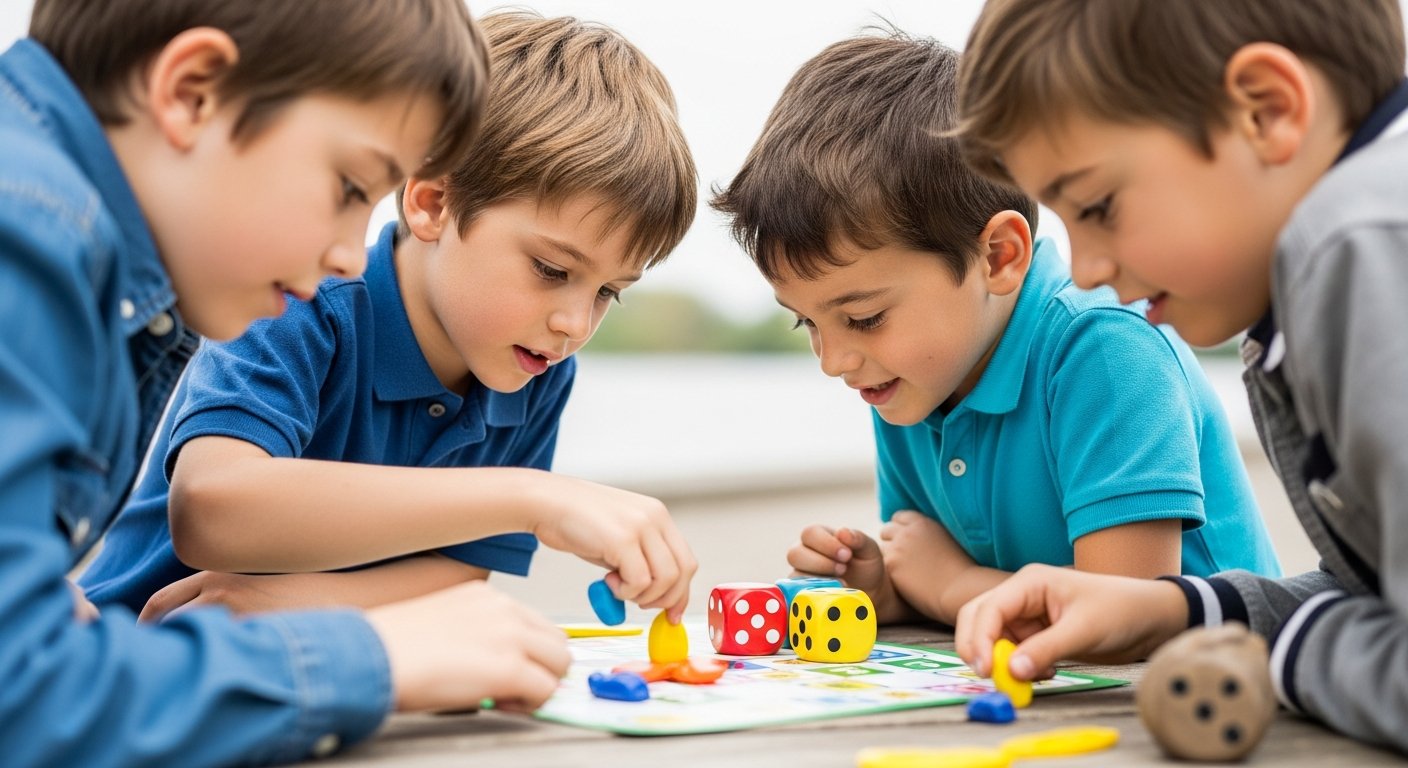
Table of Contents
- Why Play-Based Math Learning Matters (and How it Connects to Communication)
- The Core Ingredients of Engaging Math Games for Kids
- Fantastic Fun Math Games for Every Age Group
- Integrating "Smart Screen Time": When Tech Enhances Learning
- Beyond the Screen: Everyday Math Adventures
- Partnering with Speech Blubs for Holistic Development
- Setting Realistic Expectations: The Journey of Learning
- Conclusion
- FAQ
The mere mention of "math" can sometimes conjure images of daunting equations, endless worksheets, and perhaps even a touch of anxiety for both children and parents. Many of us grew up believing math was a chore, a necessary evil rather than an exciting adventure. But what if we told you it doesn't have to be that way? What if learning math could be as engaging and joyful as storytelling or building with blocks? The purpose of this comprehensive guide is to revolutionize your perception of math education, demonstrating how integrating fun, interactive games into your child's routine can transform abstract concepts into tangible, exciting experiences. We'll explore a treasure trove of activities, from hands-on play to "smart screen time" solutions, proving that a playful approach is the most effective way to build foundational math skills, foster a lifelong love for learning, and empower children to approach numbers with confidence and curiosity.

Why Play-Based Math Learning Matters (and How it Connects to Communication)
The traditional "sit-and-drill" method of teaching math often leads to rote memorization without true understanding, frequently culminating in frustration and a deep-seated aversion to the subject. Children, by their very nature, are explorers and investigators. They learn best by doing, by interacting with their environment, and by making discoveries through play. When math is presented as a game, it taps into this innate curiosity, transforming what could be a dry subject into an exciting challenge.
Cultivating a Growth Mindset Through Play
Play-based learning fosters a growth mindset, where mistakes are seen as opportunities for learning rather than failures. In a game, if a child gets an answer wrong, they simply try again, adapting their strategy. This resilience is crucial not just for math, but for all areas of development. It teaches them perseverance and problem-solving skills that extend far beyond the classroom. When children are engaged and enjoying themselves, they are more likely to take risks, ask questions, and delve deeper into concepts, laying a solid groundwork for future academic success.
The Intertwined Nature of Math and Communication
It might seem counterintuitive, but a child's ability to communicate effectively is deeply intertwined with their mathematical development. To understand and express mathematical concepts, children need to articulate their thoughts, ask clarifying questions, and explain their reasoning. A child who struggles to express themselves verbally might also struggle to vocalize their understanding of a math problem or ask for help when they're stuck.
At Speech Blubs, we deeply understand the power of empowering children to "speak their minds and hearts." Our company was born from the personal experiences of our founders, who all grew up with speech problems and created the tool they wished they had. We believe that robust communication skills are the bedrock upon which all other learning is built. Just as we help children develop the ability to articulate their ideas and emotions, enabling them to engage more fully with the world around them, we advocate for learning methods that make complex subjects, like math, accessible and enjoyable. Whether it's verbalizing the steps of a math problem or describing shapes and quantities, clear communication enhances a child's capacity to engage with and master mathematical concepts. By fostering confident communicators, we inadvertently support their cognitive development across the board, making them more ready to embrace challenges, including those found in the world of numbers. If you're curious about how Speech Blubs can support your child's communication journey, you can explore our approach on our homepage.

The Core Ingredients of Engaging Math Games for Kids
Transforming math into an enjoyable activity isn't just about throwing numbers at a child in a fun context. It requires thoughtful design and an understanding of how children learn. Here are the essential ingredients for truly engaging math games:
Interactive & Hands-On Experiences
Children are kinesthetic learners, meaning they learn by doing and touching. Games that involve physical manipulation of objects, movement, and direct interaction are far more effective than passive learning. Think of building towers with blocks and counting them, sorting buttons by size and color, or measuring ingredients while baking. These hands-on experiences anchor abstract concepts in the tangible world, making them easier to grasp and remember. For instance, rather than simply writing down addition problems, having a child physically combine groups of objects (e.g., "three apples plus two apples makes five apples") creates a concrete understanding of the process.
Age-Appropriate Challenges and Scaffolding
A game that's too easy will bore a child, while one that's too difficult will lead to frustration. The best math games offer challenges that are just slightly beyond a child's current skill level, providing enough stretch to encourage growth without overwhelming them. This concept, known as scaffolding, involves providing support that is gradually removed as the child becomes more proficient. Many digital apps, for example, adapt to a child's performance, increasing or decreasing difficulty levels automatically. This ensures continuous engagement and optimal learning.
Relatability & Real-World Connections
Math often feels abstract to children because they don't see its relevance in their daily lives. Engaging games bridge this gap by connecting mathematical concepts to real-world scenarios. Counting money at a pretend store, figuring out how many cookies each person gets, or estimating the time it takes to travel somewhere all make math relevant and practical. When children understand why they are learning something, they are far more motivated to engage with it. For a child who loves animals, a game that involves counting the legs of different creatures or sorting them by habitat and quantity makes the math instantly more meaningful.
Positive Reinforcement & Encouragement
Learning, especially when new or challenging, thrives on positive feedback. The best games celebrate effort, perseverance, and small victories, not just correct answers. Encouragement builds confidence and resilience, making children more willing to tackle future challenges. Gentle guidance and praise for trying, even if the answer isn't perfect, are far more effective than criticism. This aligns perfectly with our philosophy at Speech Blubs, where every small sound and attempt at communication is celebrated, building a positive association with learning and self-expression.
Multi-Sensory Experiences
Children learn through all their senses. Games that incorporate sight, sound, and touch create richer learning experiences. Using colorful manipulatives, singing math songs, or engaging in physical activities that involve counting or measuring can significantly enhance understanding and retention. For instance, building a pattern with different colored blocks, while simultaneously naming the colors and counting the blocks, engages visual, auditory, and kinesthetic senses.
Fantastic Fun Math Games for Every Age Group
Let's dive into some specific, actionable ideas for making math fun, categorized by age group. Remember, these are just starting points – feel free to adapt them to your child's unique interests!
Early Learners (Pre-K & Kindergarten): Building Foundations
At this age, the focus is on introducing fundamental concepts like counting, number recognition, shapes, and simple patterns.
Counting Collections
- Concept: One-to-one correspondence, quantity.
- How to Play: Gather a collection of small, engaging items (e.g., toy cars, blocks, buttons, dried pasta). Ask your child to count how many items are in a group, touching each one as they count. Start with small numbers (1-5) and gradually increase.
- Variation: "Mystery Bag Counting" – put a few items in a bag, have your child reach in and count them by touch, then guess the number before revealing.
Shape Scavenger Hunt
- Concept: Shape recognition, geometry in everyday life.
- How to Play: Call out a shape (e.g., "Can you find something that's a circle?"). Your child then searches the room for objects matching that shape.
- Variation: "Shape Sorting" – provide various cut-out shapes or household items, and ask your child to sort them into piles based on their shape.
Pattern Train
- Concept: Recognizing and extending patterns, early algebraic thinking.
- How to Play: Use colored blocks, beads, or even different types of pasta to create simple patterns (e.g., red-blue-red-blue). Ask your child to identify the pattern and then extend it.
- Variation: Create patterns with sounds or movements (e.g., clap-stomp-clap-stomp).
Number Jumps
- Concept: Number identification, sequencing.
- How to Play: Write numbers on sticky notes or index cards and spread them on the floor. Call out a number, and your child has to jump to it.
- Variation: Call out numbers in sequence and have them jump from one to the next, like a hopscotch.
Elementary Explorers (Grades 1-3): Mastering Basic Operations
This stage focuses on developing fluency with addition, subtraction, and introducing multiplication.
Number Bond Race
- Concept: Addition, subtraction, number relationships.
- How to Play: Call out a target number (e.g., 10). Have your child quickly come up with different pairs of numbers that add up to that target (e.g., 5+5, 7+3, 6+4). Make it a race if they enjoy competition.
- Variation: Use a deck of cards (face cards removed). Draw two cards and have the child add or subtract them.
Dice Roll Math
- Concept: Addition, subtraction, number operations.
- How to Play: Use two or three dice. Roll them and have your child add the numbers together.
- Variation: Challenge them to subtract the smaller number from the larger one, or even multiply the numbers if they're ready.
Array Art
- Concept: Introduction to multiplication, visual representation.
- How to Play: Explain that multiplication is repeated addition. Use small candies, stickers, or dots to create arrays (rows and columns). For example, a 3x4 array would have 3 rows of 4 items. Have them count the total and then relate it to 3 groups of 4 or 4 groups of 3.
- Variation: Draw arrays on graph paper and color them in.
Place Value Building Blocks
- Concept: Place value (ones, tens, hundreds).
- How to Play: Use LEGOs or other stackable blocks. Assign different colors to different place values (e.g., blue for ones, red for tens, green for hundreds). Call out a number, and your child builds it using the appropriate blocks. For example, for "23," they'd use 2 red blocks and 3 blue blocks.
- Variation: Have them take apart a built number and tell you how many tens and ones (or hundreds) it contains.
Intermediate Investigators (Grades 4-6): Deeper Dive into Concepts
At this level, children are ready for more complex operations, fractions, decimals, geometry, and early algebraic thinking.
Factor Find
- Concept: Multiplication, division, factors.
- How to Play: Call out a number (e.g., 24). Have your child list all the pairs of numbers that multiply to make 24 (e.g., 1x24, 2x12, 3x8, 4x6).
- Variation: "Prime Number Hunt" – identify which numbers in a given range are prime.
Fraction Pizza Party
- Concept: Fractions, equivalent fractions.
- How to Play: Draw or create a paper "pizza" and cut it into equal slices (e.g., 8 slices). Discuss what each slice represents (1/8). Then ask questions like, "If you eat 2 slices, what fraction of the pizza have you eaten?" or "How many slices make half the pizza?"
- Variation: Use real food like apple slices or segments of an orange to demonstrate fractions.
Decimal Line-Up
- Concept: Decimals, ordering numbers.
- How to Play: Write several decimal numbers on individual cards (e.g., 0.5, 0.25, 1.0, 0.75). Have your child arrange them in order from smallest to largest.
- Variation: Use a number line drawn on paper to visually represent where each decimal falls.
Area & Perimeter Challenge
- Concept: Geometry, measurement, area, perimeter.
- How to Play: Using graph paper or a ruler, challenge your child to draw different rectangles or squares with a specific area or perimeter. For example, "Draw a rectangle with an area of 12 square units."
- Variation: Measure the area and perimeter of real objects in a room.
Balance the Equation
- Concept: Early algebra, equality.
- How to Play: Write simple equations with a missing number, represented by a blank or a variable (e.g., 5 + ___ = 12, or 3 * x = 15). Have your child find the missing number.
- Variation: Use a kitchen scale with weights (or small, equal objects) to visually represent balancing equations.
Integrating "Smart Screen Time": When Tech Enhances Learning
In our digital age, the role of screens in child development is a constant topic of discussion. While passive viewing (like endless cartoons) offers little educational value, "smart screen time" — thoughtfully designed interactive applications — can be a powerful tool for learning. The key lies in choosing apps that promote active engagement, critical thinking, and skill development, rather than just consumption.
Well-designed math apps can offer numerous benefits:
- Adaptive Learning: Many apps adjust the difficulty level based on a child's performance, providing personalized challenges.
- Instant Feedback: Children receive immediate confirmation of their answers, allowing them to correct mistakes and learn efficiently.
- Engaging Graphics & Sounds: Gamified elements, characters, and rewards can make even routine practice feel exciting.
- Accessibility: Apps are available anytime, anywhere, providing convenient opportunities for learning on the go.
This approach mirrors our philosophy at Speech Blubs. We believe in providing a screen-free alternative to passive viewing and a powerful tool for family connection. Our unique approach of teaching complex communication skills uses "video modeling," where children learn by watching and imitating their peers. This is a form of active, "smart screen time" that turns observation into direct participation and learning. For example, imagine a child who is initially hesitant to vocalize numbers. Through an engaging math app, they might be encouraged by a friendly character to count aloud, just as in Speech Blubs, a child mirrors the joyful facial expressions and sounds of other children in our "Crazy Faces" section. This kind of synergy demonstrates how communication and cognitive skills develop hand-in-hand. This isn't just about an app being open; it's about the child actively engaging, imitating, and responding, transforming a screen into a launchpad for real-world skills. To discover the science behind our effective methodology, feel free to visit our research page.
Beyond the Screen: Everyday Math Adventures
While apps can be incredibly useful, some of the most profound math learning happens organically in daily life. Everyday activities offer countless opportunities to practice and apply mathematical concepts in a meaningful context.
- Cooking and Baking: Following recipes involves precise measurements (fractions!), understanding ratios, and telling time. "We need 1/2 cup of flour, and then another 1/2 cup – how much is that altogether?"
- Shopping: At the grocery store, children can help count items, compare prices ("Which cereal box is cheaper per ounce?"), estimate the total cost, or count out change.
- Travel and Journeys: Discussing distance, speed, and time. "We have 100 miles to go, and we're driving 50 miles per hour. How long until we arrive?" Estimating arrival times or counting license plates.
- Board Games & Card Games: Many classic games like Monopoly, Uno, or even simple card games involve counting, strategizing, probability, and mental arithmetic.
- Building with Blocks/LEGOs: Constructing models naturally involves geometry, spatial reasoning, measurement, and understanding symmetry. "If we have this many bricks, how many more do we need to build a tower of 20?"
These real-world scenarios make math relevant and show children that it's not just a subject in a textbook, but a practical tool for navigating the world.
Partnering with Speech Blubs for Holistic Development
At Speech Blubs, we are passionate about unlocking every child's potential. Our mission is to empower children to "speak their minds and hearts," a foundational skill that supports all areas of learning, including mathematics. We believe in providing an immediate, effective, and joyful solution for the 1 in 4 children who need speech support, blending scientific principles with play into one-of-a-kind "smart screen time" experiences. Our unique video modeling methodology, where children learn by watching and imitating their peers, fosters active participation and genuine connection. We aim to provide a powerful tool for family connection, turning screen time into quality interaction.
While Speech Blubs is dedicated to communication development, the principles of engaged, playful, and scientifically-backed learning that underpin our app are universally applicable to early childhood education. Whether a child is practicing new sounds or grappling with number concepts, the joy of discovery and the confidence built through positive reinforcement are paramount. The skills of listening, understanding instructions, and articulating thoughts—all of which Speech Blubs helps to cultivate—are invaluable when tackling math problems, explaining solutions, or engaging in collaborative math games.
We've heard incredible stories from parents whose children have blossomed with Speech Blubs, developing not just clearer speech but also greater overall confidence. You can read testimonials from other parents to see the impact firsthand.
Ready to enhance your child's learning journey and foster a love for communication and discovery? We offer flexible plans designed to fit your family's needs:
- Monthly Plan: Priced at $14.99 per month.
- Yearly Plan: Our best value at just $59.99 per year, which breaks down to an incredible $4.99 per month – a 66% savings compared to the monthly plan!
The Yearly plan is truly the superior choice, offering a comprehensive package of benefits to maximize your child's learning experience:
- A 7-day free trial: Experience the full power of Speech Blubs before committing.
- The extra Reading Blubs app: Get an additional app focused on early reading skills, seamlessly integrating with your child's language development.
- Early access to new updates: Be among the first to explore exciting new features and content.
- 24-hour support response time: Get prompt assistance whenever you need it.
The Monthly plan, while an option, does not include these exclusive, high-value features. We strongly encourage you to choose the Yearly plan to unlock the full suite of benefits, including the free trial and access to the Reading Blubs app, providing unparalleled value for your child's development.
Setting Realistic Expectations: The Journey of Learning
It's important to approach your child's math journey with patience and realistic expectations. Just as speech development is a unique process for every child, so is their mathematical understanding. Learning is a marathon, not a sprint. You won't see your child solving complex calculus problems overnight, nor will they suddenly become a public speaker in a month simply by using an app.
Our focus at Speech Blubs, and what we encourage for math learning, is on:
- Fostering a love for communication and learning: This is the most crucial outcome.
- Building confidence: Empowering children to try, even if they make mistakes.
- Reducing frustration: Creating environments where learning feels safe and enjoyable.
- Developing key foundational skills: Laying strong groundwork that future learning can build upon.
- Creating joyful family learning moments: Turning educational time into cherished memories.
Fun math games and educational apps like Speech Blubs are powerful supplements to your child's overall development plan. They complement, rather than replace, dedicated learning time, interaction with caregivers, and, when applicable, professional therapy. The goal is consistent, positive exposure that builds a strong, positive relationship with learning. If you're ever uncertain about your child's developmental path, our quick 3-minute preliminary screener can provide an assessment and a next-steps plan.
Conclusion
Transforming math from a daunting subject into a captivating adventure is entirely possible through the power of play. By integrating fun math games into your child's daily life, whether through hands-on activities, engaging "smart screen time," or everyday interactions, you're not just teaching them numbers; you're nurturing their curiosity, building their confidence, and laying the groundwork for a lifelong love of learning. These joyful experiences teach resilience, problem-solving, and critical thinking – skills that extend far beyond mathematics.
At Speech Blubs, we believe in the profound impact of joyful, active learning on a child's overall development. Our mission to help children "speak their minds and hearts" aligns perfectly with the goal of empowering them to confidently explore and understand the world around them, including its mathematical patterns.
Don't let math become a source of stress. Embrace the fun, the discovery, and the connection that learning through play can bring. Ready to embark on a journey of joyful learning, fostering both strong communication and critical thinking skills in your child? We invite you to experience the transformative power of Speech Blubs today. Choose our Yearly plan to unlock maximum value, including a 7-day free trial and the bonus Reading Blubs app.
Download Speech Blubs on the App Store or get it on Google Play to get started. Alternatively, you can create your account and begin your 7-day free trial today on our website, ensuring you select the Yearly plan to access the full suite of features and the best value for your child's bright future!
FAQ
Q1: My child says they "hate" math. How can I make it fun without forcing it?
A1: The key is to shift focus from "doing math" to "playing games" that happen to involve math. Start with activities related to their interests – if they love cars, count cars or measure distances their toys travel. Keep sessions short, light-hearted, and always end on a positive note. Praise effort, not just correctness. Integrating math into everyday activities like cooking or shopping makes it less like a chore and more like a natural part of life.
Q2: What's the right balance between hands-on math games and screen-based math apps?
A2: A healthy balance is crucial. Hands-on games provide tactile experience and real-world connections, which are fundamental for developing a deep conceptual understanding. Screen-based apps, when chosen wisely, can offer adaptive challenges, instant feedback, and engaging gamification. Think of screen time as "smart screen time" – active and interactive, much like the video modeling we use at Speech Blubs. Aim for a mix, ensuring that screen time is always supervised and balanced with plenty of unstructured play and physical activity.
Q3: How do I know which math games are appropriate for my child's age and skill level?
A3: Pay attention to your child's current abilities and interests. For younger children, focus on foundational skills like counting, sorting, and shape recognition. For older children, introduce games that reinforce operations they're learning in school (addition, subtraction, multiplication) and introduce new concepts like fractions or geometry in an accessible way. Many educational apps, like Speech Blubs, have features that adapt to your child's developmental stage. If a game causes consistent frustration, it might be too advanced, or not engaging enough for them – simply try another!
Q4: My child struggles with math concepts. Will fun games actually help, or do they need more structured help?
A4: Fun games can absolutely help, often more effectively than traditional methods. When a child is struggling, the pressure of formal learning can exacerbate anxiety. Games reduce this pressure, allowing children to learn in a low-stakes environment. They build confidence, make abstract concepts concrete, and foster a positive attitude towards math. However, if struggles persist, games should be seen as a powerful supplement, not a replacement for professional guidance. Just as Speech Blubs works wonderfully alongside professional speech therapy, early intervention with a tutor or educational specialist can provide targeted support while keeping the learning joyful.
About the author