
Fun Ocean Toddler Crafts for Language and Play
 By Speech Blubs Team•Feb 20, 2026•15 min.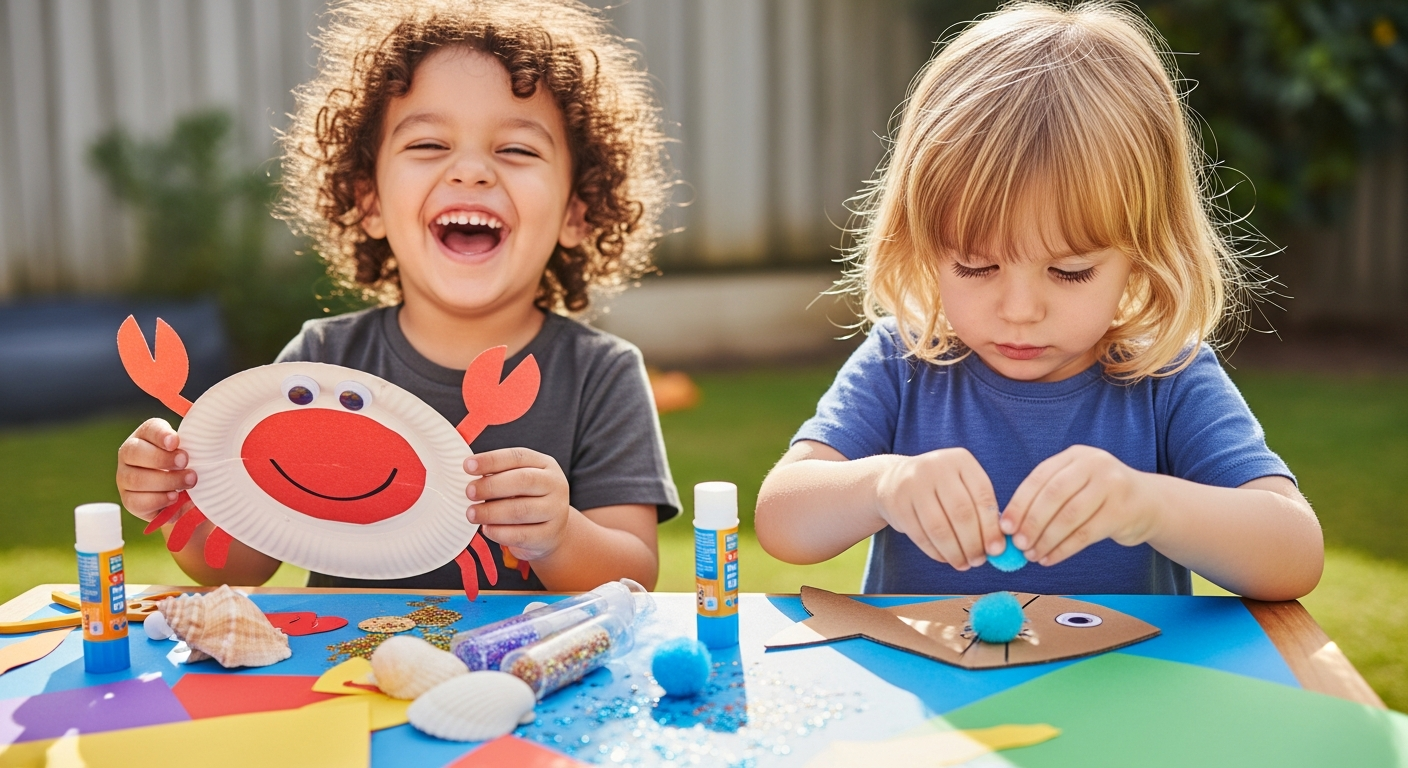
Table of Contents
- Introduction
- Why Ocean Crafts are a Developmental Goldmine
- Sensory-Based Ocean Toddler Crafts
- Easy Paper Plate & Paper Crafts
- Painting and Process Art
- Fine Motor and Precision Crafts
- Sustainable & Upcycled Ocean Crafts
- Boosting Vocabulary with Ocean Play
- Speech Blubs: The Ultimate Learning Supplement
- Setting Realistic Expectations
- Conclusion
- FAQ
Introduction
Did you know that the ocean covers more than 70% of our planet, yet it remains one of the greatest mysteries to the human mind? For a toddler, the ocean is even more magical. It is a world of shimmering blues, ticklish sand, and creatures that look like they popped out of a storybook. At Speech Blubs, we believe that this natural sense of wonder is the perfect gateway to learning. Our mission is to empower children to "speak their minds and hearts," and there is no better way to spark a child’s voice than through the joy of creative play.
In this post, we are going to dive deep into a treasure chest of ocean toddler crafts designed to boost fine motor skills, ignite sensory exploration, and—most importantly—encourage language development. Whether you are looking for a rainy-day activity or a way to supplement your child’s speech therapy journey, these projects offer more than just a cute end product; they provide a meaningful way for you to connect with your little one.

We will explore everything from sensory "jelly oceans" to recycled egg carton whales, all while weaving in tips on how to use these moments to expand your child’s vocabulary. By the end of this article, you’ll have a full maritime toolkit of activities that turn "screen-free" time into a powerful developmental engine. We are here to support the 1 in 4 children who need speech assistance by blending scientific principles with the pure, unadulterated joy of play.
Our approach is rooted in the personal experiences of our founders, who grew up with speech challenges themselves. They created the tool they wished they had—a way to make learning to talk feel like a game rather than a chore. As we explore these crafts, remember that the goal isn't perfection; it’s the laughter, the "oohs," the "aahs," and the new words discovered along the way.
Why Ocean Crafts are a Developmental Goldmine
Before we roll up our sleeves and get messy, let’s talk about the "why" behind these activities. For toddlers, crafting isn't just about making a paper plate look like a crab. It is a complex developmental workout.
Fine Motor Skill Mastery
When a child uses a glue stick, tears tissue paper, or pinches a pom-pom, they are strengthening the tiny muscles in their hands and fingers. These are the same muscles they will eventually use to hold a pencil and button their coat. In the context of speech, fine motor development is often closely linked to the coordination required for oral-motor skills.
Sensory Processing and Language
The ocean theme is inherently sensory. You have the "squish" of blue spaghetti seaweed, the "crunch" of sand playdough, and the "cold" of frozen ice aquariums. Sensory play provides a rich context for descriptive language. Instead of just saying "fish," you can prompt your child with words like "slippery," "shiny," "bubbly," or "rough."
Cognitive Connections and Video Modeling
At Speech Blubs, we utilize a unique "video modeling" methodology. Science shows that children learn best by watching and imitating their peers. This activates "mirror neurons" in the brain. When you pair a craft—like making a pufferfish—with our app's peer-led videos of the same animal, you are reinforcing the concept through multiple channels. Your child sees a peer making the sound, hears the word, and then physically creates the animal.

If you aren't sure where your child stands in their communication journey, we recommend taking our quick 3-minute preliminary screener. It consists of 9 simple questions and provides you with a personalized assessment and a next-steps plan to support your child’s growth.
Sensory-Based Ocean Toddler Crafts
Sensory play is the foundation of early learning. It grounds a child in the present moment and reduces frustration by giving them a physical outlet for their energy.
1. The Jellyfish in a Bottle
This is a mesmerizing "calm-down" tool that toddlers find absolutely hypnotic.
- Materials: A clear plastic bottle, water, blue food coloring, and a clear plastic grocery bag.
- The How-To: Cut a circle out of the plastic bag. Gather the center to create a "head" and tie it loosely with a bit of thread, leaving the edges to hang like tentacles. Fill the bottle with water, add a drop of blue dye, and pop your "jellyfish" inside.
- Speech Tip: As the jellyfish floats up and down, use those directional words! "Up, up, up... and down." This helps toddlers grasp spatial concepts while they watch.
2. Edible Spaghetti Ocean
For the little ones who still like to put everything in their mouths, this is a safe and hilarious way to play.
- Materials: Cooked spaghetti and blue/green food coloring.
- The How-To: Toss the cooked pasta with food coloring until it looks like vibrant seaweed and waves. Place it in a large bin with some plastic sea creatures.
- The Play: Encourage your child to "rescue" the animals from the seaweed. Use "action" words like "pull," "hide," "find," and "stuck."
- Connection: This activity mirrors the playful, low-pressure environment we strive for at Speech Blubs. It’s about the experience, not the result.
3. Fizzy Bicarbonate Sea
Chemistry meets the ocean in this exciting, bubbling activity.
- Materials: Baking soda, vinegar, blue food coloring, and a tray.
- The How-To: Spread a layer of baking soda on a tray. Mix vinegar with blue dye in small cups. Give your child a dropper or a spoon to pour the vinegar onto the "sand."
- The Magic: Watch the "ocean" fizz and foam!
- Speech Tip: This is perfect for practicing the "s" and "f" sounds. "Sssssss... look at the foam!" or "Ffffff... it’s fizzy!"
Easy Paper Plate & Paper Crafts
Paper plates are the unsung heroes of the toddler crafting world. They are sturdy, cheap, and perfectly shaped for all sorts of sea life.
4. The Grumpy Paper Plate Crab
Crabs are fantastic for teaching toddlers about "pincer" movements and the "C" and "K" sounds.
- Materials: A paper plate (painted red), red construction paper for legs, and googly eyes.
- The How-To: Fold the plate in half to create the body. Cut out claw shapes and accordion-fold some strips for legs. Glue them to the sides.
- Real-World Scenario: If your 2-year-old is struggling with the "K" sound (often saying "tab" instead of "crab"), use this craft to practice the "back of the throat" sound. Show them how the crab goes "Click, click, click!" with its claws. You can find similar repetitive sound exercises in our app's "Animal Kingdom" section by downloading Speech Blubs on the App Store.
5. Sticky Fish (Contact Paper Art)
This is a fantastic "no-mess" activity that focuses on textures.
- Materials: Clear contact paper (sticky back plastic), colorful tissue paper squares, and a marker.
- The How-To: Draw a large fish outline on the non-sticky side of the contact paper. Tape it to a wall or window with the sticky side facing out.
- The Play: Let your toddler press the tissue paper "scales" onto the fish.
- Speech Tip: Focus on colors! "Where is the blue scale? Can you find the yellow one?"
6. Handprint Octopus
There is nothing parents love more than a craft that preserves the size of those tiny hands.
- Materials: Washable paint and paper.
- The How-To: Paint your child’s palm and fingers. Press it down twice (overlapping the palms) to create an eight-legged friend.
- The Lesson: This is a great time to count! "One, two, three..." Counting legs is a simple way to introduce early math and speech rhythm.
Painting and Process Art
Process art is about the doing, not the making. It’s perfect for toddlers who have short attention spans and a high need for movement.
7. Salt Painting Under the Sea
This looks like magic and teaches kids about absorption.
- Materials: White glue, table salt, and watercolors.
- The How-To: Draw a jellyfish or a coral reef using the glue. Cover the wet glue with a thick layer of salt, then shake off the excess. Use a very wet paintbrush to touch the salt with color and watch it "travel" along the lines.
- Speech Tip: Use the word "wow!" or "look!" Modeling exclamation and excitement encourages your child to vocalize their own feelings of wonder.
8. Blow Painting Coral
This activity is actually a hidden speech therapy tool because it strengthens the muscles used for blowing and breath control.
- Materials: Watery paint and a straw.
- The How-To: Place a blob of paint on the paper and have your child blow through the straw to spread it out like "branches" of coral.
- Safety Note: Make sure they understand to blow out and not suck in!
- Scientific Methodology: Activities like this, which focus on oral motor control, are a great physical supplement to the digital exercises found in our app. We base our methodology on extensive research into how play-based learning affects brain development and language acquisition.
Fine Motor and Precision Crafts
For toddlers who are ready for a bit more of a challenge, these projects focus on "the pinch" and "the pull."
9. Pom-Pom Fish
- Materials: Large pom-poms, felt scraps, and glue.
- The How-To: Transform a simple pom-pom into a pufferfish or a goldfish by gluing on tiny felt fins and eyes.
- Developmental Benefit: Handling these small items builds the "pincer grasp," which is vital for writing later on.
10. Woven Turtles
- Materials: Three popsicle sticks and yarn.
- The How-To: Glue the sticks in a star shape to create the "bones" of the turtle. Have your child help you "weave" the yarn over and under to create the shell.
- Play Pattern: This mimics the "God’s Eye" crafts many of us did as children. It’s a wonderful way to practice patterns (over, under, over, under).
Sustainable & Upcycled Ocean Crafts
Teaching our kids to care for the "blue planet" starts with showing them how to reuse what we have. These eco-friendly crafts turn trash into treasure.
11. Egg Carton Whales
Don’t throw away that egg carton! It’s about to become a pod of humpbacks.
- Materials: Cardboard egg carton, blue paint, and a pipe cleaner.
- The How-To: Cut out a single "cup" from the carton. Paint it blue. Poke a hole in the top and insert a blue pipe cleaner to look like a water spout.
- Scenario: If your child is obsessed with the "Big Fish" section of our app, this is the perfect real-world tie-in. You can start your 7-day free trial to see all the different whales and dolphins we feature!
12. Cereal Box Aquarium
- Materials: An empty cereal box, blue paint, string, and paper fish.
- The How-To: Cut a large rectangle out of the front of the box. Paint the inside blue. Hang paper fish from the top using string so they "swim" when you move the box.
- Language Tip: This creates a "stage" for storytelling. Ask your child, "Where is the fish going?" or "Is the fish hungry?"
Boosting Vocabulary with Ocean Play
Crafting is only half the battle. The real magic happens when you use these crafts as "props" for conversation. At Speech Blubs, we call this "smart screen time" when it’s done through our app, but it applies to physical play too. You are the "facilitator of fun."
When your child is playing with their new paper plate crab, try these strategies:
- Parallel Talk: Describe what your child is doing as they do it. "You are moving the crab. The crab is red. Oh, look, the crab is hiding!"
- Expansion: If your child says "fish," you say, "Yes, a big blue fish!"
- The Wait: After you ask a question, wait at least 5-10 seconds. Toddlers often need extra time to process their thoughts and formulate a response.
Speech Blubs: The Ultimate Learning Supplement
While hands-on crafts are irreplaceable, we understand that modern parents need a variety of tools in their kit. That’s why we created Speech Blubs. We provide a powerful, screen-free alternative to passive viewing (like mindlessly watching cartoons). Instead, our app invites your child to be an active participant in their learning.
Our unique approach focuses on:
- Peer-to-Peer Learning: Children are much more likely to imitate another child than an adult.
- Confidence Building: By seeing other kids succeed, your child feels empowered to try new sounds.
- Joyful Connection: Our app is designed for "co-play," meaning it’s a tool for you and your child to use together, sparking conversations that last long after the screen is turned off.
Transparency in Pricing and Value
We believe in being upfront with parents. We know you are investing your time and heart into your child’s development, so we want to provide the best value possible.
- Monthly Plan: $14.99 per month. This is a great way to "test the waters" and see how your child responds to our video modeling.
- Yearly Plan: $59.99 per year. This is our best-value option, breaking down to just $4.99 per month. That’s a 66% saving compared to the monthly plan!
Why choose the Yearly Plan? Beyond the significant savings, the Yearly plan includes exclusive features that the Monthly plan does not:
- A 7-day free trial so you can explore the full library risk-free.
- The Reading Blubs app, which helps transition those early speech skills into literacy.
- Early access to all new content updates.
- Priority 24-hour support response time from our dedicated team.
Ready to see the difference for yourself? Download Speech Blubs on Google Play to begin your journey today.
Setting Realistic Expectations
It is important to remember that every child develops at their own pace. Crafting and using educational tools are not about "fixing" a child; they are about fostering a love for communication and building foundational skills. You won't see your child giving public speeches in a month, and that’s okay!
What you will see are small, joyful victories:
- Reduced frustration when they can finally signal what they want.
- Increased confidence to try new words.
- Stronger bonds formed during your shared "ocean adventures."
Our method is a supplement to your child’s overall development and, when applicable, professional therapy. We are here to make the process effective and, above all, joyful. Don't just take our word for it—read through our parent testimonials to see how other families have found success and connection through our platform.
Conclusion
The ocean is vast, but the journey of a thousand words begins with a single splash. Whether you are painting salt-crusted coral or "rescuing" plastic sharks from blue jelly, these ocean toddler crafts are more than just a way to pass the time. They are opportunities to build the "smart screen time" habits, fine motor control, and vocabulary that will serve your child for a lifetime.
At Speech Blubs, we are honored to be a part of your family’s story. From our founders' personal struggles to the vibrant community of over 5 million parents we serve today, our goal remains the same: helping your child speak their mind and heart.
Ready to dive in? Don’t miss out on the full suite of developmental tools we offer. The Yearly plan is the clear best choice for families committed to growth. It offers the most comprehensive features, including the Reading Blubs app and the 7-day free trial. Create your account and begin your journey today. Let’s make a splash together!
FAQ
1. My toddler still puts everything in their mouth. Are these crafts safe? Many of the crafts listed, like the "Edible Spaghetti Ocean" and the "Jellyfish in a Bottle" (if sealed tightly), are designed with younger toddlers in mind. However, always supervise your child during craft time, especially when using small items like googly eyes or pom-poms. We recommend focusing on sensory "process art" until they move past the mouthing phase.
2. How do ocean crafts actually help with speech delay? Crafts help by providing a "referent"—a physical object to talk about. It’s much easier for a child to learn the word "crab" when they are touching a red plate, seeing a peer say "crab" on a screen, and mimicking the "click-click" sound. This multi-sensory approach reinforces the neural pathways needed for language.
3. What if my child isn't interested in the crafts? That is perfectly normal! Some children prefer digital interaction, while others are purely tactile. If your child isn't in the mood to glue, try using the Speech Blubs app to watch videos of the animals first. Seeing other children play and make sounds often motivates a reluctant crafter to join in.
4. Is the Speech Blubs app a replacement for speech therapy? No, Speech Blubs is a powerful supplement to professional therapy and a great tool for general developmental support. It provides parents with a way to continue the "work" of speech development at home through play. Always consult with a professional if you have serious concerns about your child's milestones.
About the author