
Fun Outdoor Games for Kids: Play, Learn, and Connect
 By Speech Blubs Team•Jan 19, 2026•28 min.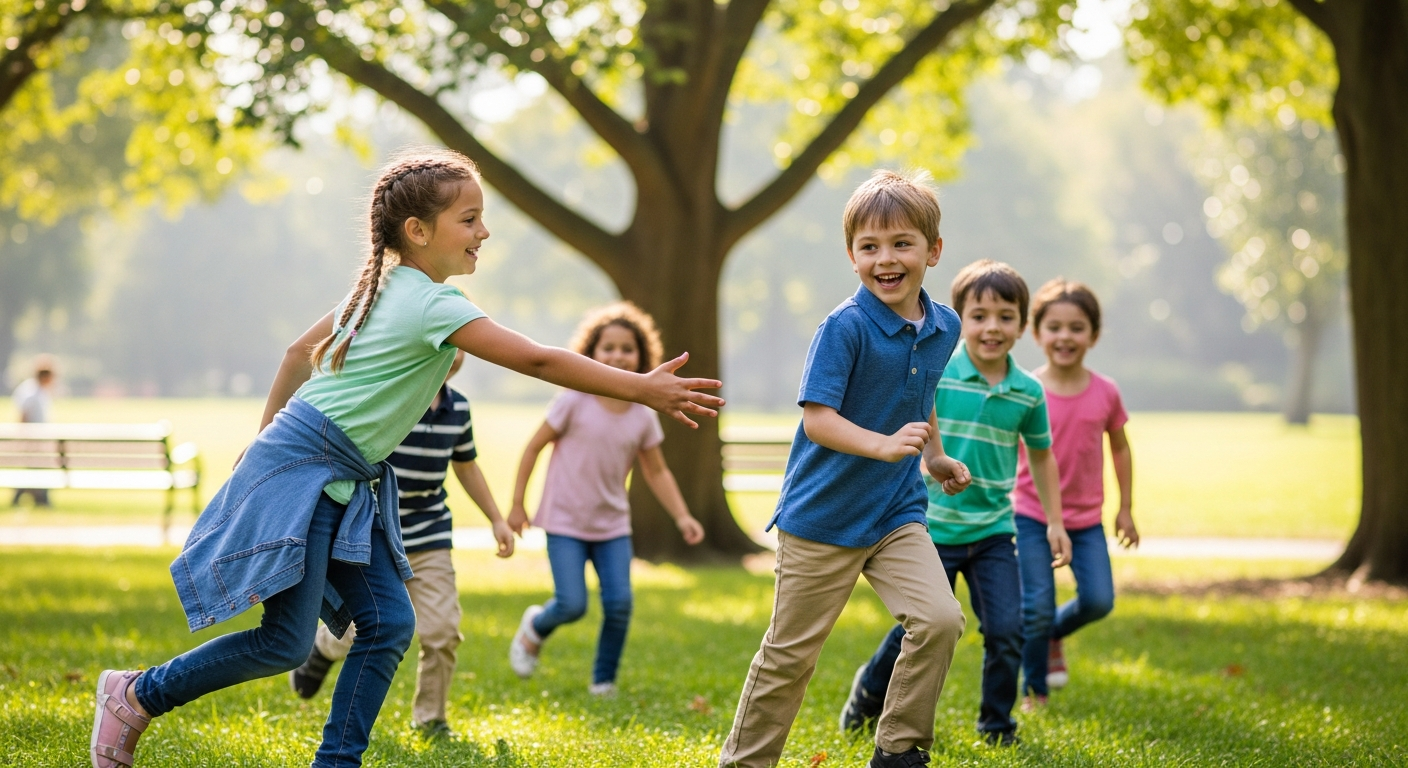
Table of Contents
- The Irresistible Call of the Outdoors: More Than Just Play
- Classic Outdoor Games: Timeless Fun for All Ages
- Team & Strategy Games: Building Social Skills and Vocabulary
- Imaginative & Creative Outdoor Adventures: Fueling Language Through Story
- Simple & Soothing Outdoor Activities: Connecting with Nature and Each Other
- Enhancing Communication Through Outdoor Play: A Speech Blubs Perspective
- Making Speech Blubs Part of Your Outdoor Play Toolkit
- Conclusion
- FAQs
Do you remember those childhood summers, stretching endlessly with the sun on your face and the joyous shouts of friends echoing across the yard? Far from the glow of screens, we built worlds, conquered imaginary foes, and forged friendships through the simple magic of outdoor play. Yet, in our bustling modern lives, it's easy to lose touch with these fundamental, enriching experiences. We often hear the familiar lament, "I'm bored!" from children who, despite a world of digital entertainment, yearn for genuine engagement. The truth is, unstructured outdoor play isn't just about fun; it's a critical catalyst for holistic child development, fostering physical health, emotional regulation, social skills, and, crucially, robust communication abilities.
This post will journey through a treasure trove of fun outdoor games for kids, from timeless classics to imaginative adventures, designed to spark joy and unleash your child's innate potential. We’ll explore how these games inherently boost speech and language skills, offering practical tips to turn every play session into a rich learning opportunity. You’ll discover how to create environments where children naturally develop confidence, express themselves freely, and connect deeply with others. Get ready to rediscover the simple, profound power of getting outside and playing together, empowering your child to truly speak their minds and hearts.

The Irresistible Call of the Outdoors: More Than Just Play
The fresh air, the open space, the limitless possibilities – the outdoors offers a unique classroom for children. Beyond the sheer delight, outdoor play provides a multitude of developmental benefits that are hard to replicate indoors.
Physical Development and Sensory Exploration
From running and jumping to climbing and balancing, outdoor games build gross motor skills, coordination, and strength. The varied textures of grass, dirt, and leaves, the sounds of birds and rustling trees, and the sights of a vast sky all offer rich sensory input that is vital for brain development. This sensory engagement also primes the brain for learning, making it more receptive to new information, including language.
Cognitive Growth and Problem-Solving
When children build a fort, devise rules for a game, or navigate an obstacle course, they are engaging in critical thinking, planning, and problem-solving. They learn about cause and effect, spatial reasoning, and adaptability. These cognitive processes are deeply intertwined with language development, as children use language to organize their thoughts, express ideas, and negotiate solutions. For instance, creating an obstacle course requires sequential thinking and the ability to describe actions and pathways.
Social-Emotional Learning and Communication Skills
Perhaps most importantly, outdoor games are a natural laboratory for social-emotional learning and communication. Children learn to share, take turns, resolve conflicts, and understand different perspectives. These interactions are fertile ground for developing crucial language skills:
- Verbalizing needs and desires: "Can I go first?" "I want to hide there!"
- Negotiating rules: "Let's say we count to twenty."
- Describing actions and locations: "I'm running fast!" "She's behind the tree!"
- Listening and following instructions: "Red Light, Green Light" is a perfect example of this.
- Expressing emotions: Joy, frustration, excitement – all provide opportunities to label feelings.
At Speech Blubs, we understand that language development thrives when children are actively engaged and motivated. Our mission, born from our founders' personal experiences with speech challenges, is to empower children to communicate effectively and joyfully. We believe that play, especially outdoor play, is a powerful complement to targeted speech support, creating a holistic environment where language blossoms.

Classic Outdoor Games: Timeless Fun for All Ages
Some games are classics for a reason – they’re simple to learn, endlessly fun, and offer a wealth of opportunities for language practice. These staples require minimal equipment, making them perfect for spontaneous play in any backyard or park.
Hide and Seek
How to Play: One person counts to a predetermined number with their eyes closed while others find hiding spots. The seeker then calls out "Ready or not, here I come!" and searches for the hidden players. The last person found wins or becomes the next seeker. Communication Boost: This game is fantastic for:
- Counting: Encourages numerical sequencing and vocalization.
- Positional words: "Where are you?" "I'm behind the bush!" "Under the slide!" "In the shed!"
- Question asking and answering: "Did you find me?" "Who's hiding?"
- Volume control: Whispering while hiding, shouting when found.
- Turn-taking: Practicing who counts next. Parent Tip: For a child who is a 'late talker' or working on early vocabulary, narrate your search: "Hmm, is anyone behind the big tree? No! What about under the blue slide?" Encourage them to use descriptive words when they reveal their hiding spot.
Tag (or It/Tig)
How to Play: One person is designated "It" and chases the other players, trying to tag them. The person tagged becomes the new "It." Communication Boost:
- Action verbs: "Run!" "Catch me!" "Stop!"
- "You're it!": Repetition of simple phrases.
- Naming players: Calling out who is "It" or who they are chasing. Parent Tip: Introduce variations like "freeze tag" (players freeze when tagged until unfrozen by another player), which adds new vocabulary like "freeze" and "unfreeze," and encourages collaboration.
Red Light, Green Light
How to Play: One person stands with their back to the others and calls out "Green Light!" while players run towards them. When they call "Red Light!" and turn around, everyone must freeze. Anyone caught moving is out or sent back to the start. The first to touch the caller becomes the new caller. Communication Boost:
- Listening and following multi-step directions: "When I say 'Green Light,' run. When I say 'Red Light,' freeze."
- Understanding opposites: "Red/Green," "Stop/Go."
- Action verbs: "Run," "freeze."
- Self-regulation and impulse control: Learning to stop and listen. Parent Tip: Narrate the game as it unfolds: "Oh, you're running so fast on 'Green Light'! Wow, you froze perfectly on 'Red Light'!" This reinforces the vocabulary and concepts.
Duck, Duck, Goose
How to Play: Players sit in a circle. One person walks around the outside, tapping each player's head and saying "Duck, duck, duck..." until they choose someone to tap and say "Goose!" The "Goose" then chases the first player around the circle to try and tag them before they sit in the empty spot. Communication Boost:
- Repetitive phrases: Reinforces common words and sounds.
- Turn-taking and social cues: Understanding when it's your turn to be "it" or to chase.
- Naming objects/animals: Identifying "duck" and "goose."
- Vocalization: Shouting "Goose!" and the ensuing cheers and giggles. Parent Tip: For younger children, exaggerate the "Duck, duck, GOOSE!" to highlight the change in sound and meaning. This can be especially helpful for children working on auditory discrimination.
Hopscotch
How to Play: Draw a hopscotch grid with chalk (numbered 1-10). Players throw a marker (stone, beanbag) into a square, then hop through the grid, skipping the square with the marker. They pick up the marker on the way back. Communication Boost:
- Counting and number recognition: "One, two, three..."
- Sequencing: Understanding the order of squares and steps.
- Body awareness and directional language: "Hop on one foot," "Two feet," "Turn around."
- Following rules: Understanding complex instructions. Parent Tip: Ask your child to verbalize the numbers as they hop or describe their movements: "I'm hopping on one foot to square five!" This connects motor action with language.
Hot Potato
How to Play: Players sit in a circle and quickly pass a soft "potato" (ball, beanbag) while music plays. When the music stops, whoever holds the potato is out. The last player remaining wins. Communication Boost:
- Quick responses: "Catch!" "Pass it!"
- Listening for cues: Attending to when the music starts and stops.
- Expressing excitement or disappointment: Provides opportunities to label emotions.
- Turn-taking: Understanding when to pass the potato. Parent Tip: Use a variety of musical genres to introduce different rhythms and encourage movement. You can also vary the "potato" to introduce new vocabulary (e.g., "red ball," "soft pillow").
Simon Says
How to Play: One person (Simon) gives commands starting with "Simon says..." (e.g., "Simon says touch your toes"). Players only follow commands that begin with "Simon says." If Simon gives a command without "Simon says" and a player follows it, they are out. Communication Boost:
- Listening comprehension: Crucial for understanding which commands to follow.
- Action verbs: "Jump," "clap," "stomp," "wiggle."
- Body parts vocabulary: "Nose," "head," "knees," "toes."
- Following multi-step directions: "Simon says clap your hands and then stomp your feet." Parent Tip: Start with simple commands, then gradually increase complexity as your child's listening skills improve. Use clear, concise language. If your child struggles with action verbs, Speech Blubs has a fantastic Action Verbs category with video modeling, which can reinforce these words in a fun, interactive way.
Musical Statues/Freeze Dance
How to Play: Play music and have everyone dance. When the music stops, everyone must freeze in position like a statue. Anyone who moves is out. Communication Boost:
- Listening for auditory cues: Recognizing when the music stops.
- Action verbs: "Dance," "spin," "wiggle," "freeze."
- Descriptive language: Encouraging children to describe their "statue" pose: "I'm a sleeping bear!" or "I'm a jumping frog!"
- Body awareness: Naming and moving different body parts. Parent Tip: Encourage creative poses and verbal descriptions. You can also introduce different types of music and discuss how it makes them want to move.
Kick the Can
How to Play: A can is placed in an open area. One player is "It" and counts while others hide. "It" then searches for hiders. If "It" finds a player, they race back to the can, call the player's name, and kick the can, sending that player to "jail." Any player still hiding can try to run to the can and kick it, shouting "Kick the can, save all!" to release everyone from jail. Communication Boost:
- Spatial reasoning and prepositions: "Behind the garage," "Under the table," "Near the fence."
- Calling out names and locations: "I see [name] behind the bush!"
- Negotiation and strategy: Discussing where to hide or how to free teammates.
- Excitement and frustration: Expressing a wide range of emotions verbally. Parent Tip: This game is excellent for developing narrative skills. After the game, encourage your child to retell their experience: "First, I hid behind the shed, then I saw Sarah run to the can..."
Team & Strategy Games: Building Social Skills and Vocabulary
These games encourage teamwork, strategic thinking, and more complex communication, making them perfect for slightly older children or groups.
Capture the Flag
How to Play: Divide players into two teams, each with a designated "flag" hidden in their territory. The goal is to capture the opposing team's flag and bring it back to your territory without being tagged. Tagged players might go to "jail" or be out, depending on the rules established. Communication Boost:
- Strategy and planning: Team discussions on roles (guard, attacker), routes, and diversion tactics.
- Negotiation and problem-solving: "How can we get past their guards?" "Let's create a distraction!"
- Descriptive language: Describing locations, actions, and team members.
- Teamwork and cooperation: Learning to listen to and build on others' ideas. Parent Tip: Encourage a pre-game "team meeting" where children verbally articulate their strategy. This provides valuable practice in expressing complex thoughts and listening to teammates.
Spud
How to Play: One player throws a ball high into the air, calling out another player's name (or number). That player must catch the ball while everyone else scatters. Once the named player catches the ball, they shout "SPUD!" and everyone freezes. The catcher then takes four steps towards the closest player, spelling out S-P-U-D with each step. They then try to hit that player below the waist with the ball. If hit, the player gets an "S." If missed, the thrower gets an "S." Players with all four letters (S-P-U-D) are out. Communication Boost:
- Naming and calling out: Clearly stating who is "it."
- Counting and spelling: Reinforces letters and numerical concepts.
- Directional language: "Come closer," "Aim for the legs."
- Quick reactions and verbalization: Shouting "SPUD!" Parent Tip: This game can be adapted for early learners by focusing on just naming players and counting the steps, simplifying the "spelling" aspect if needed.
Untangle
How to Play: Players stand in a close circle, reach into the center, and grab two different hands from two different people. The goal is to work together, without letting go, to untangle yourselves into a single circle or line. Communication Boost:
- Collaborative problem-solving: Requires constant verbal communication to guide movements.
- Positional and directional words: "Lift your arm over mine," "Step under their leg," "Twist this way."
- Turn-taking in conversation: Listening to and responding to suggestions.
- Encouragement and patience: "You've almost got it!" "Let's try again." Parent Tip: Explicitly encourage children to use words to direct each other rather than just pulling. This strengthens descriptive and instructional language.
Four Square
How to Play: Draw a large square on the ground, divided into four smaller squares (numbered 1-4). Each player occupies a square. Using a playground ball, players bounce the ball from their square into another player's square. The goal is to eliminate other players (by causing them to hit the ball out of bounds, fail to hit it, etc.) and advance to square 4. Communication Boost:
- Understanding and explaining rules: Can be quite detailed, promoting precise language.
- Calling out: "Out!" "My turn!"
- Spatial awareness: Hitting the ball into specific squares.
- Negotiation and fair play: Discussing disputed plays. Parent Tip: Encourage children to explain the rules to each other, reinforcing their understanding and ability to articulate complex procedures.
Bocce Ball or Cornhole
How to Play: These involve tossing balls or beanbags towards a target. In bocce, players aim to get their balls closest to a smaller "pallino" ball. In cornhole, players toss beanbags onto a raised board, aiming for a hole. Points are awarded for proximity or landing in the hole. Communication Boost:
- Counting and scorekeeping: "That's 3 points!" "My turn to tally."
- Descriptive feedback: "Good shot!" "Too far." "Aim left!"
- Strategic discussion: "Should I try for the hole or block their shot?"
- Sportsmanship: Congratulating others, discussing fair play. Parent Tip: These games are great for practicing comparative language: "Yours is closer!" "Mine went farther."
Pickleball
How to Play: A paddle sport combining elements of badminton, tennis, and table tennis. Players use paddles to hit a plastic ball with holes over a net. Communication Boost:
- Sports-specific vocabulary: "Serve," "volley," "fault," "point."
- Rules and strategy: Discussing how to play and win.
- Cooperation (doubles): Calling out shots, encouraging partners.
- Following directions: Understanding game flow and rules. Parent Tip: Even if your child isn't ready for a full game, simply hitting the ball back and forth can be an opportunity to practice words like "hit," "over," and "catch."
Ghost in the Graveyard
How to Play: Designate a "home base." One player is the "ghost" and hides while others count. Players then run through the yard. If a player spots the ghost, they yell "Ghost in the Graveyard!" and everyone races back to home base before being tagged by the ghost. Tagged players become ghosts. Communication Boost:
- Descriptive language: Describing hiding spots, the ghost's movements.
- Auditory processing: Listening for the "Ghost in the Graveyard!" call.
- Expressing fear/excitement: Opportunities to use words for emotions.
- Teamwork: Helping others find home base. Parent Tip: Encourage rich descriptions of the "graveyard" setting and the "ghost's" actions to stimulate imaginative language.
Imaginative & Creative Outdoor Adventures: Fueling Language Through Story
The outdoors is a blank canvas for imagination. These activities encourage storytelling, role-playing, and descriptive language, transforming simple play into profound learning.
Obstacle Course
How to Play: Gather household items (jump ropes, pillows, buckets, pool noodles) or natural elements (logs, rocks) to create a series of challenges. Kids can jump over, crawl under, balance on, or weave through obstacles. Communication Boost:
- Sequencing and narrative: "First, I'll jump over the rope, then crawl under the blanket."
- Directional and positional words: "Go through the tunnel," "Step on the rock," "Jump over the log."
- Action verbs: "Crawl," "climb," "jump," "balance," "run."
- Problem-solving language: "How can I get past this?" "I need to go around." Parent Tip: Encourage your child to narrate their journey through the course, or create a storyline around it (e.g., escaping a dragon, saving a princess). This boosts descriptive language and storytelling skills.
Treasure Hunt
How to Play: Hide a "treasure" (a favorite toy, a small snack, or a collection of interesting natural items) and provide clues (written, picture-based, or verbal) for your child to follow. Communication Boost:
- Following complex directions: "Go ten steps forward, then look behind the big tree."
- Descriptive language: Clues require understanding and using adjectives.
- Question asking: "Where should I look next?"
- Problem-solving through language: Interpreting clues, asking for clarification. Parent Tip: Tailor the complexity of the clues to your child's language level. For younger children, use picture clues or simple directional words. For older children, introduce riddles or multi-step instructions.
Fort Building
How to Play: Using blankets, branches, tarps, or even large cardboard boxes, children can construct their own outdoor hideaways. Communication Boost:
- Planning and collaboration: Discussing design, materials, and roles.
- Descriptive vocabulary: "We need a sturdy branch," "The sheet is too short," "This fort is cozy."
- Prepositions and spatial terms: "Put the blanket over the chairs," "Crawl inside."
- Imaginative play and role-playing: Once built, forts become settings for endless stories and character interactions. Parent Tip: Provide a variety of materials and encourage your child to verbally explain their building plans and describe their finished fort. "What kind of fort are you building? Who will live here?"
Backyard Artist/Nature Art
How to Play: Give children paper and crayons, or even natural materials like leaves, petals, and pebbles, to create art inspired by the backyard. They can draw scenes, make collages, or craft "mud faces" on trees. Communication Boost:
- Descriptive adjectives: Naming colors, shapes, textures ("rough bark," "smooth stone," "bright red flower").
- Expressing creativity: "I'm drawing a happy bird."
- Discussing observations: "Look at the pattern on this leaf!"
- Asking and answering questions about their art: "What did you draw?" "Why did you choose those colors?" Parent Tip: Engage your child in conversation about their artwork, focusing on open-ended questions that encourage detailed responses. This helps them articulate their thoughts and expand their vocabulary.
Mud Pies & Potions
How to Play: Provide old pots, spoons, cups, and access to dirt and water. Children can mix "ingredients" (leaves, twigs, mud, flowers) to create imaginary culinary delights or magical brews. Communication Boost:
- Sensory vocabulary: "Wet," "squishy," "gritty," "slimy."
- Action verbs: "Stir," "mix," "pour," "scoop," "sprinkle."
- Imaginative play and role-playing: "Here's your special mud cake!" "This potion will make you fly!"
- Sequencing: Describing the steps to make their creation. Parent Tip: Join in the play! Model descriptive language and encourage your child to talk about their "recipes" and the "magical effects" of their potions. This is a wonderfully messy and rich environment for language.
Nature Scavenger Hunts & Alphabet/Color Hunts
How to Play: Provide a list (words or pictures) of items to find in the backyard or neighborhood, such as "something red," "a smooth stone," "a feather," or "something that starts with the letter 'B'." Communication Boost:
- Naming and identifying objects: "I found a leaf!"
- Categorization: Grouping items by color, texture, or type.
- Descriptive language: "This leaf is crinkly and brown."
- Question asking and answering: "Did you find a blue flower?" Parent Tip: Create custom scavenger hunt lists that target specific vocabulary your child is working on. For example, if they're learning animal sounds, include "something that goes 'moo'" (a cow toy, or a picture of one).
What’s the Time Mr. Wolf?
How to Play: One player (Mr. Wolf) stands with their back to the others. The other players stand in a line and chant "What's the time, Mr. Wolf?" Mr. Wolf turns and calls out a time (e.g., "It's 3 o'clock!"), turning their back again while players take that many steps forward. This continues until Mr. Wolf responds with "It's DINNER TIME!" and chases the players back to the starting line. Communication Boost:
- Counting and number recognition: Stepping the correct number of times.
- Understanding time concepts: "O'clock."
- Anticipation and reaction: Listening for the "Dinner Time!" cue.
- Expressing excitement/fear: Building emotional vocabulary. Parent Tip: Emphasize the "dinner time" phrase with a dramatic voice and tone to make the chase more engaging and fun, encouraging vocal expression.
Pin the Tail
How to Play: Draw a large animal (or object that needs a "tail") on a poster board or with chalk on a wall. Give each player a "tail" with tape. Blindfold a player, spin them around, and have them try to pin the tail in the correct spot. Communication Boost:
- Body parts vocabulary: "Tail," "head," "leg."
- Directional words: "Move left," "Go up," "Down a little."
- Descriptive feedback: Helping the blindfolded player with verbal cues.
- Sensory words: "Blindfold," "spin." Parent Tip: Narrate the actions and provide clear, simple verbal instructions to the blindfolded child, encouraging them to listen and respond.
Simple & Soothing Outdoor Activities: Connecting with Nature and Each Other
Sometimes, the most profound communication happens in quiet moments of shared observation and gentle interaction.
Reading a Book Outside
How to Play: Grab a favorite book and a blanket, and find a cozy spot under a tree. Communication Boost:
- Shared attention: Fosters connection and focus on the story.
- Vocabulary expansion: Introducing new words through stories.
- Discussion and comprehension: Talking about the plot, characters, and illustrations.
- Sensory experience: The sounds and sights of nature while reading can deepen engagement. Parent Tip: Choose books about nature or outdoor adventures to enhance the experience. Ask open-ended questions like, "What do you think happens next?" or "How does that character feel?"
Cloud Gazing
How to Play: Lie back on the grass and watch the clouds float by, identifying shapes and telling stories. Communication Boost:
- Imagination and creativity: Describing what they see ("That cloud looks like a dragon!").
- Descriptive language: Using adjectives like "fluffy," "wispy," "big," "small."
- Storytelling: Creating narratives about the cloud characters.
- Shared observation: Building connection through a quiet, shared activity. Parent Tip: Model imaginative descriptions and encourage your child to expand on their ideas. "Oh, that dragon cloud is flying! Where do you think it's going?"
Swinging
How to Play: A classic playground activity that offers rhythmic, vestibular input. Communication Boost:
- Action verbs: "Swing," "push," "kick."
- Comparative words: "Higher," "faster," "slower."
- Requests: "Push me!" "More!"
- Sequencing: "First, I sit, then you push." Parent Tip: Engage in conversation during swinging. Count pushes, describe the sensation, or talk about what they see as they swing high.
Collecting Sticks, Leaves, or Rocks
How to Play: Simply go for a walk and collect interesting natural items. Communication Boost:
- Categorization: Sorting items by size, color, texture, or type.
- Descriptive language: "This rock is bumpy," "That leaf is long and green."
- Question asking and answering: "What kind of leaf is this?"
- Observation skills: Paying close attention to details in nature. Parent Tip: Encourage your child to describe their collection. "Tell me about your favorite stick. What makes it special?"
Water Play
How to Play: Whether it's a sprinkler, a water table, or just buckets of water, splashing and pouring can be incredibly engaging. Communication Boost:
- Sensory vocabulary: "Wet," "cool," "splashing," "dripping."
- Action verbs: "Pour," "fill," "empty," "spray."
- Prepositions: "Water in the bucket," "Pour on the grass."
- Cause and effect: "If I pour here, the water goes there." Parent Tip: Provide various containers and toys to encourage different actions and the vocabulary that goes with them. Narrate their actions: "You're filling the cup! Now you're pouring the water!"
Enhancing Communication Through Outdoor Play: A Speech Blubs Perspective
Outdoor games are a playground for language, offering natural opportunities for children to learn and practice communication skills in a dynamic, engaging environment. The spontaneity of outdoor play encourages children to initiate conversations, express their thoughts, and react to their surroundings. These real-world interactions are invaluable for language acquisition, providing context and motivation that structured learning sometimes lacks.
For example, when playing an obstacle course, a child might learn words like "over," "under," and "through" not just by hearing them, but by physically experiencing them. This kinesthetic learning deeply embeds vocabulary and concepts. Similarly, games like "Simon Says" hone listening comprehension and the understanding of action verbs, skills directly transferable to everyday interactions and academic success.
At Speech Blubs, we recognize that every child's communication journey is unique. Our mission is to provide an immediate, effective, and joyful solution for the 1 in 4 children who need speech support. Our approach blends scientific principles with play, creating one-of-a-kind "smart screen time" experiences that complement the benefits of outdoor adventures.
One of our core methodologies is "video modeling," where children learn by watching and imitating their peers. This technique leverages the power of mirror neurons, making learning natural and engaging, much like how children learn from watching and interacting with friends during outdoor play. While playing outside, a child might observe a peer saying "Go!" during "Red Light, Green Light" and naturally imitate the word. Speech Blubs extends this natural learning into a focused, supportive digital environment. If a child struggles with a particular sound or word encountered during outdoor play, such as making the 's' sound in "snake" during a nature hunt, they can transition to Speech Blubs. Our app has categories designed to target specific sounds, words, and phrases, using video models to make practice fun and effective. This creates a powerful feedback loop: real-world application, followed by focused, playful practice, and then back to real-world application, building confidence and reducing frustration.
We firmly believe in setting realistic expectations. While Speech Blubs provides a powerful supplement to a child's overall development plan and, when applicable, professional therapy, it's about fostering a love for communication, building confidence, and developing key foundational skills. It's about empowering children to speak their minds and hearts, creating joyful family learning moments, and providing a screen-free alternative to passive viewing. Our app is a tool for connection, designed to be used with adult co-play and support, ensuring that even screen time is an interactive and enriching experience.
Making Speech Blubs Part of Your Outdoor Play Toolkit
Imagine a day filled with energetic outdoor games, followed by a period of focused, joyful "smart screen time" that reinforces the very communication skills your child practiced outside. Speech Blubs is designed to seamlessly integrate into your family's routine, providing targeted support that feels like play.
Our company was born from the personal experiences of our founders, who all grew up with speech problems and created the tool they wished they had. This personal commitment fuels our dedication to providing a solution that is not only scientifically backed but also deeply empathetic. Our research page highlights our high MARS scale rating, placing us in the top tier of speech apps worldwide, a testament to our effective and joyful approach.
Unlocking Full Potential with Speech Blubs: Our Value & Pricing
We are committed to making effective speech support accessible to all families. We offer transparent pricing options designed to fit your needs, but one clearly stands out in terms of value.
Our Monthly plan is available for $14.99 per month. It's a great way to start exploring the app and see the initial benefits.
However, for the best value and the most comprehensive experience, we highly recommend our Yearly plan. At $59.99 per year, it breaks down to just $4.99 per month – that's a phenomenal 66% savings compared to the monthly option!
But the superior value of the Yearly plan isn't just about cost. It also unlocks exclusive, high-value features designed to supercharge your child's communication journey:
- A 7-day free trial: Experience the full power of Speech Blubs before committing. This is only available with the Yearly plan selection.
- The extra Reading Blubs app: A bonus app to further support literacy and early reading skills.
- Early access to new updates: Be among the first to explore new games, activities, and features.
- 24-hour support response time: Get prompt assistance whenever you need it, ensuring a smooth and rewarding experience.
The Monthly plan does not include these invaluable benefits. We want you and your child to have the very best tools at your fingertips, which is why we encourage you to choose the Yearly plan.
Ready to see the difference Speech Blubs can make? Don't miss out on the incredible value and exclusive features of our Yearly plan. Download Speech Blubs on the App Store or Google Play today and select the Yearly plan to begin your free 7-day trial and unlock the full suite of features! You can also create your account on our website to get started.
Conclusion
Outdoor games are far more than just ways to pass the time; they are vital tools for fostering comprehensive development in children, particularly in speech and language. From the simple joys of Hide and Seek to the strategic thinking required in Capture the Flag, each game offers unique pathways for children to build vocabulary, practice listening skills, develop social cues, and express themselves with growing confidence. By embracing these fun outdoor activities, we not only create cherished memories but also lay a strong foundation for our children's communication abilities.
Remember, every "Red Light, Green Light" command, every "Duck, Duck, Goose" chant, and every "Simon Says" action is a building block for language. As parents, our empathetic participation and encouragement are key to unlocking these learning opportunities. And for those moments when targeted support is needed, Speech Blubs offers a joyful, science-backed complement, transforming screen time into "smart screen time" that empowers children to truly speak their minds and hearts.
Unsure if your child could benefit from a little extra support? Take our quick 3-minute preliminary screener to get a simple assessment and a free 7-day trial.
Ready to give your child the gift of confident communication? Download Speech Blubs on the App Store or Google Play today! To unlock the most value, including a 7-day free trial, the Reading Blubs app, and exclusive updates, be sure to choose the Yearly plan. It's the best way to empower your child's journey to confident communication!
FAQs
Q1: How do outdoor games specifically help with speech development?
A1: Outdoor games provide natural, contextual opportunities for speech development. Children engage in conversations, give and follow instructions, negotiate rules, describe actions and locations, and express a wide range of emotions. This dynamic interaction helps build vocabulary, improve listening comprehension, practice articulation, and develop social communication skills in a motivating environment. The physical movement also supports overall brain development, which is crucial for language acquisition.
Q2: What if my child is shy or reluctant to participate in group outdoor games?
A2: For shy or reluctant children, start with one-on-one activities or smaller groups. Focus on games that allow for individual participation within a group setting, like Hopscotch or a Nature Scavenger Hunt, where the pressure to interact constantly is lower. You can also model enthusiasm and narrate the fun you're having. Remember, even quiet observation can be a form of learning. Gradually introduce more interactive games as their comfort grows. Speech Blubs can also be a wonderful tool to build confidence in a supportive, controlled environment before they apply those skills in a larger group.
Q3: How can I maximize the language-learning potential of simple outdoor activities?
A3: The key is active, empathetic participation and narration. Describe what you and your child are doing, seeing, and feeling. Ask open-ended questions that encourage more than a "yes" or "no" answer (e.g., "What do you like most about this game?" instead of "Do you like this game?"). Introduce new vocabulary relevant to the activity, and provide opportunities for your child to lead and give instructions. By making language a central part of the play, you naturally enhance its learning potential.
Q4: How does Speech Blubs integrate with outdoor play for a child's overall development?
A4: Speech Blubs acts as a powerful complement to outdoor play. While outdoor games offer real-world, dynamic language practice, Speech Blubs provides targeted, joyful "smart screen time" to reinforce specific skills. For instance, if a child struggles with action verbs during "Simon Says," they can practice those verbs using our video modeling in the app. This creates a balanced approach, where active play builds general communication competence, and Speech Blubs offers focused support, empowering children to confidently apply their learned language skills in all environments. Our mission is to empower children to speak their minds and hearts, and we believe a blend of dynamic outdoor play and engaging app-based learning achieves this beautifully.
About the author