
Fun Soccer Activities for Kids: Sparking Joy and Skill on the Field
 By Speech Blubs Team•Jan 13, 2026•14 min.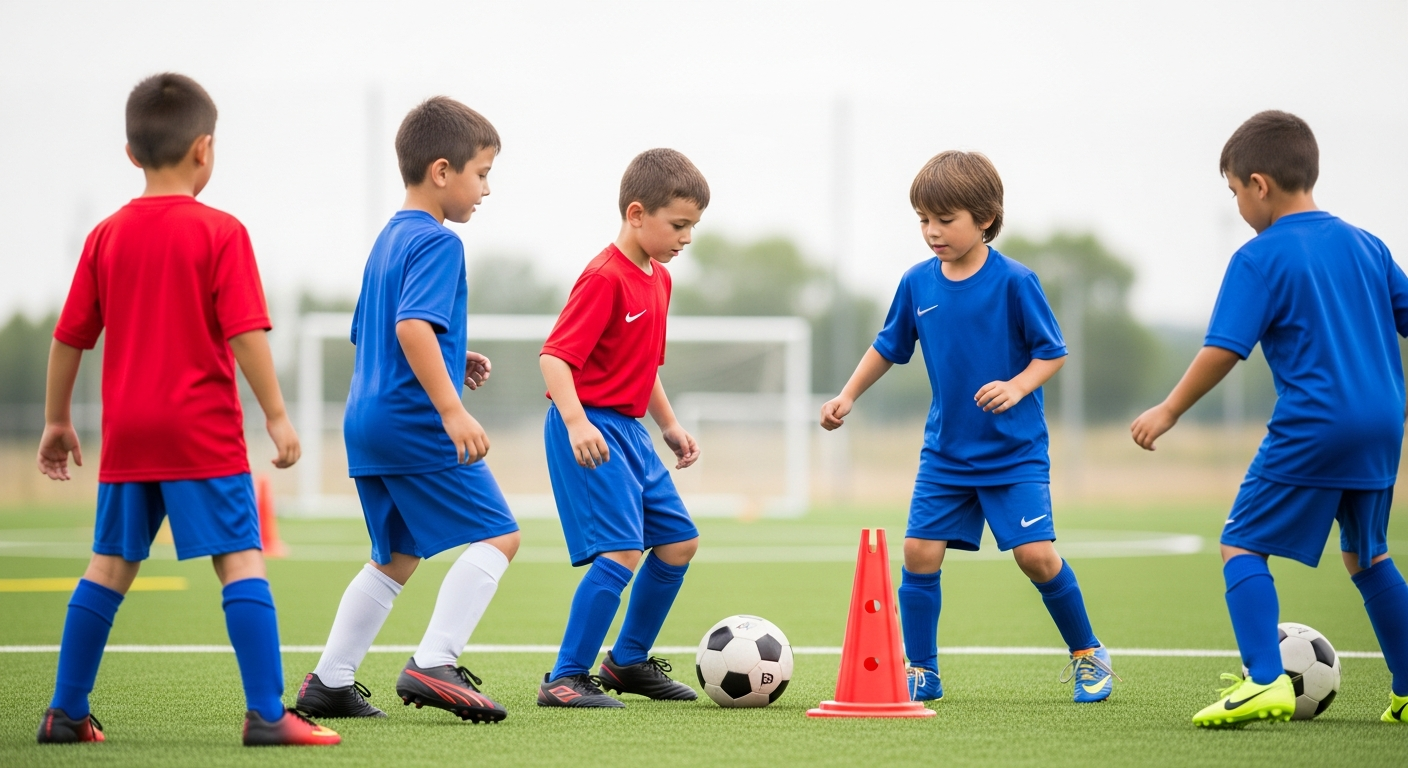
Table of Contents
- The Power of Play: Why Fun is Fundamental in Youth Soccer
- Getting Started: Essential Tips for Parents and Coaches
- Fun Soccer Activities for Younger Players (Ages 3-7)
- Engaging Activities for Developing Players (Ages 8-12)
- The Speech Blubs Approach to Skill Building
- Integrating Speech Blubs into Your Child's Play Journey
- Conclusion: Play Your Way to Success
- Frequently Asked Questions
Few things capture the boundless energy and pure joy of childhood quite like watching a child chase a soccer ball. Yet, for many parents and coaches, transforming that raw enthusiasm into actual skill development can feel like a challenge. How do we keep the spirit of play alive while subtly nurturing vital abilities? It’s a question that often lingers, especially when we consider the myriad benefits soccer offers: from fostering teamwork and physical fitness to building essential life skills and reducing stress. This post aims to answer that by diving deep into a treasure trove of fun soccer activities designed to engage children of all ages and skill levels. We'll explore how these games not only sharpen their soccer prowess but also contribute to their overall development, all while ensuring every moment on the field is filled with laughter and learning. By the end, you’ll have a comprehensive playbook of delightful, skill-building activities that will make soccer practice the highlight of any child’s week.

The Power of Play: Why Fun is Fundamental in Youth Soccer
At its heart, soccer is a game, and games are meant to be fun. This principle is especially crucial when introducing children to the sport. While the desire to see our children excel is natural, prioritizing enjoyment creates a positive foundation that encourages long-term participation and a genuine love for the game. When kids are having fun, they are more receptive to learning, more willing to take risks, and more likely to develop intrinsic motivation.
More Than Just Kicking a Ball: Holistic Development
Soccer offers a rich tapestry of developmental benefits that extend far beyond the technical skills of dribbling and shooting. These include:
- Physical Health: Regular activity improves cardiovascular health, builds muscle strength, enhances endurance, and develops gross motor skills.
- Cognitive Skills: Players learn spatial awareness, decision-making, problem-solving, and strategic thinking in real-time.
- Social-Emotional Growth: Teamwork, communication, sportsmanship, resilience, and handling both wins and losses are invaluable life lessons learned on the pitch.
- Confidence and Self-Esteem: Mastering new skills, contributing to a team, and simply participating can significantly boost a child's belief in themselves.
By focusing on fun, we unlock these benefits naturally. A child who enjoys practice is a child who will willingly engage, learn, and grow. This is why we, at Speech Blubs, advocate for playful learning across all developmental areas. Just as children learn communication by joyfully imitating peers in our app, they learn soccer skills most effectively when immersed in engaging activities.
Getting Started: Essential Tips for Parents and Coaches
Before we dive into specific activities, here are some overarching tips to ensure your soccer sessions are successful and enjoyable for everyone involved:
- Keep it Age-Appropriate: Adjust the complexity and rules of games based on the children's age and developmental stage. What excites a 4-year-old might bore a 10-year-old, and vice-versa.
- Prioritize Safety: Ensure a safe playing environment, warm-ups, and cool-downs. Emphasize proper technique to prevent injuries.
- Emphasize Participation Over Perfection: The goal, especially for younger children, is to get touches on the ball and be active. Don't stress over flawless execution.
- Be Patient and Positive: Encourage effort, celebrate small victories, and create a supportive atmosphere where mistakes are seen as learning opportunities.
- Limit Lectures: Kids learn by doing. Keep instructions concise and let them explore through play.
- Model Good Sportsmanship: Your attitude sets the tone. Show respect for all players, officials, and the game itself.
- Incorporate Communication: Encourage players to talk to each other. This is where the magic of teamwork truly begins.
Fun Soccer Activities for Younger Players (Ages 3-7)
For the youngest budding soccer stars, the focus is on developing basic coordination, listening skills, and a positive association with the ball. These games are designed to be simple, engaging, and full of movement.

1. Red Light, Green Light Dribbling
This classic game is perfect for developing close ball control, quick reactions, and listening skills.
- How to Play: Players line up with a ball. The coach (or parent) stands a distance away. When the coach calls "Green Light," players dribble towards them. When "Red Light" is called, everyone must stop their ball immediately. Any player whose ball is still moving, or who moves themselves, goes back to the starting line.
- Skills Developed: Dribbling, stopping the ball, listening, reaction time.
- Real-World Connection: Just as a child learns to pause and listen for cues in Red Light, Green Light, a child working on their first words learns to listen and imitate. For a child needing to practice initial sounds like 'S' for "stop" or 'G' for "go," this game provides a natural, kinesthetic link to language. We see similar foundational skill-building in our app, where interactive games help children develop essential listening and imitation abilities critical for speech development. For parents curious about their child's early communication, taking our quick 3-minute preliminary screener can provide valuable insights into their speech and language development, along with a free 7-day trial of our app.
2. Simon Says Soccer
Another fantastic game for listening skills and introducing specific soccer actions.
- How to Play: Players spread out with a ball. The coach calls out actions, but players only perform them if prefaced with "Simon Says." Commands can include: "Simon says stop the ball," "Simon says dribble with your right foot," "Simon says touch the ball with your knee." If a player does an action without "Simon Says," they do a fun penalty (e.g., five jumping jacks) or are "out" for a round.
- Skills Developed: Listening, ball control, following instructions, body awareness.
3. Musical Balls
A fun, fast-paced game to improve ball control and agility.
- How to Play: Set up cones in a circle, one for each player, minus one. Players dribble their balls around the cones while music plays. When the music stops, everyone must find a cone and stop their ball. The player without a cone is out, and one ball is removed. Continue until one player remains.
- Skills Developed: Dribbling, stopping the ball, awareness, quick reactions.
4. Tunnel Soccer
Encourages dribbling with the head up and passing accuracy.
- How to Play: Each player has a ball. The coach (without a ball) moves around, periodically stopping and spreading their legs to form a "tunnel." Players try to dribble and shoot their ball through the coach's legs to score a point.
- Skills Developed: Dribbling, shooting accuracy, looking up while dribbling.
5. Frog Attack
A fun, active game focusing on evasion and quick movement.
- How to Play: Designate a rectangular area. All players start on one side with their balls, trying to get to the other. Two "frogs" (players without balls) hop around in the middle, trying to tag the other players. If tagged, a player becomes a frog. Continue until only a few "non-frogs" remain.
- Skills Developed: Dribbling, evasion, agility, spatial awareness.
Engaging Activities for Developing Players (Ages 8-12)
As children grow, their coordination, understanding of teamwork, and strategic thinking develop. These activities introduce more complex skills and promote collaboration while maintaining the element of fun.
1. King of the Ring
An excellent warm-up for defending, spatial awareness, and decision-making.
- How to Play: All players start in a designated circle, dribbling a ball. The goal is to knock other players' balls out of the ring while defending your own. If your ball goes out, you're out. The last player remaining is the "King of the Ring."
- Skills Developed: Dribbling, defending, spatial awareness, ball protection.
2. Don't Feed the Monkeys
A drill that hones passing and intercepting skills in a playful way.
- How to Play: Create a "monkey cage" (a small central square) with cones. Two players are "monkeys" inside the cage. 3-4 "zookeepers" are outside the cage. Zookeepers try to pass balls to the monkeys, while other players (defenders) try to intercept the passes. Points are awarded for successful passes to monkeys or successful interceptions.
- Skills Developed: Passing accuracy, interception, teamwork, strategic thinking.
3. Sharks and Minnows
This classic game helps players develop dribbling under pressure and evasive maneuvers.
- How to Play: Set up a rectangular grid. One or two players are "Sharks" in the middle, without a ball. The remaining "Minnows" (each with a ball) start at one end. On a whistle, Minnows try to dribble their balls to the other side without having their ball kicked out of bounds by a Shark. If a Minnow's ball is kicked out, they become a Shark. The last Minnow wins.
- Skills Developed: Dribbling, ball protection, evasion, looking up, decision-making.
4. Gates Passing
A fast-paced partner game to build passing precision, timing, and awareness.
- How to Play: Set up several "gates" (two cones 2-3 feet apart) around the field. Players divide into pairs, each with a ball. They dribble and pass their ball through as many gates as possible in a set time, earning a point for each successful pass. They must use a new gate after each pass.
- Skills Developed: Passing accuracy, timing, communication, movement off the ball.
5. Capture the Balls
A soccer twist on "capture the flag" that encourages teamwork, ball control, and scanning.
- How to Play: Create a rectangular field with "home bases" in each corner for teams of 3-5 players. Place several soccer balls in the center. On a signal, teams try to dribble or pass balls from the center or other teams' bases into their own base. Players can steal from other bases and defend their own. The team with the most balls at the end wins.
- Skills Developed: Dribbling, passing, teamwork, strategy, defense.
6. World Cup Game
Infuse some competitive spirit and teamwork with a mini-tournament.
- How to Play: Divide players into teams of two. Assign them countries. Designate one player or coach as the goalkeeper. All teams start on one half of the field with one ball. On "Go!", teams try to score on the goalie. When a team scores, they leave the field and advance to the next round. The team that doesn't score is eliminated. The final two teams play for the "World Cup."
- Skills Developed: Shooting, spacing, teamwork, playing under pressure.
7. Tic-Tac-Toe Soccer
Combines agility, decision-making, and strategic thinking.
- How to Play: Create a 3x3 yard grid. Split the team into two, lining them up 15-20 yards away from the grid. Each player has a pinnie. Players run to the grid, place a pinnie in a square to try and get three in a row, then run back to tag the next player. The first team to get Tic-Tac-Toe wins.
- Skills Developed: Agility, decision-making, strategic thinking, speed.
The Speech Blubs Approach to Skill Building
At Speech Blubs, we understand that learning, whether it's speech development or soccer skills, is most effective when it's engaging and interactive. Our mission is to empower children to "speak their minds and hearts" by providing an immediate, effective, and joyful solution for the 1 in 4 children who need speech support. Our founders, all having personal experiences with speech challenges, created the tool they wished they had.
We blend scientific principles with play, creating one-of-a-kind "smart screen time" experiences. Instead of passive viewing, our app offers a screen-free alternative through our unique "video modeling" methodology. Children learn by watching and imitating their peers, fostering communication skills and building confidence in a fun, natural way. This interactive approach mirrors the dynamic, play-based learning that makes these soccer activities so effective. For example, when a child practices dribbling skills with a "Simon Says" command, they are not only improving their motor skills but also strengthening their ability to follow instructions, much like how they might learn new words by imitating sounds and actions within the Speech Blubs app.
We believe in fostering a love for communication, building confidence, reducing frustration, and creating joyful family learning moments. Our app is a powerful supplement to a child's overall development plan and, when applicable, professional therapy. You can learn more about the science behind our method and our high MARS scale rating. We've also received incredible feedback from parents, as you can read in our testimonials.
Integrating Speech Blubs into Your Child's Play Journey
For parents concerned about their child's speech and language development, Speech Blubs offers a complementary approach to the active, engaged learning found in sports. Just as a child learns to anticipate a pass on the field, they can learn to anticipate and respond to prompts within our app.
For a parent whose child struggles with processing verbal instructions quickly during soccer games, integrating Speech Blubs activities at home can help strengthen those foundational listening and comprehension skills. For instance, after a game of "Red Light, Green Light," you might explore the "Around the House" section in Speech Blubs, practicing words like "stop," "go," "run," and "ball" in a different context. This consistent reinforcement across various learning environments can be incredibly beneficial.
Ready to explore how Speech Blubs can empower your child's communication journey? Download Speech Blubs on the App Store or Google Play to begin your 7-day free trial.
Conclusion: Play Your Way to Success
Soccer is more than just a sport; it's a dynamic classroom for life. By embracing fun and engaging activities, parents and coaches can create an environment where children not only develop essential soccer skills but also build confidence, learn teamwork, and foster a lifelong love for physical activity. These games, from the simplest "Red Light, Green Light" to more strategic "Capture the Balls," are designed to make every practice session an adventure. Remember, the journey of learning and development is a marathon, not a sprint. Celebrate effort, encourage participation, and watch your child flourish on and off the field.
Ready to provide your child with joyful learning experiences that support their growth, both in communication and in play? We invite you to experience the transformative power of Speech Blubs. Take the first step towards empowering your child's voice and potential today. Create your account and begin your 7-day free trial. Remember to select the Yearly plan to unlock the best value, including our extra Reading Blubs app, early access to new updates, and 24-hour support response time – all for just $59.99 a year (saving 66% compared to the monthly $14.99 plan)! Empower your child's journey to speak their minds and hearts, starting today.
Frequently Asked Questions
Q1: How often should my child practice these soccer activities?
A1: For younger children (under 8), 2-3 sessions per week, each lasting 30-45 minutes, is ideal. For older children, 3-4 sessions of 60-90 minutes, combining these fun activities with more structured drills, can be highly beneficial. The key is consistency and ensuring the sessions remain enjoyable to prevent burnout.
Q2: What if my child isn't naturally athletic or seems shy during group activities?
A2: That's completely normal! Start with one-on-one play at home to build comfort and basic skills. Focus on positive reinforcement for any effort, no matter how small. When introducing group settings, choose smaller groups initially or activities that allow for individual participation within a team context. Encourage rather than pressure, and celebrate their unique contributions. Remember, every child develops at their own pace, and fostering a love for activity is more important than immediate athletic prowess.
Q3: Do these activities require a full soccer field or special equipment?
A3: Not at all! Most of these activities can be adapted for small spaces like a backyard, a local park, or even a living room (with soft balls!). Basic equipment typically includes soccer balls, cones (or household items like shoes or socks to mark boundaries), and perhaps pinnies for team identification. The emphasis is on creativity and adaptability, making soccer accessible wherever you are.
Q4: How can I best encourage my child's communication skills during these soccer games?
A4: Create opportunities for verbal interaction. Ask open-ended questions like, "What was your favorite part of that game?" or "How did you feel when you scored?" Encourage them to call out to teammates, explain rules, or describe their actions. For children who might need extra support, connecting these actions to sounds or words (e.g., "Kick!" "Run!" "Stop!") can reinforce vocabulary. Apps like Speech Blubs can be a great way to build communication confidence at home, making them more ready to speak up on the field.
About the author