
Fun Soccer Game Ideas for Kids: Boost Skills, Boost Speech!
 By Speech Blubs Team•Jan 28, 2026•22 min.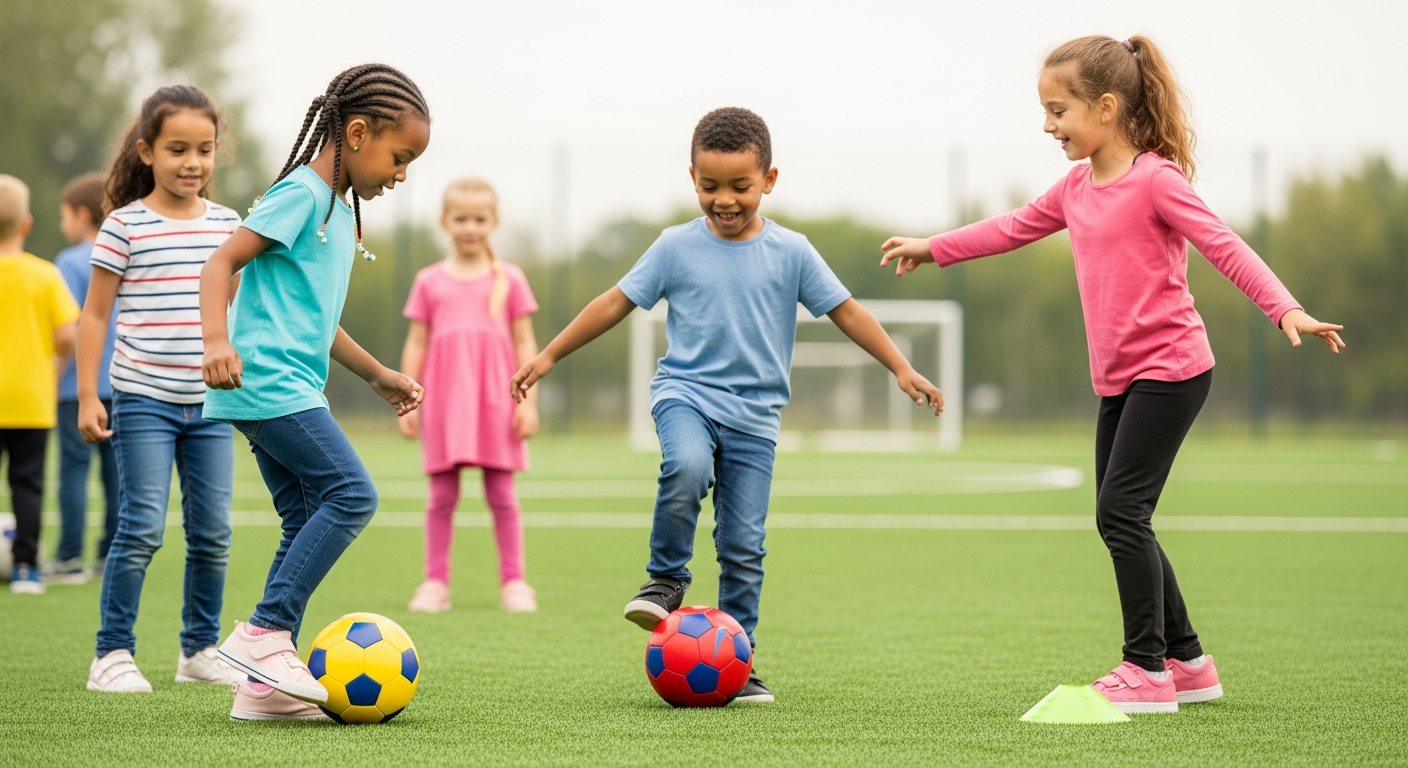
Table of Contents
- The Many Benefits of Soccer for Growing Kids
- Ignite Their Passion: Fun Soccer Games for Kids
- Enhancing Communication Through Play: The Speech Blubs Approach
- Taking the Next Step: Your Child's Journey with Speech Blubs
- Frequently Asked Questions (FAQs)
Imagine the sheer joy on a child's face as they chase a soccer ball across a sun-drenched field, laughter bubbling up with every kick. For many parents, this scene represents more than just a game; it's a vibrant tapestry of physical activity, social development, and pure, unadulterated fun. But what if we told you that these lively soccer games could also be a powerful, playful springboard for your child's communication skills?
Soccer, the world's most popular sport, offers an incredible playground for children to develop a wide array of skills. From the moment they first tap a ball, kids begin building fundamental gross motor abilities, enhancing their coordination, and sharpening their agility. Beyond the physical, soccer is a masterclass in teamwork, sportsmanship, and problem-solving, fostering social connections and a sense of community. The fast-paced nature of the game demands quick thinking and decision-making, keeping young minds active and engaged.
At Speech Blubs, we deeply understand the profound connection between play, physical activity, and holistic child development, especially when it comes to communication. Our mission is to empower children to "speak their minds and hearts," a goal that resonates strongly with the confidence and expression nurtured on the soccer field. Just as a fun soccer game can make learning complex footwork feel effortless, our innovative app uses scientific principles, like our unique video modeling methodology, to turn speech practice into joyful "smart screen time" experiences. We believe that learning, whether on the field or through our app, should always be engaging, effective, and most importantly, fun.

This post isn't just a list of games; it's a comprehensive guide designed to inspire parents, coaches, and caregivers to transform soccer practice into an enriching developmental experience. We'll explore a variety of dynamic soccer game ideas for kids of all ages, breaking down the skills each game builds – from the obvious athletic prowess to the subtle yet significant boosts in listening comprehension, expressive language, and social communication. By the end, you'll have a playbook full of creative activities that promise not only to ignite a love for the beautiful game but also to foster crucial communication pathways, turning every kick and cheer into an opportunity for growth.
The Many Benefits of Soccer for Growing Kids
Soccer is far more than just kicking a ball around; it's a holistic development powerhouse for children. Engaging in team sports like soccer offers a wealth of advantages that extend across physical, social, emotional, and even cognitive domains.
Physical Prowess and Health
From the first whistle, kids are in constant motion, running, dribbling, and kicking. This sustained activity is excellent for:
- Cardiovascular Health: Regular exercise strengthens the heart and lungs, building stamina and endurance.
- Gross Motor Skills: Dribbling, kicking, and running refine fundamental movements. Activities like crab soccer, where children move in an inverted position, also build impressive core and glute strength, as well as upper extremity strength and shoulder stability.
- Coordination and Agility: Weaving through cones, changing direction quickly, and controlling the ball with their feet all demand and develop excellent hand-eye (or rather, foot-eye) coordination and agility. Games like "Cone Dribble Relay" specifically target these skills, preparing children for more complex movements on and off the field.
- Balance: Maintaining control of the ball while running and navigating obstacles significantly improves balance.
Social and Emotional Growth
The team environment of soccer provides a rich ground for developing crucial social and emotional intelligence:

- Teamwork and Cooperation: Kids learn to work together towards a common goal, understanding that collective effort leads to success. Games like "Don't Feed the Monkeys" or "Capture the Balls" highlight the importance of coordinated action and communication among teammates.
- Communication Skills: On the field, communication is constant. Players must call out for the ball, warn teammates of opponents, and cheer each other on. This natural demand for verbal and non-verbal communication is invaluable. For children who may be late talkers or need support with social pragmatics, these scenarios offer real-world practice in a low-pressure, fun environment. Our founders at Speech Blubs understood this need for joyful communication practice, creating an app that makes speaking exciting and accessible.
- Sportsmanship and Respect: Learning to win humbly and lose gracefully, respecting opponents and referees, teaches invaluable life lessons about fairness and empathy.
- Confidence and Self-Esteem: Scoring a goal, making a great pass, or even just mastering a new dribbling technique builds immense self-confidence. This boost can translate into other areas of a child's life, including a greater willingness to participate in verbal exchanges.
- Emotional Regulation: Dealing with frustration, celebrating successes, and bouncing back from setbacks helps children develop emotional resilience.
- Community Connection: Being part of a team fosters a sense of belonging and community, which is vital for a child's overall well-being.
Cognitive Development
Soccer also sharpens young minds, enhancing various cognitive functions:
- Decision-Making: In a fast-paced game, players constantly make split-second decisions: pass or shoot? Dribble left or right? These quick choices develop critical thinking. "King of the Ring" and "Tic-Tac-Toe Soccer" are excellent for honing strategic thinking.
- Spatial Awareness: Understanding where teammates, opponents, and the ball are in relation to oneself and the field is crucial. Games like "Sharks and Minnows" or "Team Handball" significantly improve a child's spatial reasoning.
- Problem-Solving: Adjusting to different game scenarios, finding open spaces, or anticipating an opponent's move all involve problem-solving skills.
- Listening and Following Instructions: Coaches frequently give instructions and cues, requiring players to listen attentively and execute commands. Games like "Red Light, Green Light" and "Simon Says Soccer" are brilliant for practicing these fundamental listening skills, which are also foundational for speech and language development.
For a parent whose child struggles with following multi-step directions, for instance, a game like "Simon Says Soccer" offers a playful, motivating way to practice commands like "Simon says tap your toes on the ball, then jump over it!" This kind of interactive play parallels the engaging, repetition-rich environment we strive for at Speech Blubs, where children learn by doing and imitating.
Ignite Their Passion: Fun Soccer Games for Kids
Now, let's dive into some fantastic soccer game ideas that promise laughter, learning, and plenty of developmental benefits. We've gathered a mix of classics and creative twists, suitable for various age groups and skill levels. Remember, the goal is to make practice so enjoyable that kids can't wait to show up!
1. Red Light, Green Light Soccer
This classic game translates perfectly to the soccer field, focusing on ball control, quick reactions, and listening skills.
- Skills Developed: Dribbling, close ball control, impulse control, listening comprehension, quick decision-making.
- How to Play: Players line up with a ball at a starting line, with the coach acting as the "traffic light" about 15-20 yards away. When the coach calls "Green Light," players dribble towards them. When "Red Light" is called, everyone must stop their ball immediately. Any player whose ball is still moving, or who moves themselves, must return to the starting line. The first player to cross the finish line wins.
- Speech Blubs Connection: This game is fantastic for practicing receptive language ("Stop," "Go," "Dribble"), enhancing auditory processing, and following instructions. For a child learning to process sequential commands, the clear, direct instructions of "Red Light, Green Light" provide excellent practice. Just as children learn speech by imitating what they hear and see, this game encourages imitation of actions based on verbal cues.
2. Simon Says Soccer
Another timeless game that becomes a dynamic soccer drill, promoting listening, ball control, and body awareness.
- Skills Developed: Listening attentively, following verbal instructions, ball control (toe taps, dribbling, balancing), body awareness, agility.
- How to Play: Every player has a ball. The coach (or "Simon") gives commands. If the command starts with "Simon says," players must perform the action (e.g., "Simon says, do toe taps on your ball!" or "Simon says, dribble with your right foot only!"). If a command is given without "Simon says," players should not do it. Anyone who performs an action without "Simon says" is out for the round or does a fun penalty.
- Speech Blubs Connection: This game directly hones a child's ability to process and act upon verbal instructions, differentiating between conditional and unconditional commands. This is a vital skill for classroom settings and everyday communication. For a child who needs practice with action verbs or descriptive language, the coach can use varied commands like "Simon says slowly dribble," or "Simon says quickly touch your ball with your left foot." This engagement with language through movement is a key component of effective learning, similar to how Speech Blubs makes learning new words and sounds interactive and fun.
3. Musical Balls (Soccer Edition)
A lively game that improves coordination, agility, and quick thinking, while teaching turn-taking.
- Skills Developed: Coordination, agility, quick reactions, ball control (for balancing), listening to cues, turn-taking.
- How to Play: Arrange soccer balls in a circle, one less than the number of players. Play music and have players dribble their own balls around the circle. When the music stops, players must quickly find a ball to stop and balance a foot on (or simply stop their ball). The player left without a ball is out. Remove one ball each round until a champion is crowned. To add a twist, encourage players to dribble in specific ways (e.g., "dribble like a crab" or "skip around your ball") when the music plays.
- Speech Blubs Connection: The auditory cue of the music stopping, combined with the need for a swift, precise action, helps children develop auditory discrimination and rapid response skills. The shared experience of the game also encourages spontaneous exclamations and peer interaction, fostering a joyful environment for communication.
4. King of the Ring
An excellent warm-up game for practicing defending, spatial awareness, and strategic decision-making.
- Skills Developed: Dribbling, ball protection, defending, spatial awareness, decision-making, strategic thinking.
- How to Play: All players start in a designated playing area (e.g., a center circle or a cone-defined square), each dribbling their own ball. The goal is to knock other players' balls out of the ring while protecting your own. If a player's ball goes out of the circle, they are out. The last player remaining in the ring is crowned the "King" or "Queen."
- Speech Blubs Connection: This game involves constant non-verbal communication through body language and movement, but also encourages verbal cues like "Watch out!" or "I'm open!" It's a fantastic way to observe a child's problem-solving in real-time and gently prompt them to verbalize their strategies or reactions.
5. Don't Feed the Monkeys
This engaging game forges passing and intercepting skills, emphasizing teamwork and communication.
- Skills Developed: Passing accuracy, intercepting, teamwork, spatial awareness, strategic communication.
- How to Play: Create a "monkey cage" (a smaller circle or square of cones). Two players act as "monkeys" inside the cage without a ball. The remaining 3-4 players are "zookeepers" outside the cage, each with a ball. The zookeepers try to pass balls to the monkeys inside the cage. The monkeys try to intercept these passes. If a zookeeper successfully passes a ball into the cage for a monkey to receive, the zookeepers get a point. If a monkey intercepts a pass, the monkey team gets a point. The team with the most points wins.
- Speech Blubs Connection: This game inherently requires verbal communication for effective play. Zookeepers might call out "Pass to me!" or "Look out!" while monkeys might shout "I got it!" or "Block!" It's a dynamic scenario for practicing imperative sentences, turn-taking in conversation (passing and receiving), and using language to coordinate actions. For a child developing early conversational skills, this game provides immediate, motivating feedback on their communication attempts.
6. Sharks and Minnows
A classic chase game adapted for soccer, perfect for developing dribbling under pressure and scanning the field.
- Skills Developed: Dribbling under pressure, ball control, spatial awareness, scanning, quick decision-making, agility.
- How to Play: Set up a rectangular playing grid. Designate 1-2 players as "Sharks" who start in the middle without a ball. The rest are "Minnows," each with a ball, starting at one end of the grid. On a signal, Minnows must dribble their balls to the other side of the field without letting a Shark kick their ball out of bounds. If a Minnow's ball is kicked out, that Minnow becomes a Shark. The game continues until only one Minnow remains, who becomes the winner and often the first Shark in the next round.
- Speech Blubs Connection: The dynamic nature of "Sharks and Minnows" encourages exclamations of surprise, warnings, and expressions of excitement or frustration, providing natural opportunities for expressive language practice. It also helps children understand and respond to the non-verbal cues of others, enhancing their social awareness – a skill crucial for effective communication.
7. Target Practice
A simple yet effective game for improving shooting accuracy and focus.
- Skills Developed: Shooting accuracy, ball striking technique, focus, cause-and-effect understanding, goal setting.
- How to Play: Set up various targets around the playing area – these could be cones, small goals, or even natural objects like trees (if playing in a safe outdoor space). Assign different point values to each target based on difficulty. Players take turns kicking their ball at the targets, trying to score the most points. Each player gets 3-5 tries per round.
- Speech Blubs Connection: This game offers a fantastic opportunity to practice descriptive language ("I'm aiming for the tall cone!" or "I hit the red target!"). It also allows for verbalizing intentions ("I'm going to kick hard!") and celebrating successes ("I made it!"). For children working on articulation, naming the targets and describing their attempts provides repetitive, meaningful practice of target sounds.
8. Obstacle Course Challenge
Encourages creativity, problem-solving, and refines diverse motor skills.
- Skills Developed: Problem-solving, planning, gross motor skills (dribbling, weaving, jumping, crawling), spatial language (over, under, through, around), creativity.
- How to Play: Encourage children to design their own obstacle courses using cones, sticks, ropes, or any available objects. They then dribble their soccer ball through the course, completing each challenge. Examples include dribbling between cones, weaving through an "agility ladder" made of sticks, kicking the ball under a low barrier, or performing a specific ball trick at a designated spot. Time each player or team for a friendly competition.
- Speech Blubs Connection: This activity is a goldmine for language development. Children can verbalize their plan for the course ("First, I'll go around the cone, then through the tunnel!"), describe their actions as they perform them, and use spatial prepositions. For a child working on sequencing, mapping out the course provides tangible practice. At Speech Blubs, we foster this same problem-solving and descriptive language through engaging, interactive scenarios that prompt children to use their words.
9. Crab Soccer
A fun, core-strengthening twist on the classic game, adding a unique physical challenge.
- Skills Developed: Core and glute strength, upper extremity strength, shoulder stability, unique gross motor skills, coordination in an unusual position.
- How to Play: Players get into the "crab position" – belly facing the sky, hands and feet on the ground, bottom lifted. Using only their feet, they kick a large playground ball (or a regular soccer ball) to teammates or towards a goal. The key is to keep their bottom off the ground!
- Speech Blubs Connection: This unusual position naturally sparks curiosity and descriptive language. Children might comment on how it feels, the difficulty, or make funny observations ("I look like a real crab!"). It’s a great opportunity to introduce new vocabulary related to body parts and actions in a playful context, reinforcing the idea that learning can happen anywhere, just like with our engaging app.
10. Team Handball
Improves soccer IQ, awareness, and teamwork without the footwork, focusing on spatial recognition and strategy.
- Skills Developed: Spatial awareness, teamwork, strategic thinking, communication (verbal and non-verbal), defensive positioning, passing with hands (transferable to understanding passing lanes).
- How to Play: Set up a small field with two end zones. Divide players into two teams. Players must pass a soccer ball using only their hands, trying to move it into the opposing team's end zone to score. Players cannot run with the ball; they must pass. This emphasizes finding open teammates, anticipating moves, and strategic defensive positioning.
- Speech Blubs Connection: This game is a fantastic simulator for verbalizing strategy and giving clear instructions. Players will naturally call out "Pass to me!", "Man on!", or "Go deep!" It teaches the importance of clear, concise communication in a team setting, skills that are directly transferable to everyday conversations.
11. Tic-Tac-Toe Soccer
A fun, competitive game that combines agility with strategic decision-making.
- Skills Developed: Agility, speed, strategic thinking, decision-making, teamwork, quick reactions.
- How to Play: Set up a 3x3 grid using cones in the middle of a field. Divide players into two teams, lining them up about 15-20 yards from the grid on opposite sides. Each player has a colored pinnie (or a small object like a beanbag). On "Go," the first player from each team sprints to the grid and places their pinnie in an open square, trying to get three in a row (horizontally, vertically, or diagonally). After placing, they sprint back and tag the next teammate. The first team to get Tic-Tac-Toe wins.
- Speech Blubs Connection: The strategic element of this game can encourage players to communicate their intentions or observations to their teammates ("Put it here!", "Block them!"). The rapid back-and-forth action provides a dynamic context for quick verbal exchanges, fostering both fluency and strategic thought.
12. Animal Kingdom Dribble
A creative game that encourages imaginative play and sound production, especially great for younger children.
- Skills Developed: Imaginative play, dribbling, gross motor skills, sound production (animal sounds), following instructions, self-expression.
- How to Play: Each child chooses an animal they want to be. The coach calls out an animal, and all players must dribble their ball while making the sound and mimicking the movement of that animal (e.g., "Dribble like a frog, ribbit, ribbit!" or "Dribble like an elephant, making trumpet sounds with your arm!"). The coach can randomly switch animals.
- Speech Blubs Connection: This game is excellent for stimulating expressive language and speech sound production in a highly motivating way. Children can practice animal sounds, action verbs related to movement, and descriptive adjectives. For a child working on specific sounds, the coach can cleverly choose animals whose names or sounds contain those target sounds. This mirrors Speech Blubs' engaging activities that prompt children to produce sounds and words through fun, interactive imitation.
Enhancing Communication Through Play: The Speech Blubs Approach
Just as these soccer games teach complex physical and social skills through enjoyable play, we at Speech Blubs apply the same philosophy to speech and language development. We understand that effective communication is about more than just making sounds; it's about connecting, expressing, and understanding the world around us.
Our founders, who themselves grew up with speech challenges, envisioned a tool that could provide immediate, effective, and joyful support for the 1 in 4 children who need speech assistance. This personal journey is at the heart of our commitment to blending scientific principles with play, creating one-of-a-kind "smart screen time" experiences. We offer a screen-free alternative to passive viewing, transforming screen time into an active, interactive learning session that strengthens family connection.
How Speech Blubs Works: The Power of Video Modeling
A cornerstone of our methodology is video modeling, where children learn by watching and imitating their peers. This natural way of learning, observed daily in playgrounds and classrooms, is incredibly effective. When a child sees another child joyfully articulating a word or sound, it provides a powerful, relatable example that encourages imitation. This mirrors how children learn complex soccer moves by watching and trying to copy older players or teammates.
For a parent whose 3-year-old "late talker" loves animals and struggles with making specific sounds, the "Animal Kingdom" section within Speech Blubs offers a fun, motivating way to practice "moo," "baa," and "roar" sounds. Seeing another child articulate these sounds provides a clear model, fostering confidence and reducing potential frustration. This active engagement helps children develop key foundational skills like imitation, sound production, and early vocabulary in a supportive, play-based environment.
We emphasize providing practical, valuable advice and setting realistic expectations. Speech Blubs is a powerful supplement to a child's overall development plan and, when applicable, professional speech therapy. We focus on fostering a love for communication, building confidence, reducing frustration, and creating joyful family learning moments.
Curious if Speech Blubs could be the right fit for your child? Take our quick 3-minute preliminary screener to get a simple assessment and a free 7-day trial.
Taking the Next Step: Your Child's Journey with Speech Blubs
We've explored how playful soccer games can be incredible tools for both physical and communicative development. The same joy, engagement, and effective learning principles are at the core of Speech Blubs. Our app is designed to make speech practice an adventure, a game, rather than a chore. It's an opportunity for your child to grow confidence, build essential language skills, and truly "speak their minds and hearts."
Our method is backed by science, placing us in the top tier of speech apps worldwide. Explore the research behind Speech Blubs and see what makes our approach so effective.
Flexible Plans to Fit Your Family
We offer flexible subscription plans to ensure every family can access our award-winning app:
- Monthly Plan: For just $14.99 per month, you can access our core features and support your child's communication journey.
- Yearly Plan: This is our most popular and best-value option at $59.99 per year. This breaks down to an incredible $4.99 per month, allowing you to save 66% compared to the monthly plan!
Why Choose the Yearly Plan?
The Yearly Plan isn't just about saving money; it's about getting the most comprehensive support for your child's development. It includes:
- A 7-Day Free Trial: Try out Speech Blubs and Reading Blubs completely risk-free for a full week!
- The Extra Reading Blubs App: Access our companion app designed to boost early literacy skills.
- Early Access to New Updates: Be among the first to experience our latest features and content.
- 24-Hour Support Response Time: Get priority assistance whenever you need it.
The Monthly Plan, while flexible, does not include these valuable extra benefits. We strongly encourage you to choose the Yearly Plan to unlock the full suite of features and ensure your child has every advantage in their communication development.
Ready to see the magic happen? Download Speech Blubs on the Apple App Store or Google Play Store today and start your 7-day free trial with our Yearly Plan. If you prefer to sign up via our website, create your account and begin your free trial here.
Join thousands of other parents who have seen their children flourish with Speech Blubs. See what other parents are saying about their child's success with Speech Blubs. Let's empower your child to speak their minds and hearts, one joyful game and one confident word at a time!
Frequently Asked Questions (FAQs)
Q1: What age group are these soccer games suitable for?
A1: The games listed here are highly adaptable and can be enjoyed by children across a wide range of ages, generally from pre-school (3-4 years old) up through early elementary school (9-10 years old) and even older for some variations. For younger children, focus on simpler rules and lots of encouragement. For older kids, you can add more complexity, strategic elements, and competitive scoring. The key is to prioritize fun and participation over strict adherence to rules, adjusting as needed for your specific group's skill level and developmental stage.
Q2: How can I encourage my child to participate if they're shy or hesitant?
A2: Creating a supportive and low-pressure environment is crucial. Start with individual or small-group games where the focus isn't on competition, but on fun and exploration (e.g., "Target Practice" or "Animal Kingdom Dribble"). Offer plenty of positive reinforcement for effort, not just success. You can also participate alongside them initially to model enthusiasm. Games that encourage imaginative play can also help shy children express themselves in a less intimidating way. Remember, consistent exposure to fun activities builds confidence over time.
Q3: Do I need a full team or a soccer field to play these games?
A3: Absolutely not! Many of these games can be adapted for just one or two children in a backyard, local park, or even a larger indoor space. While some games, like "Don't Feed the Monkeys," are best with a few more players, most can be modified. Simple cones, household objects, or even chalk can define playing areas. The beauty of these games is their flexibility – the goal is engaging play and skill development, regardless of the setting or group size.
Q4: How do Speech Blubs activities complement these physical soccer games?
A4: Both Speech Blubs and these soccer games share a foundational philosophy: learning through joyful, active engagement. Soccer games boost physical coordination, social interaction, and the pragmatic use of language in a dynamic setting. Speech Blubs then provides targeted, play-based support for foundational speech and language skills, such as articulation, vocabulary building, and sentence formation, through interactive "smart screen time." For instance, a child who practices following instructions in "Simon Says Soccer" can then refine their receptive language and expressive vocabulary through the fun, video-modeling activities in Speech Blubs. Together, they create a comprehensive, engaging developmental ecosystem that empowers children to thrive both on and off the field.
About the author