
Fun Spanish Games for Kids: Playful Paths to Language Fluency
 By Speech Blubs Team•Jan 13, 2026•20 min.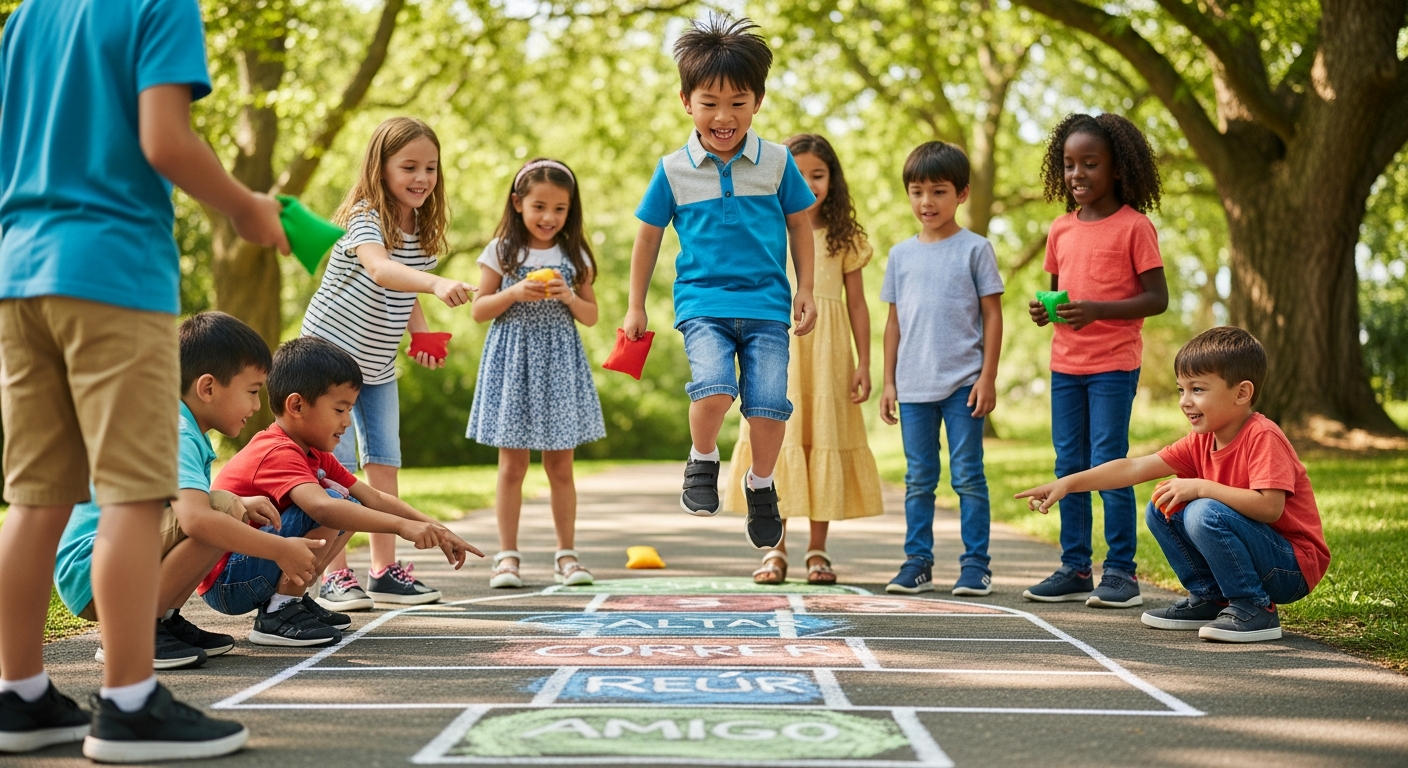
Table of Contents
- Why Learning Spanish Early Matters: More Than Just Words
- The Power of Play: How Fun Spanish Games Transform Learning
- Categories of Fun Spanish Games for Kids
- Tips for Parents: Maximizing the Fun & Learning
- Why Choose Speech Blubs for Your Child's Communication Journey
- Conclusion
- Frequently Asked Questions (FAQ)
Have you ever wondered if your child could truly "speak their mind and heart" in another language? Imagine the joy of hearing your little one confidently count to ten in Spanish or sing a simple song with perfect pronunciation. In today's interconnected world, introducing children to a second language offers a wealth of benefits, from enhanced cognitive development to a broader worldview. But how do we make language learning not just effective, but genuinely fun for our kids? The answer lies in the magic of play!
This post will explore why learning Spanish early is a powerful gift, delve into the transformative role of games in language acquisition, and provide a treasure trove of fun Spanish games for kids that you can easily integrate into your family's routine. We'll also highlight how engaging digital resources, like those offered by Speech Blubs, can complement this journey, fostering a love for communication that transcends single languages. Our mission at Speech Blubs is to empower every child to speak their minds and hearts, and we believe playful learning is at the core of achieving this goal.

Why Learning Spanish Early Matters: More Than Just Words
Introducing a second language like Spanish to children at a young age is one of the most enriching experiences you can offer. It’s about so much more than just accumulating vocabulary; it’s about opening new pathways in their developing brains and nurturing a holistic growth that benefits them for a lifetime.
Cognitive Benefits
Research consistently shows that bilingual children often exhibit superior problem-solving skills, enhanced creativity, and better task-switching abilities. Learning Spanish engages multiple areas of the brain, improving memory, attention span, and even mathematical aptitude. It helps children understand language structure more deeply, making them more adept at learning other languages later on and even strengthening their first language skills. This early exposure helps build a robust cognitive foundation, directly aligning with our goal at Speech Blubs to support comprehensive communication development.
Cultural Connection and Empathy
Language is the gateway to culture. By learning Spanish, children begin to appreciate the rich tapestry of Hispanic cultures around the world. They develop a deeper understanding and empathy for different traditions, perspectives, and ways of life. This cultural literacy fosters a sense of global citizenship, teaching them respect and openness towards others from a young age. It’s an investment in their social-emotional intelligence, helping them connect with a wider community and truly "speak their hearts" to the world.
Practical Advantages for the Future
In an increasingly globalized world, Spanish is a highly valuable asset. With hundreds of millions of speakers worldwide, proficiency in Spanish can open doors to future academic, travel, and career opportunities. Giving your child this head start provides them with a practical skill that will serve them well in a diverse range of fields, from business and healthcare to education and diplomacy.
Overcoming Challenges: A Parent's Perspective
For many parents, the idea of introducing a new language can feel daunting, especially if they aren't fluent in Spanish themselves. You might wonder where to start, how to make it stick, or how to keep your child motivated. This very sentiment—the desire to provide the best tools for communication despite personal challenges—is what inspired the creation of Speech Blubs. Our founders, all of whom grew up with speech problems, built the tool they wished they had: an immediate, effective, and joyful solution for the 1 in 4 children who need speech support. Just as we empower children in their primary language, the principles of engaging, supportive, and playful learning apply perfectly to Spanish language acquisition.

The Power of Play: How Fun Spanish Games Transform Learning
Children are natural learners, and their primary mode of learning is through play. When it comes to language acquisition, games are not just supplementary activities; they are the cornerstone of effective, joyful, and lasting learning. Games provide a low-pressure, high-engagement environment where mistakes are opportunities for growth, and repetition feels like fun, not drill.
Engagement and Motivation
Traditional rote memorization can quickly lead to boredom and disinterest in young children. Games, on the other hand, tap into a child’s intrinsic motivation. They offer challenges, rewards, and the sheer delight of interaction. When a child is actively engaged in a game, they are more likely to focus, retain information, and even initiate communication. This active participation is crucial for deep learning.
Natural Language Acquisition
Think about how children learn their first language: through constant interaction, observation, and imitation within meaningful contexts. Games replicate this natural process for a second language. Instead of isolated words, children encounter Spanish within a narrative or a playful scenario, making the meaning clear and memorable. They learn to associate words with actions, objects, and emotions, building a robust understanding rather than just surface-level recognition.
At Speech Blubs, our scientific methodology is built on a similar principle: video modeling. Children learn by watching and imitating their peer coaches, who demonstrate words and sounds in an engaging way. This powerful technique, backed by neuroscience through the activation of mirror neurons, shows how observation and imitation can unlock complex communication skills. Similarly, in Spanish games, children learn by observing actions, imitating sounds, and repeating phrases, making the learning process intuitive and effective. Our research-backed approach to creating interactive and engaging learning experiences, which has earned us a high MARS scale rating, can offer a strong foundation for any language journey. You can explore more about the science behind our method on our research page.
Skill Development Beyond Language
The benefits of playing Spanish games extend far beyond language proficiency. These activities often inherently foster a wide range of developmental skills:
- Fine Motor Skills: Handling game pieces, drawing, or pointing.
- Gross Motor Skills: Acting out verbs, dancing to songs, or playing active games.
- Social Skills: Taking turns, collaborating, negotiating, and communicating with peers or family members.
- Problem-Solving: Figuring out game rules, strategizing, or deciphering new vocabulary in context.
- Memory and Attention: Recalling words, following sequences, or concentrating during play.
By integrating fun Spanish games, you’re not just teaching a language; you’re nurturing a well-rounded, confident, and communicative child.
Categories of Fun Spanish Games for Kids
Let's dive into some fantastic, easy-to-implement Spanish games designed to make learning a joyful adventure for your children. These games are suitable for various ages and can be adapted to your child's proficiency level, ensuring continuous engagement and growth.
1. Vocabulary Builders: Laying the Foundation
Building a strong vocabulary is the first step in any language journey. These games focus on introducing and reinforcing core Spanish words in an interactive and memorable way.
Numbers (Los Números)
Numbers are fundamental, and children love to count!
- "Bingo de Números": Create bingo cards with Spanish numbers (e.g., uno, dos, tres). Call out the numbers in Spanish, and children mark them off. The first to get Bingo shouts "¡Bingo!" For younger children, use numbers 1-10; for older kids, extend to 20 or even 100 (diez, veinte, treinta).
- "Contar Objetos": Gather everyday objects. Count them together in Spanish: "¡Uno, dos, tres manzanas!" (One, two, three apples!). This connects numbers to tangible items.
- "El Escondite Numérico": Write Spanish numbers on cards. Hide them around the room. As your child finds them, they say the number aloud.
Colors (Los Colores)
Colors are vibrant and naturally engaging for kids.
- "Veo Veo (I Spy) con Colores": Play a Spanish version of I Spy: "Veo veo algo de color rojo" (I spy something red). Your child then looks for red objects.
- "Colorea el Dibujo": Print out coloring pages. Call out colors in Spanish for your child to use: "Usa el color azul para el cielo" (Use blue for the sky).
- "Carrera de Colores": Scatter colored items or toys. Call out a color ("¡Corre al amarillo!") and have your child race to touch an item of that color.
Animals (Los Animales)
Animal sounds and names are universally appealing to children.
- "Adivina el Animal": Describe an animal in simple Spanish (e.g., "Es grande, tiene trompa, le gusta el agua" - It's big, has a trunk, likes water). Your child guesses "¡Es un elefante!" (It's an elephant!).
- "Sonidos de Animales": Make animal sounds, and your child says the animal's name in Spanish ("¡Muuuuu! Es una vaca.").
- "El Zoológico Español": Use animal figurines. Practice saying their names and simple actions: "El perro corre" (The dog runs).
Practical Scenario: For a parent whose child loves animals and is just starting to articulate, playing "El Zoológico Español" can be incredibly motivating. They can practice saying "el perro" and imitating its bark. This direct imitation of sounds and words, akin to our video modeling approach at Speech Blubs, builds foundational vocabulary and confidence. Our app provides a safe and effective way to practice sounds and words, making it an excellent companion for any child learning new vocabulary, whether in English or another language.
Food (La Comida) & Body Parts (Las Partes del Cuerpo)
These categories are excellent for everyday practice.
- "Mercado Español": Set up a pretend market with food items. Role-play buying and selling, using Spanish words for fruits (la manzana, la banana), vegetables (la zanahoria), and other foods.
- "Simon Dice (Simon Says) con Partes del Cuerpo": Play Simon Says using body parts: "Simon dice, ¡toca tu nariz!" (Simon says, touch your nose!). This game is fantastic for both vocabulary and following instructions.
- "Mi Cara y Cuerpo": Use a mirror or a doll. Point to body parts and name them in Spanish: "Aquí está mi ojo" (Here is my eye).
2. Sentence Structure & Grammar in Action
Once your child has a basic vocabulary, you can start weaving in simple sentence structures and grammatical concepts through games.
Verbs (Los Verbos)
Verbs are action words that bring sentences to life.
- "Charadas (Charades) de Verbos": Write simple Spanish verbs on cards (e.g., correr - to run, saltar - to jump, comer - to eat). Children pick a card and act out the verb while others guess in Spanish.
- "Canta y Baila (Sing and Dance)": Many Spanish children's songs incorporate action verbs. "Si tú tienes muchas ganas de aplaudir" (If you're happy and you know it, clap your hands) is a great example. Encourage singing and acting out the verbs.
- "El Juego de Acciones": Call out a verb in Spanish, and everyone performs the action. "¡Dormir!" (Sleep!) – everyone pretends to sleep.
Prepositions (Las Preposiciones)
Prepositions describe location and relationship, crucial for clear communication.
- "Dónde Está el Objeto": Hide an object and give clues using prepositions: "Está debajo de la mesa" (It’s under the table), "Está encima de la silla" (It’s on top of the chair).
- "Obstáculo Preposicional": Create a simple obstacle course. Give instructions in Spanish using prepositions: "Pasa por debajo de la cuerda" (Go under the rope), "Salto sobre la almohada" (Jump over the pillow).
Adjectives (Los Adjetivos)
Adjectives help children describe the world around them.
- "Describe al Monstruo": Draw a monster together, taking turns to add features and describe them in Spanish. "Tiene ojos grandes" (It has big eyes), "Es un monstruo azul" (It's a blue monster).
- "El Tesoro Escondido": Hide a "treasure" and give descriptive clues in Spanish for your child to find it: "Busca la caja pequeña y roja" (Look for the small, red box).
- Speech Blubs Connection: Developing descriptive language is a significant step in fostering rich and clear communication. Our app helps children articulate words and expand their vocabulary, which forms the building blocks for more complex sentences and descriptive speech in any language. We empower children to use language effectively to share their observations and feelings.
3. Interactive & Imaginative Play
These games encourage creativity, role-playing, and using Spanish in more fluid, conversational contexts.
Role-Playing (Juegos de Rol)
Role-playing allows children to practice Spanish in simulated real-life scenarios.
- "La Tienda (The Shop)": Set up a play store. Your child can be the cashier or the customer, practicing phrases like "¿Cuánto cuesta?" (How much does it cost?), "Quiero una manzana" (I want an apple), and "Gracias" (Thank you).
- "El Restaurante (The Restaurant)": Pretend to order food. Your child can be the waiter/waitress, asking "¿Qué quieres comer?" (What do you want to eat?), and you can respond with menu items in Spanish.
Storytelling (Contar Cuentos)
Storytelling develops narrative skills and expands vocabulary.
- "Cuento Colectivo": Start a simple story in Spanish, and have each person add a sentence or two. For example, "Había una vez un perro..." (Once upon a time there was a dog...).
- "Títeres (Puppets)": Use puppets to act out simple Spanish stories or dialogues. This can be less intimidating for children who are hesitant to speak.
Songs & Rhymes (Canciones y Rimas)
Music is a powerful tool for language learning, improving pronunciation, rhythm, and memory.
- "Las Ruedas del Autobús": Sing popular children's songs like "The Wheels on the Bus" in Spanish ("Las ruedas del autobús girando van...").
- "Estrellita dónde estás": (Twinkle, Twinkle Little Star). Repetitive rhymes help with sound recognition and word recall.
- Finger Play Songs: Many simple Spanish songs involve hand actions, making them highly interactive and engaging for younger children.
4. Digital Tools & "Smart Screen Time"
In today's world, digital resources can be incredible allies in language learning, especially when used mindfully. The key is "smart screen time" – experiences that are active, educational, and promote interaction, rather than passive viewing.
At Speech Blubs, we are dedicated to providing such "smart screen time" experiences. We believe that screen time doesn't have to be passive; it can be a powerful tool for learning and family connection. Our app's unique approach to speech and language development, using video modeling where children watch and imitate their peer coaches, translates beautifully to language learning principles. While our primary focus is on core speech and language skills in English, the active imitation and interactive format can inspire similar engaging digital play for Spanish. We are committed to fostering family connection and providing a screen-free alternative to passive viewing.
Practical Scenario: If a parent has a child who is a "late talker" and needs support with articulation, Speech Blubs provides targeted, fun exercises guided by peer models. Similarly, for a child learning Spanish, actively engaging with a language app that reinforces pronunciation and vocabulary in an interactive way can be incredibly effective. For example, a child working on the "R" sound in Speech Blubs can apply that same focus on articulation when practicing "perro" or "ratón" in Spanish. We are proud to have created a tool that empowers children to communicate effectively, laying the groundwork for mastering any language. Download Speech Blubs on the App Store or Google Play to explore how we can support your child's overall communication journey.
Tips for Parents: Maximizing the Fun & Learning
Making Spanish learning a joyful experience for your child involves more than just picking the right games. Your approach and involvement are key to fostering a love for the language.
Consistency is Key
Even short, daily sessions are more effective than infrequent long ones. Aim for 5-10 minutes of playful Spanish interaction each day. This consistent exposure helps children internalize new words and concepts naturally. It’s like tending a garden; regular care yields the best results.
Create an Immersive Environment
While you might not be able to move to a Spanish-speaking country, you can bring Spanish into your home. Label objects in Spanish, listen to Spanish music, or watch short Spanish cartoons together. The more your child encounters Spanish in various contexts, the more natural it will feel.
Make it Playful, Not Pressure
The goal is to foster a love for language, not to create stress. Keep the atmosphere light and fun. If your child isn't interested in a particular game, try another. Avoid correcting every mistake; instead, model the correct pronunciation or phrase gently. The emphasis should always be on engagement and enjoyment.
Celebrate Small Victories
Acknowledge and celebrate every effort and achievement, no matter how small. Did your child correctly say "¡Hola!" to a Spanish-speaking character in a book? Did they count to three in Spanish? A simple "¡Bien hecho!" (Well done!) goes a long way in building confidence and motivation. This positive reinforcement is central to how we encourage progress at Speech Blubs, reducing frustration and building self-esteem.
Involve the Whole Family
Learning a new language can be a wonderful bonding experience. When parents, siblings, and even grandparents join in, it creates a supportive and enthusiastic learning environment. Family game nights can easily become "Spanish game nights," making it a shared adventure.
Don't Be Afraid to Start (Even if You Don't Speak Spanish)
Many parents feel intimidated by introducing a new language if they're not fluent themselves. The beauty of these games and resources like Speech Blubs is that they provide the structure and support you need. You can learn alongside your child, using apps, online resources, and even dictionaries. Your enthusiasm will be contagious!
Unsure where to begin or if your child needs specific speech support, which often impacts overall language acquisition? Take our quick 3-minute preliminary screener. It involves 9 simple questions and provides an immediate assessment and next-steps plan, along with a free 7-day trial of Speech Blubs to experience our engaging approach firsthand.
Why Choose Speech Blubs for Your Child's Communication Journey
At Speech Blubs, we believe that every child deserves the opportunity to "speak their minds and hearts." Our company was born from the personal experiences of our founders, all of whom grew up with speech problems and created the tool they wished they had. We are committed to providing an immediate, effective, and joyful solution for the 1 in 4 children who need speech support, blending scientific principles with play into one-of-a-kind "smart screen time" experiences. While this post focuses on fun Spanish games, remember that strong foundational speech and language skills are crucial for excelling in any language.
Our unique approach of teaching complex communication skills through "video modeling" allows children to learn by watching and imitating their peers. This active engagement makes learning natural and highly effective, fostering not just articulation but also confidence and a love for communication. We provide a screen-free alternative to passive viewing (like cartoons) and a powerful tool for family connection, making learning a shared, joyful experience.
We want to make this transformative experience accessible to every family, ensuring that financial barriers don't stand in the way of a child's communication potential. We offer two clear subscription plans for Speech Blubs, designed to fit your family's needs:
- Monthly Plan: Priced at $14.99 per month.
- Yearly Plan: Our most popular and highly recommended option at $59.99 per year. This breaks down to just $4.99 per month, representing an incredible 66% saving compared to the monthly plan.
The Yearly plan is not just about significant savings; it's about unlocking the full potential of Speech Blubs and gaining access to exclusive, high-value features designed to accelerate your child's progress:
- 7-Day Free Trial: Only with the Yearly plan do you get a full 7-day free trial to experience every feature and see the magic of Speech Blubs unfold.
- The Extra Reading Blubs App: Access our companion Reading Blubs app, which further enhances literacy skills.
- Early Access to New Updates: Be the first to experience new games, activities, and features as they are released.
- 24-Hour Support Response Time: Get priority support from our dedicated team, ensuring any questions or concerns are addressed promptly.
The Monthly plan does not include these additional benefits. To truly empower your child's communication journey and unlock all features, we wholeheartedly encourage you to choose the Yearly plan. Not only do you save significantly, but you also gain access to exclusive content and unparalleled support, including a 7-day free trial to experience the full benefits. Don't just take our word for it; see what other parents are saying about their child's success with Speech Blubs and how we help children speak their minds and hearts.
Conclusion
Introducing your child to Spanish through fun, interactive games is one of the most enriching gifts you can give them. It’s a journey that goes beyond simple vocabulary, fostering cognitive growth, cultural understanding, and a lifelong love for communication. From playful counting games to imaginative role-playing, every Spanish game is an opportunity for connection, learning, and growth. Remember to keep it consistent, playful, and celebrate every step of the way.
At Speech Blubs, we are dedicated to helping children develop strong communication foundations, empowering them to speak their minds and hearts in any language. Our scientifically-backed, engaging approach provides a perfect complement to your child's language learning adventure.
Ready to embark on this exciting language adventure and give your child the gift of communication and connection? We invite you to explore Speech Blubs and see how our approach can support your child's journey. Start your 7-day free trial today by choosing our Yearly plan – the best value with exclusive features, including the Reading Blubs app and priority support.
Download Speech Blubs on the App Store or Google Play today! Or, if you prefer, create your account on our website to begin your free trial and discover the full suite of features waiting for your family.
Frequently Asked Questions (FAQ)
1. At what age can my child start learning Spanish with games?
Children can begin absorbing a second language as early as infancy! The earlier the exposure, the more natural the acquisition process. For structured game-based learning, toddlers (1-3 years old) can start with simple vocabulary games (colors, numbers, animals), while preschoolers and early elementary children (3-8 years old) can engage in more complex activities involving simple sentences and role-playing. Consistency and playfulness are more important than a specific starting age.
2. Do I need to be fluent in Spanish to help my child learn?
Absolutely not! Many parents who are not fluent in Spanish successfully introduce the language to their children. Your enthusiasm and willingness to learn alongside your child are what truly matter. Utilize resources like educational apps, online dictionaries, Spanish children's music, and simple phrasebooks. Focus on incorporating a few new words or phrases each day, and let your child see you embracing the learning process too.
3. How can Speech Blubs support my child's language development alongside learning Spanish?
Speech Blubs is designed to build foundational speech and language skills, which are essential for learning any language, including Spanish. Our app uses engaging video modeling to help children articulate sounds, expand their vocabulary, and form clearer sentences. By strengthening these core communication abilities, Speech Blubs provides a robust platform from which your child can more easily acquire and confidently use new Spanish words and phrases, empowering them to "speak their minds and hearts" in both languages.
4. What's the best way to get started with Speech Blubs?
The best way to get started with Speech Blubs and unlock its full potential is by choosing our Yearly plan. This plan includes a 7-day free trial, granting you full access to all features, including the companion Reading Blubs app, early access to updates, and 24-hour support. It’s also our most cost-effective option, saving you 66% compared to the monthly plan. Simply download the app from the App Store or Google Play and select the Yearly plan to begin your free trial and embark on your child's communication journey.
About the author