
Fun Toddler Car Wash Activity Ideas for Speech and Play
 By Speech Blubs Team•Feb 23, 2026•16 min.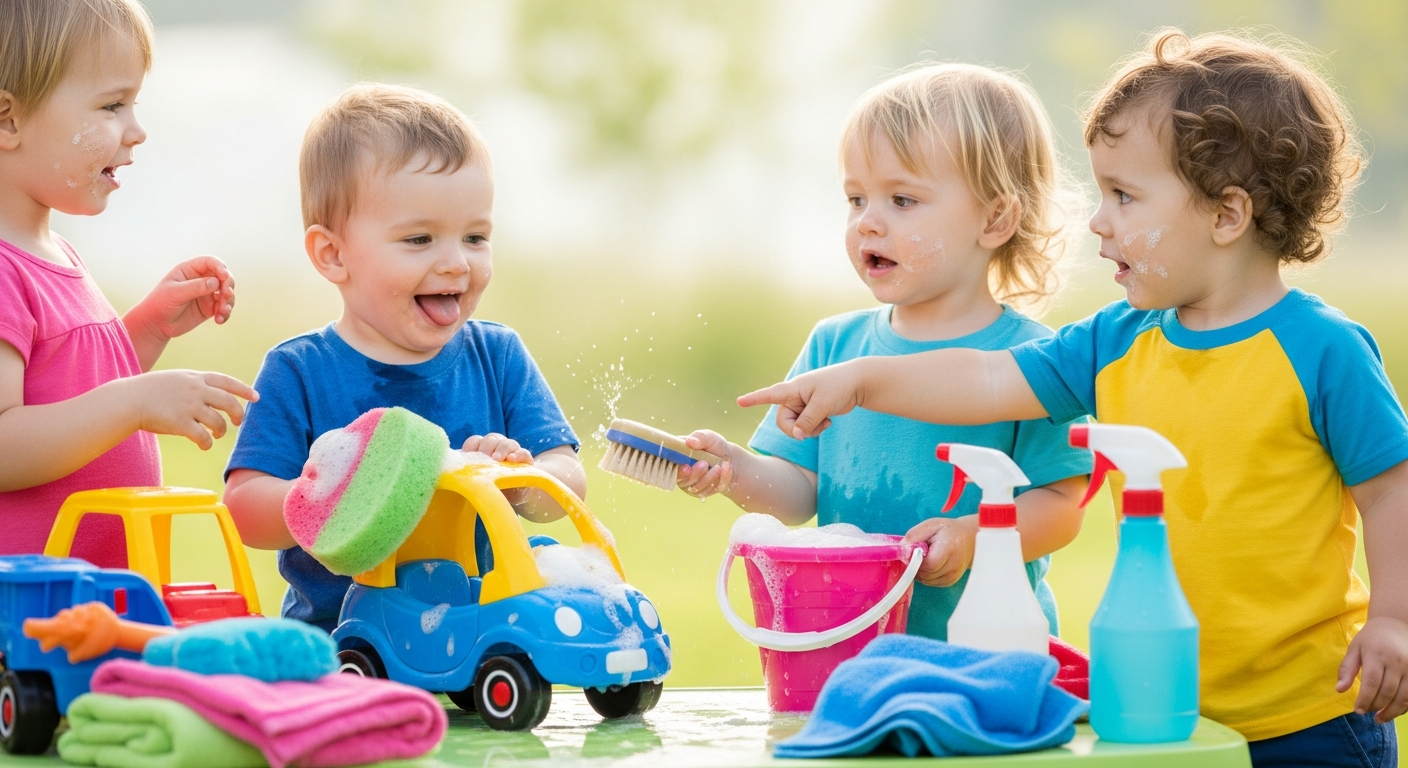
Table of Contents
- Introduction
- Why a Toddler Car Wash Activity is a Developmental Powerhouse
- The Speech Blubs Connection: Building Language Through Play
- Setting the Stage: Essential Supplies for Your Car Wash
- Variation 1: The "Muddy" Chocolate Car Wash
- Variation 2: The Shaving Cream "Snow" Wash
- Variation 3: The Outdoor "Cozy Coupe" Wash
- Maximizing Language Opportunities
- Practical Scenario: The "Animal Kingdom" Wash
- Science-Backed Learning: Why Play Matters
- Making the Most of Your Time Together
- Choosing the Best Support for Your Child
- Conclusion
- Frequently Asked Questions
Introduction
Have you ever noticed how a simple bucket of soapy water and a few plastic cars can transform an ordinary afternoon into an hour of pure, concentrated joy? There is a magnetic pull between toddlers and water that seems almost universal. Whether they are splashing in a puddle or trying to "help" you wash the dishes, children are naturally drawn to the tactile, sensory nature of liquids. A toddler car wash activity is more than just a way to kill time before naptime; it is a multi-sensory learning laboratory.
In this post, we will explore why this classic activity is a powerhouse for child development. We will dive into various ways to set up your own car wash at home—from muddy "chocolate" messes to fluffy shaving cream mountains—and show you how to use these moments to spark new words and build confidence. Our goal is to provide you with practical, actionable strategies that turn play into "smart" learning time. By the end of this guide, you will see how a few bubbles can help your little one "speak their minds and hearts," creating foundational communication skills through the simple power of play.

At Speech Blubs, we believe that the best learning happens when children are having so much fun they don’t even realize they are practicing. We invite you to explore our main homepage to learn more about our philosophy of blending science with joyful interaction. This blog post is designed to be your go-to resource for a language-rich, sensory-heavy adventure that you and your child can enjoy together.
Why a Toddler Car Wash Activity is a Developmental Powerhouse
When we think of a "car wash," we might think of a chore. But for a two- or three-year-old, it is an epic saga of transformation. They see something dirty and, through their own effort, they make it clean. This process hits several key developmental markers that are essential for early childhood growth.
Sensory Exploration and Regulation
Sensory play is the foundation of all learning. When a child dips their hands into cool water, feels the grit of "mud," or squeezes a foamy sponge, their brain is firing on all cylinders. This type of play helps children learn to process different textures and temperatures. For some children, especially those who might be sensitive to certain sensations, a car wash is a safe, controlled way to explore "messy" play. It allows them to engage at their own pace, building a sense of security and curiosity.
Fine Motor Skill Development
Think about the physical actions involved in a car wash. A toddler has to grip a small car, squeeze a sponge, scrub with a brush, and perhaps even pull the trigger on a spray bottle. These actions strengthen the small muscles in the hands and fingers. These are the same muscles your child will eventually use to hold a pencil, use scissors, and button their own coat. By encouraging these movements now, you are laying the groundwork for future independence.
Cognitive Milestones: Cause and Effect
A car wash is a living lesson in cause and effect. "If I rub this brown stuff with the sponge, it disappears!" "If I pour water on the car, it gets shiny!" This type of logical thinking is a precursor to problem-solving and scientific inquiry. It teaches children that their actions have a direct impact on the world around them, which is incredibly empowering for a little person who often feels like they have very little control over their environment.

The Speech Blubs Connection: Building Language Through Play
At Speech Blubs, our mission is deeply personal. Our founders grew up with speech challenges themselves, and they created the tool they wished they had: something that makes learning to talk feel like a game rather than a clinical exercise. We focus on "smart screen time," which is the polar opposite of the passive "zombie mode" that often happens with traditional cartoons.
Our approach is built on the concept of video modeling. In our app, children see other children—their peers—performing actions and making sounds. This triggers "mirror neurons" in the brain, making the child more likely to imitate what they see. A toddler car wash activity is the perfect "real world" extension of this methodology.
For example, imagine a parent whose 3-year-old is a "late talker" but is absolutely obsessed with anything that has wheels. In the "Big Wheels" section of the Speech Blubs app, the child can watch a peer make "vroom vroom" sounds or say the word "truck." When you then set up a physical car wash, you are giving that child a chance to take what they learned on the screen and apply it to a three-dimensional experience. You might say, "Look, just like the boy in the app, we are washing the truck! Can you say 'wash'?" This transition from "smart screen time" to active, co-play with a caregiver is where the magic happens.
If you aren't sure where your child stands in their communication journey, we recommend taking our quick 3-minute preliminary screener. It involves 9 simple questions and provides you with a personalized assessment and a next-steps plan to help your child thrive.
Setting the Stage: Essential Supplies for Your Car Wash
The beauty of a toddler car wash activity is its simplicity. You likely already have everything you need in your kitchen or bathroom.
The Basic Toolkit
- Two Large Bins: One will be for the "dirt" or "mud," and the other will be for the soapy "wash" station.
- Plastic Vehicles: Any cars, trucks, or tractors that don't have batteries.
- Soap: Use a tear-free baby wash or a gentle dish soap to create those all-important bubbles.
- Scrubbing Tools: Sponges, old washcloths, paintbrushes, or even an old toothbrush.
- Towels: A large bath towel for the floor (if indoors) and a smaller hand towel for the "drying station."
Choosing Your "Dirt"
You can't have a car wash without getting things dirty first! Depending on your tolerance for mess, you can choose from several "dirt" options:
- Cocoa Mud: A mixture of cocoa powder and water. It smells amazing and is completely non-toxic.
- Shaving Cream: Great for a "snow" or "bubbles" theme.
- Real Dirt: If you are outside, just mix some backyard soil with water for the ultimate authentic experience.
Variation 1: The "Muddy" Chocolate Car Wash
This is a fan favorite because it engages the sense of smell along with touch. The scent of chocolate creates a positive, high-reward environment for the activity.
Step 1: Create the Mud. Mix about a 1/4 cup of cocoa powder with a few tablespoons of water in your first bin. Stir until it reaches a thick, goopy consistency. If you want it to be even thicker, add a little cornstarch.
Step 2: The Dirty Drive. Let your child roll their cars through the "mud." This is a great time to practice verbs. You can say, "Oh no! The car is stuck! It's so dirty! Look at the brown mud."
Step 3: The Soapy Scrub. Fill the second bin with warm water and a generous squirt of soap. Whisk it up until there are plenty of bubbles. Transfer the muddy cars to the bubbles. This is the moment for "Scrub, scrub, scrub!" Encourage your child to use a brush to get the mud out of the tiny crevices of the wheels.
Step 4: The Rinse and Dry. If you have a third bin, fill it with plain water for a final rinse. Then, move to the drying station. Drying the cars is just as important as washing them—it teaches the sequence of a task (beginning, middle, and end).
To see how other families have successfully used these types of interactive play to boost their child's confidence, check out our parent testimonials.
Variation 2: The Shaving Cream "Snow" Wash
If you want a version that is a bit "cleaner" (ironically), shaving cream is an incredible sensory medium. It has a unique texture that holds its shape, allowing for a different kind of play.
How to Set It Up: Cover a tray or the lid of a storage bin with a thick layer of shaving cream. This is the "Car Wash Tunnel." Your child can "drive" the cars through the thick foam.
The Educational Angle: Shaving cream is perfect for practicing "pre-writing" skills. Before washing the cars, encourage your child to use their finger to draw tracks or shapes in the foam. Ask them to make "tracks" like a car. This builds hand-eye coordination and spatial awareness.
The Wash Station: Because shaving cream is essentially soap, the cars will get clean very quickly once they hit the water bin. You can add a drop of blue food coloring to the water bin to make it look like a "deep blue sea" for the cars to swim in.
Variation 3: The Outdoor "Cozy Coupe" Wash
If the weather is nice, take the car wash to a larger scale. This activity uses your child’s ride-on toys, like a Cozy Coupe or a tricycle.
Why It Works: Working on a larger object requires "gross motor" movements—reaching high, bending low, and moving the whole body. It also provides a great opportunity for "real-life" mimicry. Children love doing what adults do. If they see you washing the family car, giving them their own "station" makes them feel important and helpful.
The Squirt Bottle Trick: Instead of just a bucket, give your child a spray bottle. Spraying water is a fantastic way to build hand strength. It also introduces the concept of "aiming" and "target practice." You might say, "Can you spray the red wheel? Now spray the yellow roof!"
Maximizing Language Opportunities
A toddler car wash activity is a "language-rich" environment, meaning it provides endless opportunities to introduce new vocabulary and concepts. Here is how you can narrate the play to help your child develop their communication skills:
1. Focus on Verbs (Action Words)
Verbs are the engines of sentences. Without them, we can't express what is happening. During the car wash, emphasize words like:
- Wash
- Scrub
- Splash
- Pour
- Dry
- Drive
2. Descriptive Adjectives
Help your child learn to describe the world around them. Use contrasting pairs to help the concept stick:
- Dirty vs. Clean
- Wet vs. Dry
- Bumpy vs. Smooth
- Soapy vs. Clear
3. Prepositions (Location Words)
Play is the best way to teach where things are in space. Use words like:
- The car is in the mud.
- Put the sponge under the water.
- The bubbles are on top of the truck.
By narrating these actions, you are providing a linguistic map for your child. They might not repeat the words immediately, but they are soaking them up like a sponge. This is a core part of our methodology at Speech Blubs, where we use "smart screen time" to model these exact types of interactions. You can create your account and begin your 7-day free trial today to see these concepts in action through our interactive exercises.
Practical Scenario: The "Animal Kingdom" Wash
What if your child isn't into cars? No problem! The beauty of this activity is that it can be adapted to any interest.
Consider a parent whose toddler isn't interested in trucks but lights up whenever they see a dog or a cow. You can easily pivot to a "Muddy Animal Bath." Use the "Animal Kingdom" section in the Speech Blubs app to let your child hear the sounds the animals make—the "woof woof" of a dog or the "moo" of a cow. Then, bring out the plastic animal figurines.
Tell your child, "Oh no, the cow got into the mud! We need to give her a bath." As they wash the cow, you can practice the "M" sound together. This makes the learning feel organic and connected to their genuine interests. This strategy of following the child's lead is a cornerstone of effective early intervention and is something we advocate for in all our resources.
Science-Backed Learning: Why Play Matters
You might wonder, "Is this really therapy?" While a toddler car wash activity isn't a replacement for professional speech therapy when it's needed, it is a powerful supplement backed by scientific principles.
Our method relies heavily on the concept of Peer-to-Peer Modeling. Research shows that children are more likely to attend to and imitate other children than they are adults. When they see a child on a screen (like in our app) having fun with sounds and words, it lowers their anxiety and increases their "communicative intent"—the desire to share an idea with you.
Furthermore, our app has received high ratings on the MARS (Mobile App Rating Scale), which evaluates apps based on engagement, functionality, aesthetics, and information quality. We take the science of "smart screen time" seriously because we know that parents want tools that are both effective and joyful. You can dive deeper into the data on our research page.
Making the Most of Your Time Together
As a parent, your time is your most valuable resource. We know that the idea of a "messy" activity can sometimes feel overwhelming. Here are a few tips to keep the experience joyful and stress-free:
- Set Realistic Expectations: Your child might only stay engaged for 10 minutes, or they might play for an hour. Both are okay! The goal isn't a perfectly clean car; it's the process of exploration and the connection between you.
- Embrace the Mess: If you are worried about your floors, move the activity into the bathtub. It’s a contained environment that is literally built for water play.
- Follow Their Lead: If your child decides that the "car wash" is actually a "soup kitchen" for the cars, go with it! Imaginative play is just as valuable as the structured activity you planned.
- Co-Play is Key: Your presence is the most important part. By sitting on the floor and engaging in the "vroom vrooms" and the "splashes" with them, you are showing them that communication is fun and rewarding.
Choosing the Best Support for Your Child
While activities like the toddler car wash are fantastic for daily development, many parents look for additional tools to support their child's milestones. Speech Blubs was designed to fill that gap, providing an immediate, effective, and joyful solution for the 1 in 4 children who need extra speech support.
We are transparent about our pricing because we want to build a lasting relationship with our families. We offer two main plans to fit your needs:
- Monthly Plan: For $14.99 per month, you get full access to our library of 1,500+ activities and regular content updates.
- Yearly Plan: For $59.99 per year, which breaks down to just $4.99 per month.
The Yearly Plan is our most popular choice for a reason. It offers a 66% savings compared to the monthly rate and includes exclusive benefits that the monthly plan does not:
- A 7-day Free Trial: Test the full experience with your child before committing.
- Reading Blubs: Access to our second app designed to build early literacy and reading skills.
- Priority Support: 24-hour response time from our dedicated support team.
- Early Access: Be the first to try out new features and updates.
We encourage you to download Speech Blubs on the App Store or get it on Google Play to start your journey today.
Conclusion
A toddler car wash activity is a beautiful reminder that the simplest things in life are often the most meaningful. Through the combination of mud, water, and bubbles, your child is learning to navigate their world, strengthen their body, and find their voice. It is a screen-free alternative to passive viewing and a powerful tool for family connection.
By pairing these hands-on activities with the peer-led video modeling found in Speech Blubs, you are providing a holistic environment for your child to thrive. Remember, our mission is to empower children to "speak their minds and hearts." We aren't just teaching words; we are fostering a love for communication and building the confidence your child needs to express who they are.
Ready to see your child's progress take off? Start your 7-day free trial today by downloading the app. We highly recommend selecting the Yearly plan to unlock the full suite of features, including Reading Blubs and priority support, all while saving 66%. Let’s make every moment—even a messy one—a joyful learning opportunity.
Frequently Asked Questions
Is the toddler car wash activity safe for children who still put things in their mouths?
Yes, as long as you use safe materials. We recommend using the "Cocoa Mud" recipe (cocoa powder and water) because it is edible and non-toxic. For the wash station, use a tear-free baby soap. Always supervise your child during water play to ensure their safety.
How does this activity actually help with speech delay?
It provides a "low-pressure" environment where language is modeled in context. By narrating your child's actions (e.g., "The car is wet!"), you are helping them connect words to physical sensations and actions. This builds their receptive language (what they understand), which is the necessary foundation for expressive language (what they say).
Can I do this activity indoors during the winter?
Absolutely! If you don't want to deal with a mess on your carpets, move the bins into the bathtub or onto a tiled kitchen floor with plenty of towels. You can also use "shaving cream" as a less-runny alternative to mud, which stays contained more easily on a tray.
What should I do if my child doesn't want to touch the "mud"?
Some children have sensory sensitivities. Never force a child to touch a texture that makes them uncomfortable. You can start by giving them a "tool," like a long-handled brush or a spoon, so they can interact with the mud without getting it on their hands. Over time, they may become curious enough to try a fingertip!
About the author