
Fun Toddler Language Development Activities at Home
 By Speech Blubs Team•Feb 23, 2026•14 min.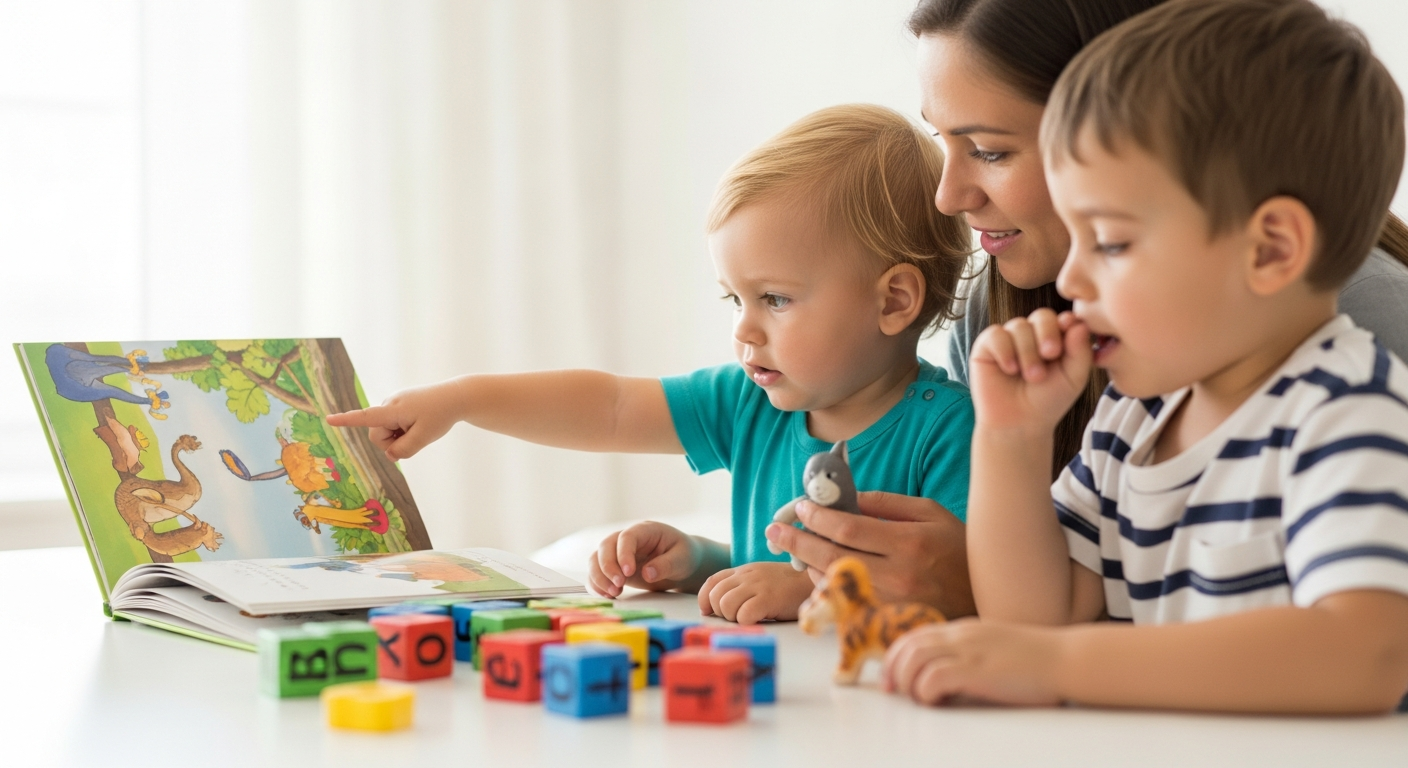
Table of Contents
- Introduction
- Understanding Toddler Language Milestones
- Why Play is the Key to Speech
- 10 Engaging Toddler Language Development Activities
- The Science of "Smart Screen Time"
- Practical Scenarios: Connecting Play to Speech Blubs
- Value and Investment: Choosing the Best Path for Your Family
- When Should You Seek Professional Help?
- FAQ
- Conclusion
Introduction
Picture this: your two-year-old is standing by the window, pointing excitedly at a squirrel darting across the fence. They look back at you, eyes wide, and let out a joyful, "Look! Nut!" In that tiny moment, a massive neurological symphony is playing. Every time a child cries, points, makes eye contact, or uses a facial expression, they are communicating. Whether they are hungry, upset, or thrilled by a backyard visitor, this nonverbal communication is a beautiful sign of growth. As parents, our most important job is to notice, encourage, and translate these moments into the building blocks of speech.
At Speech Blubs, we believe that every child deserves to "speak their minds and hearts." We understand the anxiety that comes when those first words seem a little late, or when you aren’t quite sure how to move from single words to full sentences. Our founders grew up with speech challenges themselves and created the very tool they wished they had—a bridge between silence and expression. If you are looking for effective toddler language development activities, you’ve come to the right place. In this guide, we will explore why play is the "work" of childhood, provide ten research-backed activities you can do today, and show how "smart screen time" can be a powerful ally in your child’s journey.

Our goal is not to turn your toddler into a public speaker overnight, but to foster a lifelong love for communication, build their confidence, and create joyful family learning moments. Let’s dive into how you can turn your living room into a hub of linguistic discovery.
Understanding Toddler Language Milestones
Before we jump into the activities, it is helpful to understand the landscape of development. Language development is a gradual process, and every child follows their own unique timeline. However, the period between ages one and three is often characterized by a "language explosion." During this time, children transition from simple babbling and cooing to mastering a robust vocabulary and basic grammar.
Typically, toddlers begin by acquiring "receptive language"—the ability to understand what you are saying—long before they can produce the words themselves. If you ask your child to "go get your shoes" and they toddle off to find them, they are demonstrating strong language skills, even if they haven't said the word "shoes" yet. "Expressive language" follows, where they begin to use words, signs, or gestures to communicate their internal world.
It is estimated that 1 in 4 children will need some form of speech support during their early years. If you find yourself wondering if your child is on track, you are not alone. We recommend using a quick 3-minute preliminary screener to get a simple assessment. This tool involves 9 simple questions and provides a next-steps plan to give you peace of mind.
Why Play is the Key to Speech
Why do speech-language pathologists (SLPs) focus so much on play? It’s because play is the natural language of children. When a child is engaged in an activity they love—whether it’s crashing toy cars or pretending to be a chef—their brain is in an optimal state for learning.
Play reduces the "performance pressure" that often comes when a parent asks, "Say 'apple.' Can you say 'apple'?" When we shift the focus from "teaching" to "playing," we create a low-stress environment where children feel safe to experiment with sounds. This is the heart of the Speech Blubs methodology. We don’t just provide passive content; we provide an interactive experience designed to mimic the way children naturally learn: by watching and imitating their peers.

10 Engaging Toddler Language Development Activities
Here are ten fun, easy, and effective language activities you can implement at home starting today.
1. The Animal Sound Mimicry Game
What do children love more than animals? The silly sounds they make! Animal sounds (like "moo," "baaa," and "woof") are often easier for toddlers to produce than complex words because they rely on simple, repetitive phonemes.
How to do it: Cut out pictures of animals or use a favorite picture book. Take turns showing the picture and making the sound. For a parent whose 3-year-old "late talker" loves animals, the "Animal Kingdom" section of our app offers a fun, motivating way to practice these sounds through peer-led video modeling. When your child sees another child on the screen making a "lion roar," their mirror neurons fire, making them more likely to try the sound themselves.
2. The "Telephone" Conversation
Even if your child is only babbling, the "Telephone Game" is a perennial favorite for teaching the "serve and return" nature of conversation.
How to do it: Use a toy phone (or even an old, disconnected one) and pretend it’s ringing. "Answer" the phone, have a brief, animated conversation, and then pass it to your toddler. "It’s for you!" This encourages them to "talk" into the receiver, helping them understand that communication is a back-and-forth exchange.
3. Singing and Nursery Rhymes
From "Itsy, Bitsy Spider" to "The Wheels on the Bus," songs are a powerhouse for language. They provide a predictable rhythm and rhyme that helps children anticipate the next word.
How to do it: Sing during transitions—bath time, car rides, or while cleaning up. Try pausing at the end of a familiar line (e.g., "The wheels on the bus go round and....") and wait for your child to fill in the blank. This "cloze procedure" is a classic speech therapy technique to encourage word production.
4. Building Tunnels and Using Spatial Concepts
Simple physical play provides the perfect context for teaching "prepositions" and spatial concepts like "under," "through," "on top," and "inside."
How to do it: Use cardboard boxes or pillows to build a tunnel for toy cars. As you play, narrate the action: "The car is going through the tunnel! Now it’s under the chair." This helps your child connect physical actions with specific descriptive words.
5. Labeling the World (The "Name This Thing" Game)
Everyday routines are full of opportunities for vocabulary building. You don't need fancy toys; you just need to talk about what you are seeing and doing.
How to do it: During a trip to the grocery store, focus on one category, like vegetables. "Look, a green broccoli! This is a red apple." At home, point to household objects and name them. If your child is already speaking, you can ask, "What is this?" Give them plenty of "wait time" (at least 5-10 seconds) to process and respond.
6. Interactive Reading and "Dialogic" Books
Reading is perhaps the most important habit you can establish. However, for toddlers, you don't always have to read the words on the page.
How to do it: Focus on the pictures. Point to a dog and say, "I see a dog! What is the dog doing?" If your toddler points to the dog, expand on their thought: "Yes, the dog is jumping!" This interaction turns reading from a passive activity into an active conversation. For kids who struggle to sit still, try books with flaps or textures to keep their hands busy while their ears are listening.
7. The Mystery "Sensory" Box
This activity is fantastic for older toddlers (2.5 to 3 years old) who are starting to use descriptive adjectives.
How to do it: Place several familiar objects (a spoon, a small ball, a block, a toy car) inside a box or an opaque bag. Have your child reach in without looking. Ask them, "What does it feel like? Is it hard? Is it soft?" This encourages them to use words like "round," "bumpy," or "smooth" before they finally pull the object out and name it.
8. "I Spy" with Initial Sounds
Help your child develop "phonemic awareness"—the ability to hear the individual sounds in words—with a simplified version of I Spy.
How to do it: Place three objects in front of your child (e.g., a ball, a cup, and a dog). Say, "I spy something that starts with the 'bbbbb' sound." Exaggerate the sound and watch them identify the ball. This helps them make the critical connection between sounds and the objects they represent.
9. Pretend Play and Puppets
Puppets are a "secret weapon" in speech therapy because they allow a child to practice social communication in a safe, imaginative way.
How to do it: Use a puppet to ask your child questions. "Hi! I’m Hungry Hippo. Do you have any pretend cookies for me?" Often, a child who is shy about talking to adults will "chat" happily with a puppet. This builds the foundational skills for social interaction and narrative storytelling.
10. Mirror Mimicry and Facial Expressions
Children learn by watching our mouths move. Playing in front of a mirror is a great way to help them visualize how sounds are formed.
How to do it: Sit with your child in front of a large mirror. Make silly faces—stick out your tongue, blow a raspberry, or make a wide "O" with your mouth. Encourage them to copy you. This "oral motor" play strengthens the muscles used for speech and helps them become more aware of their own articulators.
The Science of "Smart Screen Time"
In a world full of passive cartoons, we are often asked: "Isn't screen time bad for speech?" The answer depends entirely on how the screen is used. Passive viewing, where a child sits silently watching a show, does not promote language growth. However, research shows that "active" or "smart" screen time can be a powerful tool for development.
Our approach at Speech Blubs is rooted in the science of video modeling. This is a proven method where children learn new behaviors by watching their peers perform them. Unlike cartoons with exaggerated characters, our app features real children. When your toddler sees a peer successfully pronouncing a word or making an animal sound, they feel a sense of "If they can do it, I can too!"
This is why we call our app a "screen-free alternative" in spirit—it is designed to be used with a parent to spark real-world interaction. It isn't a digital babysitter; it’s a digital facilitator. To see how this has transformed the lives of thousands of families, you can read our parent testimonials.
Practical Scenarios: Connecting Play to Speech Blubs
Let’s look at how these activities translate into the Speech Blubs experience:
- Scenario A: Your child loves "The Wheels on the Bus." You can practice the song at home, and then use the "Sing Along" section of Speech Blubs to watch other children perform the hand motions and sing the lyrics. This reinforces the vocabulary through multiple senses.
- Scenario B: You are practicing the "b" sound using the I Spy game. You can then head to the "Early Sounds" section of the app, where your child can practice "B-B-Bubble" and "B-B-Ball" alongside their "Blub" friends.
- Scenario C: You’ve been working on labeling body parts during bath time. The "Yummy Time" or "My Body" sections in the app provide a fun way to reinforce those labels, using the built-in face filters to make the learning process hilarious and memorable.
Value and Investment: Choosing the Best Path for Your Family
We are committed to making effective speech support accessible to everyone. We offer two clear paths for families looking to integrate Speech Blubs into their daily routine:
- The Monthly Plan ($14.99 per month): Perfect for families who want to try the app on a short-term basis.
- The Yearly Plan ($59.99 per year): This is our clear best-value option. At just $4.99 per month, you save 66% compared to the monthly rate.
Choosing the Yearly Plan unlocks a suite of exclusive, high-value features that are not available on the monthly plan:
- A 7-day free trial to ensure the app is the right fit for your child before you commit.
- The Reading Blubs app, which extends the learning journey into early literacy and phonics.
- Early access to all new content updates.
- 24-hour support response time from our dedicated team.
Create your account and begin your 7-day free trial today to see the difference for yourself.
When Should You Seek Professional Help?
While these toddler language development activities are incredibly beneficial, they are meant to supplement, not replace, professional advice if a significant delay is present. Early intervention is the "gold standard" for a reason—the earlier a child receives support, the better the long-term outcomes.
If you notice your child is not meeting major milestones—such as not using any words by 15 months, or not following simple directions by age two—it is always a good idea to consult your pediatrician or a licensed Speech-Language Pathologist. You can download Speech Blubs on the App Store or find it on Google Play to use as a powerful daily tool alongside professional therapy.
Key Takeaway: You are your child’s first and most important teacher. Your enthusiasm, your voice, and your willingness to get down on the floor and play are the most powerful "speech therapy" tools in existence.
FAQ
1. How long should I spend on these activities each day? Consistency is more important than duration. Even 15 to 20 minutes of dedicated, face-to-face play or "smart screen time" with Speech Blubs can make a significant impact. Try to weave these activities into your existing routines (like mealtime or car rides) so they don't feel like a chore.
2. My child gets frustrated when they can't say a word. What should I do? Frustration is a common part of the learning process. If your child is struggling, focus on the effort rather than the accuracy. Use "Total Communication"—accept gestures, pointing, and signs as valid forms of speech. When they point to a cup, say, "Oh, you want the cup! Here is the cup." This validates their attempt and provides the correct model without correcting them.
3. Is the Reading Blubs app included in the monthly subscription? No, the Reading Blubs app is an exclusive benefit of the Yearly Plan. This plan also includes a 7-day free trial, giving you the best opportunity to explore our full ecosystem of language and literacy tools.
4. Can Speech Blubs replace traditional speech therapy? Speech Blubs is designed to be a powerful supplement to a child's overall development plan. While it is built on scientific principles like video modeling and is used by many therapists in their sessions, it should not replace the personalized care of a professional SLP if your child has a diagnosed delay. It is a tool for home reinforcement, confidence building, and joyful practice.
Conclusion
Helping your child find their voice is one of the most rewarding journeys you will ever take. By incorporating these toddler language development activities into your daily life, you are doing more than just teaching words; you are building a foundation of confidence, curiosity, and connection. Remember to keep it light, keep it fun, and follow your child’s lead.
Whether you are singing "The Wheels on the Bus" for the hundredth time or exploring the "Animal Kingdom" within our app, every interaction counts. Our mission at Speech Blubs is to be your partner in this process, providing the "smart" tools your child needs to flourish.
Ready to start this journey with us? Download Speech Blubs on the App Store or Google Play today. For the best value, including the Reading Blubs app and a 7-day free trial, be sure to select our Yearly Plan. Let’s work together to help your little one speak their mind and heart!
About the author