
Fun Valentine's Game Ideas for Kids: Boost Speech & Connection
 By Speech Blubs Team•Jan 28, 2026•19 min.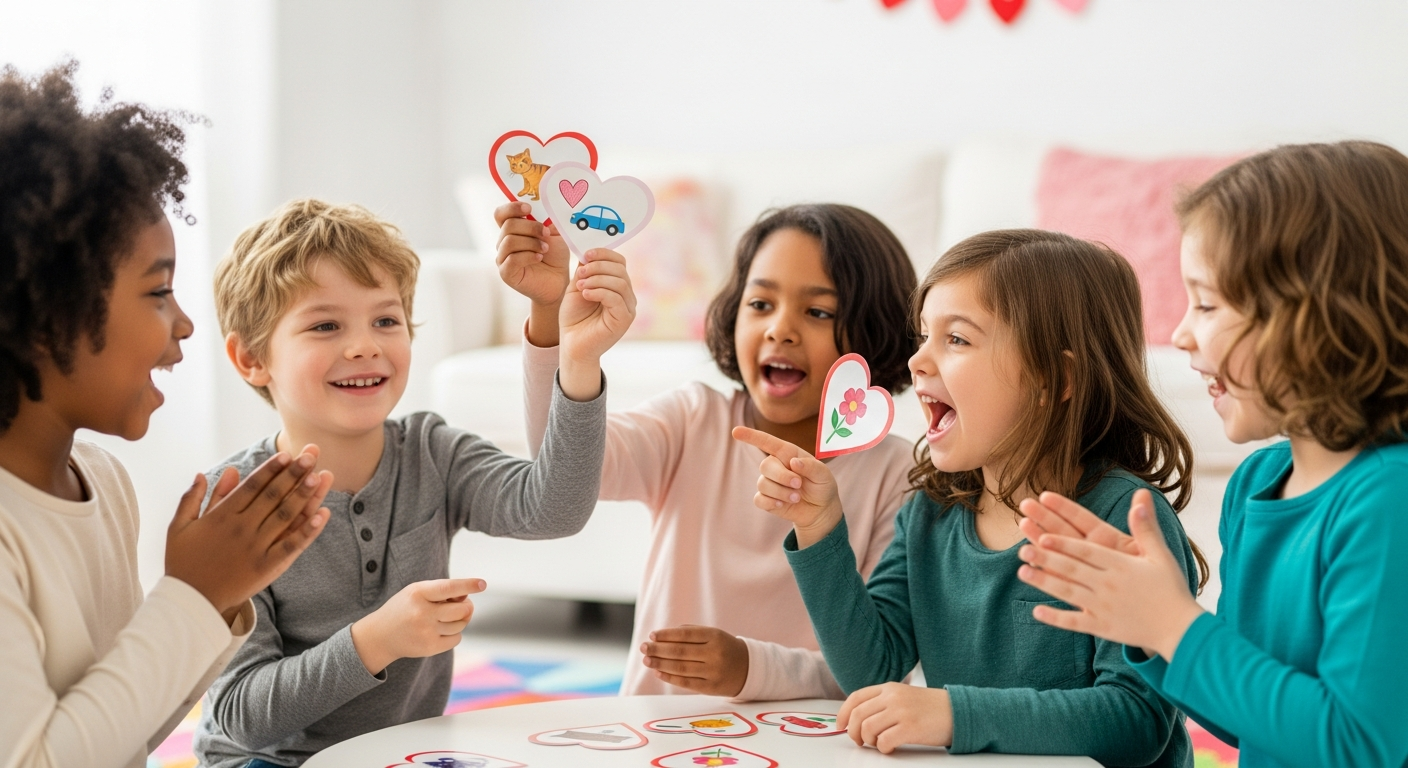
Table of Contents
- The Heart of the Matter: Why Valentine's Games Are More Than Just Fun
- Sweet Sounds & Simple Words: Valentine Games for Toddlers & Preschoolers
- Building Blocks of Love: Valentine Games for Early Elementary
- Heartfelt Connections: Valentine Games for Older Kids
- Beyond the Games: Speech Blubs as Your Communication Companion
- Making the Most of Speech Blubs: Value & Pricing
- Conclusion
- Frequently Asked Questions
Imagine a day filled with giggles, shared secrets, and heartfelt expressions. Valentine's Day isn't just for cards and candy; it's a golden opportunity to create cherished memories and, importantly, nurture your child's communication skills through play. While the focus is often on romantic love, at its heart, Valentine's Day celebrates all forms of affection, friendship, and connection – perfect themes for engaging children in activities that subtly strengthen their speech and language development.
This post explores a treasure trove of engaging Valentine's game ideas for kids of all ages, from toddlers to pre-teens. We'll delve into how these games can do more than just entertain; they offer unique opportunities to enhance vocabulary, encourage turn-taking, foster social connections, and build confidence – all while celebrating love. By integrating thoughtful, communication-focused play into your Valentine's Day festivities, you can create a joyful environment where children naturally "speak their minds and hearts," laying foundational communication skills that last a lifetime. Get ready to transform your celebrations into powerful learning experiences that are both fun and enriching!

The Heart of the Matter: Why Valentine's Games Are More Than Just Fun
Play is the cornerstone of childhood development, and its role in fostering speech and language skills is profound. When children engage in games, they aren't just passing the time; they are actively experimenting with sounds, words, and social interactions. Valentine's Day games, with their inherent themes of love, friendship, and giving, provide a unique and emotionally rich context for this developmental journey.
Think about it: during a simple game, a child might practice new vocabulary ("heart," "pink," "sweet"), learn to follow multi-step directions, or take turns speaking. They might express preferences ("I like this one!"), ask questions ("What's next?"), or even articulate feelings ("I feel happy!"). These seemingly small interactions are crucial building blocks for complex communication.
Moreover, the celebratory nature of Valentine's Day itself creates a positive and low-pressure environment for communication. Children are often more open to experimenting with language when they feel joyful and connected. It’s an ideal setting to practice descriptive language, express appreciation, and understand social cues – all essential components of effective communication. When games are played collaboratively with family, they strengthen bonds, reduce potential frustration associated with communication challenges, and transform learning into joyful family moments. This is why we at Speech Blubs are so passionate about blending scientific principles with play, creating "smart screen time" experiences that are powerful tools for family connection and developing key foundational skills.
Sweet Sounds & Simple Words: Valentine Games for Toddlers & Preschoolers
For our youngest communicators, Valentine's Day offers a wonderful chance to explore sounds, single words, and basic concepts through playful activities. These games are designed to be highly interactive, encouraging imitation and early vocabulary acquisition.

Heart Sorting Extravaganza
This game takes a classic sorting activity and infuses it with Valentine's charm, making it perfect for toddlers and preschoolers who are just beginning to vocalize and understand categories.
- How to Play: Gather a variety of heart-shaped objects or cutouts in different colors, sizes, and even textures (e.g., felt hearts, paper hearts, plastic hearts, rough sandpaper hearts, smooth silk hearts). Provide several bins or baskets, each labeled with a color, size, or texture. Ask your child to sort the hearts into the correct bins.
- Speech & Language Benefits:
- Vocabulary: Naming colors ("red," "pink"), sizes ("big," "small"), and textures ("smooth," "bumpy").
- Following Directions: Simple instructions like "Put the red heart in the red bin."
- Descriptive Language: Encouraging sounds or words related to textures (e.g., "ooh, soft!" or "rough!").
- Concept Development: Understanding categories and attributes.
- Relatable Scenario: For a parent whose 2-year-old "late talker" loves to explore with their hands, a Heart Sorting Extravaganza with varied textures can be incredibly motivating. As they touch a fuzzy heart, you can say "fuzzy!" and encourage them to imitate the sound, or simply to feel and look while you model the descriptive word. Our approach at Speech Blubs, using video modeling where children learn by watching and imitating their peers, works on similar principles of imitation and reinforcement in a fun, engaging way.
"Cupid Says" for Little Learners
A Valentine's twist on "Simon Says," this game helps children practice listening skills, follow commands, and learn action verbs.
- How to Play: You take on the role of Cupid. Give instructions preceded by "Cupid says..." For example: "Cupid says, give a hug!" or "Cupid says, blow a kiss!" If you give an instruction without "Cupid says," players shouldn't follow it.
- Speech & Language Benefits:
- Listening Comprehension: Paying attention to specific words.
- Action Verbs: Learning and performing actions like "hug," "kiss," "jump," "touch."
- Body Parts: "Cupid says, touch your nose."
- Following Multi-Step Directions: "Cupid says, touch your toes and then clap your hands."
- Relatable Scenario: If your 3-year-old often needs help remembering sequences, "Cupid Says" can be adapted. Start with one-step commands and gradually introduce two-step directions, always keeping it playful and low-pressure. This kind of interactive play is a wonderful screen-free alternative to passive viewing, promoting active engagement and family connection.
Valentine's Sensory Bin Discovery
Sensory bins are fantastic for engaging multiple senses and encouraging spontaneous communication.
- How to Play: Fill a bin with Valentine's themed items: red and pink rice or pasta, heart-shaped cookie cutters, silk rose petals, small plastic hearts, red and pink pom-poms, spoons, and small cups. Let your child explore, scoop, pour, and discover.
- Speech & Language Benefits:
- Descriptive Vocabulary: "What does it feel like?" ("soft," "crunchy," "smooth"). Naming colors and objects.
- Action Verbs: "scoop," "pour," "dig," "hide."
- Imaginative Play: Creating stories about the items, fostering narrative skills.
- Asking & Answering Questions: "What did you find?" "Where is the red heart?"
Heart Matching Game with Sounds
This game combines visual matching with auditory input, perfect for building early sound and word recognition.
- How to Play: Create pairs of large paper hearts. On each pair, draw or glue pictures of common objects that make distinct sounds (e.g., a "moo" cow, a "woof" dog, a "vroom" car). Lay them face down. Children take turns flipping two hearts. If they match, they make the sound and say the word.
- Speech & Language Benefits:
- Phonological Awareness: Associating sounds with objects.
- Vocabulary: Naming animals, vehicles, etc.
- Turn-Taking: Understanding social rules of play.
- Imitation: Practicing target sounds and words modeled by you.
- Relatable Scenario: For a child who loves animals but is still working on producing specific animal sounds, the "Animal Kingdom" section within Speech Blubs offers a fun, motivating way to practice "moo" and "baa" sounds through our video modeling, mirroring their peers in a playful context. Our mission at Speech Blubs is to empower children to speak their minds and hearts, and integrating activities like these with our app can provide a comprehensive approach to early language development.
Ready to explore more ways to boost your child's communication? Download Speech Blubs today on the App Store or Google Play!
Building Blocks of Love: Valentine Games for Early Elementary
As children grow, their language skills become more complex. Valentine's games for early elementary kids can focus on expanding vocabulary, forming more elaborate sentences, describing in detail, asking and answering open-ended questions, and refining turn-taking abilities.
Valentine's Story Chain
This collaborative storytelling game encourages creativity and narrative structure.
- How to Play: Start a love-themed story with one sentence, for example, "Once upon a time, there was a little heart who wanted to find a friend." The next person adds a sentence, building on the story. Continue around the circle, creating a unique Valentine's tale.
- Speech & Language Benefits:
- Narrative Skills: Developing plots, characters, and settings.
- Sentence Formation: Practicing creating grammatically correct and complex sentences.
- Vocabulary Expansion: Introducing new adjectives and verbs to enrich the story.
- Sequencing: Understanding the order of events in a story.
- Relatable Scenario: For a 5-year-old who struggles with sentence formation or connecting ideas, a "Valentine's Story Chain" game can encourage them to build on each other's sentences, practicing narrative skills in a fun, low-pressure way. The shared laughter and creative output reinforce positive communication experiences.
"Describe the Heart" Challenge
This game hones descriptive language skills using simple Valentine's objects.
- How to Play: Provide a collection of various heart-shaped objects (e.g., a plush heart, a wooden heart, a heart sticker, a conversation heart candy). One person picks a heart but doesn't show it. They describe it using adjectives related to color, size, texture, and other attributes. Others guess which heart it is.
- Speech & Language Benefits:
- Adjective Usage: Expanding vocabulary related to sensory details.
- Specific Language: Learning to use precise words to differentiate objects.
- Asking Clarifying Questions: "Is it red?" "Is it soft?"
- Inferencing: Using clues to make an educated guess.
Valentine's Charades
Charades are excellent for non-verbal communication and understanding, as well as vocabulary recall.
- How to Play: Write down love-themed words, phrases, or actions on slips of paper (e.g., "blowing a kiss," "making a Valentine's card," "hugging a friend," "eating chocolate," "Cupid shooting an arrow"). Players take turns acting out the phrase without speaking, while others guess.
- Speech & Language Benefits:
- Vocabulary: Recalling and understanding specific words and phrases.
- Non-Verbal Communication: Understanding gestures, facial expressions, and body language.
- Inferencing & Problem-Solving: Using visual cues to deduce meaning.
- Emotional Expression: Acting out feelings associated with Valentine's Day.
DIY Valentine's Card Creation with Conversation
Creating handmade cards is a classic Valentine's activity that can be transformed into a rich language-learning opportunity.
- How to Play: Provide various crafting supplies (paper, glue, glitter, stickers, markers) and encourage children to make cards for family or friends. As they create, engage them in conversation about their recipients.
- Speech & Language Benefits:
- Expressing Appreciation: "What do you love about Grandma?" "Why is your friend special?"
- Cause & Effect: "If I put glitter here, what will happen?"
- Planning & Sequencing: "First I'll draw a heart, then I'll write a message."
- Social Language: Discussing what messages are appropriate for different people.
- Relatable Scenario: For a child who might struggle to articulate what they like about others, the act of making a card provides a concrete context to practice these expressions. Prompt them with specific questions, turning the craft into a verbal exercise in gratitude.
Curious if your child could benefit from targeted speech support? Take our quick 3-minute preliminary screener to get a simple assessment and a free 7-day trial.
Heartfelt Connections: Valentine Games for Older Kids
For older children, Valentine's Day games can move beyond basic vocabulary to focus on more complex language, social pragmatics, abstract concepts (like the nuances of love and friendship), problem-solving, and sophisticated storytelling.
Valentine's "Would You Rather"
This game is excellent for encouraging kids to articulate preferences, justify their reasoning, and engage in thoughtful discussion.
- How to Play: Create a list of Valentine's-themed "Would You Rather" questions (e.g., "Would you rather receive a giant box of chocolates or a giant bouquet of flowers?" "Would you rather write a love poem or sing a love song?" "Would you rather have a secret admirer or know who likes you?"). Ask the questions and have children explain their choices.
- Speech & Language Benefits:
- Justification & Reasoning: Articulating why they prefer one option over another.
- Comparing & Contrasting: Discussing similarities and differences between choices.
- Opinion Formation: Expressing and defending personal viewpoints.
- Complex Sentence Structures: Using conjunctions like "because," "although," and "therefore."
- Relatable Scenario: For an 8-year-old who finds it hard to express abstract feelings or justify opinions, a "Would You Rather: Valentine's Edition" game can provide a safe space to articulate preferences and develop their reasoning skills without the pressure of a "right" answer.
"Love Song" Guessing Game
This game taps into popular culture while enhancing vocabulary and listening skills.
- How to Play: Play short snippets of popular love songs (kid-appropriate, of course!). Players guess the song title or artist. For an extra challenge, ask them to identify a specific word from the lyrics or describe the mood of the song.
- Speech & Language Benefits:
- Listening Comprehension: Actively processing auditory information.
- Vocabulary in Context: Understanding words used in song lyrics.
- Memory & Recall: Remembering song titles, artists, and lyrics.
- Emotional Vocabulary: Describing the feelings evoked by the music.
Valentine's Day Family Feud
A group game that promotes quick thinking, categorization, and turn-taking in a competitive yet friendly setting.
- How to Play: Create categories related to Valentine's Day (e.g., "Things you give on Valentine's Day," "Words associated with love," "Romantic movie titles," "Red things"). Divide into teams. Ask questions, and teams try to guess the most popular answers based on a (fictional) survey.
- Speech & Language Benefits:
- Categorization: Grouping related items and concepts.
- Vocabulary Recall: Accessing words quickly under pressure.
- Turn-Taking & Negotiation: Collaborative play within a team.
- Strategic Thinking: Deciding which answers to give.
Heartfelt Debate: Give or Receive?
This game encourages critical thinking and persuasive communication skills.
- How to Play: Choose a Valentine's-themed topic for debate, such as "Is it better to give or receive gifts on Valentine's Day?" or "Are handmade cards better than store-bought cards?" Divide players into two teams, assign them a side, and let them prepare arguments to support their stance. Facilitate a structured debate.
- Speech & Language Benefits:
- Argumentation & Persuasion: Developing and presenting logical arguments.
- Active Listening: Attending to opponents' arguments to formulate rebuttals.
- Critical Thinking: Analyzing different perspectives.
- Formal Language: Practicing more structured and polite debate language.
To support your child's communication journey and build their confidence, explore the targeted activities within Speech Blubs. We provide a powerful tool for family connection, grounded in scientific principles, helping children develop key foundational skills. To learn more about our methodology, you can visit our research page.
Beyond the Games: Speech Blubs as Your Communication Companion
At Speech Blubs, our mission is to empower children to "speak their minds and hearts." We understand that every child's communication journey is unique, and sometimes, they need a little extra support to find their voice. Our company was born from the personal experiences of our founders, who all grew up with speech problems and created the tool they wished they had. This personal connection drives our commitment to providing an immediate, effective, and joyful solution for the 1 in 4 children who need speech support.
We achieve this by blending scientific principles with play, transforming screen time into one-of-a-kind "smart screen time" experiences. Unlike passive viewing like cartoons, Speech Blubs offers a screen-free alternative where children actively engage. Our unique approach of teaching complex communication skills is centered around our "video modeling" methodology. Children learn by watching and imitating their peers, a powerful and natural way to acquire new sounds, words, and even social cues. This methodology is backed by robust scientific research, placing us in the top tier of speech apps worldwide with a high MARS scale rating.
We believe in fostering a love for communication, building confidence, and reducing the frustration that can often accompany speech challenges. While we never promise guaranteed outcomes or suggest that your child will be giving public speeches in a month, we focus on the immense benefits of the process: developing key foundational skills, creating joyful family learning moments, and providing a powerful supplement to a child's overall development plan and, when applicable, professional therapy. The activities within our app are always designed with the implicit understanding of adult co-play and support, ensuring that learning is a shared, enriching experience. Our goal is to make every child's voice heard, celebrated, and understood. See what other parents are saying about their child's success with Speech Blubs by visiting our testimonials page.
Making the Most of Speech Blubs: Value & Pricing
We believe in transparency and providing exceptional value to families. Understanding our subscription options helps you choose the plan that best suits your family's needs and communication goals.
Speech Blubs offers two primary subscription plans:
- Monthly Plan: For $14.99 per month, this plan provides access to our core app features. It’s a great option for those who want to try us out on a shorter-term basis.
- Yearly Plan: Our Yearly Plan is priced at $59.99 per year. This breaks down to just $4.99 per month, offering a substantial saving.
Why the Yearly Plan is the Best Choice for Your Family:
The Yearly Plan isn't just cheaper; it's a comprehensive package designed to give your child the full Speech Blubs experience and maximize their progress. By choosing the Yearly plan, you save 66% compared to the monthly option, making it the clear best value.
But the savings are just the beginning. The Yearly Plan includes exclusive, high-value features that are not available with the Monthly Plan:
- A 7-Day Free Trial: This allows you to fully explore the app's features and see the magic of video modeling firsthand with no commitment. It’s the perfect opportunity to witness how engaging and effective our unique approach is for your child.
- The Extra Reading Blubs App: This bonus app extends the learning beyond speech, focusing on early literacy skills, phonics, and reading comprehension. It's a fantastic complement to speech development, supporting overall language acquisition.
- Early Access to New Updates: Be among the first to experience new features, games, and content as we continuously enhance our app.
- 24-Hour Support Response Time: Get priority support from our dedicated team, ensuring any questions or concerns are addressed promptly.
The Monthly Plan, unfortunately, does not include these invaluable benefits. It does not come with a free trial, the Reading Blubs app, early access to updates, or priority support.
Our Recommendation:
To unlock these incredible benefits and give your child the best possible start on their communication journey, we wholeheartedly recommend choosing the Yearly Plan. The 7-day free trial allows you to experience the full suite of features and witness the positive impact on your child's communication and confidence.
Ready to provide your child with an engaging, scientifically-backed tool to empower their voice? Create your account and begin your 7-day free trial today by choosing the Yearly Plan!
Conclusion
Valentine's Day offers more than just a chance to share candy and cards; it's a powerful opportunity to infuse joy and connection into your child's communication development. By embracing thoughtful Valentine's game ideas, you create an environment where children can playfully enhance their vocabulary, practice turn-taking, build confidence in expressing themselves, and strengthen foundational speech and language skills. These games foster not just communication, but also the heartfelt bonds that make learning a truly joyful experience.
At Speech Blubs, we are dedicated to supporting every child on their unique communication journey, ensuring they can "speak their minds and hearts." Our app, born from personal experience and built on scientific principles like video modeling, offers "smart screen time" that actively engages children and complements family play. We empower children to find their voice, reduce frustration, and develop crucial skills for a lifetime of confident communication.
Don't let this Valentine's season pass without unlocking your child's full communication potential. Start your 7-day free trial today by downloading Speech Blubs from the App Store or Google Play! Remember to choose the Yearly Plan during sign-up to unlock all premium features, including the extra Reading Blubs app, early access to new updates, and 24-hour support, giving your child the most comprehensive and effective tool to thrive. Let's make this Valentine's Day the start of a beautiful communication journey for your child! Visit our homepage to learn more.
Frequently Asked Questions
Q1: How can I adapt these Valentine's Day games for children with varying speech development levels?
A1: The key is flexibility and observation. For children with emerging language, focus on basic sounds, single words, and simple commands. Model sounds and words clearly, use gestures, and offer plenty of praise for any attempt at communication. For more advanced speakers, encourage longer sentences, descriptive language, storytelling, and explanations. You can also adjust game rules – for example, a child with limited vocabulary might just point to an object, while another might describe it in detail. The most important thing is to keep it fun and pressure-free.
Q2: Are these games suitable for a classroom setting or large groups?
A2: Many of these games are highly adaptable for groups! For example, "Heart Sorting" can be done in small groups or as individual stations. "Cupid Says" and "Valentine's Charades" are excellent for whole-group engagement, promoting turn-taking and listening skills in a social context. "Valentine's Day Family Feud" or "Heartfelt Debate" can be fantastic for older kids in a classroom. Just ensure you have enough materials and clear instructions for the group size.
Q3: How do Speech Blubs activities complement these physical Valentine's games?
A3: Speech Blubs offers a fantastic digital complement to hands-on play. While your child practices sounds and words through our engaging video modeling with peers, the physical games reinforce those skills in a different, interactive environment. For example, after practicing animal sounds in Speech Blubs, your child can apply those sounds during a "Heart Matching Game" using animal cards. Our app provides targeted, scientific support, while these games offer organic, social practice, creating a holistic approach to language development. It’s all about creating "smart screen time" that works in harmony with real-world interactions.
Q4: What if my child is hesitant to participate in speech-focused games?
A4: Keep the atmosphere light and playful! Avoid labeling games as "speech therapy" or putting pressure on your child to perform. Frame them simply as "Valentine's fun." Start by participating yourself, modeling enthusiasm and sounds. Allow your child to lead sometimes, choosing the game or how to play. If they're resistant, take a break and try again later, or adapt the game to their current interest. Remember, the goal is to foster a love for communication and build confidence, not to force participation. Speech Blubs’ playful, peer-led activities are designed to naturally engage children, making learning feel like pure fun.
About the author