
Fun Yard Games for Kids: Boost Skills Outdoors
 By Speech Blubs Team•Jan 19, 2026•20 min.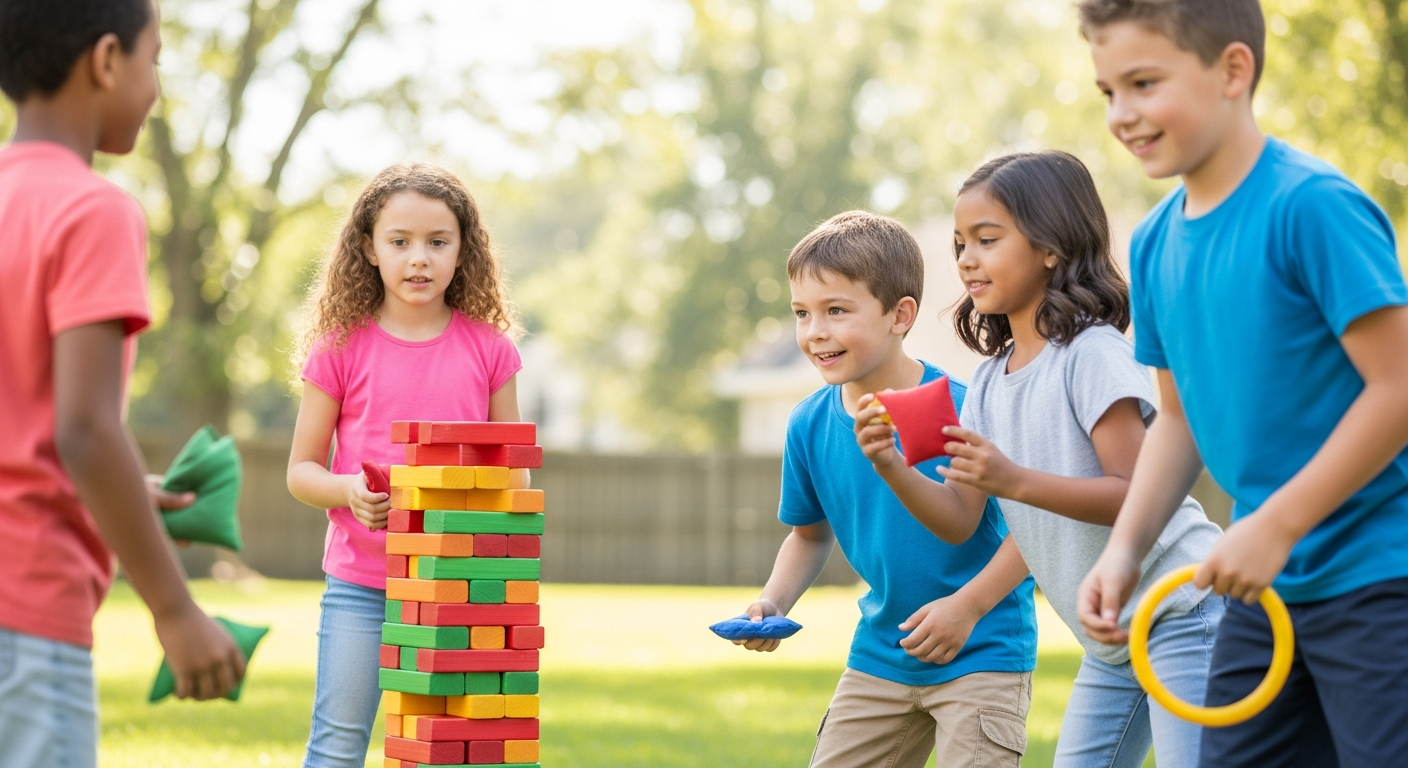
Table of Contents
- Introduction
- The Power of Outdoor Play: More Than Just Fun
- Setting Up Your Outdoor Adventure Zone
- Classic & Creative Fun Yard Games for Kids
- Weaving Communication into Every Game
- Beyond the Yard: Smart Screen Time with Speech Blubs
- Conclusion
- Frequently Asked Questions (FAQ)
Introduction
Does the familiar cry of "I'm bored!" echo through your home as soon as screens are off, even when a beautiful day beckons outside? You're not alone. In an age filled with digital distractions, reconnecting children with the simple joys of outdoor play can feel like a challenge. Yet, the backyard, a local park, or even a quiet cul-de-sac holds boundless potential for adventure, laughter, and incredible growth. This blog post isn't just about finding ways to entertain your children; it's about unlocking the profound developmental benefits hidden within fun yard games for kids. We’ll explore how these seemingly simple activities can be powerful catalysts for physical, cognitive, and, crucially, communication skill development, laying a strong foundation for your child to thrive. Through engaging outdoor experiences, we can empower our children to explore, connect, and, ultimately, speak their minds and hearts.
The Power of Outdoor Play: More Than Just Fun
The fresh air and open space of the outdoors offer a unique classroom for children. While often viewed purely as a source of entertainment, outdoor play is a cornerstone of holistic child development, fostering growth in ways that indoor activities simply cannot replicate.

Holistic Development Through Movement and Nature
Stepping outside immediately engages a child's entire being. Physically, running, jumping, throwing, and climbing build crucial gross motor skills, coordination, and balance. These actions are vital for developing strong bodies and healthy habits. Mentally, outdoor environments stimulate cognitive growth through problem-solving (e.g., how to navigate an obstacle course), critical thinking (strategizing in a game), and boundless creativity as children transform sticks into magic wands or cardboard boxes into rocket ships. Nature itself offers a rich sensory experience, from the feel of grass underfoot to the sound of birdsong and the sight of buzzing bees, all contributing to a child's understanding of the world around them. Furthermore, the freedom and expanse of outdoor play can significantly boost a child's emotional well-being, enhancing self-confidence, reducing stress, and providing outlets for self-expression.
Fostering Communication and Social Skills
Perhaps one of the most remarkable benefits of outdoor play, particularly through structured and unstructured games, is its profound impact on speech, language, and social-emotional development. When children play together outside, they are constantly engaged in communication. They learn to:
- Take Turns: A fundamental social skill directly linked to conversational turn-taking.
- Negotiate: Deciding on game rules, roles, or who goes next builds persuasive language and compromise.
- Express Needs and Wants: Clearly articulating desires or frustrations during play.
- Follow and Give Instructions: Essential for both receptive and expressive language, from "Simon says, jump!" to "You stand there, and I'll count."
- Imitate Sounds and Actions: Mimicking peers, animal sounds, or character voices, which is a key precursor to speech development.
- Tell Stories: Crafting narratives during imaginative play, expanding vocabulary and narrative structure.
- Engage in Dialogue: Back-and-forth conversations that are organic and context-rich.
At Speech Blubs, our mission is to empower children to "speak their minds and hearts," and we see outdoor play as a powerful, natural extension of this. It's where children can test out new words, express complex emotions, and build social connections, all in a dynamic and forgiving environment.

Setting Up Your Outdoor Adventure Zone
You don't need a sprawling estate or expensive equipment to create a fantastic outdoor play space. With a little creativity and consideration, any outdoor area can become a vibrant playground.
Safety First: Creating a Secure Play Area
Before the fun begins, ensure the play area is safe. Clear away any potential hazards like sharp objects, poisonous plants, or uneven ground. Define clear boundaries for play, especially if you have younger children, and ensure they understand them. Always prioritize sun protection with hats and sunscreen, and keep water readily available to prevent dehydration, as kids can easily get absorbed in their games and forget to drink.
Gathering Your Gear: DIY vs. Store-Bought
Many of the best fun yard games for kids require little to no special equipment, encouraging resourcefulness and imagination.
- DIY Essentials: Old sheets, blankets, cardboard boxes, pool noodles, buckets, balls of various sizes, jump ropes, sidewalk chalk, hula hoops, and even items from your recycling bin can be transformed into game components. These readily available items spark creativity and reduce cost.
- Popular Store-Bought Additions: For those looking to invest in specific games, classics like a simple bean bag toss, a croquet set, or bocce balls can provide structured fun for all ages. You might also consider ladder toss games or giant versions of popular board games for larger gatherings. Remember, the goal is interaction and engagement, not simply owning the most toys.
Classic & Creative Fun Yard Games for Kids
Here's a curated list of fun yard games for kids, complete with instructions, variations, and specific insights into how each activity nurtures communication and development.
Games for Movement & Active Engagement
These games get bodies moving and voices active!
1. The Epic Obstacle Course
Transform your backyard into a challenge zone! Use household items like jump ropes to crawl under, pillows to step over (watch out for lava!), hula hoops to hop through, or even chairs to weave around.
- How to Play: Kids (or you!) design a course. One child demonstrates, and others follow. Time them, or just play for fun.
- Speech & Language Benefits:
- Vocabulary: Reinforces prepositions ("over," "under," "through," "around," "between"), action verbs ("jump," "crawl," "balance," "climb"), and descriptive words ("fast," "slow," "tricky").
- Following Directions: Crucial for listening comprehension, especially multi-step instructions ("Crawl under the blanket, then jump over the rope").
- Sequencing: Understanding the order of actions ("First I jump, then I crawl").
- Narrative Skills: Encourage children to narrate their run-through or describe the "story" of the course (e.g., "I'm a secret agent escaping the lasers!").
- Relatable Scenario: For a child who struggles with prepositions, creating an obstacle course encourages them to physically embody "jumping over the rope" or "crawling under the blanket," naturally reinforcing those words through movement and repetition.
2. Simon Says
A classic for a reason, this game is all about listening!
- How to Play: One person is "Simon." Simon gives commands, but players only follow if "Simon Says" precedes the command. If Simon doesn't say "Simon Says" and a player acts, they're out. The last player remaining wins.
- Speech & Language Benefits:
- Auditory Discrimination: Helps children distinguish between commands with and without the "Simon Says" phrase.
- Listening Comprehension: Following single-step and multi-step directions.
- Vocabulary Expansion: Introducing new action verbs and body parts.
- Verbal Imitation: When children take turns being Simon, they practice giving clear, well-articulated commands.
3. Kick the Can
A lively blend of tag and hide-and-seek, perfect for groups.
- How to Play: Place an empty can in an open area. One player is "It," counts with eyes closed while others hide. "It" searches. If "It" spots a player, they race back to the can, kick it, and call out the player's name, sending them to "jail." Hidden players can "free" those in jail by kicking the can before "It" tags them.
- Speech & Language Benefits:
- Strategic Communication: Whispering plans, calling out "all clear," or shouting for help.
- Descriptive Language: Describing hiding spots, "I'm behind the big bush!"
- Negotiation & Problem Solving: Deciding who will try to kick the can, working as a team.
4. Theme Tag (e.g., Animal Tag, Color Tag)
Add a twist to a simple game of tag.
- How to Play: When tagged, instead of just being "out," the player must act out an animal or say a color before they can re-join the game or become "It."
- Speech & Language Benefits:
- Sound Imitation: Making animal sounds ("moo," "baa," "roar").
- Categorization: Naming animals or colors quickly.
- Quick Retrieval: Accessing vocabulary under pressure.
- Sentence Formation: "I am a jumping frog!" or "My color is blue!"
Games for Imagination & Storytelling
These games harness creativity and encourage rich language use.
5. Fort Building Extravaganza
Transform sheets, blankets, and furniture into magnificent forts.
- How to Play: Provide materials like old sheets, blankets, tarps, sturdy cardboard boxes, clotheslines or rope, and clips. Let children collaborate to design and construct their dream fort.
- Speech & Language Benefits:
- Collaborative Language: Planning ("We need a tall wall here!"), negotiating ("No, let's put the entrance over there!"), and problem-solving discussions.
- Descriptive Vocabulary: Describing materials ("fluffy blanket," "big box"), shapes, and functions.
- Role-Play Dialogue: Once the fort is built, it becomes a stage for endless imaginative scenarios, from a pirate ship to a castle, prompting characters and storytelling.
- Relatable Scenario: A child who is usually quiet might find their voice while directing peers to "put the sheet here" or "get the big box," building confidence in expressing their ideas and taking initiative in play.
6. Backyard Artist / Recycled Robot Builders
Unleash inner artists and engineers outdoors.
- How to Play: Set up an "art station" with paper, crayons, paints, or provide a bin of clean recyclables (boxes, bottles, cans), tape, and glue. Challenge kids to draw their backyard with a twist (e.g., "our backyard if it were a jungle") or build a robot or creature from recyclables.
- Speech & Language Benefits:
- Observational Language: Describing what they see ("The leaves are pointy," "The sky is blue").
- Explanatory Language: Explaining their artistic choices or how their robot works.
- Vocabulary Building: Naming colors, shapes, textures, and the objects they are drawing or building.
- Articulation Practice: Focusing on specific sounds in words related to their creations (e.g., "r" in "robot," "b" in "bottle").
7. The Great Treasure Hunt
Turn snack time or a simple object search into an exciting adventure.
- How to Play: Hide a "treasure" (like a small toy or a healthy snack) in the yard. Provide clues—either verbal, written, or picture clues for younger children. Take turns hiding and searching.
- Speech & Language Benefits:
- Following Directions: Listening to and interpreting clues.
- Spatial Vocabulary: Using words like "behind," "under," "next to," "on top of," "left," "right."
- Question Asking: "Is it hot or cold?" "Where should I look next?"
- Descriptive Language: Describing the found treasure or where it was hidden.
Games for Aim & Skill Development
These games enhance motor skills and promote focus, often involving counting and simple rules.
8. Bean Bag Toss / Ladder Toss
Simple, engaging, and adaptable.
- How to Play: Set up a target (a ladder with rungs assigned points, buckets, or even chalk circles on the ground). Players take turns tossing bean bags or bolas, aiming for the highest points.
- Speech & Language Benefits:
- Counting: Tallying scores, practicing number words.
- Turn-Taking Language: "My turn," "Your turn," "Who's next?"
- Cause and Effect: "I threw it too hard, it went over!" "It landed in the bucket!"
- Celebratory Language: "Good job!" "You got it!"
9. Hula Hoop Games
More versatile than just waist-wiggling!
- How to Play: Use hula hoops as targets for bean bag toss, as "bases" for a game of tag, or create a path to step through. Of course, the classic "who can hula hoop the longest" is always a hit!
- Speech & Language Benefits:
- Action Verbs: "Spin," "wiggle," "toss," "jump," "step."
- Simple Instructions: "Spin the hoop," "Jump in the hoop."
- Body Awareness: Naming body parts used in hula hooping.
10. Bocce Ball / Croquet
Introduce a touch of strategic fun.
- How to Play: Both games involve teams trying to roll or hit their balls closest to a target ball (pallino for bocce, wicket for croquet). These often require a specific set, easily found at sporting goods stores.
- Speech & Language Benefits:
- Rules Explanation: Children learn to articulate complex rules and listen to them.
- Strategy Discussions: Planning shots, discussing angles.
- Spatial Terms: "Closest," "furthest," "beside," "through."
- Polite Competition: Learning how to win and lose gracefully, using encouraging language.
11. Four Square
A playground favorite that translates perfectly to a hard, flat yard surface.
- How to Play: Draw a large square on the ground and divide it into four smaller squares, numbered 1 to 4. Players stand in each square. The player in square 4 serves the ball, bouncing it once into another player's square. The receiving player must hit it to another square. If a player fails to hit the ball correctly, or it bounces out of bounds, they are out and go to the end of the line (or square 1).
- Speech & Language Benefits:
- Rule Comprehension: Understanding and recalling specific game rules.
- Clear Communication: Calling out "out," "fault," or specific plays.
- Turn-Taking & Sequencing: Following a set order of play.
- Sportsmanship Language: Encouraging others, fair play.
Games for Observation & Language Enrichment
These games sharpen observation skills and broaden vocabulary.
12. Alphabet or Color Hunt
A playful way to reinforce early literacy and color recognition.
- How to Play: Give kids a list of letters or colors. Challenge them to find objects in the backyard that start with each letter or match each color.
- Speech & Language Benefits:
- Object Naming: Expanding vocabulary as they identify items.
- Initial Sound Identification: For letter hunts, this reinforces phonological awareness.
- Categorization: Grouping objects by color or beginning sound.
- Descriptive Language: "I found a green leaf!" "Look, an acorn starts with A!"
- Relatable Scenario: A child working on initial 's' sounds can be challenged to find things that "start with S" like a "smooth stone" or "shiny leaf," making phonological awareness playful and deeply connected to their environment.
13. Nature Scavenger Hunt
Connect with nature through an engaging search.
- How to Play: Create a list of natural items to find: "something rough," "something smooth," "a feather," "a specific type of leaf," "a buzzing insect," "a flower that smells good."
- Speech & Language Benefits:
- Sensory Vocabulary: Describing textures, smells, sounds, and sights.
- Questioning & Hypothesizing: "Where do you think we'll find a feather?"
- Collaborative Search: Communicating discoveries and helping each other.
- Classification: Learning about different parts of nature.
14. "I Spy"
A simple game that's excellent for descriptive language.
- How to Play: One person says, "I spy with my little eye, something (color/shape/texture/beginning sound)." Others guess.
- Speech & Language Benefits:
- Descriptive Vocabulary: Using adjectives to describe objects.
- Object Identification: Naming common objects.
- Questioning & Inferencing: Asking clarifying questions and making educated guesses.
- Turn-Taking: Simple and clear turn rotation.
Weaving Communication into Every Game
The magic of these fun yard games for kids isn't just in playing them, but in how we, as adults, facilitate communication within them.
Modeling Language: How Adults Can Help
As parents and caregivers, you are your child's most important language model. During outdoor play, you can:
- Narrate Actions: "I'm jumping over the rope now!" "You found a bumpy rock!"
- Ask Open-Ended Questions: Instead of "Did you have fun?", try "What was your favorite part of building the fort?" or "Tell me about your robot."
- Expand on Children's Utterances: If your child says "Car!", you can respond, "Yes, that's a fast red car!"
- Encourage Clear Articulation: Gently prompt, "Can you say that again so I can understand?" if needed, without pressuring them.
Adapting Games for All Abilities
Every child learns and communicates at their own pace. Be mindful of their developmental stage and adapt games accordingly:
- Simplify Rules: For younger children, focus on just one or two rules at a time.
- Reduce Distance or Complexity: Make targets closer, or obstacle courses shorter.
- Use Visual Aids: For children who benefit from visual support, use pictures for scavenger hunts or demonstrate actions clearly.
- Emphasize Participation Over Winning: The goal is connection and communication, not always being the best player.
- Embrace Repetition: Children often need to hear and practice words multiple times to internalize them.
These adaptations align perfectly with our values at Speech Blubs, where we believe in an inclusive approach that meets every child where they are.
Beyond the Yard: Smart Screen Time with Speech Blubs
While outdoor play is invaluable, there are times when indoor activities, particularly those that offer focused learning, become essential complements. This is where Speech Blubs steps in, providing "smart screen time" that actively engages your child's speech and language development.
How Speech Blubs Complements Outdoor Play
We know that active outdoor play is crucial, and we would never suggest replacing it with screen time. Instead, Speech Blubs offers a powerful supplement to your child's overall development. Imagine a child who enjoyed making animal sounds during "Theme Tag" outside. They can then come inside and reinforce those same sounds, practice new animal names, and learn more about their habitats in Speech Blubs' "Animal Kingdom" section.
Our unique "video modeling" methodology is at the heart of our approach. Just as children learn to play games outside by watching and imitating their peers, Speech Blubs uses real children on screen, performing sounds, words, and sentences. This method leverages mirror neurons in the brain, making learning intuitive and engaging. Our founders, who all grew up with speech problems, created the tool they wished they had—a joyful, effective way to learn complex communication skills by watching and imitating others.
Speech Blubs transforms passive viewing into an active, interactive learning experience. It's a screen-free alternative to cartoons, where children are prompted to participate, imitate, and practice. This scientifically-backed blend of play and learning has earned us a top-tier rating on the MARS scale for speech apps worldwide, as detailed on our Research page. It's a powerful tool for family connection, as parents can join in the activities, making learning a shared, joyful experience.
Empowering Every Child to "Speak Their Minds and Hearts"
At Speech Blubs, our commitment is simple: to provide an immediate, effective, and joyful solution for the 1 in 4 children who need speech support. We aim to foster a love for communication, build confidence, and reduce the frustration that can come with speech delays. We provide practical, valuable advice and realistic expectations. While we don't promise your child will be giving public speeches in a month, we do promise a tool that builds foundational skills, encourages clear communication, and creates countless positive learning moments. Don't just take our word for it—see what other parents are saying about their child's success on our Testimonials page.
The Value of Speech Blubs: Choose Your Plan
We believe in transparency and providing the best value for your family. Speech Blubs offers two main subscription options:
- Monthly Plan: For $14.99 per month, you get access to our core features.
- Yearly Plan: Our best value option, priced at just $59.99 per year, which breaks down to an incredible $4.99 per month. That's a 66% savings compared to the monthly plan!
Beyond the significant cost savings, the Yearly plan includes exclusive, high-value features designed to enhance your child's learning journey:
- A 7-day free trial: Experience the full power of Speech Blubs before committing.
- The extra Reading Blubs app: An additional resource to support early literacy skills.
- Early access to new updates: Be the first to try out exciting new content and features.
- 24-hour support response time: Get faster assistance whenever you need it.
The Monthly plan does not include these additional benefits. To unlock the full suite of features and embark on a comprehensive speech and language adventure with your child, we highly recommend choosing the Yearly plan.
Conclusion
Embracing fun yard games for kids is more than just a way to fill an afternoon; it's an investment in your child's holistic development. From the physical exhilaration of an obstacle course to the imaginative narratives of fort building, each outdoor activity is a golden opportunity to foster critical speech, language, and social skills. These joyful, screen-free experiences build confidence, reduce frustration, and strengthen family bonds.
As you integrate more outdoor play into your routine, remember that complementary tools can further accelerate your child's progress. Speech Blubs offers "smart screen time" that reinforces communication skills through engaging, research-backed activities. It’s the perfect partner to keep the learning going, whether inside or out, helping your child find their voice and empowering them to truly "speak their minds and hearts."
Ready to unlock a world of outdoor fun and communication growth for your child? Discover the transformative power of Speech Blubs. We encourage you to start your 7-day free trial today by choosing our Yearly plan to access the full suite of features, including the Reading Blubs app and priority support. You can download Speech Blubs on the App Store or get it on Google Play. If you prefer, you can also create your account and begin your free trial on our website.
Frequently Asked Questions (FAQ)
Q1: How do outdoor games specifically help with speech development?
Outdoor games significantly boost speech development by creating natural, engaging contexts for communication. Children use language to negotiate rules, give and follow instructions, describe actions and objects, express emotions, and engage in imaginative dialogue. The physical activity also helps with breath control and vocalization, while the constant interaction with peers and adults provides rich language models and opportunities for imitation, all of which are crucial for speech and language growth.
Q2: What if my child is shy or reluctant to participate in group games?
It's common for some children to be hesitant. Start with activities that require less direct social interaction, like a nature scavenger hunt or backyard art, where they can work independently but still communicate about their discoveries. Gradually introduce cooperative games with a small group of trusted friends or family members, focusing on participation rather than competition. You can also model enthusiasm and narrate your own participation to encourage them. Remember to celebrate small successes and let them ease into activities at their own pace.
Q3: How does Speech Blubs fit in with all this outdoor play?
Speech Blubs is designed to complement, not replace, active play. Think of it as a "smart screen time" tool that reinforces the communication skills your child is developing outdoors. For instance, if your child practices animal sounds during backyard games, they can then use Speech Blubs to further develop those sounds, learn new vocabulary, and improve articulation through engaging video modeling exercises. It provides targeted, scientifically-backed practice that makes learning joyful and effective, offering a structured way to enhance speech development in a fun, interactive way, as highlighted on our homepage.
Q4: What's the best way to get started with Speech Blubs?
The best way to start is by taking our quick 3-minute preliminary screener. It involves 9 simple questions and provides an immediate assessment along with a personalized next-steps plan. Once you have a better understanding of your child's needs, we highly recommend choosing the Yearly plan when you sign up. This includes a 7-day free trial, giving you full access to all features, including the Reading Blubs app and priority support, ensuring your child gets the most comprehensive and joyful learning experience from day one. You can download the app from the Apple App Store or the Google Play Store.
About the author