
Green & Gold Play: Fun Kid Activities for St. Patrick's Day
 By Speech Blubs Team•Jan 13, 2026•19 min.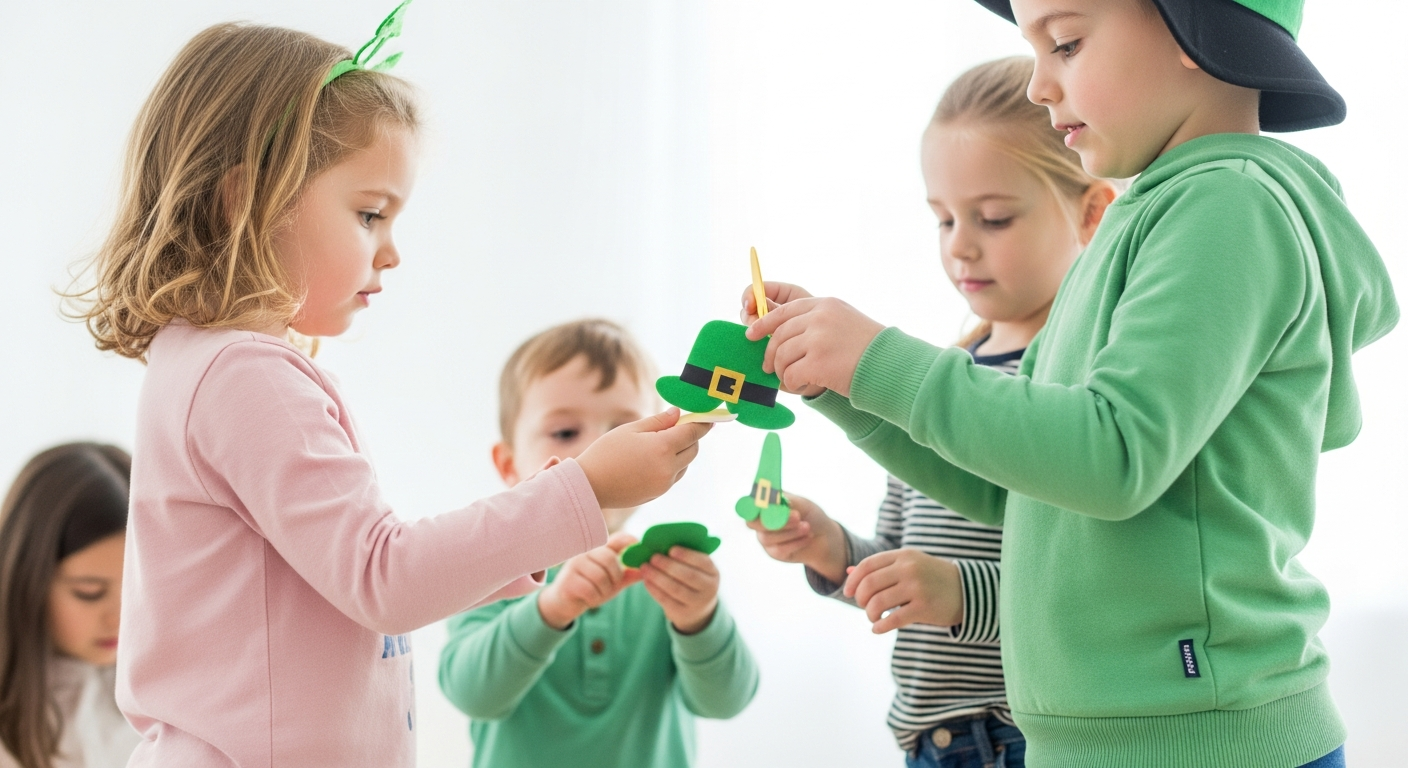
Table of Contents
- Introduction to the Magic of St. Patrick's Day Play
- Magical St. Patrick’s Day Traditions for Speech & Language Development
- Hands-On Activities for Speech & Fine Motor Skills
- Adventure-Filled Activities for Cognitive & Social Skills
- Culinary Adventures for Language & Sensory Exploration
- Literary & Performing Arts for Auditory & Expressive Skills
- Bringing It All Together: A Celebration of Communication
- Frequently Asked Questions (FAQ)
March brings with it a special kind of magic, a vibrant burst of green and gold that signals the arrival of St. Patrick’s Day. For many families, it’s a welcome opportunity to shake off the last vestiges of winter’s chill and dive into playful activities that ignite imagination and bring smiles. But beyond the leprechauns, shamrocks, and pots of gold, this festive holiday offers a unique and often overlooked chance to foster crucial developmental skills in our children, particularly in the realm of speech and language.
Here at Speech Blubs, we believe that every interaction is an opportunity for growth, and that learning should always be joyful. That's why we're so passionate about helping children speak their minds and hearts, equipping them with the tools they need to communicate confidently. While our app offers a powerful, scientifically-backed "smart screen time" experience, we know that real-world, hands-on play is just as vital. So, let’s explore a rainbow of fun kid activities for St. Patrick's Day that are not only entertaining but also cleverly designed to boost your child’s communication, cognitive, and motor skills, making every moment count towards their developmental journey.

Introduction to the Magic of St. Patrick's Day Play
Have you ever noticed how a simple holiday like St. Patrick's Day can transform a regular day into an adventure for your child? Suddenly, the world is filled with hidden treasures, mischievous characters, and endless possibilities for creative expression. This inherent sense of wonder and excitement is a powerful catalyst for learning, especially for developing young minds. When children are engaged and having fun, their brains are more receptive to new information, and they are more likely to practice emerging skills without even realizing it.
In this comprehensive guide, we're not just offering a list of activities; we're providing a framework for transforming St. Patrick's Day celebrations into rich, interactive learning experiences. We'll show you how to leverage the holiday's themes – colors, luck, leprechauns, and Irish culture – to create opportunities for vocabulary expansion, storytelling, social interaction, and fine motor skill development, all crucial precursors to effective communication. From crafting sparkling shamrocks to embarking on an epic scavenger hunt, each suggestion is designed to be accessible, engaging, and deeply beneficial for children of all ages and abilities. By the end, you’ll be ready to celebrate St. Patrick's Day with a newfound appreciation for its potential to foster communication and connection within your family, perfectly aligning with our mission at Speech Blubs to make every child’s voice heard.
Magical St. Patrick’s Day Traditions for Speech & Language Development
St. Patrick's Day traditions are often imbued with a sense of magic and mischief, which can be fantastic for sparking imagination and, in turn, language. When children are captivated by an idea, they are more eager to talk about it, ask questions, and tell stories. These activities encourage descriptive language, sequencing, and imaginative play, all vital for robust speech and language skills.
Crafting a Leprechaun Trap: Engineering Communication
One of the most beloved St. Patrick’s Day activities for kids is building a leprechaun trap. This isn't just a craft; it's an engineering project that requires planning, problem-solving, and plenty of communication.

- How it works: Gather materials like shoeboxes, construction paper, pipe cleaners, glitter, and plastic gold coins. Encourage your child to design a trap, discussing how it will work, what will attract the leprechaun, and how the leprechaun will be caught.
- Speech & Language Boost:
- Planning & Sequencing: "First, we need to make a base. Then, we can add a ladder." This helps children practice using temporal words and organizing their thoughts in sequence.
- Descriptive Language: "What color should the trap be? How will we make it shiny? What does a leprechaun like?" Encourage them to describe the materials, the trap's features, and the leprechaun's characteristics.
- Problem-Solving & Expressive Language: "What if the leprechaun is too smart? How can we make it sneakier?" These questions prompt critical thinking and encourage children to verbalize their ideas and solutions.
- Imaginative Play: Pretending to be a leprechaun trying to escape or a child trying to catch one fosters narrative skills and character development.
- Speech Blubs Connection: Just as children learn to articulate new sounds by watching and imitating their peers in our app's video modeling activities, they can learn to express complex ideas by imitating your language and engaging in imaginative scenarios during this activity.
The Great Green & Gold Swap: Observational Language
Imagine your child waking up to discover that a mischievous leprechaun has turned everyday objects green or swapped them around! This simple trick can lead to delightful conversations.
- How it works: Overnight (or while your child is distracted), swap out their regular toothbrush for a green one, put a few drops of green food coloring in the toilet water, or even change a lightbulb to a green one. Leave a trail of gold glitter or plastic coins to indicate a leprechaun’s visit.
- Speech & Language Boost:
- Observation & Description: "What's different about your toothbrush today? It's green! Tell me about the color." This activity encourages careful observation and the use of descriptive adjectives (green, sparkly, gold).
- "Wh" Questions: "Who do you think did this? What happened here? Why is the water green?" These questions stimulate curiosity and encourage children to formulate explanations and theories.
- Cause and Effect: "If the leprechaun visited, then..." Children can begin to understand and articulate simple cause-and-effect relationships.
Magical Rainbow Windshield: Exploring Colors and Action Verbs
A simple, magical way to start St. Patrick's Day is with a rainbow surprise on the car windshield.
- How it works: Before a drive, place small blobs of washable paint in rainbow order along the base of the car's windshield. When you turn on the wipers, a rainbow will paint across the glass.
- Speech & Language Boost:
- Color Identification & Sequencing: "What colors do you see? Red, orange, yellow... What comes next?" Reinforce color names and their order in a rainbow.
- Action Verbs: "The wipers are moving, painting, swirling!" Use a variety of verbs to describe the process.
- Expressing Amazement: "Wow! Look at that! It's so beautiful!" Encourage exclamations and sharing feelings, vital for social-emotional communication.
Hands-On Activities for Speech & Fine Motor Skills
Engaging in sensory and craft activities is more than just fun; it's a powerful way to develop fine motor skills, which are surprisingly linked to speech development. The same neural pathways used for intricate hand movements are often involved in the precise muscle control needed for articulation. Plus, these activities provide rich contexts for vocabulary, descriptive language, and following instructions.
Green and Gold Sensory Bin: A Tactile Language Adventure
Sensory bins are fantastic for tactile exploration and generating rich descriptive language.
- How it works: Fill a large bin with dried green peas, plastic gold coins, green pom-poms, and various small green objects. Add scoops, cups, and play tweezers.
- Speech & Language Boost:
- Descriptive Vocabulary: Encourage your child to describe what they feel: "The peas are smooth and hard." "The pom-poms are soft and fluffy." Introduce words like gritty, bumpy, cool, warm.
- Action Verbs: "Dig! Pour! Scoop! Hide! Find!" Use and encourage a wide range of action verbs.
- Counting & Quantity: "How many gold coins did you find? Are there more peas or fewer coins?"
- Requesting & Turn-Taking: "Can I have the big scoop, please?" "My turn to pour!"
- Speech Blubs Connection: Sensory play helps develop pre-speech skills by engaging multiple senses and improving fine motor control, much like our interactive app helps children develop the foundational muscle memory for clear speech. For children whose speech is developing, the repetitive movements and clear verbal prompts in Speech Blubs are designed to encourage motor planning for speech, just as a sensory bin encourages motor planning for play. If you're wondering if your child could benefit from more targeted support, take our quick 3-minute preliminary screener for an assessment and next-steps plan.
Painting Rainbows with Gold Coins: Creative Expression & Coordination
This activity combines art with a fun manipulative element, enhancing fine motor control and color recognition.
- How it works: Cut a "pot of gold" shape from black paper and glue it onto white paper. Place dabs of rainbow-colored paint on a palette. Give your child gold coins to dip into the paint and stamp onto the paper, creating arcs to form a rainbow leading to the pot.
- Speech & Language Boost:
- Color Recognition & Matching: "Which color are you using now? Can you find another red coin?"
- Action Verbs & Prepositions: "Dip the coin into the paint. Stamp it on the paper. Make an arc above the pot."
- Sequencing & Patterning: "What color comes next in the rainbow?" This reinforces logical order.
- Descriptive Art Talk: "Tell me about your rainbow. What's your favorite part?"
- Speech Blubs Connection: The coordination required to handle the coins and apply paint directly translates to the fine motor skills needed for speech articulation. Our app fosters this hand-eye coordination and attention to detail through its interactive games and activities, preparing children for clearer and more confident verbal expression.
Tissue Paper Shamrock: Fine Motor & Texture Talk
A simple craft that yields a lovely decoration and strengthens small hand muscles.
- How it works: Cut a shamrock shape from green construction paper. Have your child tear small pieces of green tissue paper, roll them into tiny balls, and glue them onto the shamrock outline.
- Speech & Language Boost:
- Action Verbs: "Tear, roll, glue, press!"
- Descriptive Words: "The tissue paper is crinkly, soft, light."
- Shape Recognition: "What shape is this? It's a shamrock! How many leaves does it have?" (three, or four for luck!).
- Following Multi-Step Directions: "First, tear the paper. Next, roll it into a ball."
- Speech Blubs Connection: Activities like this build hand strength and dexterity, which are essential for developing the oral motor control needed for clear speech. Our app, born from our founders' personal experiences with speech problems, understands the intricate link between physical development and communication, offering tools to support overall growth.
Adventure-Filled Activities for Cognitive & Social Skills
St. Patrick’s Day lends itself beautifully to adventures that encourage problem-solving, collaboration, and social language. These activities are perfect for developing narrative skills, asking and answering questions, and practicing prepositions and directions.
The Great Green Scavenger Hunt: Spatial Concepts & Questioning
A scavenger hunt is an exciting way to practice following directions and understanding spatial concepts.
- How it works: Hide various green or gold St. Patrick's Day themed items (plastic coins, shamrock socks, green candies) around the house or yard. Create clues that use prepositions (e.g., "Look under the couch for a shiny gold coin," "Find something green behind the curtain").
- Speech & Language Boost:
- Prepositions & Directional Words: "Under, over, next to, behind, in front of, inside, outside, left, right." This is a natural way to practice crucial spatial vocabulary.
- Asking & Answering Questions: "Where should we look next? Did you find it?" Children practice formulating and responding to questions.
- Descriptive Clues: If your child creates clues for you, they practice using descriptive language to specify objects and locations.
- Turn-Taking & Collaboration: Working together to find items encourages cooperative play and conversational turn-taking.
- Speech Blubs Connection: Our app features numerous activities that require children to follow verbal instructions and identify objects based on descriptions, building the listening comprehension skills vital for a successful scavenger hunt and for everyday communication. You can see how we empower children through interactive play and structured learning by downloading Speech Blubs on the App Store or Google Play today.
Virtual Trip to Ireland: Expanding Vocabulary & World Knowledge
Even if you can't travel, you can still immerse your child in Irish culture.
- How it works: Watch videos of Ireland's famous landmarks (Cliffs of Moher, Giant's Causeway, ancient castles), learn about Irish music and dance, or explore virtual tours of Irish museums.
- Speech & Language Boost:
- Vocabulary Expansion: Introduce new words related to geography, culture, history, and architecture (e.g., cliff, castle, folklore, bagpipes, ancient).
- Descriptive Language: "Tell me about what you see. How would you describe that landscape?"
- Narrative Skills: Encourage your child to retell what they learned or to imagine what it would be like to visit.
- Asking Questions: Prompt curiosity with questions like "What do you wonder about Ireland?"
- Speech Blubs Connection: Broadening a child's world knowledge provides more topics to talk about and a richer vocabulary to draw from, mirroring how Speech Blubs introduces diverse themes and word categories to stimulate language acquisition.
Culinary Adventures for Language & Sensory Exploration
Cooking and baking are multisensory activities that naturally invite language. From discussing ingredients to following recipe steps, there are endless opportunities for communication.
Baking Festive Green Treats: Sequencing & Sensory Descriptions
Making St. Patrick's Day themed snacks provides a delicious way to practice language.
- How it works: Bake shamrock cookies and decorate them with green icing, or try making naturally green spinach muffins or pancakes (using spinach puree for color, not artificial dye!).
- Speech & Language Boost:
- Sequencing: "First, we mix the flour. Next, we add the eggs." Following a recipe is excellent for practicing sequential language.
- Sensory Vocabulary: "How does the dough feel? Sticky? Smooth? How do the muffins smell? Sweet? What does the frosting taste like? Creamy?"
- Requesting & Collaborating: "Can you hand me the green sprinkles, please?" "Let's work together to stir."
- Tool Identification: Naming kitchen tools like "whisk," "spatula," and "mixing bowl."
- Speech Blubs Connection: Collaborative cooking fosters shared attention, turn-taking, and conversational skills, all vital components of healthy communication. These joyful family learning moments are precisely what we champion at Speech Blubs, where our unique methodology blends scientific principles with play for a truly effective experience.
Rainbow Celery Experiment: Observation & Prediction
This simple science experiment is both visually engaging and educational, perfect for stimulating curious minds and language.
- How it works: Place celery stalks with cut bottoms into glasses of water dyed with different food colors. Observe as the celery "drinks" the colored water, turning the leaves and stalks various shades.
- Speech & Language Boost:
- Prediction: "What do you think will happen to the celery? Will it change color?"
- Observation & Description: "The blue water is going up the stalk! Now the leaves are blue." Use words like absorb, capillary action, experiment.
- Asking & Answering "Why" Questions: "Why do you think the water is moving up the celery?"
- Comparative Language: "Is the red brighter than the yellow?"
- Speech Blubs Connection: Encouraging observation and verbalizing findings helps children develop critical thinking and descriptive language skills. This active engagement with the world around them complements the interactive, discovery-based learning in our app, further enhancing their cognitive and linguistic development.
Literary & Performing Arts for Auditory & Expressive Skills
Stories, songs, and movement are fundamental to language acquisition. They enhance auditory processing, introduce new vocabulary, and provide models for narrative structure and expressive communication.
Reading Irish Tales & Poems: Narrative & Auditory Skills
Immerse your child in the rich literary tradition of Ireland.
- How it works: Read picture books about St. Patrick, leprechauns, or Irish folklore (e.g., "How to Catch a Leprechaun," "Fiona's Luck"). Look for simple Irish blessings or poems to recite together.
- Speech & Language Boost:
- Vocabulary Expansion: Introduce new words from the stories (e.g., blarney, shamrock, brogue, limerick).
- Narrative Comprehension: Ask "wh" questions about the story: "Who was the main character? Where did the story take place? What happened first, next, and last?"
- Rhyme & Rhythm: Reciting poems helps children develop phonological awareness and an ear for the rhythm of language.
- Emotional Understanding: Discuss characters' feelings and motivations.
- Speech Blubs Connection: Reading aloud is a powerful tool for language development, fostering a love for words and stories. Our app supports this by helping children build a robust vocabulary and develop the foundational speech skills needed to express their own narratives. We are committed to providing an effective and joyful solution for the 1 in 4 children who need speech support, and a big part of that is celebrating all forms of communication.
Irish Dancing & Music: Auditory Processing & Action Verbs
Movement and music are excellent for engaging the whole child and promoting language.
- How it works: Play some lively Irish music. Watch videos of Irish step dancing and encourage your child to try imitating the movements.
- Speech & Language Boost:
- Action Verbs: "Hop! Skip! Jump! Tap! Kick! Twirl!" Use a variety of verbs to describe the dance moves.
- Following Instructions: "Now, let's tap our toes. Then, we jump."
- Auditory Discrimination: Identifying different instruments or tempos in the music.
- Expressing Joy: "This music makes me want to dance! How does it make you feel?"
- Speech Blubs Connection: Combining auditory input with physical movement strengthens neural connections and supports language processing. Our "smart screen time" approach uses interactive video modeling to engage children similarly, helping them learn by watching and imitating their peers, a natural and highly effective method.
Bringing It All Together: A Celebration of Communication
These fun kid activities for St. Patrick's Day offer more than just a momentary diversion; they provide rich, interactive platforms for developing essential speech and language skills. By focusing on descriptive language, sequencing, problem-solving, and social interaction within a festive context, you’re not only celebrating a holiday but also nurturing your child’s ability to communicate their thoughts and feelings effectively.
At Speech Blubs, we understand the profound impact that confident communication has on a child's life. Our company was born from the personal experiences of our founders, who all grew up with speech problems and created the tool they wished they had: an immediate, effective, and joyful solution for children needing speech support. Our unique video modeling methodology, where children learn by watching and imitating their peers, provides a screen-free alternative to passive viewing and a powerful tool for family connection, complementing the hands-on activities discussed here. We don't promise guaranteed outcomes like public speaking in a month, but we do promise to foster a love for communication, build confidence, reduce frustration, develop key foundational skills, and create joyful family learning moments.
Ready to make communication an even bigger part of your family’s journey? Take the first step today. We encourage you to start your 7-day free trial and experience the full suite of features Speech Blubs has to offer. For the best value, choose our Yearly plan at just $59.99 per year (breaking down to only $4.99/month), which saves you 66% compared to the Monthly plan ($14.99/month). The Yearly plan also includes exclusive benefits like early access to new updates, 24-hour support response time, and the extra Reading Blubs app. The Monthly plan does not include these benefits.
Create your account and begin your 7-day free trial today and select the Yearly plan to unlock all these amazing features. You can also download Speech Blubs directly on the Apple App Store or Google Play Store to get started on your path to confident communication and joyful learning. We're proud to be backed by science, placing us in the top tier of speech apps worldwide, and we invite you to explore our research to learn more. See what other parents are saying about their child's success with Speech Blubs by visiting our testimonials page.
Frequently Asked Questions (FAQ)
Q1: How can I make these St. Patrick's Day activities adaptable for a child with limited verbal skills?
A1: Focus on non-verbal communication and engagement. Use gestures, visual aids (like pictures or real objects), and simplified language. Encourage pointing, nodding, or making sounds to respond. For example, during a scavenger hunt, let them point to what they found. For crafts, focus on the actions and simple choices ("green or gold?"). Speech Blubs is also designed to be highly visual and interactive, providing models that even non-verbal children can imitate, laying the groundwork for first words and sounds.
Q2: What's the best way to encourage my child to talk more during these activities?
A2: Create a language-rich environment. Narrate your actions, ask open-ended questions (questions that can't be answered with a simple "yes" or "no"), and pause to give your child time to respond. Expand on their utterances; if they say "green," you can say, "Yes, a bright green shamrock!" Also, model correct language and new vocabulary. Remember, play-based learning is most effective when adults actively participate and provide a communication scaffold.
Q3: Are there specific activities that are better for fine motor skill development?
A3: Absolutely! Any activity involving manipulation of small objects is great for fine motor skills. Tearing and rolling tissue paper for a shamrock, threading Fruit Loops for a necklace, painting with coins, or even mixing ingredients for green treats all contribute significantly. These precise hand movements are crucial for developing the oral motor control needed for clear speech.
Q4: How does Speech Blubs complement these hands-on activities?
A4: Speech Blubs offers a structured, engaging, and scientifically-backed approach to speech development that perfectly complements real-world play. While hands-on activities foster natural conversation and broad developmental skills, our app uses unique video modeling, where children learn by imitating peers, to specifically target speech sounds, vocabulary, and sentence structures. It provides "smart screen time" that is active rather than passive, ensuring consistency and targeted practice. Together, real-world play and Speech Blubs create a comprehensive and joyful learning experience, empowering your child to communicate confidently.
About the author