
Heartfelt Kid Crafts for Mom This Christmas
 By Speech Blubs Team•Dec 22, 2025•19 min.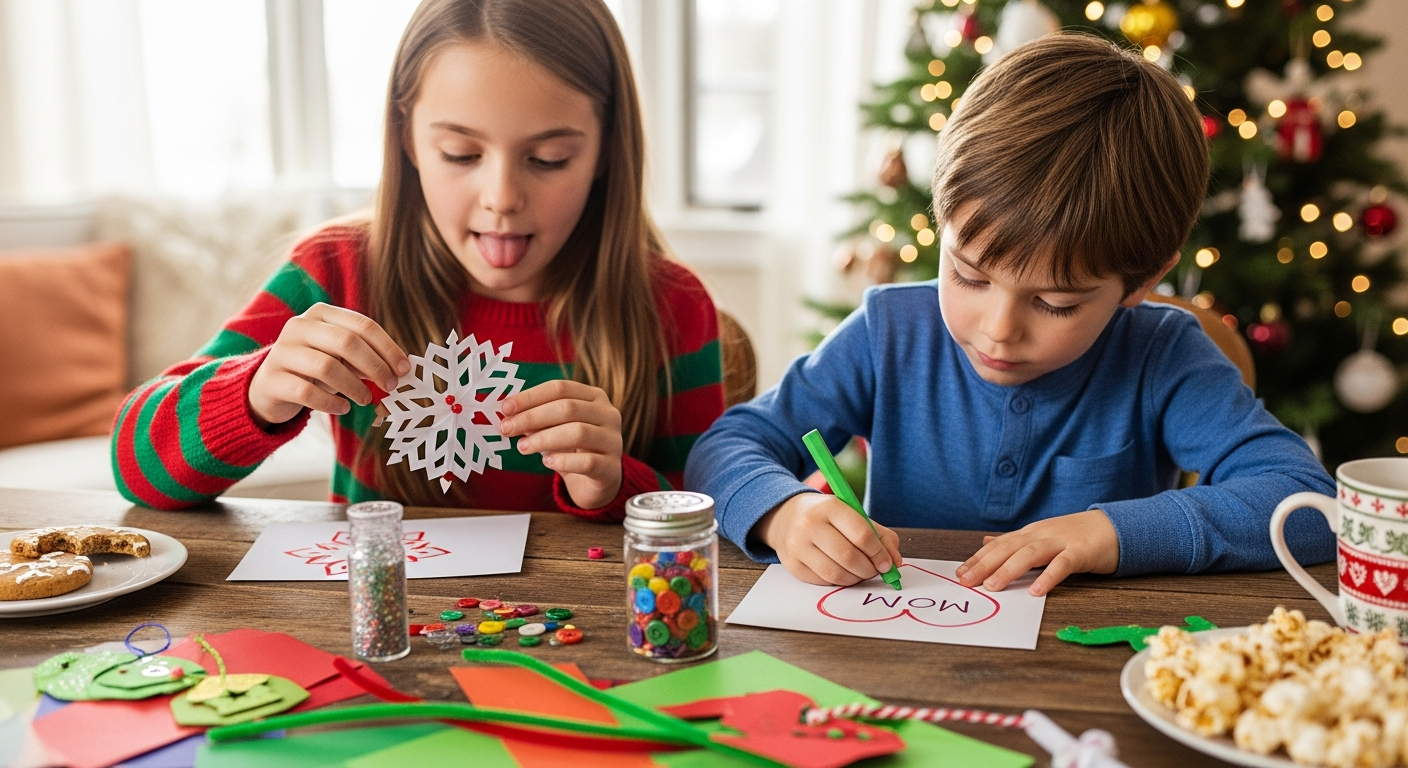
Table of Contents
- Introduction
- The Enduring Magic of Handmade Gifts
- Developmental Benefits Beyond the Beautiful Gift
- Crafting a Language-Rich Environment
- Delightful Kid Crafts for Mom This Christmas: Ideas & Instructions
- Tips for a Stress-Free Crafting Experience
- Integrating "Smart Screen Time" with Speech Blubs
- Ready to Empower Your Child's Voice?
- Frequently Asked Questions
Introduction
Christmas morning is a magical time, filled with anticipation, joy, and the warmth of family. As children excitedly unwrap their presents, there's a unique thrill in watching a parent open a gift made especially for them by tiny hands. For many moms, these handmade treasures aren't just gifts; they are cherished memories, tangible symbols of love, and proof of their child's growing creativity. They often hold more sentimental value than any store-bought item. Imagine your child’s beaming face as they proudly present their creation, a gift truly from their heart. These aren't just cute keepsakes; engaging in craft activities offers incredible developmental benefits, fostering fine motor skills, cognitive growth, and crucially, boosting communication and language development.
This post will dive deep into a treasure trove of delightful kid crafts for Mom this Christmas, providing actionable ideas that are easy, fun, and meaningful. We'll explore how these creative endeavors not only bring joy but also serve as powerful opportunities for learning and connection. From simple handprint art to personalized ornaments and charming DIY gifts, we'll guide you through making this holiday season truly special with gifts that speak volumes, crafted with love by your little ones. We'll also explore how these hands-on activities, when combined with supportive resources like Speech Blubs, can further empower your child to "speak their minds and hearts" through rich, interactive experiences.

The Enduring Magic of Handmade Gifts
In a world increasingly dominated by mass-produced items, a handmade gift stands out. It carries an imprint of the giver, a story of effort, love, and creativity. For a mom, receiving a craft made by her child for Christmas is an unparalleled experience. It's a reminder of a moment shared, a skill learned, and the unique personality of her little one captured in art. These aren't just presents; they're future heirlooms, tucked away and brought out year after year, sparking smiles and fond memories.
Why Handmade Gifts Resonate So Deeply
- Personal Connection: Each stroke of paint, every glued pom-pom, and every heartfelt drawing is a direct expression of a child's love. This personal touch makes the gift irreplaceable.
- Unique and One-of-a-Kind: Unlike anything you can buy in a store, a child's craft is truly original. Its imperfections are part of its charm and authenticity.
- Memory Makers: The process of creating the craft becomes a shared experience, a fun activity that parents and children can do together, building lasting holiday memories.
- Celebration of Growth: These gifts often showcase a child's developmental milestones – their improved dexterity, their imaginative flair, or their ability to follow instructions.
- Sustainability: Many kid crafts can be made using recycled materials or items found around the house, promoting an early understanding of eco-friendly practices.
Developmental Benefits Beyond the Beautiful Gift
Crafting is far more than just a fun pastime; it's a rich learning ground that nurtures a child's holistic development. When children engage in making kid crafts for Mom this Christmas, they're not just creating an object; they're building foundational skills that will serve them throughout their lives.
Fine Motor Skill Development
From holding a crayon to cutting with safety scissors, gluing tiny sequins, or threading beads, crafting activities are a powerhouse for developing fine motor skills. These are the small muscle movements in the hands and wrists that are essential for tasks like writing, buttoning clothes, and self-feeding. The repetitive, intricate movements involved in many crafts strengthen these muscles and improve hand-eye coordination.

Cognitive Growth and Problem Solving
Crafting naturally encourages children to think critically and solve problems. How do I make this piece stick? What color should I use next? Where should this go? These seemingly simple questions spark cognitive processes, helping children understand cause and effect, sequence steps, and plan their actions. Following a recipe for edible crafts or a set of instructions for a layered art project strengthens their ability to understand and execute multi-step tasks.
Emotional Expression and Self-Esteem
Art is a powerful outlet for emotional expression. Children can channel their feelings, ideas, and creativity into their projects. The sense of accomplishment they feel upon completing a craft, especially one intended as a gift for someone they love, is immense. This boosts their self-esteem and confidence, encouraging them to tackle new challenges and embrace their unique artistic voice. It's a joyful experience to see their creations bring a smile to Mom's face.
Language and Communication Enhancement
This is where crafting truly shines as a developmental powerhouse, and where tools like Speech Blubs complement the experience beautifully. Crafting provides a natural, low-pressure environment for children to practice and expand their language skills.
- Vocabulary Expansion: As you craft together, you'll naturally introduce new words: "sticky," "smooth," "rough," "sparkly," "trim," "attach," "decorate," "pattern," "texture," "symmetrical." Describing the materials, colors, and actions enriches their vocabulary.
- Following Instructions: Craft recipes or step-by-step guides are excellent for practicing receptive language skills. "First, get the blue paper. Next, cut a circle. Then, glue it here." Breaking down multi-step directions into manageable chunks helps children develop listening comprehension.
- Expressing Ideas and Describing: Encourage your child to talk about their creation. "What are you making? Why did you choose that color? How does it feel?" These open-ended questions prompt expressive language, helping them articulate their thoughts and feelings.
- Narrative Skills: As they work, children can narrate their process: "I'm cutting the paper. Now I'm gluing the stars on the tree for Mommy." This builds storytelling abilities and helps them sequence events logically.
- Social Communication: When crafting with a parent or sibling, children practice turn-taking, sharing materials, and negotiating ideas, all crucial social communication skills.
For a parent whose 3-year-old "late talker" loves animals, for instance, a craft project like creating animal-themed Christmas ornaments can be a fantastic opportunity. As you cut out the shapes, talk about the "baa-baa" of the sheep, the "oink-oink" of the pig, and the "moo-moo" of the cow. Then, transition to the Speech Blubs app, where the "Animal Kingdom" section offers a fun, motivating way to practice these very sounds and words through engaging video modeling. Our app provides "smart screen time" that encourages imitation and active participation, making those animal sounds come alive on screen just as they did during your crafting session. This blend of real-world interaction and focused digital learning empowers children to connect sounds with meaning and practice their emerging language skills. To explore how we transform passive viewing into an active learning adventure, visit our main homepage.
Crafting a Language-Rich Environment
Creating a special Christmas gift for Mom can be a prime opportunity to foster communication skills. At Speech Blubs, we believe in empowering children to "speak their minds and hearts," and craft time is a perfect, playful extension of this mission. Our founders, all with personal experiences of speech problems, created Speech Blubs to be the tool they wished they had – an immediate, effective, and joyful solution for the 1 in 4 children who need speech support. By blending scientific principles with play, we offer one-of-a-kind experiences, just like the imaginative world of crafting.
Here's how to turn your crafting session into a language-building activity:
- Narrate Everything: Talk about what you're doing, what your child is doing, and what you see. "I'm pouring the glitter. You're spreading the glue. Wow, look at that shiny red paper!"
- Ask Open-Ended Questions: Instead of yes/no questions, ask questions that require more than a one-word answer. "What do you think Mom will do with this?" "How does this feel?" "Tell me about your favorite part."
- Introduce New Vocabulary: Use descriptive words for colors, shapes, textures, and actions. "This paint is gloopy," "Let's make a zigzag pattern," "The glitter makes it so sparkly."
- Practice Following Directions: Give simple, clear instructions, especially multi-step ones as your child gets older. "First, draw a circle, then cut it out." Use words like "first," "next," "then," "last."
- Encourage Imitation: When you make a sound or say a word related to the craft ("snip-snip" for scissors, "smoosh" for clay), encourage your child to imitate you. This is the core of our "video modeling" methodology at Speech Blubs, where children learn by watching and imitating their peers.
- Read Related Books: Before or after crafting, read a book about Christmas, colors, or art to extend the language experience.
These strategies align perfectly with the scientific principles behind Speech Blubs. We provide a screen-free alternative to passive viewing, making connections between what children see, hear, and do. Our video modeling approach helps children learn complex communication skills by watching and imitating their peers, providing a powerful tool for family connection, much like crafting itself. If you're wondering if your child could benefit from a little extra communication support, take our quick 3-minute preliminary screener to get a simple assessment and a free 7-day trial.
Delightful Kid Crafts for Mom This Christmas: Ideas & Instructions
Let's dive into some specific, heartwarming craft ideas perfect for little hands to make for Mom this Christmas. We'll focus on crafts that are engaging, relatively easy, and offer rich opportunities for language development.
1. Handprint or Footprint Salt Dough Ornaments
These classic keepsakes are always a hit. They capture a moment in time and become treasured ornaments for the tree.
Materials:
- 1 cup flour
- 1/2 cup salt
- 1/2 cup water (adjust as needed)
- Mixing bowl
- Rolling pin
- Baking sheet
- Parchment paper
- Straw or toothpick (for hole)
- Acrylic paints, glitter, paintbrushes
- Ribbon or twine
Instructions:
- Mix the Dough: In a bowl, combine flour and salt. Gradually add water, mixing until a firm, playdough-like consistency is achieved. Knead for a few minutes until smooth. As you mix, talk about the "sticky" dough and the "smooth" flour.
- Roll it Out: Roll the dough to about 1/4 inch thickness on parchment paper. Let your child help push the rolling pin – great for gross motor skills!
- Make Impressions: Gently press your child's hand or foot into the dough to make an impression. You can also use cookie cutters to create shapes around the print. Ask, "How does the dough feel on your hand?"
- Create a Hole: Use a straw or toothpick to make a small hole at the top for hanging.
- Bake: Carefully transfer the parchment paper with the ornaments to a baking sheet. Bake at 250°F (120°C) for 2-3 hours, or until completely dry and hard. (The drying time depends on thickness).
- Decorate: Once cooled, let your child paint the ornaments. Use bright Christmas colors! Add glitter for extra sparkle. This is a fantastic opportunity to discuss colors, "sparkly" vs. "dull," and "shimmering."
- Finish: Thread a ribbon through the hole for hanging. Present it to Mom with pride!
2. Personalized Photo Frame
A picture frame decorated by your child makes a beautiful home for a favorite family photo.
Materials:
- Plain wooden or cardboard photo frame (available at craft stores)
- Acrylic paints, markers, glitter glue
- Small decorative items: buttons, sequins, small pom-poms, craft foam shapes
- Craft glue
- A favorite family photo
Instructions:
- Paint the Frame: Let your child paint the frame in their favorite colors. Encourage them to mix colors and experiment. "What color are you making?" "That's a beautiful rainbow frame!"
- Decorate: Once the paint is dry, use glue to attach buttons, sequins, or other embellishments. This is excellent for fine motor precision. "Can you pick up the tiny sequin?"
- Add Details: Use glitter glue or markers to add patterns, drawings, or your child's name.
- Insert Photo: Place a cherished family photo inside the frame.
- Gift with Love: Mom will adore displaying this masterpiece!
3. "I Love You Because..." Jar
This gift is as heartwarming to make as it is to receive.
Materials:
- A clean glass mason jar with a lid
- Construction paper in various colors
- Pens or markers
- Ribbon, stickers, or other decorative items for the jar
Instructions:
- Decorate the Jar: Let your child decorate the outside of the mason jar with paint, markers, stickers, or ribbon.
- Write "Love Notes": Cut the construction paper into small strips. For younger children, you can write down their dictated reasons for loving Mom. For older children, they can write or draw their own. Encourage them to think of specific things: "I love you because you read me stories," "I love you because you give the best hugs." This activity encourages abstract thinking and emotional vocabulary.
- Fill the Jar: Fold the strips of paper and fill the jar with these heartfelt messages.
- Present: Mom can pull out a note whenever she needs a reminder of her child's love.
4. Fingerprint Christmas Lights Card
A vibrant card that makes a perfect accompaniment to any gift.
Materials:
- Cardstock (folded in half)
- Washable paint in various colors
- Black marker
Instructions:
- Draw the String: On the front of the folded cardstock, use a black marker to draw a squiggly line resembling a string of Christmas lights.
- Add Fingerprint "Lights": Dip your child's finger into different colors of paint and press their fingerprint along the "string." Talk about the colors as you go: "Red light! Green light! Blue light!"
- Draw Bulbs: Once the paint is dry, use the black marker to draw little "caps" on top of each fingerprint to make them look like light bulbs.
- Write a Message: Inside the card, help your child write a personal message to Mom.
5. Edible Reindeer Treats
A delicious and fun craft that Mom can enjoy eating!
Materials:
- Pretzel rods
- Melting chocolate (milk or white)
- Small candy eyes
- Red M&M's or small red candies (for the nose)
- Parchment paper
Instructions:
- Melt Chocolate: Melt the chocolate according to package directions. This is a good time to talk about "melting," "warm," and "liquid."
- Dip Pretzels: Dip about two-thirds of each pretzel rod into the melted chocolate.
- Decorate: While the chocolate is still wet, attach two candy eyes and one red M&M for the nose. Break small pretzel pieces to make antlers and attach them at the top.
- Cool: Place the decorated pretzels on parchment paper to set.
- Pack & Present: Once firm, package them in a pretty bag or box for Mom.
These activities are not just about the final product; they are about the shared experience, the conversation, and the joy of creation. Remember, the focus is on the process and the learning, not perfection.
Tips for a Stress-Free Crafting Experience
To ensure your kid crafts for Mom this Christmas are joyful and enriching, rather than stressful, here are some practical tips:
- Choose Age-Appropriate Crafts: Select projects that match your child's developmental stage. Toddlers will thrive with simple, messy art, while preschoolers can handle multi-step projects. Always supervise closely.
- Prepare Your Space: Lay down newspaper or a plastic tablecloth. Have all materials ready and easily accessible. This minimizes interruptions and keeps things cleaner.
- Embrace the Mess: Crafts with kids are often messy. It's part of the fun! Dress your child (and yourself!) in old clothes. Focus on the creative freedom rather than perfectly clean hands.
- Focus on the Process, Not Perfection: The goal isn't a gallery-worthy piece of art. It's about the child's engagement, their learning, and the joy of creation. Encourage their unique ideas, even if they deviate from the plan.
- Set Realistic Expectations: Don't expect your child to sit for hours. Short, focused crafting sessions are often more productive for young children. If they lose interest, it's okay to take a break or finish another time.
- Be a Partner, Not a Director: Guide and assist, but let your child take the lead as much as possible. Offer choices ("Do you want red or blue paint?") to give them a sense of control and boost their confidence.
- Celebrate Their Efforts: Shower them with praise for their hard work, creativity, and the thought they put into making something special for Mom.
By creating a supportive and language-rich environment during these crafting sessions, you're not just making a gift; you're nurturing their communication skills. If you're eager to see more testimonials from parents whose children have found their voice with us, visit our reviews page.
Integrating "Smart Screen Time" with Speech Blubs
While hands-on crafting offers invaluable benefits, "smart screen time" can be a powerful complement to your child's overall communication development. At Speech Blubs, we've carefully crafted our app to be an active, engaging learning experience that encourages imitation and interaction – a stark contrast to passive viewing like cartoons. Our method, which has earned us a top-tier MARS scale rating, is backed by extensive research into video modeling and mirror neurons, which are crucial for learning new sounds and words.
Think of it this way: your child is cutting shapes for a craft, learning words like "circle" and "triangle." Afterward, they can open Speech Blubs and engage with activities that reinforce these concepts, or perhaps explore a new category like "Yummy Time" where they practice saying "apple" and "banana." This creates a comprehensive learning ecosystem, where real-world play and digital interaction work hand-in-hand to build strong communication skills and foster a genuine love for language. Our mission is to provide an immediate, effective, and joyful solution for the 1 in 4 children who need speech support, and our app achieves this by blending scientific principles with play.
We are committed to providing an immediate, effective, and joyful solution for children who need speech support. We encourage parents to think of Speech Blubs as a powerful supplement to these kinds of enriching, real-world activities and, when applicable, professional therapy. It’s about building confidence, reducing frustration, and creating joyful family learning moments together.
Ready to Empower Your Child's Voice?
The joy of seeing a child proudly present a handmade gift to their mom at Christmas is truly special. These moments are not just about the gift itself, but about the shared experience, the developmental growth, and the blossoming communication skills. By engaging in these fun, language-rich crafting activities, you're helping your child build a strong foundation for expressing their thoughts and feelings.
To further support your child's communication journey and empower them to "speak their minds and hearts," we invite you to explore Speech Blubs. Our app is designed to make learning speech and language a joyful, interactive experience, leveraging our unique video modeling methodology where children learn by watching and imitating their peers. This holiday season, give the gift of communication confidence.
We offer two main plans for Speech Blubs, and we want to be transparent about their value:
- Monthly Plan: This plan is available for $14.99 per month. It's a great option if you prefer flexibility, but it doesn't include some of our most valuable features.
- Yearly Plan: For superior value, our Yearly plan is available for just $59.99 per year. This breaks down to an incredible $4.99 per month, allowing you to save 66% compared to the monthly option!
Beyond the significant cost savings, the Yearly plan is truly the best choice because it includes:
- A generous 7-day free trial, giving you a full week to explore all the app's features and see the magic unfold.
- Access to our amazing Reading Blubs app, helping your child build foundational literacy skills.
- Early access to new updates and a dedicated 24-hour support response time for any questions you may have.
The Monthly plan does not include the free trial, Reading Blubs, early access, or priority support. To unlock the full suite of benefits and embark on a transformative journey for your child's communication, we highly recommend the Yearly plan.
Don't wait to give your child the gift of a confident voice.
Download Speech Blubs on the App Store today!
Or get it on the Google Play Store!
Ready to get started on your desktop? You can also create your account and begin your 7-day free trial today by choosing the Yearly plan for the best value and exclusive features. Let's make this Christmas not only about handmade crafts but also about empowering every child to speak their minds and hearts!
Frequently Asked Questions
Q1: What age group are these Christmas crafts suitable for?
A1: The crafts listed, such as handprint ornaments, personalized frames, and edible treats, are generally suitable for toddlers (2-3 years old) with significant adult assistance, preschoolers (3-5 years old) with some guidance, and early elementary children (5-8 years old) who can work more independently. The key is to adapt the complexity to your child's developmental stage and focus on the process rather than perfection.
Q2: How can I make crafting less messy with young children?
A2: Preparing your workspace is crucial. Lay down newspaper, old sheets, or a plastic tablecloth. Dress your child in old clothes or an art smock. Use washable paints and markers whenever possible. Keep wet wipes or a damp cloth nearby for quick clean-ups. Embrace that a little mess is part of the creative fun, but planning ahead can help manage it!
Q3: What if my child isn't interested in crafting for very long?
A3: Young children often have short attention spans. Keep crafting sessions brief, perhaps 15-20 minutes, and don't force it if they lose interest. You can break down a larger project into smaller steps over multiple days. The goal is positive engagement, not completing a project in one sitting. Remember, the process is more important than the product.
Q4: How does Speech Blubs specifically help with communication during craft activities?
A4: Speech Blubs enhances the language skills vital for crafting by building vocabulary, improving the ability to follow instructions, and encouraging expressive language. For example, the app's video modeling helps children learn words like colors, shapes, or action verbs that they can then apply directly to their craft project. By using the app, children develop the foundational communication skills needed to describe their craft, understand directions, and articulate their creative ideas, making the real-world crafting experience even richer and more language-intensive.
About the author