
Jolly Christmas Party Games for Kids
 By Speech Blubs Team•Dec 24, 2025•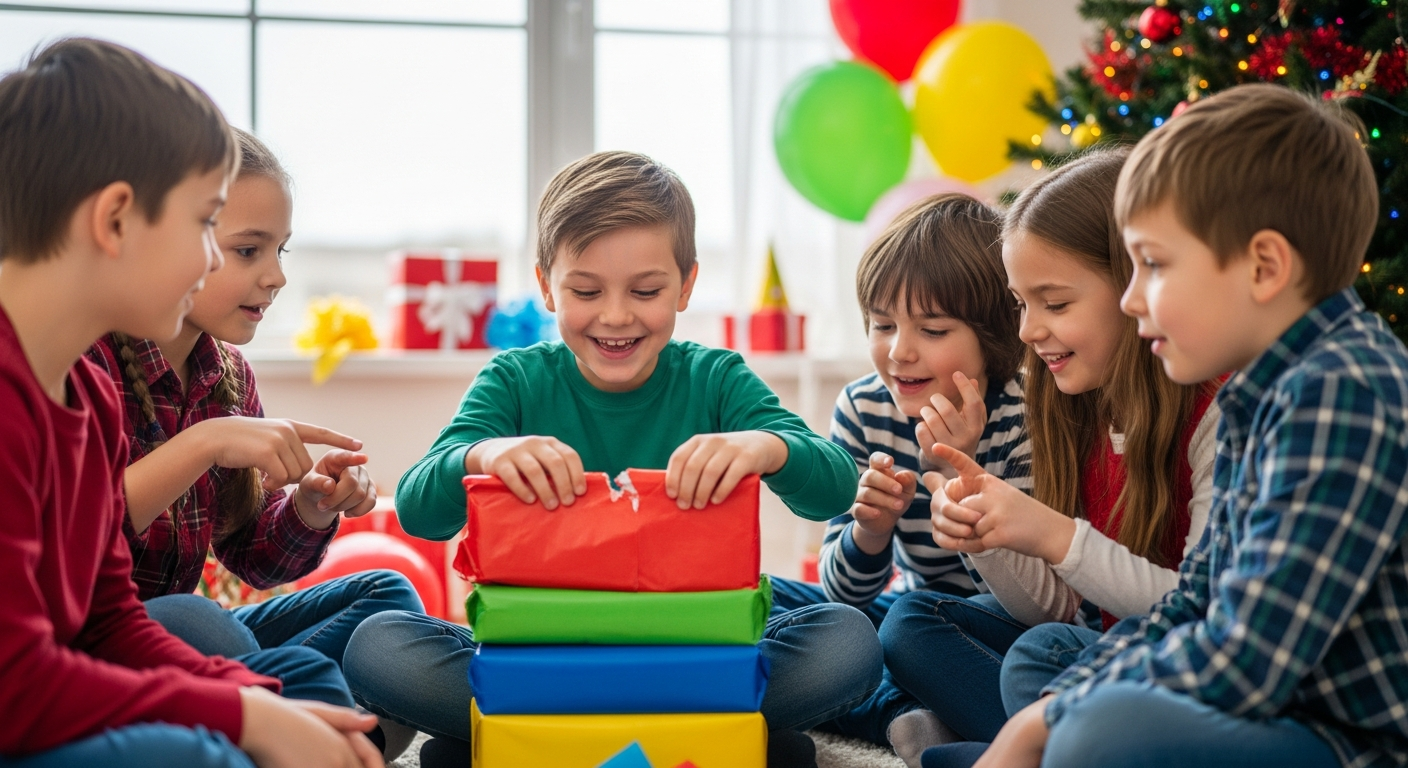
Table of Contents
- Introduction
- Why Christmas Party Games Matter for Kids (and Their Speech)
- Setting the Stage: Planning Your Festive Fun
- Active & Energetic Christmas Games
- Calmer & Creative Christmas Games
- Sweet & Edible Christmas Games
- Enhancing Communication Skills with Speech Blubs
- Ready to Empower Your Child's Voice This Christmas and Beyond?
- Conclusion
- FAQ
The holiday season often feels like a whirlwind of twinkling lights, festive music, and a seemingly endless to-do list. In the midst of gift wrapping and cookie baking, it’s easy for the true magic of Christmas—connecting with our loved ones and creating lasting memories—to get lost. For families with children, especially those navigating the exciting journey of speech and language development, Christmas parties offer a golden opportunity. Imagine transforming festive gatherings into joyful, interactive playgrounds that not only spark laughter but also subtly nurture essential communication skills. This post is your comprehensive guide to fun, engaging, and speech-boosting Christmas party games that will bring cheer to your little ones and warmth to your family’s heart, proving that holiday fun can be both entertaining and incredibly beneficial for growing minds.
Introduction
As parents, we often seek out activities that entertain our children while also enriching their development. Christmas parties provide a unique backdrop for this, offering a chance to gather, celebrate, and play. But what if these joyful celebrations could also be powerful catalysts for speech and language growth? Beyond the tinsel and carols, many classic and new holiday games hold immense potential to build vocabulary, practice articulation, enhance listening skills, and encourage social interaction. At Speech Blubs, we believe in empowering children to "speak their minds and hearts," and we know that the most effective learning often happens through play. This holiday season, we invite you to discover how to infuse your kids' Christmas party with purposeful fun that supports their communication journey, ensuring every giggle and spoken word contributes to their confidence and connection.
Why Christmas Party Games Matter for Kids (and Their Speech)
Christmas party games are far more than just time fillers; they are dynamic platforms for development. When children engage in games, they're not just having fun; they're actively developing crucial skills across multiple domains.
Beyond Just Fun: Holistic Development
Games naturally foster teamwork, problem-solving, and sportsmanship. They teach children how to take turns, handle winning and losing gracefully, and follow instructions—all vital social-emotional skills. Physically, many games involve gross and fine motor coordination, whether it’s tossing a ring, stacking cups, or carefully unwrapping a candy. Mentally, they stimulate creativity, memory, and quick thinking.
The Speech & Language Superpowers of Play
From a communication perspective, the benefits are profound:
- Vocabulary Expansion: Introducing new words related to Christmas themes (e.g., reindeer, sleigh, carols, ornaments, gingerbread) and action words associated with gameplay (e.g., toss, stack, guess, wrap, slide).
- Articulation Practice: Games can naturally encourage the repetition of specific words or sounds, helping children practice their pronunciation in a low-pressure, fun environment.
- Following Instructions: Most games come with rules, requiring children to listen attentively and follow multi-step directions. This builds auditory processing skills.
- Expressive Language: Describing actions, objects, or characters during charades or "Guess Who" games encourages children to formulate sentences and express themselves clearly.
- Social Communication: Turn-taking, asking questions, responding to others, and expressing emotions (excitement, frustration, joy) are all integral parts of game-play that hone pragmatic language skills.
This integrated approach to learning aligns perfectly with our mission at Speech Blubs. We understand that effective speech development isn't about rote memorization; it's about making connections, experimenting with sounds, and building confidence in a playful, supportive environment. Our founders, all with personal experiences navigating speech challenges, created Speech Blubs to be the immediate, effective, and joyful solution they wished they had—a tool that blends scientific principles with play. We champion "smart screen time" experiences, where children actively learn by imitating peers through our unique video modeling methodology, contrasting sharply with passive viewing.
Setting the Stage: Planning Your Festive Fun
Successful Christmas party games don't require elaborate setups or expensive supplies. Thoughtful planning can make all the difference, ensuring every child feels included and engaged.
Age Appropriateness is Key
Consider the age range of the children attending. Toddlers will thrive with simpler, sensory-rich games, while older children might enjoy more complex challenges and competitive elements. Always have a mix of options to keep everyone entertained.
Space and Materials
Assess your party space. Do you have room for active games, or will you need to focus on tabletop activities? Many games can be adapted for different environments. Gather your supplies in advance. Often, everyday household items or inexpensive Christmas decorations can be repurposed into game components.
Involve the Children
If possible, get the children involved in the planning or setup. Giving them a sense of ownership can boost their excitement and participation. They might even have creative ideas for game variations!
Prizes and Participation
Small, inexpensive prizes like stickers, candy canes, or festive erasers can add an extra layer of excitement, but remember that the true prize is the fun of playing and connecting. Emphasize participation and effort over winning.
Active & Energetic Christmas Games
These games are perfect for burning off some holiday energy and encouraging gross motor skills alongside communication.
Christmas Charades/Pictionary
How to Play: Write down various Christmas-themed words or phrases (e.g., Santa Claus, reindeer, building a snowman, singing carols, unwrapping a present) on slips of paper. Children take turns drawing one and acting it out (charades) or drawing it (Pictionary) for their team to guess. Speech & Language Benefits: This game is a vocabulary goldmine! Children practice expressive language by describing or interpreting actions and objects. For children working on articulation, guessing a word like "sleigh" or "star" provides opportunities to practice 'sl' or 'st' sounds. It also encourages non-verbal communication, understanding facial expressions, and body language. Speech Blubs Connection: For a child who might be hesitant with expressive language, acting out a word first can be a stepping stone to saying it. Speech Blubs offers sections focused on Action Words and Vocabulary Builders that could help build confidence for games like this.
Reindeer Antler Ring Toss
How to Play: Purchase inflatable reindeer antlers (or make some from cardboard) and rings. One child wears the antlers, and others take turns tossing rings, aiming to hook them on the antlers. Keep score! Speech & Language Benefits: Encourages turn-taking ("My turn!"), counting ("You got one! How many?"), and using action words ("toss," "catch," "hook"). Parents can narrate the process: "You threw the red ring. Did you catch it on the antler?" Scenario: For a parent whose child is learning numbers and simple commands, saying, "Ready, set, throw the green ring!" and then counting together provides a fun, physical way to reinforce these concepts.
Snowman Slam / Christmas Tree Bowling
How to Play: Decorate empty plastic bottles or cups to look like snowmen or Christmas trees. Stack them in a pyramid and have children roll a soft ball to knock them down. Speech & Language Benefits: Great for action words ("roll," "knock down," "crash"), counting the knocked-down pins, and expressive exclamations ("Wow!", "Oops!"). It also helps with following simple rules. Scenario: A child struggling with multi-step directions can practice "roll the ball" then "pick up the pins" in a playful sequence. The anticipation of the "slam" provides intrinsic motivation.
Candy Cane Relay (No Hands)
How to Play: Divide players into teams. Each player holds a candy cane in their mouth (hook facing down). The goal is to hook another candy cane from a bowl onto the one in their mouth, then pass it to the next teammate's candy cane without using hands. Speech & Language Benefits: Focuses on sustained attention, fine motor control, and following multi-step directions. Narrate with descriptive words like "careful," "steady," "wobble," and "hook." Scenario: This game is excellent for children who need practice with precision and focus. The verbal cues from parents ("Be careful not to drop it!") encourage active listening and understanding of instructions.
Gift Wrapping Race
How to Play: Set up stations with wrapping paper, tape, scissors, and various oddly shaped boxes or items. On "go," players race to wrap their items as neatly and quickly as possible. Speech & Language Benefits: Encourages descriptive language for shapes and sizes ("This box is square," "That present is big and round"). It also involves following sequences of actions ("First, you cut the paper, then you tape it"). Scenario: For a child developing descriptive vocabulary, asking them, "What shape is your present?" or "How long is your ribbon?" helps them apply new words to real-world objects.
Calmer & Creative Christmas Games
For moments when you need a quieter pace, these games encourage imagination, critical thinking, and refined communication skills.
Holiday Memory Game
How to Play: Create matching pairs of Christmas-themed pictures on cards (or use store-bought sets). Lay them face down and have children take turns flipping two cards to find a match. Speech & Language Benefits: Boosts vocabulary (identifying "angel," "snowman," "stocking"), memory recall, and descriptive comparison ("They don't match! One is an elf, and one is a candy cane."). Great for practicing phrases like "My turn," "Your turn," "It's a match!" Speech Blubs Connection: Our app's interactive games often include matching activities that reinforce vocabulary and auditory recognition. This game mirrors that engaging learning style.
Christmas Movie Bingo / Trivia
How to Play: Create Bingo cards with common elements from popular Christmas movies (e.g., "Santa says 'Ho ho ho'," "someone sings a carol," "a snowflake falls"). As you watch a movie, mark off squares. For trivia, prepare questions about holiday films. Speech & Language Benefits: Enhances auditory processing and comprehension, broadens vocabulary related to movie themes and plots, and encourages narrative skills as children recount scenes. Trivia builds critical thinking and recall. Scenario: During trivia, asking "Who is Rudolph's best friend?" prompts recall and expressive language. Bingo helps children associate spoken words with visual cues.
"Guess Who" Christmas Character Game
How to Play: Write Christmas characters (e.g., Santa, Rudolph, an elf, a gingerbread man, a snowman) on sticky notes. Each player gets one placed on their forehead without looking. Players take turns asking "yes" or "no" questions to guess their character (e.g., "Am I red?", "Do I have a beard?"). Speech & Language Benefits: This game is exceptional for practicing question formulation, using descriptive adjectives, and developing inferential reasoning. It's fantastic for both receptive (understanding questions) and expressive (asking questions, giving answers) language. Speech Blubs Connection: For children who benefit from structured questioning, Speech Blubs' interactive "What Am I?" activities or similar guessing games provide targeted practice, using our unique video modeling to show how peers form questions and descriptions.
Christmas Scent Game
How to Play: Gather small containers with distinct Christmas scents (e.g., cinnamon, peppermint, pine needles, orange peel, gingerbread spice). Blindfold players and have them guess each scent. Speech & Language Benefits: Introduces and reinforces sensory vocabulary ("spicy," "sweet," "fresh," "warm," "minty," "piney"). Encourages descriptive language and memory. Scenario: For a child expanding their descriptive language, guiding them with "What does it remind you of?" or "Is it a strong smell?" helps them articulate their experience beyond a simple "good" or "bad."
Holiday Mad Libs
How to Play: Use printable Christmas-themed Mad Libs (fill-in-the-blank stories that require specific parts of speech). Have children provide nouns, verbs, adjectives, etc., without knowing the story context, then read the hilarious results. Speech & Language Benefits: An incredibly fun way to learn and practice parts of speech, expand vocabulary, and develop creative language use. The silliness encourages verbal participation and can be a fantastic way to develop a love for language and storytelling. Scenario: This game is perfect for older children or those with a good grasp of basic grammar. It makes learning grammatical concepts engaging and highlights how word choices can dramatically change a story, fostering a playful approach to language.
Sweet & Edible Christmas Games
What's a party without treats? These games incorporate edible elements, adding an extra layer of delicious fun!
Gingerbread Shuffle
How to Play: Each player places a small gingerbread cookie on their forehead. The goal is to get the cookie into their mouth using only facial muscles, no hands allowed! Speech & Language Benefits: This game subtly encourages facial motor control and coordination, which are foundational for articulation. It also builds sustained attention and problem-solving. Scenario: "Can you crinkle your nose? Wiggle your eyebrows?" These playful prompts help children become more aware of their facial muscles, which are crucial for producing various speech sounds.
Mistletoe Kissing Toss (wrapped chocolates)
How to Play: Divide into teams of two. One partner holds a handful of wrapped Hershey's Kisses, the other tries to catch them in their mouth. Count how many are caught in one minute. Speech & Language Benefits: Promotes counting skills, hand-eye coordination, and turn-taking. Encourages verbal communication between partners ("Ready?", "Catch!"). Scenario: A parent can narrate the counting: "One for you! Two for you!" and celebrate successes, reinforcing number words in a high-energy context.
Bell / Candy Stack Party Game
How to Play: Give each player a handful of bell-shaped candies or small chocolate coins. In one minute, they must stack them as high as possible. Speech & Language Benefits: Develops fine motor skills, which are linked to speech development. Encourages spatial vocabulary ("tall," "wobbly," "higher"), counting, and descriptive words for texture and stability. Scenario: "Look how tall your tower is getting! Oh, it's a little wobbly!" These descriptions help children connect abstract concepts to tangible experiences.
Oh, Christmas Tree (Whipped Cream)
How to Play: Give each player a plate and a can of whipped cream. In one minute, they must spray the whipped cream into the tallest or best-looking Christmas tree. Speech & Language Benefits: A sensory and creative activity that encourages descriptive language ("fluffy," "white," "tall," "melted"), expressive exclamations, and following simple instructions. Scenario: "What a beautiful, fluffy tree you made! It looks so white!" This encourages children to use adjectives and express creativity.
Guess the Candy in the Jar
How to Play: Fill a clear jar with a variety of holiday candies. Have guests guess how many candies are inside. The closest guess wins the jar! Speech & Language Benefits: Encourages estimation, counting, number word recognition, and comparing numbers ("My guess is bigger," "Your guess is closer"). Scenario: This simple game is perfect for practicing number concepts and comparison, prompting questions like, "Do you think there are more red candies or green candies?"
Enhancing Communication Skills with Speech Blubs
While these Christmas party games are fantastic for fostering communication, consistent support for speech and language development is a year-round commitment. This is where Speech Blubs comes in, acting as a powerful supplement to your child’s overall development plan and, when applicable, professional therapy.
At Speech Blubs, our mission is born from personal experience; our founders all grew up with speech problems and created the tool they wished they had. We are committed to providing an immediate, effective, and joyful solution for the 1 in 4 children who need speech support. We achieve this by blending scientific principles with play, transforming screen time from passive viewing into one-of-a-kind "smart screen time" experiences. Our unique approach of "video modeling" allows children to learn by watching and imitating their peers, a powerful method backed by scientific research, placing us in the top tier of speech apps worldwide, as validated by a high MARS scale rating. You can explore the science behind our methods and effectiveness by visiting our Research page.
For example, a child who loved the Christmas Scent Game might enjoy the "Sensory Exploration" section within Speech Blubs to expand their descriptive vocabulary for textures, sights, and sounds, helping them articulate what they experience beyond just smell. Or, if your child thrived on the "Guess Who" Christmas game, Speech Blubs offers engaging "What Am I?" activities and similar interactive guessing games designed to provide structured practice in asking questions and using descriptive language. We offer a screen-free alternative to passive viewing, promoting active engagement and serving as a powerful tool for family connection, as echoed by countless happy parents in their testimonials.
We understand that every child's journey is unique, and our goal is to foster a love for communication, build confidence, and reduce frustration. While we never promise guaranteed outcomes, we are dedicated to helping children develop key foundational skills and create joyful family learning moments.
Unsure if your child could benefit from a little extra support in their speech journey? Take our quick 3-minute preliminary screener to get a simple assessment and a personalized next-steps plan. It’s a convenient way to gain insight and discover how Speech Blubs can become part of your family's daily routine.
Ready to Empower Your Child's Voice This Christmas and Beyond?
This Christmas, make your kids' party unforgettable not just for the fun, but for the subtle yet powerful boost it gives to their communication skills. From energetic relays to quiet guessing games, each activity offers a chance for growth, laughter, and deeper connection. And when the festive season winds down, let Speech Blubs continue to be your partner in nurturing your child's voice.
Our mission is to empower children to speak their minds and hearts, and we’re committed to making speech practice engaging and effective. We encourage you to experience the transformative power of our app.
Getting started is easy, and choosing the right plan makes all the difference:
- Monthly Plan: For $14.99 per month, you get access to our core features.
- Yearly Plan: This is our best value at just $59.99 per year, which breaks down to an incredible $4.99 per month – that’s a 66% saving!
The Yearly plan isn't just cheaper; it's packed with exclusive benefits designed to maximize your child's learning journey:
- A 7-day free trial to explore all our features without commitment.
- The extra Reading Blubs app, further enhancing literacy skills.
- Early access to new updates and a dedicated 24-hour support response time.
The Monthly plan does not include these invaluable benefits. We strongly recommend choosing the Yearly plan to unlock the free trial and the full suite of features that will truly empower your child's communication development.
Ready to begin? Download Speech Blubs today and give your child the gift of confident communication.
- Download Speech Blubs on the App Store
- Get Speech Blubs on Google Play
- Prefer to sign up on your computer? Create your account and start your 7-day free trial on our website today!
Join the Speech Blubs family and watch your child's confidence and communication blossom, not just this Christmas, but all year long. Visit our homepage to learn more about our comprehensive approach.
Conclusion
This Christmas, don't just host a party; create an experience that nurtures your child's growth and strengthens family bonds. The games we've explored offer endless opportunities for laughter, learning, and vital communication practice. From the energetic "Reindeer Antler Ring Toss" to the imaginative "Christmas Character Guess Who," each activity is a chance to build vocabulary, refine articulation, and enhance social skills in a joyous, festive setting.
Remember that playful interactions are fundamental to speech development. By actively engaging with your children during these games, you’re not only making wonderful holiday memories but also laying crucial groundwork for their ability to express their thoughts and feelings confidently. And for continued support in their communication journey, Speech Blubs stands as a dedicated partner, offering scientifically-backed, playful learning experiences that empower children to "speak their minds and hearts" year-round.
Make this holiday season count for both fun and growth. We encourage you to explore the benefits of Speech Blubs firsthand. Take our quick preliminary screener to assess your child's needs and then dive into our engaging activities. When you're ready, choose our Yearly plan for the best value, including a 7-day free trial and exclusive access to Reading Blubs, early updates, and priority support. Don't miss out on these essential tools for your child's bright future.
Download Speech Blubs on the App Store or Google Play today, or create your account on our website to start your free trial. Give the gift of empowered communication this Christmas!
FAQ
Q1: What age range are these Christmas party games suitable for?
A1: The games suggested here are broadly suitable for children aged 2-10, with many adaptable for mixed age groups. For toddlers and preschoolers, focus on simpler, sensory-rich games like "Snowman Slam" or "Christmas Scent Game" with adult guidance. Older children might enjoy the strategic elements of "Guess Who" or the creative challenge of "Holiday Mad Libs." We recommend having a variety of options to ensure all children can participate and have fun, and always adapting rules to fit the developmental stage of the children playing.
Q2: How can I make sure these games are inclusive for all children, including those with speech delays or developmental differences?
A2: Inclusivity is key to a joyful party. Adapt games by simplifying rules, offering visual aids (like picture cards for charades), providing extra time for turns, and focusing on participation rather than competition. Encourage all forms of communication, whether verbal, gestural, or through AAC devices. For children working on specific sounds or words, gently incorporate opportunities for them to practice those within the game context. Remember, the goal is connection and fun, and every child's attempt to communicate is a success. Tools like Speech Blubs are designed to be inclusive, offering diverse video models for children to imitate at their own pace.
Q3: What if I don't have a lot of time or resources to prepare elaborate games?
A3: Many of the best Christmas party games are simple and require minimal preparation and inexpensive materials. Games like "Gingerbread Shuffle," "Candy Cane Relay," or "Holiday Memory Game" can be set up in minutes with basic items. Focus on games that use common household items or cheap store-bought holiday candies and decorations. The spirit of play and interaction is far more important than a fancy setup. Even 5-10 minutes of an engaging game can bring immense joy and communication benefits.
Q4: How does Speech Blubs specifically help with communication skills beyond party games?
A4: Speech Blubs offers structured, playful learning experiences designed to support a wide range of speech and language skills year-round. Our app utilizes a unique video modeling methodology, where children learn by watching and imitating their peers, fostering a natural and engaging learning environment. We help with articulation, vocabulary expansion, sentence formation, social communication, and early literacy through interactive activities. By providing a "smart screen time" alternative to passive viewing, Speech Blubs acts as a consistent, effective, and joyful tool to build confidence and communication skills, making it a valuable complement to the occasional, fun holiday party games.