
Joyful Christmas Activities for Kids at Home: Spark Speech & Connection
 By Speech Blubs Team•Dec 19, 2025•17 min.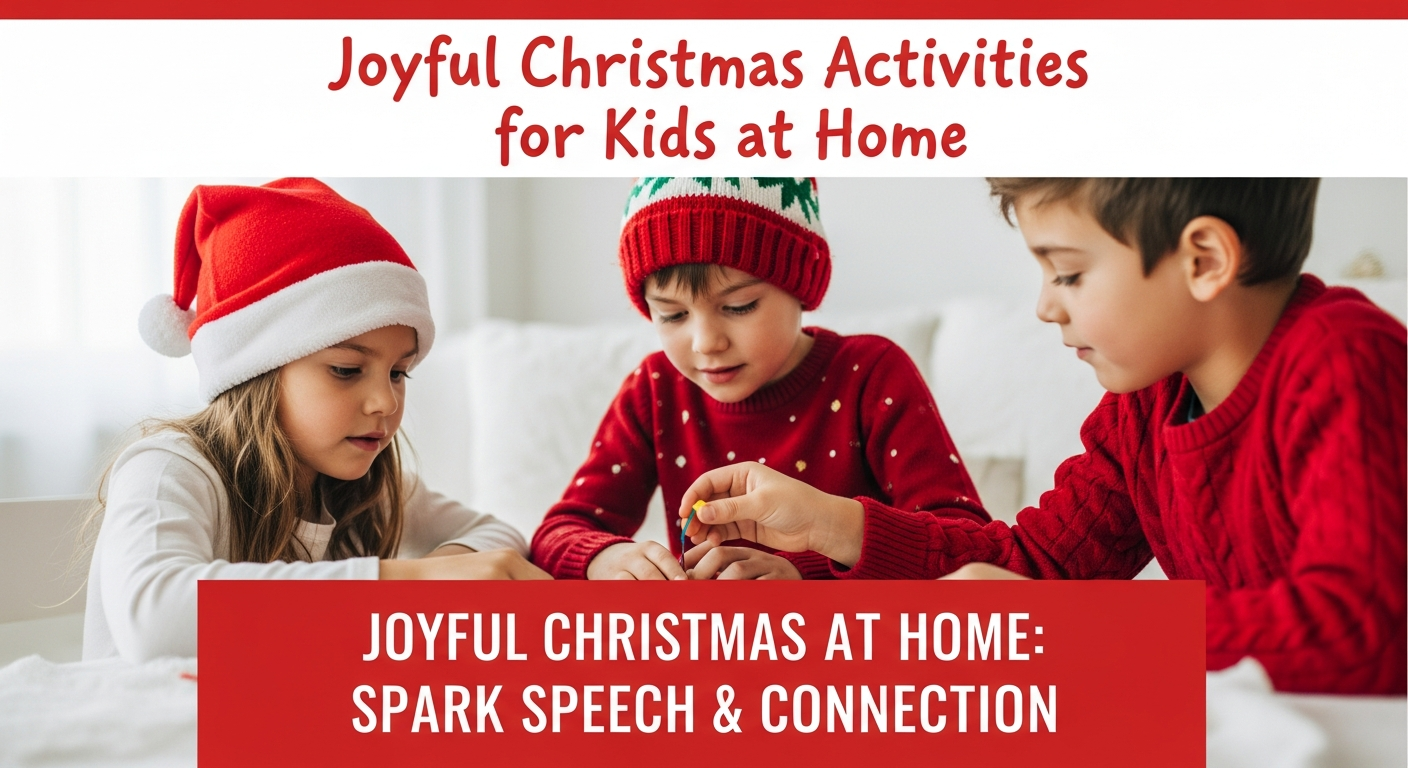
Table of Contents
- Introduction
- Why Christmas Activities are More Than Just Fun
- Decorate & Articulate: Speech-Boosting Decorations
- Bake & Converse: Kitchen Adventures
- Craft & Communicate: Creative Expression
- Read & Relate: Storytelling & Literacy
- Sing & Speak: The Power of Music
- Sensory Play: Exploring with Words
- Game On: Boosting Social & Language Skills
- Gift Giving & Gratitude: Expressing Thoughts & Feelings
- Making Memories & Building Confident Communicators
- Unwrap the Gift of Communication with Speech Blubs
- Conclusion
- Frequently Asked Questions (FAQ)
Introduction
The holiday season twinkles with a unique magic, painting our homes with warmth, wonder, and the promise of cherished family moments. As snow (or at least chilly air!) settles outside, and the aroma of gingerbread fills the kitchen, we instinctively seek ways to connect, celebrate, and create lasting memories with our children. But what if these beloved Christmas traditions could also be powerful catalysts for your child's speech and language development?
Beyond the glittering decorations and festive treats, the holidays offer a treasure trove of opportunities to engage your child's budding communication skills in the most natural, joyful ways imaginable. This isn't just about fun; it's about transforming everyday moments into speech-boosting adventures. We understand the deep desire parents have to empower their children to confidently express themselves, to "speak their minds and hearts." This desire is at the very core of Speech Blubs, a company born from our founders' own experiences with speech challenges. We created the tool we wished we had as children, blending scientific principles with the magic of play to provide an immediate, effective, and joyful solution for the 1 in 4 children who need speech support.

In this comprehensive guide, we'll explore a sleigh-full of engaging Christmas activities perfect for kids at home. We'll show you how each activity can naturally foster critical language skills, encourage interaction, and build a strong foundation for clear and confident communication. Get ready to sprinkle some extra speech sparkle on your holiday season!
Why Christmas Activities are More Than Just Fun
The holidays are synonymous with heightened sensory experiences, emotional richness, and ample unstructured time – all vital ingredients for fostering communication. Think about it: new decorations appear, special foods are baked, unique stories are told, and familiar songs are sung. Each new sight, sound, smell, and taste presents a fresh vocabulary lesson, a chance to describe, ask questions, and share feelings.
Engaging in festive activities together means more than just having fun; it's about creating a language-rich environment. When you and your child participate in an activity side-by-side, you naturally model language, offer opportunities for imitation, practice following directions, and build shared experiences that spark conversation. This kind of interactive play is far more beneficial than passive screen time, transforming moments into "smart screen time" when combined with targeted resources like ours. We provide a screen-free alternative to passive viewing and a powerful tool for family connection, ensuring that every interaction counts towards developing those crucial communication skills.
At Speech Blubs, we believe in the power of play to unlock potential. Our approach is rooted in the "video modeling" methodology, where children learn by watching and imitating their peers, making learning feel like fun. We recognize that every child's journey is unique, and while we can’t promise your child will be giving public speeches in a month, we are committed to fostering a love for communication, building confidence, reducing frustration, and developing key foundational skills through joyful family learning moments.

Decorate & Articulate: Speech-Boosting Decorations
The act of decorating for Christmas is a multi-sensory experience ripe with language opportunities. From untangling lights to hanging ornaments, every step can be a chance for your child to learn and practice new words.
Activity: Trimming the Tree Together
This classic holiday tradition offers a wealth of language-building potential:
- Vocabulary Expansion: Introduce words like "sparkly," "fragile," "round," "pointy," "star," "angel," "garland," "tinsel," "bauble." For a child who might be a "late talker," even simple words like "up," "down," "on," "off," "more," or "help" are fantastic starting points.
- Following Directions: "Find the red ornament," "Put the star on top," "Hand me the lights." Start with one-step directions and gradually increase complexity.
- Descriptive Language: Encourage your child to describe what they see. "What color is this ornament?" "How does the tinsel feel?" "Is it big or small?"
- Sequencing: "First, we put on the lights. Next, we hang the ornaments. Last, we put the star on top."
- Prepositions: "Put the ornament on the branch," "The lights are around the tree," "Stand under the mistletoe."
Relatable Scenario: Imagine your 3-year-old, captivated by the twinkling lights. Instead of just pointing, encourage them to say "lights on!" or "more lights!" as you plug them in. You can also model descriptive words: "Wow, these are bright lights!" or "Look, the red light is blinking."
Enhancing with Speech Blubs: For children who love engaging with visual stimuli, our app can complement these activities by offering fun sections that reinforce new vocabulary. For instance, after talking about colors while decorating, you could explore our "Colors" section where children imitate peers saying color names. This provides a focused, engaging way to practice new words. If you're wondering how Speech Blubs fits into your child's communication journey, why not take our quick 3-minute preliminary screener? It involves just 9 simple questions and provides an assessment along with a next-steps plan.
Bake & Converse: Kitchen Adventures
The kitchen during Christmas is a wonderland of aromas, textures, and tastes. Baking holiday treats isn't just about delicious outcomes; it's an excellent opportunity for sensory exploration and language development.
Activity: Christmas Cookie Baking Extravaganza
Baking is a fantastic, hands-on way to work on a variety of speech and language skills:
- Action Verbs: "Mix," "stir," "pour," "roll," "cut," "sprinkle," "eat." These actions are concrete and easily demonstrated.
- Vocabulary for Ingredients: "Flour," "sugar," "eggs," "milk," "vanilla," "butter." Point to each ingredient as you name it.
- Sensory Words: "Sticky," "sweet," "spicy," "warm," "smooth," "crunchy."
- Sequencing & Problem-Solving: Following a recipe involves a sequence of steps. "First, we add the flour, then the sugar." If a mistake happens (e.g., too much flour), it's a chance to problem-solve together: "Oh no, it's too dry! What should we do?"
- Requesting: "More sugar, please!" "Can I have the cookie cutter?"
- Describing: "What does it smell like?" "How does the dough feel?" "What shape is your cookie?"
Relatable Scenario: Your 4-year-old is eagerly waiting to decorate the gingerbread cookies. Hand them the sprinkles and ask, "What color sprinkles do you want?" or "Where should we put the sprinkles?" This encourages them to make choices and use descriptive language. For a child working on articulation, practice sounds by exaggerating words like "s-s-sprinkles" or "s-s-sweet!"
Making it Easy with Speech Blubs: Our app can support this real-world learning. For instance, after talking about the ingredients, your child can visit the "Food" section in Speech Blubs to practice saying names of different foods, reinforcing those new words in a playful, interactive setting. You can download Speech Blubs on the App Store or Google Play to explore how our "video modeling" approach encourages speech development.
Craft & Communicate: Creative Expression
Crafting is not only a fantastic outlet for creativity but also a structured way to encourage communication. The process of creating something from scratch provides countless opportunities for instruction, description, and sharing ideas.
Activity: DIY Christmas Ornaments & Cards
- Naming Materials: "Paper," "glue," "glitter," "ribbon," "paint," "scissors."
- Action Verbs: "Cut," "glue," "draw," "color," "fold," "decorate."
- Giving & Following Instructions: "First, cut the paper. Then, glue it here."
- Describing Creations: "What did you make?" "Tell me about your snowflake." "Is your reindeer jumping or sleeping?"
- Sharing & Turn-Taking: When sharing materials like glitter or crayons, practice phrases like "my turn," "your turn," "can I have?"
- Understanding Concepts: "Big/small," "long/short," "inside/outside."
Relatable Scenario: Your child is decorating a homemade Christmas card for grandma. You can ask, "Who is this card for?" "What picture are you drawing?" This prompts them to think about their audience and express their intentions, which are crucial pre-writing and narrative skills. Even if they just point, you can model the words: "Oh, you're drawing a snowman for Grandma!"
Speech Blubs Connection: For additional support in learning to describe or identify objects, Speech Blubs provides numerous categories designed to expand vocabulary and descriptive language. Our research-backed methodology ensures that children learn effectively by imitating real children, creating an immersive and highly engaging experience. Our app has received high ratings on the MARS scale, placing us in the top tier of speech apps worldwide, a testament to our commitment to science-backed solutions. You can learn more about our methodology and impact on our research page.
Read & Relate: Storytelling & Literacy
There's nothing quite like snuggling up with a festive book during the holidays. Reading together is one of the most powerful activities for language development, fostering listening skills, expanding vocabulary, and nurturing a love for stories.
Activity: Christmas Story Time
- Vocabulary: Introducing new words related to the story (e.g., "sleigh," "elves," "reindeer," "fireplace," "chimney").
- Comprehension: Asking "who," "what," "where," "when," "why" questions about the story. "Who is Santa?" "What did the elves do?"
- Narrative Skills: Encourage your child to retell parts of the story in their own words or predict what might happen next. "What do you think will happen when Santa goes down the chimney?"
- Emotional Language: Discuss the characters' feelings. "Is the little elf happy or sad?" "How would you feel if you got that gift?"
- Print Awareness: Pointing to words as you read, showing the direction of reading, and explaining the role of pictures.
Relatable Scenario: As you read "The Night Before Christmas," pause on a page with a detailed illustration of Santa's sleigh. Ask your child, "What do you see in Santa's sleigh?" or "What sounds do you hear the reindeer making?" This encourages observation and imaginative language.
Speech Blubs for Literacy: Reading Blubs, our complementary app included with the Yearly Speech Blubs subscription, takes this further by helping children develop early literacy skills. With interactive stories and phonics activities, it's a perfect pairing for fostering a love for reading and speaking. To get access to both Speech Blubs and Reading Blubs, along with a 7-day free trial, we highly recommend our Yearly plan.
Sing & Speak: The Power of Music
Christmas carols are infectious, joyful, and an incredible tool for speech development. The rhythm, repetition, and melodic nature of songs make them highly memorable and engaging for children.
Activity: Christmas Carol Sing-Alongs
- Articulation: Repeating song lyrics helps children practice speech sounds in a fun, non-pressured way.
- Vocabulary: Learning new words through context in songs (e.g., "jingle," "tiding," "wassail").
- Memory & Sequencing: Remembering the order of verses and lines.
- Rhythm & Intonation: Developing an ear for the natural rhythm and melody of spoken language, which aids in prosody.
- Social Interaction: Singing together fosters a sense of connection and shared joy.
Relatable Scenario: You're singing "Jingle Bells." Encourage your child to join in on repetitive phrases like "Jingle bells, jingle bells!" or to make the "ding-dong" sound for a bell. Use actions to accompany the words, like shaking hands for "shaking all the way," to further connect words to meaning.
Sensory Play: Exploring with Words
Sensory play engages multiple senses, creating rich experiences that naturally prompt descriptive language and exploration. Christmas offers a plethora of sensory elements to incorporate.
Activity: Christmas Sensory Bins
Create a bin filled with Christmas-themed items:
- Materials: Pinecones, cinnamon sticks, dried orange slices, jingle bells, artificial snow, small Christmas ornaments, cranberries, cookie cutters, red and green pasta.
- Language Opportunities:
- Descriptive Vocabulary: "Rough," "smooth," "prickly," "soft," "cold," "warm," "spicy," "sweet," "jingling," "silent."
- Action Verbs: "Pour," "scoop," "bury," "find," "hide," "shake."
- Prepositions: "Under," "over," "in," "out," "next to."
- Asking & Answering Questions: "What do you feel?" "What does it smell like?" "Can you find the bell under the pinecone?"
Relatable Scenario: Your child is sifting through a bin of artificial snow and small plastic reindeer. You can ask, "How does the snow feel?" They might respond with a sound or a single word, and you can expand: "Yes, it feels cold and soft!" Then, "Can you find a red reindeer?" This helps them connect adjectives to objects.
Game On: Boosting Social & Language Skills
Family game nights become extra special during Christmas. Games, even simple ones, are excellent for developing crucial social communication skills and expanding language use.
Activity: Festive Board Games & Charades
- Turn-Taking: Essential for conversation. "My turn, your turn."
- Following Rules: Understanding and verbalizing instructions.
- Problem-Solving: Discussing strategies or figuring out how to play.
- Asking Clarifying Questions: "What do I do next?" "Can you explain that rule again?"
- Describing & Guessing (Charades/Pictionary): Using descriptive language or actions to convey a concept, and using questioning skills to guess.
- Emotional Regulation: Learning to express excitement, frustration, or disappointment with words.
Relatable Scenario: Playing a simple "Roll and Move" Christmas-themed board game. When your child lands on a space, you can ask, "What picture did you land on?" or "What color is that space?" If they roll a specific number, practice counting together. "You rolled three! One, two, three spaces!"
Gift Giving & Gratitude: Expressing Thoughts & Feelings
The spirit of giving and receiving is central to Christmas. These moments are profound opportunities to practice expressing thoughts, desires, and gratitude.
Activity: Discussing Gifts & Writing Thank You Notes (or drawing pictures)
- Expressing Wants/Needs: Writing a letter to Santa (or discussing wishes) encourages children to articulate what they desire. "I want a toy car." "I wish for a doll."
- Descriptive Language: Describing gifts received. "It's a big, red truck!" "This doll has long, brown hair."
- Expressing Gratitude: "Thank you for the gift!" or drawing a picture for the giver and explaining it. This cultivates social pragmatics and emotional expression.
- Sharing Experiences: "What was your favorite gift?" "What did you do with your new toy?"
- Pre-writing Skills: For older children, writing thank you notes helps with sentence structure and conveying messages. For younger children, drawing a picture and explaining it is just as valuable.
Relatable Scenario: After opening a present, encourage your child to talk about it. "What did you get?" "How do you feel about it?" If they say "Happy," you can expand: "Yes, you're so happy! It's a brand new train!" This models richer language.
Making Memories & Building Confident Communicators
These Christmas activities are more than just ways to pass the time; they are vital building blocks for your child's communication journey. Every conversation, every shared laugh, every new word learned creates connections in their brain and reinforces the idea that their voice matters.
By embracing these festive opportunities for interaction, you're not just creating magical holiday memories; you're actively nurturing your child's ability to express themselves, understand others, and navigate the world with confidence. Remember, the journey of speech development is a marathon, not a sprint, and every joyful step counts.
We are incredibly proud to support families in this journey. Our mission at Speech Blubs is to empower children to speak their minds and hearts, providing an immediate, effective, and joyful solution for children needing speech support. Our tool blends scientific principles with play into one-of-a-kind "smart screen time" experiences, offering a powerful tool for family connection. Read what other parents are saying about their child's success with us on our testimonials page.
Unwrap the Gift of Communication with Speech Blubs
While real-world interactions are paramount, Speech Blubs is designed to be a powerful supplement, offering targeted, engaging practice that reinforces the skills learned through these activities. Our unique video modeling approach, where children learn by watching and imitating their peers, taps into their natural inclination to mimic, making learning fun and effective.
Ready to provide your child with an engaging and effective tool to foster their communication skills this Christmas? It's easy to get started!
We offer two convenient plans:
- Monthly Plan: $14.99 per month.
- Yearly Plan: Just $59.99 per year, which breaks down to an incredible value of only $4.99 per month. You save 66% with the Yearly plan!
The Yearly plan is not just cheaper; it offers a significantly enhanced experience with exclusive, high-value features, including:
- A 7-day free trial so you can experience the magic firsthand.
- The extra Reading Blubs app, complementing speech development with early literacy skills.
- Early access to new updates and a 24-hour support response time for peace of mind.
The Monthly plan does not include these benefits. To unlock the full potential of Speech Blubs, enjoy the free trial, and gain access to our complete suite of features, we strongly encourage you to choose the Yearly plan.
Don't wait to give your child the gift of confident communication this holiday season.
Create your account and begin your 7-day free trial today! Or, download the app directly: Download Speech Blubs on the App Store Download Speech Blubs on Google Play
Conclusion
This Christmas, transform your home into a vibrant language laboratory filled with joy, connection, and growth. By engaging in these simple yet profound activities, you're not just creating holiday memories; you're actively nurturing your child's communication skills, building their confidence, and fostering a love for expressing themselves. Every whispered secret to Santa, every shared giggle over a decorated cookie, and every carol sung together contributes to a richer, more articulate future.
Remember, the greatest gift you can give your child is the power of their voice. Let this holiday season be a springboard for endless conversations, boundless creativity, and confident communication. We are here to support you every step of the way, helping children "speak their minds and hearts" through effective, joyful learning experiences.
Ready to make this Christmas the season your child’s speech truly blossoms? Start your 7-day free trial with Speech Blubs today by choosing our Yearly plan, and unlock a world of interactive learning and family connection.
Frequently Asked Questions (FAQ)
Q1: How can I encourage my shy child to participate in these Christmas activities?
A1: Start small and follow your child's lead. Offer choices (e.g., "Do you want to decorate with the red ornament or the green one?"). Participate alongside them and model the language without pressure. Focus on shared enjoyment rather than perfect articulation. For example, during cookie decorating, simply describe what you are doing, and they might naturally start imitating or commenting. Speech Blubs is also designed to be non-intimidating, with children learning by observing peers, which can be less daunting for shy children.
Q2: My child has a limited vocabulary. How can these activities help without overwhelming them?
A2: Focus on single words or very short phrases initially. During decorating, point to an ornament and say "ball." When baking, point to the flour and say "flour." Gradually introduce descriptive words like "big ball" or "white flour." Repetition is key. Many Speech Blubs activities are structured around single-word imitation and basic vocabulary, making them ideal for expanding a limited word bank in a playful way.
Q3: How often should we do these activities to see a benefit for speech?
A3: Consistency is more important than duration. Even 5-10 minutes of focused, language-rich interaction during an activity can be beneficial. Try to incorporate speech-boosting elements into several holiday activities each day. Think of it as weaving language practice into the fabric of your holiday fun. Supplementing these interactions with short, regular sessions on Speech Blubs can also provide valuable structured practice, reinforcing new skills.
Q4: Is Speech Blubs a substitute for professional speech therapy?
A4: Speech Blubs is designed as a powerful, scientifically-backed supplement to a child's overall development plan. While it offers immediate, effective, and joyful solutions for communication development, it is not a direct substitute for a licensed speech-language pathologist's diagnosis and personalized therapy plan, especially for children with significant speech delays or disorders. We encourage parents who have concerns about their child's speech to consult with a professional. Our app can then be used in conjunction with therapy, or as a valuable resource for early intervention and continuous practice at home.
About the author