
Joyful Jamborees: Fun Party Games Kids Will Absolutely Adore
 By Speech Blubs Team•Jan 19, 2026•19 min.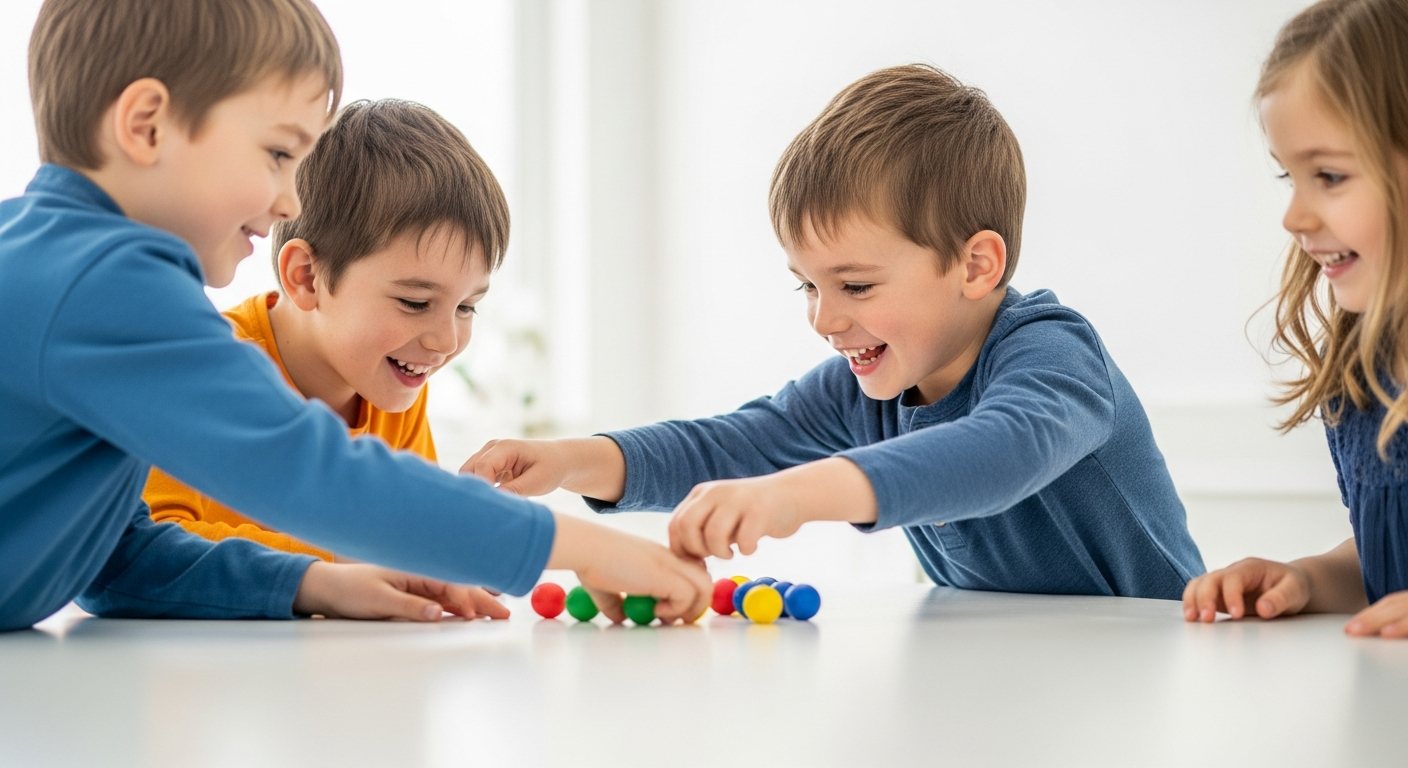
Table of Contents
- The Magic Beyond the Merriment: Why Party Games Matter
- Setting the Stage for Success: Tips for Hosting a Stellar Kids' Party
- Our Top Picks for Fun Party Games Kids Will Absolutely Love
- Transforming Play into Language Growth with Speech Blubs
- The Speech Blubs Difference: Your Partner in Joyful Communication
- Conclusion
- FAQ
As parents, we've all been there: staring at a calendar, a child's birthday fast approaching, and the daunting question looming – how do I make this party truly memorable and engaging for kids? In an age where screens often dominate playtime, finding activities that spark genuine laughter, foster connection, and encourage active participation can feel like a quest for hidden treasure. But what if we told you that the most "fun party games kids" will ever experience are not just about entertainment, but are also powerful catalysts for their development, helping them grow socially, cognitively, and, most importantly for us at Speech Blubs, communicatively?
This blog post is your ultimate guide to unlocking a world of playful possibilities. We're diving deep into a curated collection of engaging, easy-to-organize party games that promise endless giggles and meaningful interactions. More than just a list of activities, we'll explore how each game serves as a unique opportunity to enhance your child's communication skills, boost their confidence, and create cherished memories. At Speech Blubs, our mission is to empower children to "speak their minds and hearts," and we believe that play is the most natural, joyful path to achieving that. So, let's turn up the fun and discover how to host a party that truly speaks volumes!

The Magic Beyond the Merriment: Why Party Games Matter
Party games are far more than just time-fillers; they are miniature ecosystems of learning and growth. When children engage in structured play, they're not just running around; they're actively developing a wide array of essential skills that will serve them throughout their lives.
Nurturing Social-Emotional Intelligence
Games inherently require interaction. Children learn the crucial art of turn-taking, an foundational social skill. They practice empathy as they encourage teammates or comfort a friend who didn't win. Learning to navigate winning gracefully and losing with resilience are invaluable life lessons. These moments build confidence, teach patience, and help children understand different perspectives, fostering a stronger sense of self and connection with others.
Boosting Cognitive Development
From memory challenges in "Simon Says" to strategic planning in "Capture the Flag," party games are excellent brain boosters. Children learn to follow multi-step instructions, solve problems on the fly, and think creatively to achieve a goal. These activities enhance focus, attention span, and critical thinking abilities, all while they're having a blast.
Enhancing Physical Skills
Whether it's the fine motor precision needed for "Stack Attack" or the gross motor coordination required for an "Obstacle Course," games provide vital physical exercise. They improve balance, agility, hand-eye coordination, and overall physical literacy. This active engagement is crucial for healthy development and provides a wonderful outlet for children's boundless energy.
Unleashing Language and Communication Potential
This is where the magic truly aligns with our purpose at Speech Blubs. Every single game is a goldmine for language development. Children are constantly:
- Following Instructions: "Simon says touch your nose," "Move to the red cone."
- Expressing Desires and Needs: "Can I go next?", "I need help!"
- Describing Actions and Objects: "He's running fast!", "The ball is big and bouncy."
- Asking Questions: "What do I do now?", "Where do we hide the flag?"
- Narrating Experiences: "First, I ran, then I hid, then I found the treasure!"
- Negotiating and Collaborating: "Let's work together," "You go left, I'll go right."
These natural, joyful interactions are precisely what builds a strong foundation for communication. At Speech Blubs, we understand that meaningful engagement, whether through our app's unique video modeling or through classic party games, is key to helping children develop robust language skills. When children feel safe and excited, they are more likely to experiment with new words and sounds, truly empowering them to "speak their minds and hearts."

Setting the Stage for Success: Tips for Hosting a Stellar Kids' Party
A successful party isn't just about the games; it's about the atmosphere you create. Here are some tips to ensure your "fun party games kids" experience is a hit:
- Age-Appropriateness is Key: Tailor games to the youngest attendees to ensure everyone can participate and feel successful. Simple rules work best for younger children, while older kids might enjoy more complex challenges.
- Clear and Concise Rules: Explain each game clearly and demonstrate if necessary. Keep explanations brief to maintain excitement.
- Embrace Flexibility: Be ready to adapt! If a game isn't clicking, or if kids are losing interest, don't be afraid to switch gears. The goal is fun, not rigid adherence to a plan.
- Promote Inclusivity: Ensure every child feels like a valuable part of the group. Avoid games that put too much pressure on one individual or lead to excessive eliminations, which can cause tears. Focus on cooperative play or quick rounds.
- Celebrate Participation, Not Just Winning: Offer small, non-competitive prizes or simply acknowledge everyone's effort and good sportsmanship. The joy of playing together is the biggest reward.
- Adult Involvement is Gold: Actively participate! Your enthusiasm is contagious. Guide, encourage, and model good sportsmanship. Your presence makes the experience richer and provides valuable support for any child who might need a little extra encouragement.
Our Top Picks for Fun Party Games Kids Will Absolutely Love
Let's dive into some fantastic game ideas, categorized for easy planning, and discover how each one can be a language-building opportunity!
Interactive Icebreakers & "Get-to-Know-You" Games
These games are perfect for getting everyone comfortable and engaged right from the start.
Simon Says
How to Play: A designated leader (Simon) gives commands, but players only follow if the command starts with "Simon Says." If Simon says "touch your nose," players touch their nose. If Simon just says "hop on one foot" (without "Simon Says"), anyone who hops is out. The last player remaining wins.
Language Boost: This game is a fantastic workout for auditory comprehension and following instructions. Children listen carefully for specific phrases and action verbs. You can introduce new vocabulary (e.g., "Simon says wiggle your pinky finger") or complex instructions (e.g., "Simon says pat your head and rub your tummy"). For parents of children needing communication support, this game provides a playful, low-pressure way to practice responding to verbal cues, a core skill strengthened by the guided activities in our Speech Blubs app.
Follow the Leader
How to Play: One child leads, and everyone else lines up behind them, mimicking every movement, action, and silly gesture the leader makes. When the leader decides, they can pass the leadership to someone else.
Language Boost: "Follow the Leader" is all about imitation and action verbs. As children mimic, they connect actions with words. The leader can narrate their actions ("I'm stomping!", "Now I'm wiggling!"), and the followers can repeat or describe what they're doing. This mirrors the "video modeling" methodology at the heart of Speech Blubs, where children learn by watching and imitating their peers, building confidence through observation and replication.
Charades
How to Play: Write a variety of words, phrases, or actions (animals, sports, emotions) on slips of paper. Players take turns drawing a slip and acting out what's written without making a sound. The first person to guess correctly gets to act next.
Language Boost: This game supercharges expressive and receptive language. The actor uses non-verbal cues to express a concept, while guessers use their receptive vocabulary to understand and articulate their guesses. It encourages descriptive language ("Is it a cat? A dog? Is it running?"). The sillier the actions, the more laughter, and the more motivation to communicate!
High-Energy Outdoor Adventures
When weather permits, outdoor games are perfect for burning off energy and exploring the surroundings.
Red Light, Green Light
How to Play: One person stands at one end of the play area (the "stoplight") and faces away from the other players, who line up at the opposite end. The stoplight calls out "Green light!" and players move forward. When the stoplight turns around and calls "Red light!", players must freeze. Anyone caught moving must go back to the starting line. The first player to reach the stoplight wins.
Language Boost: Excellent for listening skills, impulse control, and understanding directives. Children learn to associate specific words ("red," "green") with actions (stop, go) and to wait for verbal cues before acting. It's a fun way to practice understanding simple commands in an exciting context.
Scavenger Hunt
How to Play: Hide a series of objects or clues around the yard or party space. Provide a list (with words, pictures, or both, depending on age) for players to find. They can work individually or in teams.
Language Boost: Scavenger hunts are incredible for descriptive language, spatial concepts, and teamwork. Kids use words like "under," "behind," "next to," "up," "down" as they search. Clues can be designed to include adjectives ("find something red and round") or questions ("Where does the fluffy bunny hide?"). Team-based hunts encourage negotiation and verbal collaboration. If you're wondering if your child could benefit from a little extra support with these kinds of descriptive words or following sequences, consider taking our quick 3-minute preliminary screener. It offers a simple assessment and a next-steps plan.
Water Games (Slip and Slide, Water Balloon Toss, Sprinkler Tag)
How to Play: These classic water activities are simple. Set up a Slip and Slide, have kids toss water balloons to each other, or play tag through a sprinkler.
Language Boost: Water play is rich in sensory language and action verbs. Children naturally use words like "wet," "splash," "cold," "gush," "slide," "throw," "catch." It also provides opportunities for requesting ("More water!"), protesting ("It's too cold!"), and expressing delight.
Obstacle Course
How to Play: Create a simple course using household items or backyard equipment. Kids might crawl under a blanket, jump over a pool noodle, step on stepping stones, and run around a tree.
Language Boost: Obstacle courses are excellent for practicing sequencing, directional terms, and prepositions. You can narrate the course ("First, crawl under the tunnel, then jump over the rope, next run around the cone"). This helps children understand multi-step instructions and spatial concepts, skills that our app reinforces through engaging activities focused on "What Am I Doing?" or "Where Is It?".
Silly & Creative Challenges (Minute to Win It Style)
These quick, often hilarious games are perfect for filling short gaps or adding bursts of energy. Many can be adapted from "Minute to Win It" concepts.
Face the Cookie
How to Play: Each player places a cookie on their forehead. Using only their facial muscles (no hands!), they must try to move the cookie into their mouth within one minute.
Language Boost: Beyond the pure hilarity, this game offers chances to describe sensations ("It's slipping!", "It's tickling!") and actions ("I'm wiggling my eyebrows!", "I'm trying to frown!"). It's a lighthearted way to encourage self-commentary and expressive language about physical movements.
Mummy Wrap
How to Play: Divide players into teams of two or three. One player is the "mummy," and the others rapidly wrap them in toilet paper or streamers, aiming for full coverage (leaving space for breathing!). The first team to "mummify" their player wins.
Language Boost: This cooperative game is fantastic for giving and following instructions, using descriptive words ("wrap it tighter!", "over here!", "we need more paper!"), and negotiation within the team. The anticipation and excitement naturally prompt conversation and laughter, making communication flow freely.
Stack Attack
How to Play: Players race to stack a certain number of small, flat objects (like cookies, conversation hearts, or dominoes) into a tower within a minute.
Language Boost: "Stack Attack" encourages counting, spatial terms ("on top," "wobbly," "tall"), and problem-solving language ("It's falling!", "Try again!", "How many do we have?"). It's a focused activity that can prompt verbal strategies and self-talk.
Commercial Break
How to Play: Gather a few unusual household objects (a whisk, a shower cap, a rubber duck). Divide kids into small teams. Each team must invent a "commercial" for a new, imaginary use for one of the objects. Give them 15-20 minutes to brainstorm and practice, then let them perform.
Language Boost: This game is a powerhouse for imagination, storytelling, and persuasive language. Children develop creative vocabulary, practice sequencing ideas into a coherent narrative, and learn to articulate an argument or concept. It's a wonderful exercise in expressive communication that brings out their unique voices, aligning perfectly with our aim to help children "speak their minds and hearts."
Cooperative & Team-Building Games
These games emphasize working together, fostering camaraderie and shared success.
Parachute Games
How to Play: With a large fabric parachute (or even a big sheet), kids hold the edges and work together to make waves, raise it high, or even make a "mushroom" by pulling it down and running underneath. You can place light balls on top and try to keep them from falling off.
Language Boost: Parachute games demand cooperation, action words, and group commands. Children learn to respond to directives like "lift it up," "shake it fast," "pull it down." It's a fantastic way to develop a sense of shared purpose and engage in natural, flowing conversation while playing.
Tug-of-War
How to Play: Divide kids into two teams. Each team holds one end of a sturdy rope and pulls, trying to get the opposing team to cross a center line.
Language Boost: This classic game encourages teamwork, encouragement, and action words. Kids will naturally cheer each other on, shout words of encouragement ("Pull! Pull harder!"), and describe the action ("We're winning!", "They're strong!"). It’s a great way to experience collaborative communication.
Sardines
How to Play: This is a reverse Hide and Seek. One person hides, and everyone else counts. When they're done counting, they all go look for the hidden person. Whoever finds the hider joins them in their hiding spot. This continues until everyone is squeezed into one spot like sardines, and the last person to find the group becomes the next hider.
Language Boost: "Sardines" promotes spatial reasoning and quiet, whispered communication. Children learn to describe locations ("I think they're behind the couch!"), use prepositions, and practice subtle social communication as they join the group.
Transforming Play into Language Growth with Speech Blubs
Every one of these fun party games offers a built-in opportunity for communication development. But what if your child needs a little extra boost, or you want to provide a structured, yet still incredibly fun, way to build their speech and language skills? That's where Speech Blubs comes in.
We believe that learning to communicate should be a joyous adventure, not a chore. Our app is designed to complement these natural play experiences, offering what we call "smart screen time"—an active, engaging alternative to passive viewing like cartoons.
Here’s how Speech Blubs enhances the language-rich environment you create with party games:
- Video Modeling Reinforcement: Just as "Follow the Leader" encourages imitation, our app uses a unique video modeling methodology. Children learn by watching and imitating their peers on screen, activating mirror neurons in their brains. This scientifically backed approach makes learning new sounds and words intuitive and engaging, building confidence with every successful imitation. You can explore the science behind our methods on our website.
- Targeted Skill Development: After a game of "Animal Kingdom" with toy animals, your child can practice clear pronunciation of "moo," "baa," and "roar" in our app's "Animal Kingdom" section. If an "Obstacle Course" highlighted a need for more practice with prepositions, Speech Blubs has interactive activities that reinforce "over," "under," "in," and "out."
- Empowering Every Child: For children who might be "late talkers" or are navigating specific speech sound challenges, our app provides a safe, encouraging space to practice without pressure. The joyful interactions within Speech Blubs reduce frustration and build a love for communication.
- Fostering Family Connection: Speech Blubs is designed for co-play. It's not about handing your child a device and walking away. It's about you sitting together, laughing, imitating, and celebrating successes. This strong family connection, nurtured through shared play, is at the core of our values. You can even see what other parents are saying about their experiences.
Imagine this scenario: Your child loves the "Scavenger Hunt" at a party but struggles with multi-step directions. Instead of frustration, you can turn to Speech Blubs. Our app offers engaging activities that break down complex instructions into manageable, visual, and auditory steps, building foundational comprehension skills that translate directly back to playground fun. Or, perhaps your little one is shy during "Charades." Practicing expressive actions and sounds within the app’s "What Am I Doing?" section can build the confidence they need to participate more boldly next time.
At Speech Blubs, we were founded by individuals who grew up with speech problems themselves. We created the tool we wished we had—an immediate, effective, and joyful solution for the 1 in 4 children who need speech support. We are committed to providing a powerful tool for family connection, blending scientific principles with play into one-of-a-kind "smart screen time" experiences.
The Speech Blubs Difference: Your Partner in Joyful Communication
We want every child to experience the joy of clear communication. That's why we've made Speech Blubs accessible and packed with value.
You have two main subscription options for Speech Blubs:
- Monthly Plan: For $14.99 per month.
- Yearly Plan: For only $59.99 per year, which breaks down to just $4.99 per month! This is an incredible value, allowing you to save 66% compared to the monthly option.
The Yearly plan is truly the best choice, offering significantly more benefits:
- 7-Day Free Trial: Experience the full power of Speech Blubs before committing. The Monthly plan does not include this trial.
- Extra Reading Blubs App: Unlock our companion Reading Blubs app, designed to further support literacy skills. This is not included with the Monthly plan.
- Early Access & Priority Support: Gain early access to new updates and enjoy a rapid 24-hour response time for any support needs. These are exclusive to Yearly subscribers.
Ready to provide your child with an engaging, evidence-based path to better communication? Don't miss out on the full suite of features and the incredible savings. Create your account and begin your 7-day free trial today by choosing the Yearly plan! Or, you can always download Speech Blubs on the App Store or Google Play Store to get started right away.
Conclusion
Planning "fun party games kids" will cherish doesn't have to be a chore; it can be an exciting opportunity to foster their development and create unforgettable memories. By choosing games that encourage interaction, movement, and creative thinking, you're not just throwing a party – you're building a foundation for essential life skills, including robust communication.
At Speech Blubs, we believe in the power of play to unlock a child's full potential. Our app seamlessly integrates with these real-world experiences, providing a joyful, scientifically-backed approach to supporting your child's speech and language journey. By combining vibrant party games with our "smart screen time" activities, you're giving your child the best of both worlds: laughter-filled learning and targeted skill development.
So, go ahead, plan that party, and fill it with games that spark joy and conversation. And when you're ready to further empower your child's voice, remember that Speech Blubs is here to support you every step of the way. Download Speech Blubs on the App Store or Google Play Store today, and make sure to select the Yearly plan to unlock your 7-day free trial and a full suite of premium features. Let's make every moment count, for every child, for every word.
FAQ
Q1: How do I choose the right games for different age groups at a party?
A1: Always consider the age range of the majority of the children attending. For younger kids (3-5), focus on simple rules, short duration, and sensory engagement (e.g., water games, "Follow the Leader"). For elementary school children (6-9), you can introduce slightly more complex rules, team-based games, and challenges that involve problem-solving (e.g., "Scavenger Hunt," "Charades"). For older kids (10-12+), competitive elements, strategic thinking, and creative expression become more appealing (e.g., "Commercial Break," "Capture the Flag"). Be flexible and have a few backup games ready in case one isn't a hit with the group.
Q2: What if a child is shy or doesn't want to participate in a game?
A2: It's common for some children to be hesitant. Never force participation. Instead, gently invite them, offer a specific role that feels less exposed (like being the scorekeeper or helping set up), or suggest they watch for a few rounds. Often, seeing others have fun will encourage them to join in naturally. You can also engage them in one-on-one "pre-game" activities before the main group starts, helping them feel more comfortable. Remember, the goal is fun and positive interaction, not mandatory participation.
Q3: How can I adapt party games to specifically encourage speech and language development?
A3: Turn every game into a language opportunity! Narrate what's happening ("He's running fast!", "The balloon went up!"). Ask open-ended questions ("What do you think will happen next?", "How did you feel when you won?"). Encourage children to describe their actions, plans, or observations. For games like "Scavenger Hunt," use descriptive clues. For "Simon Says," introduce new vocabulary. You can also encourage children to take turns being the leader, prompting them to use more directive language. Integrating these playful language strategies alongside resources like Speech Blubs can significantly enhance their communication journey.
Q4: How does Speech Blubs fit into my child's overall communication journey beyond party games?
A4: Speech Blubs acts as a consistent, engaging, and scientifically-backed complement to natural language acquisition. While party games provide invaluable real-world social and communicative practice, our app offers structured, "smart screen time" activities for targeted skill development. For example, if your child practices animal sounds during a game, they can reinforce those sounds with video modeling in the app. If they struggle with following multi-step directions during a scavenger hunt, Speech Blubs has activities designed to build that comprehension. It's a powerful tool for daily practice, confidence building, and reducing communication frustration, especially for the 1 in 4 children who need speech support.
About the author