
Joyful Kids' Christmas Party Activities for Festive Family Fun
 By Speech Blubs Team•Dec 19, 2025•22 min.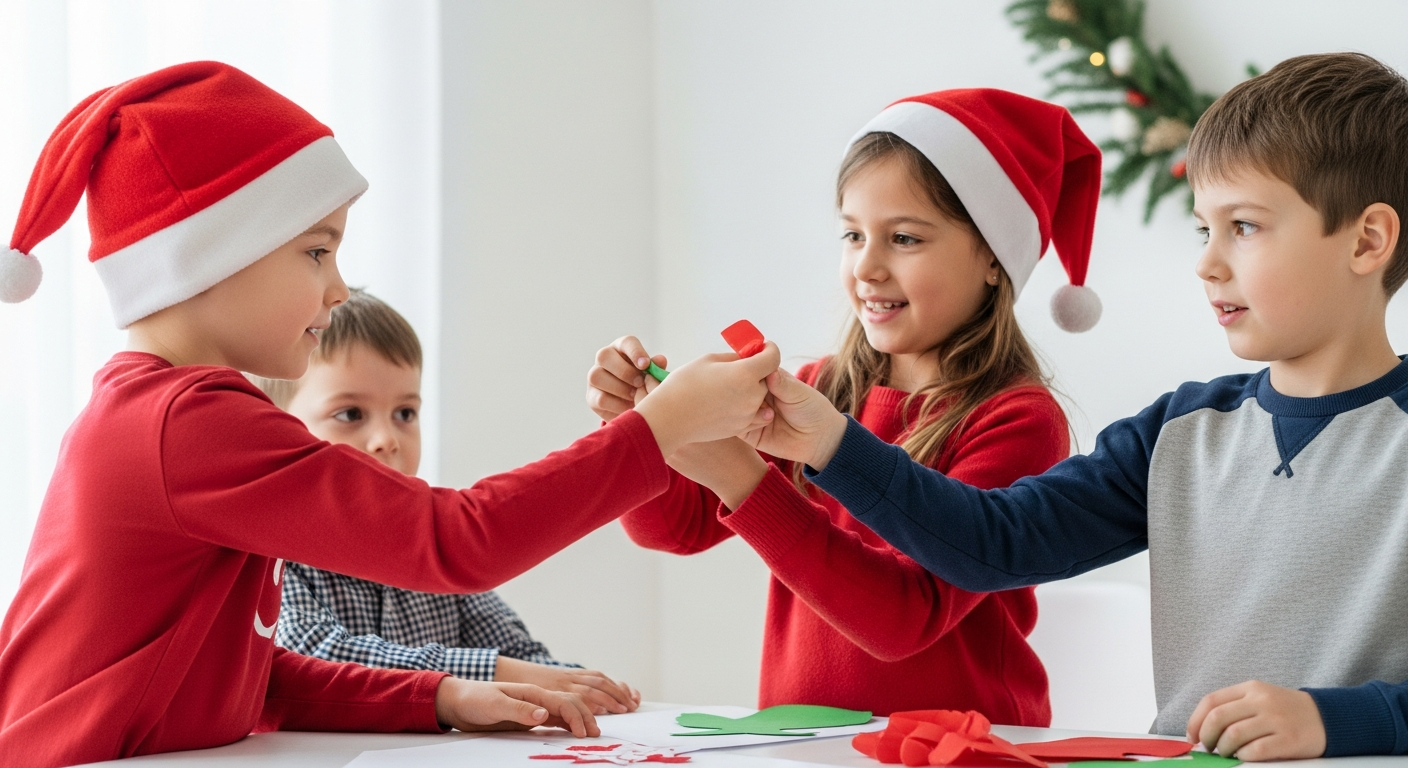
Table of Contents
- Why Christmas Party Activities are More Than Just Fun
- Active & Energetic Christmas Games
- Creative & Crafty Christmas Corner
- Musical & Rhythmic Christmas Joy
- Storytelling & Imaginative Christmas Adventures
- Quiet & Calming Christmas Activities
- Speech Blubs: Your Partner in Communication Development This Christmas and Beyond
- Making the Most of Speech Blubs: Pricing and Value
- Conclusion
- Frequently Asked Questions
The holiday season bursts with magic, bringing with it a unique opportunity to create cherished memories and spark joyful connections. But for many parents, the thought of hosting a kids' Christmas party can also bring a touch of panic: How do I keep them all entertained? How can I make it truly special and not just chaotic? Imagine a party where every laugh, every game, and every shared craft isn't just fun, but also a hidden opportunity for growth, connection, and even language development.
This blog post is your comprehensive guide to transforming your festive gathering into an unforgettable experience for every child. We'll dive into a curated list of engaging, age-appropriate Christmas party activities, ranging from high-energy games to creative crafts and heartwarming storytelling. Beyond mere entertainment, we’ll explore how these activities naturally foster crucial developmental skills, from fine motor coordination and problem-solving to social-emotional growth and, most importantly, communication. You'll discover practical tips to enhance speech and language during play, ensuring that every festive moment contributes to your child's ability to speak their minds and hearts. Get ready to embrace the festive spirit with confidence, knowing you're creating a truly enriching and joyful celebration for your little ones.

Why Christmas Party Activities are More Than Just Fun
Christmas parties are vibrant hubs of sensory experiences – the jingle of bells, the scent of gingerbread, the sparkle of decorations. For children, these environments are rich with potential, offering far more than just a good time. They are dynamic classrooms where kids learn through doing, observing, and interacting.
The Developmental Power of Play
Structured and unstructured play, especially in a social setting, is fundamental to a child's development. Party activities provide unique avenues for:
- Cognitive Skills: Games often require problem-solving, strategic thinking, and memory recall. Guessing games, for instance, encourage children to think critically and categorize.
- Fine and Gross Motor Skills: From decorating cookies to tossing beanbags, activities engage different muscle groups, improving coordination, dexterity, and balance.
- Social-Emotional Learning: Sharing, taking turns, negotiating, and understanding others' emotions are all practiced in a party environment. Children learn empathy and cooperation, navigating the give-and-take of group play.
- Sensory Exploration: The tactile experience of crafting with glitter, the taste of festive treats, the sounds of carols – all contribute to rich sensory input that helps children understand and process their world.
Fostering Communication in Festive Settings
While physical and cognitive development is important, the social nature of parties makes them prime opportunities for boosting speech and language skills. Children are motivated to communicate when they are excited, engaged, and surrounded by peers.
- Vocabulary Expansion: Introducing new words related to Christmas (e.g., "reindeer," "tinsel," "mistletoe," "carol") in context makes learning natural and memorable.
- Narrative Skills: Storytelling activities, or even simply recounting the events of a game, help children develop the ability to structure a narrative, describe sequences, and express themselves coherently.
- Following Instructions: Many games require listening carefully and following multi-step directions, which is a crucial skill for both comprehension and participation.
- Turn-Taking and Social Pragmatics: Waiting for one's turn to speak or play, understanding non-verbal cues, and engaging in reciprocal conversation are all vital aspects of social communication that flourish in a party setting.
- Sound Imitation and Articulation: Singing, making animal sounds for charades, or repeating festive phrases can be playful ways to practice speech sounds and improve articulation.
At Speech Blubs, we understand that every moment is a learning opportunity. Our mission is to empower children to speak their minds and hearts, and we know that blending scientific principles with play creates one-of-a-kind "smart screen time" experiences. Just as our app encourages communication through engaging activities, these party games can be powerful tools to nurture your child's expressive language in real-world, joyful contexts.

Active & Energetic Christmas Games
Let's kick off the party with some activities that get everyone moving and talking! These games are fantastic for burning off some holiday energy while promoting physical coordination and a lively communication environment.
Reindeer Antler Ring Toss
This classic game gets a festive makeover. You'll need a set of toy reindeer antlers (or make your own from headbands and pipe cleaners) and some lightweight rings (pool rings, plastic bracelets, or even glow stick necklaces). Children take turns wearing the antlers while others try to toss rings onto them.
- How to Play: One child wears the antlers, standing a short distance away. Other children try to toss the rings onto the antlers. Rotate roles so everyone gets a turn to wear the antlers and to throw.
- Developmental Benefits: Improves hand-eye coordination, depth perception, and gross motor skills. Encourages patience and turn-taking.
- Speech Connection: Practice requesting ("My turn!"), counting ("One ring, two rings!"), descriptive words ("red ring," "big antlers"), and expressive language ("I got it!"). Parents can model clear instructions ("Throw the red ring now").
Snowball Toss
Create your own indoor "snowball fight" with soft, safe materials. Crumpled white paper, cotton balls, or soft white pom-poms make excellent snowballs. Set up buckets, baskets, or even empty gift boxes as targets.
- How to Play: Divide children into teams or let them play individually. They take turns tossing "snowballs" into the targets. Assign points for different targets to make it a friendly competition.
- Developmental Benefits: Enhances gross motor skills, aiming, and spatial awareness. Teaches basic math concepts (counting points).
- Speech Connection: Encourage descriptive language about the "snowballs" ("soft," "fluffy," "light"), actions ("throw," "catch," "miss"), and spatial prepositions ("in the basket," "under the chair"). You can also practice verbalizing scores ("We have five points!").
Pin the Nose on Rudolph
A beloved party staple, this game is simple to set up and always gets a giggle. Print a large picture of Rudolph without his red nose. Cut out several red "noses" with a sticky tack or tape on the back.
- How to Play: Blindfold each child in turn, spin them around a few times, and direct them to pin the nose as close to the correct spot as possible.
- Developmental Benefits: Develops spatial reasoning, memory, and proprioception (awareness of body position). It's also great for encouraging laughter and lighthearted competition.
- Speech Connection: This game is perfect for practicing directional words ("Up a little," "Down, down, down," "To the left!"), prepositions ("on the face," "above the mouth"), and following simple commands. Parents can give verbal cues as the child moves.
Christmas Charades or Pictionary
These classic games are fantastic for encouraging non-verbal communication and then translating it into spoken words, promoting rich descriptive language. Adapt them with Christmas-themed words and phrases.
- How to Play (Charades): Write Christmas-related actions (e.g., "decorating the tree," "singing carols," "building a snowman," "opening presents") on slips of paper. Children pick one and act it out without speaking, while others guess.
- How to Play (Pictionary): Similar to charades, but children draw the Christmas word/phrase.
- Developmental Benefits: Boosts creative thinking, non-verbal communication skills, and imagination. Encourages quick thinking and problem-solving.
- Speech Connection: These games are goldmines for language development! Guessers practice asking questions ("Is it an animal?"), forming hypotheses ("Is it building a snowman?"), and expanding vocabulary. The actor, once revealed, can describe how they acted it out. For children still developing their verbal skills, this can be a powerful motivator to try and articulate their guess.
Ready to bring more joyful communication into your child's daily routine? Download Speech Blubs on the Apple App Store or Google Play Store today and start your journey towards clearer, more confident speech!
Creative & Crafty Christmas Corner
Every child loves to create, and a dedicated craft station can provide a wonderful opportunity for imaginative play, fine motor skill development, and engaging conversations. Set out materials in an organized way and let their creativity shine.
Ornament Decorating Station
Provide plain ornaments (clear plastic, wooden, or ceramic bisque), paints, glitter, sequins, glue, and markers. Let children personalize their own ornaments to take home as a party favor.
- How to Do: Set up individual workstations with materials. Encourage children to choose their colors and designs, providing assistance as needed.
- Developmental Benefits: Excellent for fine motor skills (grasping small items, painting), color recognition, and self-expression.
- Speech Connection: Focus on descriptive language ("shiny," "sparkly," "rough," "smooth"), color names, and shape names. Practice requesting materials ("Can I have the blue paint?"), and sequential instructions ("First paint, then glitter"). This is also a great opportunity for narrative speech as they explain their creation.
Gingerbread House Building
Pre-baked gingerbread house kits simplify this activity, or you can pre-assemble the structures yourself. Provide plenty of icing, candy, sprinkles, and edible decorations.
- How to Do: Provide each child (or small group) with a gingerbread house structure and a variety of decorating supplies. Guide them in attaching candies with icing.
- Developmental Benefits: Develops fine motor skills, hand-eye coordination, and encourages planning and sequencing. It's a wonderful multi-sensory experience.
- Speech Connection: This activity is rich in vocabulary building – talk about textures ("sticky," "crunchy"), tastes ("sweet," "spicy"), shapes, and colors of the candies. Use directional words ("Put the gumdrop on top," "Put the sprinkles next to the door"). Encourage collaborative talk if building in groups.
DIY Christmas Cards
Set up a station with various colors of cardstock, stamps, stickers, glitter glue, markers, and festive cut-outs. Children can create cards for their family or friends.
- How to Do: Provide examples of simple card designs, but encourage original creations. Offer help with writing messages if children are too young.
- Developmental Benefits: Enhances fine motor skills, creativity, and introduces the concept of giving.
- Speech Connection: Practice pre-writing skills (drawing lines, shapes), writing names, and discussing who the card is for. Encourage children to dictate messages, helping them articulate their thoughts and wishes. Discuss the different textures and colors of the craft supplies.
Does your child love hands-on activities and thrive with visual learning? Speech Blubs incorporates video modeling, where children learn by watching and imitating their peers, providing a powerful visual learning experience. If you're unsure if your child could benefit from targeted speech support, take our quick 3-minute preliminary screener to get a simple assessment and a free 7-day trial.
Musical & Rhythmic Christmas Joy
Music is a universal language that transcends barriers and ignites joy. Incorporating musical activities into your Christmas party is a fantastic way to engage children, encourage self-expression, and naturally support rhythm and auditory processing – key components of speech development.
Christmas Carol Karaoke
Set up a simple karaoke machine or just use a microphone and a speaker connected to a device playing instrumental Christmas carols. Print out lyrics for children who can read, or just encourage singing along.
- How to Play: Children take turns singing their favorite Christmas songs. Encourage everyone to join in the chorus.
- Developmental Benefits: Boosts self-confidence, auditory discrimination, and rhythm. Singing can also be a wonderful way to practice breath control and vocal projection.
- Speech Connection: Singing helps children practice clear articulation, pronunciation, and rhythm. It's a low-pressure way to use their voice and experiment with different sounds and tones. Choose songs with repetitive phrases for younger children to easily join in.
Freeze Dance to Festive Tunes
Play upbeat Christmas music and have the children dance freely. When the music stops, they must freeze in place like a statue. Anyone who moves is out, or they can simply do a funny pose.
- How to Play: Start the music and encourage dancing. Pause the music randomly; children freeze. Resume playing.
- Developmental Benefits: Enhances listening skills, gross motor coordination, balance, and impulse control.
- Speech Connection: Use clear commands ("Freeze!", "Dance!"). Encourage children to describe their "frozen" poses or to talk about their favorite dance moves. This is also great for practicing verbs related to movement.
DIY Instrument Parade
Before the party, gather some household items that can be turned into instruments: empty plastic bottles with rice for shakers, pots and pans for drums, spoons for rhythm sticks. Children can also decorate their instruments.
- How to Play: Hand out the DIY instruments and play some festive music. Lead a "parade" around the party area, encouraging children to play their instruments along with the rhythm.
- Developmental Benefits: Promotes auditory awareness, rhythm, and gross motor skills. Encourages creative expression.
- Speech Connection: This activity is excellent for practicing sound imitation ("Shake, shake, shake," "Bang, bang, bang"), building vocabulary related to sounds and instruments, and following rhythmic patterns which are foundational for speech.
Make communication development a seamless part of your family's daily routine! Our app provides a screen-free alternative to passive viewing (like cartoons) and a powerful tool for family connection. Ready to start your child's joyful learning journey? Create your account and begin your 7-day free trial today! Remember to choose the Yearly plan for the best value and access to all premium features.
Storytelling & Imaginative Christmas Adventures
Storytelling is an ancient art that captivates minds and fosters imagination. Christmas, with its rich traditions and magical tales, provides the perfect backdrop for activities that encourage narrative skills, imaginative play, and active listening.
Festive Story Time & Puppetry
Gather the children for a cozy story time. Read classic Christmas stories or invent your own. You can enhance the experience with simple puppets – even just paper cut-outs on sticks – to act out characters.
- How to Do: Choose engaging Christmas books. Use expressive voices for characters. For puppetry, let children create their own characters and then tell a short story together.
- Developmental Benefits: Boosts listening comprehension, expands vocabulary, and encourages imaginative play. Helps children understand story structure (beginning, middle, end).
- Speech Connection: Ask open-ended questions about the story ("What do you think will happen next?", "Why did the reindeer feel sad?"). Encourage children to retell parts of the story in their own words, practicing sequencing and descriptive language. Puppetry allows children to experiment with different voices and personas, building confidence in verbal expression.
"What's in the Stocking?" Guessing Game
Fill a large Christmas stocking with various Christmas-themed objects (e.g., a small ornament, a candy cane, a miniature toy Santa, a jingle bell). Children reach inside without looking and guess what they feel.
- How to Play: Each child takes a turn reaching into the stocking, feeling an object, and describing it before guessing what it is.
- Developmental Benefits: Enhances tactile sensory processing, descriptive vocabulary, and logical reasoning.
- Speech Connection: This game is fantastic for encouraging descriptive language related to texture ("smooth," "bumpy," "soft," "hard"), shape ("round," "pointy"), and size ("big," "small"). It also promotes questioning skills ("Is it soft?", "Does it jingle?") and provides opportunities to practice turn-taking in conversation.
Christmas Treasure Hunt
Hide Christmas-themed items or small treats around the party area. Create simple picture clues for younger children or written riddles for older ones to lead them from one spot to the next.
- How to Play: Give children the first clue, which leads to the next clue, and so on, until they find the "treasure" (a shared treat or party favor).
- Developmental Benefits: Develops problem-solving skills, spatial reasoning, and the ability to follow directions (both verbal and written). It also encourages teamwork if played in groups.
- Speech Connection: This game naturally generates conversation! Children will be asking for clues, describing where they've looked, using spatial prepositions ("behind the tree," "under the rug"), and collaborating verbally. For younger children, parents can give verbal clues or prompts, encouraging them to respond.
We are committed to providing an immediate, effective, and joyful solution for the 1 in 4 children who need speech support. Don't just take our word for it – see what other parents are saying about their child's success with Speech Blubs. Their stories inspire us every day!
Quiet & Calming Christmas Activities
After all the energetic games and creative endeavors, it's a good idea to wind down with some quieter activities. These can be just as engaging, providing opportunities for focused attention, strategic thinking, and calm conversation.
Christmas Bingo or Memory Game
Create Bingo cards with pictures of Christmas items (Santa, reindeer, tree, elf, present). Call out the items or show picture cards. For a memory game, use pairs of matching Christmas-themed cards.
- How to Play (Bingo): Each child has a Bingo card. You call out Christmas items, and they mark them off. First to get Bingo wins.
- How to Play (Memory): Lay all cards face down. Children take turns flipping two cards to find a match.
- Developmental Benefits: Enhances visual discrimination, memory, attention span, and turn-taking skills.
- Speech Connection: Practice identifying and naming Christmas vocabulary. For memory, encourage children to say the names of the pictures as they flip them over. For Bingo, clearly articulate the words being called out, giving children auditory practice.
Christmas-Themed Sensory Bin
Fill a large container with festive sensory materials: green and red rice, cotton balls (snow), small plastic ornaments, jingle bells, cinnamon sticks, mini pinecones, cookie cutters. Provide scoops, small cups, and tongs.
- How to Do: Simply present the bin to the children and let them explore. Supervise closely, especially with younger children, to ensure safety.
- Developmental Benefits: Promotes tactile exploration, fine motor skills (scooping, pouring), and imaginative play. Calming and engaging for many children.
- Speech Connection: This is a wonderful activity for rich descriptive language. Encourage children to talk about what they are feeling ("soft," "prickly," "cold"), smelling ("spicy," "sweet"), and doing ("scooping," "shaking," "hiding"). Ask open-ended questions like "What are you making?" or "What does that feel like?"
Looking for more engaging and educational activities to support your child's speech development? We provide a screen-free alternative to passive viewing (like cartoons) and a powerful tool for family connection. Download Speech Blubs on the App Store or Google Play Store to get started on your child's communication journey today!
Speech Blubs: Your Partner in Communication Development This Christmas and Beyond
At Speech Blubs, we believe that every child deserves the chance to speak their minds and hearts, to connect with others, and to express their unique personality. Our company was born from the personal experiences of our founders, who all grew up with speech problems and created the tool they wished they had: an immediate, effective, and joyful solution for the 1 in 4 children who need speech support.
Our Mission: Empowering Every Child
Our mission extends beyond simply helping children produce sounds. We're about building confidence, reducing frustration, and fostering a lifelong love for communication. While these festive party activities are incredible for social and language growth in a real-world setting, we know that consistent, targeted practice is key. That’s where Speech Blubs comes in.
The Science Behind the Fun: Video Modeling
We blend scientific principles with play, creating one-of-a-kind "smart screen time" experiences. Our unique approach utilizes "video modeling," where children learn by watching and imitating their peers. This technique leverages mirror neurons in the brain, making learning intuitive and highly effective. Kids naturally gravitate towards learning from other kids, making our app a powerful, engaging tool. This method is backed by science, placing us in the top tier of speech apps worldwide. You can delve deeper into the research that supports our innovative approach on our research page.
Smart Screen Time for Busy Families
We understand that modern families are busy, and screen time is a reality. Instead of passive viewing like cartoons, Speech Blubs offers an active, interactive, and educational alternative. It's a screen-free alternative in the sense that it prompts active participation rather than just passive watching, transforming screen time into "smart screen time" that truly supports development. It’s also a powerful tool for family connection, as many of our activities are designed for co-play with a parent or caregiver, reinforcing those precious bonding moments while learning.
Real Progress, Real Joy
While we can't promise your child will be giving public speeches in a month, we do promise a process that fosters a love for communication, builds confidence, and reduces frustration. We focus on developing key foundational skills and creating joyful family learning moments. For a parent whose 3-year-old "late talker" loves animals, for example, the "Animal Kingdom" section offers a fun, motivating way to practice "moo" and "baa" sounds, reinforcing the animal sounds they might make during a Christmas charades game. This consistent practice, alongside real-world interactions, is how true progress is made. You can read countless stories of real families experiencing these benefits and making remarkable strides in their communication journey by visiting our testimonials page.
Making the Most of Speech Blubs: Pricing and Value
We believe in making effective speech therapy accessible to every family. That’s why we offer transparent pricing options designed to provide maximum value and flexibility.
When you're ready to explore how Speech Blubs can support your child's communication journey, you have two main options:
- Monthly Plan: For just $14.99 per month, you get access to our core app features. This plan is ideal if you prefer a short-term commitment. However, it does not include the 7-day free trial, our Reading Blubs app, early access to new updates, or our expedited 24-hour support response time.
- Yearly Plan: This is by far our most popular and value-packed option at $59.99 per year. This breaks down to an incredible $4.99 per month, allowing you to save 66% compared to the monthly plan!
Why choose the Yearly Plan?
The Yearly plan isn't just cheaper; it's a complete package designed to give your child the best start possible:
- 7-Day Free Trial: Kick off your experience with a full week of free access to truly see the app's benefits.
- Reading Blubs App: Gain exclusive access to our complementary Reading Blubs app, designed to further enhance literacy skills.
- Early Access to New Updates: Be the first to try out exciting new features and content.
- 24-Hour Support Response Time: Get priority assistance from our dedicated support team whenever you need it.
We genuinely want you to experience the full power of Speech Blubs, which is why we highly recommend the Yearly plan. It gives you all the tools and support you need for consistent progress and truly impactful learning.
Ready to empower your child's voice and unlock a world of communication? Start your 7-day free trial today by creating your account and select the Yearly plan to get the best value, including the free trial and the complete suite of premium features!
Conclusion
Hosting a kids' Christmas party is a fantastic opportunity to create cherished memories, strengthen social bonds, and, as we've explored, significantly boost your child's developmental and communication skills. From the energetic laughter of a snowball toss to the quiet concentration of decorating an ornament, each activity offers a unique pathway for learning and growth. By intentionally incorporating elements that encourage descriptive language, turn-taking, following instructions, and imaginative expression, you transform simple festive fun into powerful learning experiences that foster confidence and a love for communication.
Remember, the goal isn't perfection, but connection and joy. These activities, whether active or calming, musical or crafty, lay a strong foundation for your child's ability to engage with the world around them. And when it comes to consistent, targeted support for speech and language development, Speech Blubs is here to be your partner, offering "smart screen time" that complements these real-world experiences. Our unique video modeling methodology provides a joyful, effective, and scientifically-backed way for children to practice and master crucial communication skills every day.
Empower your child to speak their minds and hearts, not just during the holidays, but throughout their lives. Take the first step towards a brighter, more communicative future.
Don't wait to give your child the gift of confident communication. Download Speech Blubs on the Apple App Store or Google Play Store and sign up for the Yearly plan to unlock your 7-day free trial, the Reading Blubs app, and all premium features. Transform screen time into smart learning time today!
Frequently Asked Questions
Q1: How can I ensure these activities are suitable for different age groups at the party? A1: Adaptations are key! For younger children, simplify rules, focus on sensory exploration, and provide more hands-on assistance. For example, in a Christmas treasure hunt, use picture clues instead of riddles. For older children, add more complex rules, introduce scoring, or encourage leadership roles within activities. Most importantly, observe the children's engagement and be flexible enough to adjust activities on the fly.
Q2: What if some children are shy or reluctant to participate in games? A2: Create a welcoming and low-pressure environment. Offer a variety of activities, including quieter options like a craft station or sensory bin, so every child can find something they enjoy. Avoid singling out shy children; instead, encourage participation through gentle invitations and by having adults model enthusiasm. Sometimes, having a parent or trusted adult participate alongside a shy child can make a big difference.
Q3: How much preparation is needed for these Christmas party activities? A3: Preparation time varies by activity. Crafts and sensory bins generally require more setup (gathering materials, pre-cutting, etc.), while games like charades or freeze dance are quick to prepare. To minimize stress, choose a few activities that fit your available time and resources. Batch similar tasks (e.g., cut out all craft shapes at once) and involve older children in the preparation to make it a fun family activity before the party even begins!
Q4: Can Speech Blubs really help with my child's communication skills, even if they attend therapy? A4: Absolutely! Speech Blubs is designed to be a powerful supplement to a child's overall development plan and, when applicable, professional therapy. It provides consistent, engaging practice in a fun, home-based setting, reinforcing skills learned in therapy and introducing new vocabulary and concepts. Our "smart screen time" approach ensures that time spent on the app is active and educational, making it a valuable tool for building foundational skills and fostering a love for communication in a joyful way.
About the author