
Joyful Valentine Craft Toddler Activities for Early Learning
 By Speech Blubs Team•Feb 23, 2026•14 min.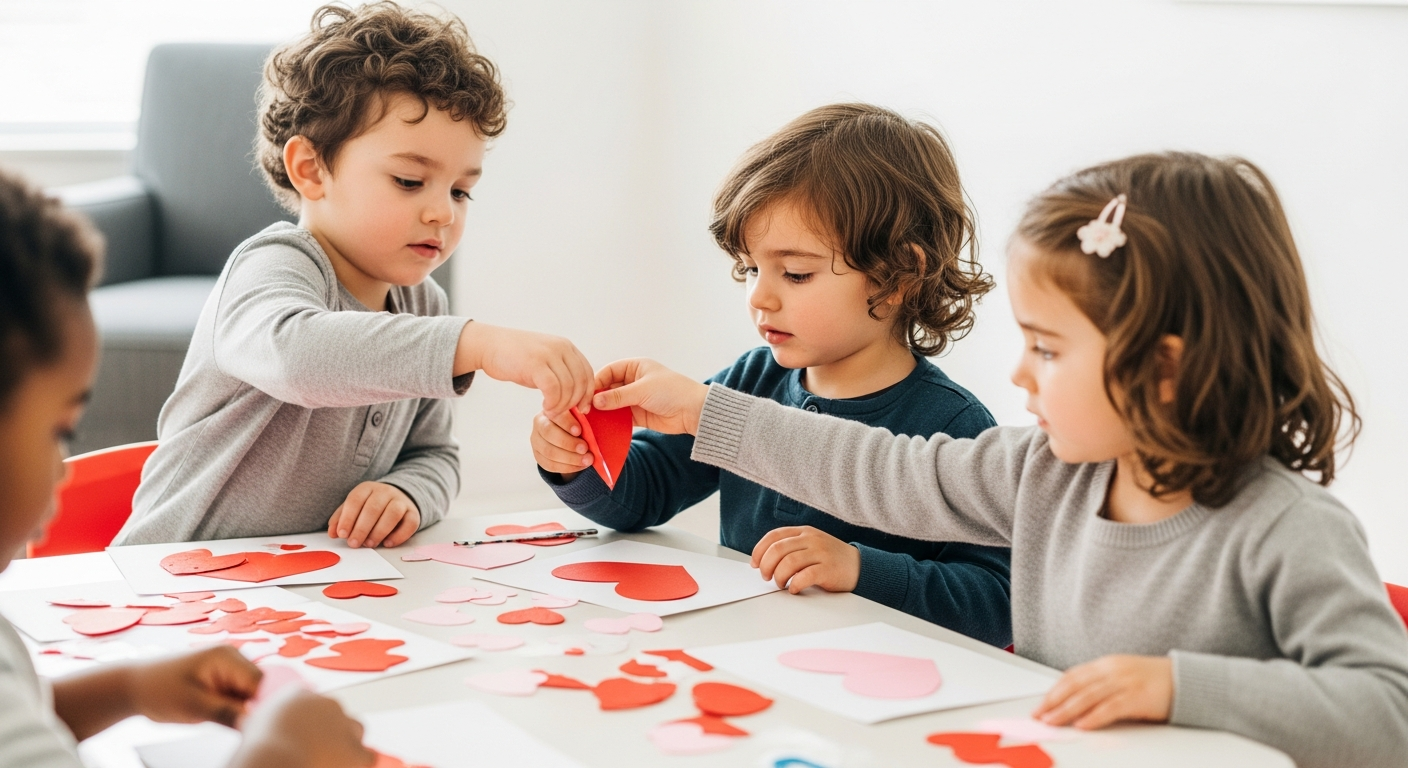
Table of Contents
- Introduction
- The Connection Between Crafting and Communication
- Activity 1: Heart Scrape Art
- Activity 2: "Warm Fuzzies" Sensory Jars
- Activity 3: The "I Love You" Handprint Keepsake
- Incorporating Smart Screen Time into Your Valentine’s Routine
- Transparent Pricing: Investing in Your Child’s Future
- Realistic Expectations for Your Toddler’s Progress
- Practical Scenario: The "Animal Valentine"
- Tips for a Stress-Free Crafting Experience
- Building Confidence Through Joyful Moments
- Summary of Valentine Craft Toddler Fun
- Start Your Journey Today
- Frequently Asked Questions
Introduction
Have you ever watched a two-year-old try to glue a giant, glittery heart onto a tiny scrap of paper? There is a specific kind of magic in those messy, glue-covered fingers and the focused tongue-poke of a toddler working on a masterpiece. While the end result might look like a beautiful blob to the untrained eye, for us parents, it represents a massive leap in development. But here is something many families don't realize: every time your child asks for "more glue" or points to the "red" paint, they aren't just making a decoration—they are building the foundations of communication.
At Speech Blubs, we believe that every moment of play is a moment for growth. This Valentine’s Day, we want to help you turn simple crafting sessions into powerful opportunities for speech and language development. Whether your little one is already a chatterbox or is among the 1 in 4 children who need a little extra support with their speech, holiday activities provide a natural, low-pressure environment to practice new words and sounds.

In this guide, we will explore several engaging valentine craft toddler ideas that focus on sensory play, fine motor skills, and, most importantly, language building. We’ll also show you how to pair these activities with our unique "smart screen time" tools to create a holistic learning experience. Our mission is to empower children to speak their minds and hearts, and what better time to start than a holiday dedicated to love and connection? By the end of this post, you’ll have a toolkit of activities that foster a love for communication and build the confidence your child needs to thrive.
The Connection Between Crafting and Communication
Before we dive into the glitter and glue, it’s important to understand why we advocate for hands-on activities. Crafting is inherently communicative. It requires a child to make choices (Which color?), follow directions (Put the sticker here), and express needs (Help me, please!). For a toddler, these are high-level cognitive tasks masked as simple fun.
Our founders at Speech Blubs understand this journey intimately. Having grown up with speech challenges themselves, they created the tool they wished they had—a way to blend scientific principles with the sheer joy of play. This same philosophy applies to your Valentine’s Day crafts. When you engage in "co-play," you aren't just a supervisor; you are a language model. You provide the words for the actions they are performing, which is a key component of how children learn to speak.
We often talk about "video modeling," which is the core of our app's methodology. In the app, children watch their peers perform speech exercises, which triggers "mirror neurons" in their brains, making them more likely to imitate the sounds. You can do the same thing at home! By sitting across from your toddler and over-emphasizing the mouth movements for words like "heart," "pop," or "red," you are acting as a live model for their development.
If you’re curious about where your child currently stands in their communication journey, you can take our quick 3-minute preliminary screener. It involves 9 simple questions and provides an assessment and a next-steps plan to help you support your little one’s growth.

Activity 1: Heart Scrape Art
Scrape art is a fantastic "process art" activity. Process art focuses on the experience of creating rather than the final product, which is perfect for toddlers who might not have the fine motor skills to create a "perfect" heart yet.
What You’ll Need:
- White cardstock or thick paper
- Washable paint (red, pink, purple)
- A piece of cardboard (about the size of a credit card)
- A tray to contain the mess
How to Play and Talk:
- Preparation: Draw a large heart on the cardstock. As you do this, say the word "heart" clearly. Encourage your child to trace the shape with their finger.
- Drip the Paint: Let your toddler put small "globs" of paint inside the heart. This is a great time to practice the "G" and "L" sounds in "glob" or the "P" in "pink" and "purple."
- The Scrape: Show them how to use the cardboard to scrape the paint across the paper. As the colors blend, use descriptive words like "smooth," "fast," "slow," and "mix."
For a parent whose 3-year-old "late talker" loves bright colors, this activity offers a motivating way to practice basic requests. You might hold the paint bottle and wait for them to say "please" or "more" before giving them the next glob. This reduces frustration by turning the "work" of speech into a game. If you want to see how other families have used similar play-based strategies to see progress, check out our parent testimonials.
Activity 2: "Warm Fuzzies" Sensory Jars
Toddlers learn about the world through their senses. A sensory-heavy valentine craft toddler project helps them link tactile feelings to specific words.
What You’ll Need:
- A small plastic jar or container
- Pink and red pom-poms (the "warm fuzzies")
- Heart-shaped sequins
- Soft felt scraps
How to Play and Talk:
This activity is less about "making" and more about "exploring." Encourage your child to fill the jar with the items. As they touch the pom-poms, say the word "soft." When they drop the sequins, say "shiny."
This is a wonderful alternative to passive screen time. Instead of just watching a cartoon, you are interacting. However, we know that parents need a break too. That’s where "smart screen time" comes in. While your child plays with their sensory jar, you can use the Speech Blubs app on the App Store to find the "Sensory Box" section. This can help reinforce the vocabulary they just learned through interactive peer-led videos.
Activity 3: The "I Love You" Handprint Keepsake
There is nothing more classic than a handprint craft. It’s a snapshot in time that parents cherish forever, but for the toddler, it’s a funny, ticklish experience.
What You’ll Need:
- Non-toxic tempera paint
- Large paper
- Markers
How to Play and Talk:
Painting a toddler’s hand requires cooperation. Use this as a time to practice body parts. "Let’s paint your hand! Here is one finger, two fingers..." When you press their hand onto the paper, say "Press!" or "Down!" and "Up!"
If your child is working on specific consonant sounds, you can adapt this. For example, if they are working on the "M" sound, focus on "Mama" or "Mine." If they are working on the "B" sound, talk about the "Blue" paint or the "Big" hand. This intentional focus is part of our scientific methodology, which is designed to make learning feel like a natural part of your day.
Incorporating Smart Screen Time into Your Valentine’s Routine
As a child development expert, I often hear parents express guilt about screen time. At Speech Blubs, we want to change that narrative. Screen time doesn't have to be a "plug and play" distraction. It can be a powerful tool for family connection when used correctly.
Our app is built on the concept of "video modeling." When your toddler sees another child—not a cartoon character, but a real peer—making a sound or saying a word, it builds their confidence. They think, "If that kid can do it, I can too!" This is especially effective for children who may feel intimidated by the "pressure" of traditional speech therapy.
For example, after finishing your valentine craft toddler session, you might open the app and head to the "Early Sounds" section. If you were just using red paint, find the colors section and let your child see their "digital friends" say the word "Red." This repetition across different mediums (physical paint and digital modeling) is how foundational skills are solidified.
Transparent Pricing: Investing in Your Child’s Future
We believe that high-quality speech support should be accessible and transparent. We offer two main paths to join our community, each designed to fit different family needs.
The Monthly Plan
At $14.99 per month, this plan gives you full access to our library of over 1,500 activities. It’s a great way to test the waters and see how your child responds to our peer-led video modeling.
The Yearly Plan: Our Best Value
The Yearly plan is the clear choice for families committed to seeing long-term progress. It costs $59.99 per year, which breaks down to just $4.99 per month. That is a 66% saving compared to the monthly plan.
But the value goes beyond just the price. The Yearly plan includes exclusive features that the monthly plan does not:
- 7-Day Free Trial: Start your journey with zero risk.
- Reading Blubs App: Access to our additional app focused on early literacy and reading skills.
- Early Access: Be the first to try our new updates and features.
- Priority Support: A 24-hour response time from our dedicated support team.
We encourage you to create your account and begin your 7-day free trial through the Yearly plan to unlock the full suite of tools available to your family.
Realistic Expectations for Your Toddler’s Progress
It’s important to remember that every child develops at their own pace. While we love seeing the immediate joy our app brings, we want to set realistic expectations. You won't see your child giving public speeches in a month, and that’s perfectly okay!
The goal of these valentine craft toddler activities and our app is to foster a love for communication. We want to reduce the frustration that comes when a child can't express their needs. By building foundational skills—like imitation, turn-taking, and basic vocabulary—you are setting the stage for more complex communication later on. Think of Speech Blubs as a powerful supplement to your child's overall development and, if necessary, professional therapy. It’s about creating joyful family learning moments that stick.
Practical Scenario: The "Animal Valentine"
Let's look at a real-world way to use these tools together. Imagine a parent whose 2-year-old loves animals but is currently only using a few words.
The Craft: You decide to make "Animal Valentines." You cut out a heart shape and add ears to make it look like a dog or a cat. The Interaction: As you glue on the ears, you say, "The dog says...?" and wait. The App Integration: To reinforce this, you open the "Animal Kingdom" section of Speech Blubs. Your child watches a peer bark like a dog or meow like a cat. Because they just made a dog craft, they are highly motivated to imitate the sound they see on the screen.
This combination of physical play and targeted digital modeling is the "sweet spot" for early childhood learning. You can find our app for all your devices, so whether you use an iPad or an Android tablet, the support is ready. Download Speech Blubs on Google Play to get started with these animal sounds today.
Tips for a Stress-Free Crafting Experience
To make sure your Valentine’s Day remains a "day of love" and not a "day of tantrums," keep these expert tips in mind:
- Embrace the Mess: Toddlers and "neatness" don't often go together. Use a tray, lay down some old newspapers, and let them explore. If you are stressed about the carpet, they will feel that tension.
- Follow Their Lead: If your toddler decides the heart should be blue instead of red, go with it! This gives them a sense of autonomy and makes them more likely to stay engaged.
- Keep it Short: A toddler’s attention span is roughly 3 to 5 minutes. If they walk away from the craft after five minutes, that’s okay. You can always come back to it later.
- Narrate Everything: Think of yourself as a sports commentator for your child's life. "You are picking up the blue crayon. Now you are drawing a big circle!" This constant stream of language helps them map words to actions.
Building Confidence Through Joyful Moments
Our mission to help children "speak their minds and hearts" isn't just a corporate slogan; it’s a commitment to the emotional well-being of your family. When a child finally says "I love you" or even just "mama" for the first time while handing you a messy paper heart, the frustration of the past weeks melts away.
These small victories are what we live for at Speech Blubs. We provide a screen-free alternative to passive viewing by encouraging children to look away from the screen and interact with you. Our "Smart Screen Time" acts as a bridge, giving them the tools and the confidence to engage with the physical world around them.
Summary of Valentine Craft Toddler Fun
Valentine’s Day is a beautiful opportunity to slow down and connect. By engaging in simple crafts like scrape art, sensory jars, and handprint keepsakes, you are providing your toddler with a rich linguistic environment.
Remember the key takeaways:
- Focus on Process: The act of making is more important than the finished craft.
- Model Speech: Use the crafts as a reason to practice specific sounds and words.
- Use Smart Tools: Supplement your play with Speech Blubs to leverage the power of peer modeling.
- Be Patient: Every "pop," "muh," and "da" is a step in the right direction.
Start Your Journey Today
Are you ready to make this Valentine’s Day a milestone in your child’s development? We invite you to join the Speech Blubs family. Our yearly plan offers the best value, including a 7-day free trial, the Reading Blubs app, and early access to all our latest speech-boosting updates.
Don't wait to give your child the gift of confidence. Download Speech Blubs on the App Store or Google Play to begin your 7-day free trial. Remember to select the Yearly plan at checkout to receive the 66% discount and the full suite of features designed to help your child speak their mind and heart.
Frequently Asked Questions
What are the best valentine craft toddler ideas for a 2-year-old?
For 2-year-olds, focus on sensory-rich activities like finger painting, "warm fuzzy" sensory jars, or sticker hearts. At this age, the goal is to develop fine motor skills and associate words with textures and colors. Avoid crafts with many small parts or complex instructions, and focus on the joy of exploration.
How can I use Valentine's crafts to help my child's speech?
The best way is to narrate the process. Use simple, repetitive words like "glue," "red," "heart," and "more." Wait for your child to make a sound or attempt a word before giving them the next craft item. This "communication temptation" encourages them to use their voice to get what they want in a fun environment.
Is Speech Blubs appropriate for a toddler who isn't talking yet?
Yes! Speech Blubs is specifically designed for children who are "late talkers" or need foundational support. Our video modeling technique shows real children making simple sounds and mouth movements. This is a low-pressure way for non-verbal toddlers to start imitating sounds and building the confidence to speak.
Why should I choose the Yearly plan over the Monthly plan?
The Yearly plan offers the best long-term value at $59.99 (just $4.99/month), which is a 66% saving. Crucially, it includes a 7-day free trial, the Reading Blubs app for literacy, and priority support. The Monthly plan ($14.99) does not include the free trial or the extra app, making the Yearly plan the superior choice for most families.
About the author