
Keeping Busy & Boosting Brains: Fun Kid Games to Play Inside
 By Speech Blubs Team•Jan 19, 2026•21 min.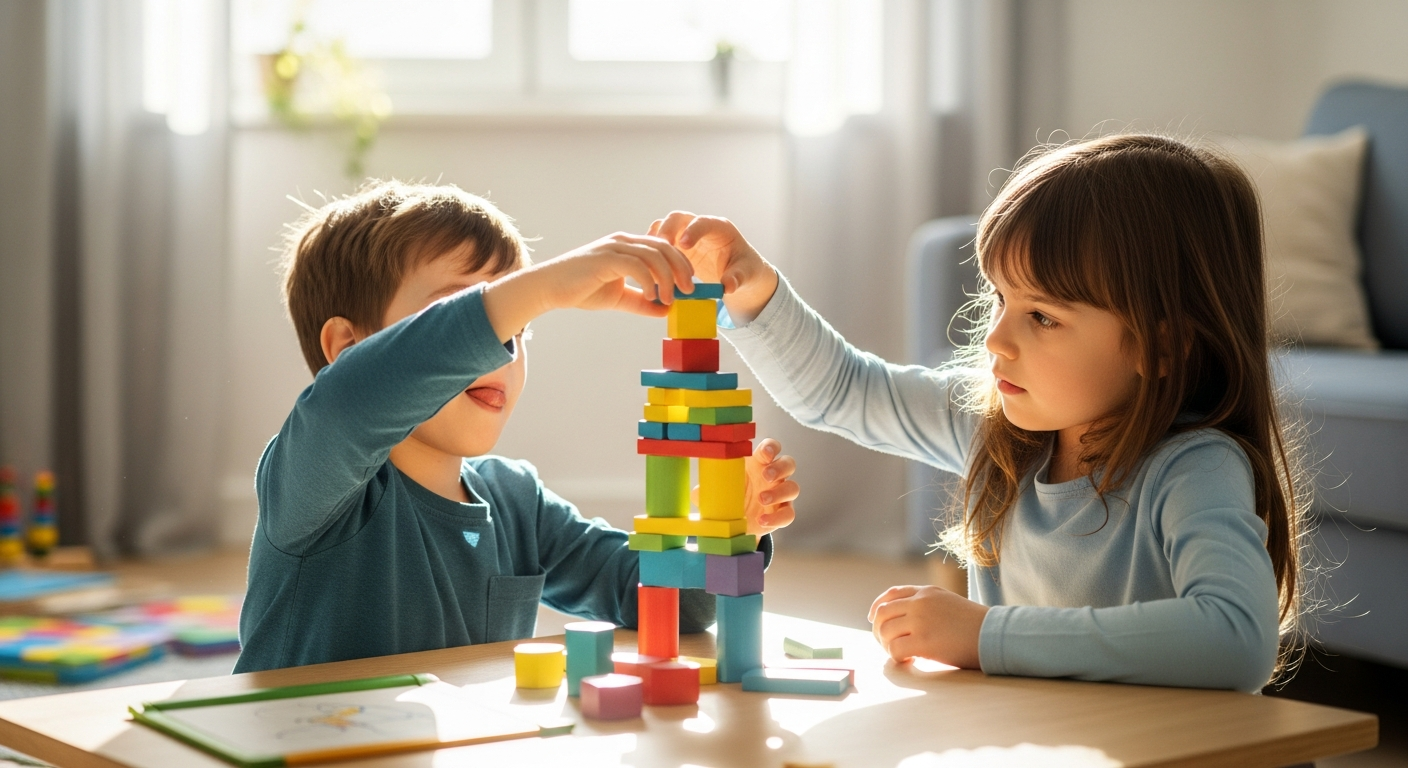
Table of Contents
- Why Indoor Play is More Than Just Fun
- Active Indoor Adventures: Burning Energy & Building Skills
- Igniting Imagination: Creative & Pretend Play
- Brain-Boosting Bonanza: Cognitive & Fine Motor Games
- Boosting Communication with "Smart Screen Time": How Speech Blubs Helps
- Making the Most of Speech Blubs: Value and Features
- Conclusion
- FAQ
The rain drums against the window, the snow falls silently, or perhaps a persistent sniffle keeps everyone indoors. Sound familiar? Every parent faces those days when outdoor adventures are simply not an option. It's easy to fall into the trap of endless passive screen time, but we know deep down that our children need more. The challenge isn't just to keep them entertained; it's to keep them engaged, active, and learning, even within the confines of our homes.
Cabin fever can set in quickly, leading to boredom and restlessness for both kids and adults. But what if those indoor days weren't just about surviving, but thriving? What if they became opportunities for rich, developmental play that builds crucial skills, boosts confidence, and fosters joyful family connection? This post will transform your perspective on indoor play, offering a treasure trove of engaging, screen-free activities that are not only incredibly fun but also powerfully beneficial for your child's physical, cognitive, social, and — most importantly — communication development. We'll explore everything from energetic races to imaginative storytelling, and reveal how innovative tools like Speech Blubs can integrate "smart screen time" into your child's learning journey, empowering them to speak their minds and hearts.

Why Indoor Play is More Than Just Fun
Far from being a fallback for bad weather, indoor play is a powerhouse for development. When kids are engaged in meaningful activities inside, they're not just passing the time; they're actively building a foundation for lifelong skills.
Physical Benefits: From Wiggles to Wobbles
Even without a sprawling backyard, indoor games can be incredibly physical. They help children:
- Develop Gross Motor Skills: Running, jumping, crawling, dancing, and balancing all contribute to large muscle development and coordination.
- Refine Fine Motor Skills: Manipulating small objects, drawing, building, and crafting strengthen the small muscles in hands and fingers, essential for writing and self-care.
- Enhance Balance and Spatial Awareness: Navigating an obstacle course or walking a "tightrope" teaches children about their body in space and how to maintain equilibrium.
- Boost Proprioception: Activities that involve pushing, pulling, or deep pressure (like crawling through tunnels) provide calming sensory input that helps children understand their body's position and movement.
Cognitive Benefits: Thinking Outside the Box (Inside the House)
Indoor games are mental workouts, sharpening young minds in countless ways:
- Problem-Solving and Critical Thinking: Scavenger hunts, puzzles, and building challenges encourage children to think strategically and overcome obstacles.
- Memory and Attention: Games like "Simon Says" or "Memory Match" improve recall and the ability to focus.
- Following Instructions: Almost every structured game requires listening carefully and executing multi-step directions, a crucial skill for learning and daily life.
- Creativity and Imagination: Pretend play, storytelling, and building activities foster innovative thinking and the ability to envision new possibilities.
Social-Emotional Benefits: Learning to Play Together
Many indoor games naturally lend themselves to social interaction, teaching invaluable life lessons:
- Turn-Taking and Sharing: Essential components of almost any game played with others.
- Cooperation and Teamwork: Building a fort or participating in a relay race teaches children to work together towards a common goal.
- Emotional Regulation: Learning to win graciously and lose with resilience, managing frustration, and expressing feelings appropriately are vital social-emotional skills.
- Empathy: Taking on different roles in imaginative play helps children understand various perspectives.
Communication Benefits: Finding Their Voice
This is where indoor play truly shines for language and speech development. Every interaction is an opportunity for communication:

- Vocabulary Expansion: Describing objects during a scavenger hunt, narrating a story, or explaining game rules introduces new words and concepts.
- Descriptive Language: Parents can model and encourage the use of adjectives, adverbs, and spatial concepts ("under," "over," "behind") during play.
- Storytelling and Narrative Skills: Putting on a play or creating a story together helps children structure thoughts, sequence events, and express themselves coherently.
- Articulation Practice: Imitating animal sounds, practicing specific words during games, or singing songs helps refine speech sounds.
- Active Listening: Games that require careful listening, like "Broken Telephone," strengthen auditory processing skills.
These benefits underscore that indoor play isn't just about fun; it's a holistic approach to nurturing a child's growth. And when designed thoughtfully, it can significantly boost their journey to confident communication.
Active Indoor Adventures: Burning Energy & Building Skills
When the weather prevents outdoor play, the key is to bring the energy indoors! These games encourage movement, coordination, and strength, all while fostering big smiles.
Obstacle Courses: Navigate and Negotiate
Transform your living room into an exciting playground. Let your child help design and build the course – often, the construction is as much fun as the execution!
- How to Play: Use pillows as stepping stones, crawl under draped blankets, balance along a rolled-up rug, or slither through a tunnel made of chairs. Painter’s tape can mark zigzags, lines, and shapes for walking or hopping paths.
- Developmental Boost: This activity hones gross motor planning, balance, coordination, and spatial awareness. For children learning to follow multi-step instructions, it's a fantastic real-world application. For a child who might struggle with sequencing verbal instructions, you can give one step at a time, reinforcing vocabulary like "over," "under," and "through."
- Pro-Tip: Add "stations" where your child has to perform a specific action, like "jump five times" or "make an animal sound" before moving on.
Animal Walks & Races: Roar, Slither, and Leap
Movement with an imaginative twist! Kids love mimicking animals, and this game gets their whole body involved.
- How to Play: Challenge your child to move across the room like different animals: bear crawl, crab walk, frog jump, snake slither, or even an elephant stomping. Race against siblings, parents, or a timer for added excitement.
- Developmental Boost: Excellent for strengthening core muscles, bilateral coordination (using both sides of the body together), and imaginative play. For language development, it's a natural way to practice animal names, sounds, and descriptive verbs (e.g., "The lion prowls," "The bunny hops"). Our friends at Speech Blubs have an amazing "Animal Kingdom" section filled with peers demonstrating animal sounds and movements, offering a fun extension for children working on early vocalizations.
Dance Parties & Yoga Freeze Dance: Get Your Groove On
Music is a universal language, connecting us and inspiring movement.
- How to Play: Put on your child's favorite tunes and let loose! For Yoga Freeze Dance, when the music stops, everyone strikes a yoga pose and holds it.
- Developmental Boost: Dancing boosts gross motor skills, rhythm, and emotional expression. Yoga improves flexibility, strength, balance, and body awareness. For children still developing their verbal skills, dancing provides a powerful outlet for self-expression. It can also be a wonderful way to teach action verbs like "spin," "jump," "clap," and "shake."
Balloon Volleyball & Paper Plate Skating: Light as Air, Smooth as Ice
Simple household items can create surprising levels of fun and physical activity.
- How to Play (Balloon Volleyball): Blow up a balloon and try to keep it off the ground, hitting it from person to person. Use a string for a makeshift net. For an extra challenge, make paper plate paddles!
- How to Play (Paper Plate Skating): Place a paper plate under each foot (best on smooth floors) and let your child "skate" around.
- Developmental Boost: Balloon games enhance visual tracking, motor planning, and hand-eye coordination. Paper plate skating works on lower body strength, balance, and core stability. These activities are fantastic for encouraging joint attention—where you and your child are focused on the same object (the balloon or the plates)—a key precursor to communication.
Relay Races & Pillowcase Races: Compete and Collaborate
Inject some friendly competition and teamwork into indoor play.
- How to Play (Relay Races): Create mini-challenges like walking backward to a finish line, balancing a small ball on a spoon, or carrying a stack of pillows. Team up for cooperative efforts. You can even turn cleanup into a relay race!
- How to Play (Pillowcase Races): Children hop across the room with their legs in a pillowcase.
- Developmental Boost: These games foster physical activity, teamwork, coordination, and problem-solving. They're also great for practicing directional language (e.g., "Go forward," "Turn around," "Hop to the side") and turn-taking, which is a fundamental aspect of conversational speech.
Friendly Fitness Competitions: Stronger Together
Kids love to imitate adults, so make fitness a family affair.
- How to Play: Challenge each other to push-ups, jumping jacks, somersaults, or long jumps (mark distances with tape). Keep score for a fun, friendly competition.
- Developmental Boost: Encourages physical activity, setting goals, and improving personal bests. It also provides opportunities for positive reinforcement and boosts self-confidence. Verbally describing the exercises ("Arms up! Legs out!") reinforces language associated with body parts and actions.
Indoor Track: Stay in Line
Masking tape is your secret weapon for transforming floors.
- How to Play: Create squiggly lines, loops, or zig-zag paths across the floor with tape. Challenge kids to stay on the tape as they walk, run, or balance. Add signs like "Stand on One Foot" or "Jump Like a Kangaroo."
- Developmental Boost: Promotes movement, balance, and following visual cues. It can also be an excellent way to practice colors, shapes (if you tape out shapes), and directional words as your child navigates the track.
Igniting Imagination: Creative & Pretend Play
Imagination is the engine of creativity and a powerful tool for language development. These games encourage children to dream, create, and express themselves.
Put On A Play Or Make A Movie: Storytelling Stars
Every child is a natural storyteller and actor.
- How to Play: Help your child create a simple story, plan scenes, and make props and costumes from household items. Stage a production for the family or record it to share with friends.
- Developmental Boost: This activity is a goldmine for narrative skills, sequencing events, character development, and emotional expression. Children learn to articulate ideas, use descriptive language, and understand plot structure. For children working on articulation, assigning them a character with specific sounds to practice can make therapy fun and engaging.
Indoor Camping Trip: Cozy Adventures
Bring the magic of the outdoors inside.
- How to Play: Set up a tent in the living room or build a fort from pillows and blankets. Cook s'mores on the stove and tell "spooky" (age-appropriate) stories with the lights off.
- Developmental Boost: Encourages imaginative play, problem-solving (fort building), and sensory exploration. Storytelling around the "campfire" is a wonderful way to develop narrative skills and vocabulary. Discussing the "camping gear" (blankets, pillows, flashlights) provides opportunities for naming objects and describing their functions.
Action Storytime: Books Come to Life
Transform reading from a passive activity into an immersive experience.
- How to Play: As you read a book, encourage your child to act out parts of the story. If a character rolls down a hill, your child rolls across the room. If they climb a tower, they can climb stairs or furniture safely.
- Developmental Boost: Enhances comprehension, brings stories to life, and encourages physical engagement. This interactive approach helps children connect words to actions, improving vocabulary and understanding of verbs and prepositions. It's especially beneficial for children who are learning to follow action commands.
Cardboard Box Adventures: Beyond the Bin
A simple cardboard box is a gateway to endless possibilities.
- How to Play: Transform large cardboard boxes into tunnels, forts, cars, spaceships, or even a house. Use a few boxes to create an obstacle path or an imaginative setting for pretend play.
- Developmental Boost: Fosters imaginative play, creativity, and spatial reasoning. Children can use descriptive language to talk about their creations ("My spaceship is huge and has blinking lights!") and develop narratives around their adventures.
Building Forts & Tunnels: Architect of Play
The classic fort never gets old.
- How to Play: Use blankets, pillows, and furniture to build a cozy fort or crawl tunnel. Let your child take the lead in design and construction.
- Developmental Boost: Encourages collaborative play, spatial reasoning, and problem-solving ("How do we make this blanket stay up?"). It also offers a comforting, enclosed space that can be calming for some children, and an excellent setting for quiet imaginative play or storytelling.
Brain-Boosting Bonanza: Cognitive & Fine Motor Games
These activities stimulate the mind, sharpen fine motor skills, and often involve quiet, focused engagement.
Scavenger Hunts & Color Quests: Search and Discover
A favorite that can be endlessly customized.
- How to Play (Scavenger Hunt): Create a list of items for your child to find – either concrete objects ("find a red car") or more abstract requests ("find something soft").
- How to Play (Color Quest): Ask your child to find a certain number of objects of a specific color, shape, or texture. Add a timer for a fun challenge.
- Developmental Boost: Excellent for problem-solving, observation skills, and vocabulary expansion (especially adjectives like "shiny," "rough," "tiny"). For children learning to categorize, you can ask them to find "things that start with the 'B' sound" or "things that are food."
Tag Team Puzzles: Piece by Piece Progress
Puzzles are fantastic for focused attention and fine motor skill development.
- How to Play: For puzzles with bigger pieces, hide them around the room. Take turns searching, and when a piece is found, run back to add it to the puzzle and tag the next person.
- Developmental Boost: Improves visual discrimination, problem-solving, fine motor coordination, and persistence. Collaborative puzzle-solving also encourages communication and turn-taking.
Giant Game Board: Life-Sized Fun
Turn your floor into a dynamic play space.
- How to Play: Use masking tape to create a giant hopscotch, a race track, or a "Snakes and Ladders" board on your floor. Use dice and have players move themselves or a large marker.
- Developmental Boost: Teaches turn-taking, counting skills, following rules, and spatial reasoning. It's a fantastic way to practice numbers and sequencing, which are foundational for many cognitive skills.
Classic Childhood Games (Simon Says, Red Light Green Light): Timeless Lessons
These games have stood the test of time for a reason.
- How to Play:
- Simon Says: Players must only follow commands preceded by "Simon Says."
- Red Light, Green Light: Players move on "Green Light" and freeze on "Red Light."
- Developmental Boost: These games are excellent for developing listening skills, impulse control, and the ability to follow directions. They're particularly helpful for children who need practice with auditory processing and self-regulation.
Board Games & Card Games: Strategic Fun
Unplug and engage with traditional games.
- How to Play: Pull out classics like Uno, Connect 4, Jenga, or even simple card games like Go Fish or Memory.
- Developmental Boost: Promotes strategic thinking, turn-taking, fair play, and social interaction. These games provide natural contexts for conversational exchanges, expressing choices, and even learning basic math concepts.
Sensory Bins & Bottles: Tactile Exploration
Engage the senses for calming and stimulating play.
- How to Play (Sensory Bin): Fill a container with rice, beans, pasta, water beads, or sand, along with small toys, scoops, and cups. Let your child explore freely.
- How to Play (Sensory Bottle): Fill a clear bottle with water, glitter, small beads, or toy figures, sealing the lid securely.
- Developmental Boost: Sensory play exposes children to a variety of textures, helps regulate the nervous system, and provides opportunities for descriptive language. As your child explores, you can encourage them to describe what they feel, see, and hear, boosting their vocabulary and communication.
Fine Motor Skill Games: Dexterity and Delight
Focus on intricate movements that build strength and precision.
- How to Play: Build with LEGOs, practice drawing or coloring, use play-dough for sculpting, or try threading beads.
- Developmental Boost: Enhances hand-eye coordination, dexterity, and concentration. These skills are crucial for tasks like writing, buttoning clothes, and using utensils. Discussing their creations (e.g., "Tell me about your play-dough monster!") encourages narrative and descriptive language.
Making Books/Scrapbooks: Their Own Stories
Empower your child to become an author and illustrator.
- How to Play: Staple pages together or use a blank notebook. Encourage your child to write, draw, or dictate their own stories. Print family photos to create a scrapbook of memories.
- Developmental Boost: Fosters creativity, narrative skills, sequencing, and fine motor skills (drawing, writing). It's an incredible way for children to express their thoughts and feelings, building confidence in their ability to communicate.
Boosting Communication with "Smart Screen Time": How Speech Blubs Helps
In a world filled with screens, it’s understandable for parents to feel guilty about screen time. But what if screen time could be genuinely beneficial, interactive, and even a powerful tool for speech and language development? This is where Speech Blubs comes in.
We understand the challenge parents face in finding educational screen time that truly supports development. At Speech Blubs, our mission is to empower children to "speak their minds and hearts." Our company was born from the personal experiences of our founders, who all grew up with speech problems and created the tool they wished they had. We are committed to providing an immediate, effective, and joyful solution for the 1 in 4 children who need speech support, blending scientific principles with play into one-of-a-kind "smart screen time" experiences.
Our Unique Approach: Video Modeling
One of the cornerstones of our methodology is video modeling. Instead of passively watching cartoons, children learn by watching and imitating their peers on screen. This taps into the brain's natural ability to learn through observation and imitation, activating mirror neurons and making the learning process incredibly engaging and effective. For a child who might be hesitant to try new sounds or words, seeing other children successfully do it can be incredibly motivating and confidence-building. We invite you to explore the research behind our methods to understand why Speech Blubs is rated in the top tier of speech apps worldwide.
Interactive, Not Passive
Speech Blubs provides a screen-free alternative to passive viewing. Our app is designed for active participation, encouraging children to vocalize, repeat, and imitate. This interactive experience transforms screen time into a powerful tool for family connection, as parents can join in, cheer on, and celebrate every milestone with their child.
Let's consider a relatable scenario: For a parent whose 3-year-old is a "late talker" and loves animals, the "Animal Kingdom" section within Speech Blubs offers a fun, motivating way to practice "moo" and "baa" sounds. Seeing other children clearly articulate these sounds provides a powerful model for imitation, fostering confident vocalization in a playful environment. This isn't just entertainment; it's targeted practice delivered in an engaging format.
Benefits Beyond Words
Using Speech Blubs helps children:
- Foster a Love for Communication: By making speech practice fun and rewarding.
- Build Confidence: Through successful imitation and positive reinforcement.
- Reduce Frustration: By providing clear models and supportive activities.
- Develop Key Foundational Skills: Such as imitation, articulation, and vocabulary.
- Create Joyful Family Learning Moments: Encouraging active participation from both children and parents.
It's important to set realistic expectations; Speech Blubs is a powerful supplement to a child's overall development plan and, when applicable, professional therapy. It’s a tool designed to enrich their journey, not guarantee overnight transformations.
If you're unsure if your child could benefit from targeted speech support, take our quick 3-minute preliminary screener. It involves 9 simple questions and provides an assessment and a next-steps plan, along with a free 7-day trial of Speech Blubs. See what other parents are saying about their child's success with our app.
Making the Most of Speech Blubs: Value and Features
We believe in transparency and providing exceptional value to families. When considering Speech Blubs, it's helpful to understand our subscription options.
Our plans are designed to be flexible, but the Yearly plan offers significantly superior value and a richer experience for your child's communication journey.
- Monthly Plan: $14.99 per month. This provides access to the core Speech Blubs app.
- Yearly Plan: $59.99 per year. This breaks down to just $4.99/month, meaning you save 66% compared to the monthly option!
The Yearly Plan's Superior Value and Exclusive Features
The Yearly plan is the clear best choice, packed with high-value benefits not available with the Monthly plan:
- A 7-day free trial: This is your risk-free opportunity to explore everything Speech Blubs has to offer before committing. The Monthly plan does not include a free trial.
- The extra Reading Blubs app: Double the fun and learning! This additional app complements speech development by fostering early literacy skills.
- Early access to new updates: Be among the first to experience our latest features and content.
- 24-hour support response time: Get prompt assistance whenever you need it.
Choosing the Yearly plan isn't just about saving money; it's about investing in a comprehensive suite of tools that support your child's development across multiple fronts, ensuring you have the full Speech Blubs experience. Ready to get started? Download Speech Blubs on the App Store or Google Play to begin, or create your account and begin your 7-day free trial today by selecting the Yearly plan to unlock all these amazing features!
Conclusion
Indoor days don't have to be synonymous with boredom or endless passive screen time. As we've explored, your home can be transformed into a vibrant hub of learning, creativity, and connection through a wide array of fun kid games to play inside. From active obstacle courses that build gross motor skills to imaginative plays that spark storytelling, and cognitive games that sharpen young minds, every activity offers a unique opportunity for growth. These games are not just about passing the time; they're essential for fostering your child's physical, cognitive, social-emotional, and crucially, communication development.
Remember, the goal is to create joyful moments that encourage your child to explore, interact, and express themselves confidently. And when it comes to supporting communication in a "smart screen time" way, Speech Blubs stands ready to empower your child with its unique video modeling approach, transforming screen time into a powerful developmental tool.
We encourage you to embrace these ideas, adapt them to your child's interests, and join us in building a future where every child can speak their minds and hearts. Start your 7-day free trial today by downloading the app from the App Store or Google Play and choosing the Yearly plan for the best value and access to all our exclusive features, including the extra Reading Blubs app. Let the indoor adventures begin!
FAQ
Q1: How can I encourage my child to play indoor games instead of watching TV or playing video games?
A1: Make indoor games an exciting, shared experience. Children are often motivated by parental involvement. Introduce new, engaging activities with enthusiasm, provide novel materials (like a new box for fort building), and offer choices. Set clear boundaries around screen time and present engaging alternatives proactively. Highlighting the interactive and creative aspects of these games can make them more appealing than passive viewing.
Q2: My child has a short attention span. How can I keep them engaged in indoor games?
A2: Keep activities brief and varied. Rotate between different types of games (active, quiet, creative) to maintain interest. Focus on child-led play where they have a say in the activity. Break down complex games into smaller, manageable steps. Remember that it's okay for them to move on to something new; even short bursts of focused play are beneficial.
Q3: Are there indoor games that specifically help with speech and language development?
A3: Absolutely! Many indoor games naturally boost speech and language. Examples include storytelling (acting out books, putting on plays), descriptive scavenger hunts (finding "something soft and blue"), "Simon Says" (following instructions), and games that encourage turn-taking and verbal interaction. Additionally, apps like Speech Blubs offer targeted activities using video modeling that are specifically designed to enhance articulation, vocabulary, and overall communication skills in a fun and interactive way.
Q4: How much does Speech Blubs cost, and what's the best way to subscribe?
A4: Speech Blubs offers two main subscription plans: a Monthly plan at $14.99 per month, and a Yearly plan at $59.99 per year, which breaks down to just $4.99/month. We highly recommend the Yearly plan as it offers the best value, allowing you to save 66%. It also includes exclusive benefits such as a 7-day free trial, the extra Reading Blubs app, early access to new updates, and 24-hour support response time. The Monthly plan does not include these additional features or a free trial.
About the author