
Meaningful Toddler Ornament Craft Ideas for Holiday Joy
 By Speech Blubs Team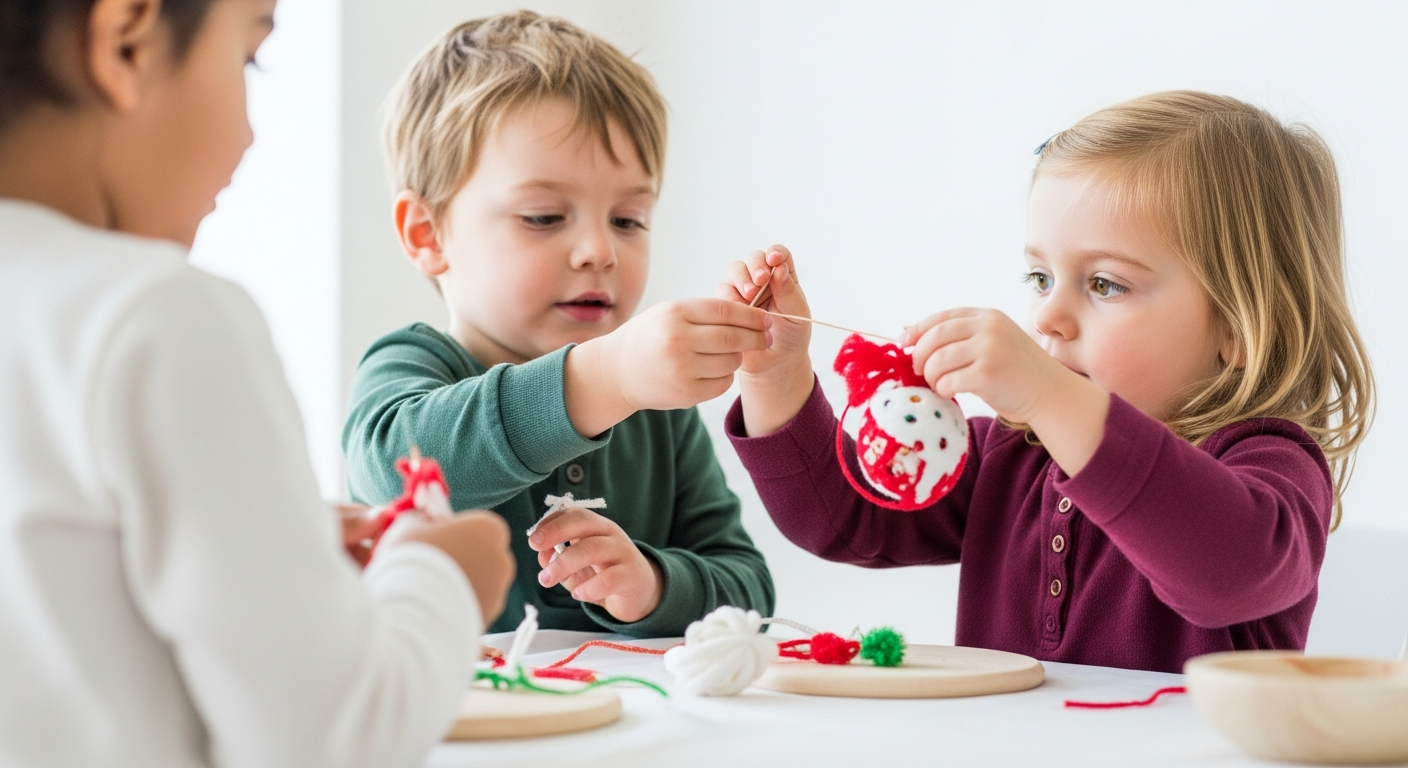
Table of Contents
- Introduction
- The Science of Play and Speech Development
- 1. Handprint Reindeer: A Sensory Language Experience
- 2. Fillable "I Spy" Ornaments for Vocabulary Building
- 3. Popsicle Stick Trees: Developing Fine Motor and Focus
- 4. Salt Dough Keepsakes: A Kitchen Science Experiment
- 5. Painted Wood Animals: Boosting Categorization Skills
- 6. Photo Snow Globes: Building Narrative and Memory
- 7. Beaded Stars: Working on Early Math and Coordination
- 8. Nature-Inspired Pinecone Ornaments
- Making Screen Time "Smart" This Holiday Season
- Why the Yearly Plan is Your Best Choice
- Fostering Realistic Expectations
- Conclusion
- Frequently Asked Questions (FAQs)
Introduction
Picture this: your holiday tree is standing in the corner, glowing with soft lights. Among the store-bought glass baubles and perfectly coordinated ribbons hangs a slightly lopsided, salt-dough star with a tiny thumbprint in the middle and a reindeer made from a popsicle stick that has one too many googly eyes. For many of us, these are the decorations that actually matter. They aren’t just ornaments; they are snapshots of a moment in time, representing the messy, joyful, and often loud process of a child learning to express themselves.

At Speech Blubs, we believe every moment—even a messy crafting session—is an opportunity for connection. Our mission is to empower children to speak their minds and hearts, a goal born from the personal experiences of our founders who grew up with speech challenges themselves. We know that the holidays can sometimes feel overwhelming for parents of "late talkers" or children with speech delays. You might find yourself wishing for more "spark" in their communication. That is why we focus on blending scientific principles with play to create "smart screen time" that supports what you’re doing at the kitchen table.
In this post, we’re going to dive deep into toddler ornament craft ideas that do more than just decorate your home. We will explore activities that foster fine motor skills, encourage vocabulary growth, and build the confidence your child needs to communicate. Whether you are looking for sensory-rich experiences or simple keepsakes to gift to grandparents, these ideas are designed to be achievable, fun, and rooted in developmental progress.

By the end of this guide, you’ll have a toolkit of holiday activities and a better understanding of how tools like Speech Blubs can supplement your child’s journey toward joyful communication.
The Science of Play and Speech Development
Before we roll up our sleeves and get out the glitter, it’s helpful to understand why crafting is such a powerhouse for speech development. At Speech Blubs, our approach is centered on "video modeling." This is a proven method where children learn by watching and imitating their peers. When your child sees another child in our app making a "b" sound or naming a "tree," it triggers mirror neurons in their brain, making them more likely to try it themselves.
Crafting works similarly. When you sit with your toddler to make a reindeer ornament, you are modeling language in real-time. You say "glue," they see the glue. You say "sticky," they feel the stickiness. This multi-sensory approach helps cement new words into their vocabulary. Our methodology is backed by science, placing us in the top tier of speech apps worldwide. You can read more about the science and research that informs every activity we create.
We aren't just looking for "perfect" words; we are fostering a love for communication. If your child points to a red button and says "wed," that is a victory! Our goal is to reduce frustration and create joyful family learning moments that extend far beyond the screen.
1. Handprint Reindeer: A Sensory Language Experience
This is a classic for a reason. It captures the size of those tiny hands and provides a wealth of sensory input.
Materials Needed:
- Brown non-toxic washable paint
- Cardstock or construction paper
- Googly eyes and red pom-poms
- Ribbon for hanging
The "Speech" Strategy:
As you coat your child’s hand in paint, describe the sensation. "Ooh, cold paint!" or "Tickle, tickle!" This encourages your child to react and perhaps imitate those descriptive words. Once the handprint is on the paper, it becomes the reindeer's antlers.
For a parent whose 3-year-old loves animals, the "Animal Kingdom" section in the Speech Blubs app is a perfect companion to this craft. You can practice the "snort" of a reindeer or the "moo" of a cow together while the paint dries. This keeps the momentum of the activity going and reinforces the names of the creatures they are creating.
Steps:
- Paint the palm and fingers brown.
- Press firmly onto paper.
- Once dry, cut around the handprint.
- Glue the eyes on the palm and the red pom-pom on the thumb (the nose).
- Add a name and date on the back to preserve the memory.
2. Fillable "I Spy" Ornaments for Vocabulary Building
These are fantastic for toddlers because they are relatively mess-free and act as a "speech jar" once completed.
Materials Needed:
- Clear plastic (shatterproof) ornaments
- Small items: sequins, mini bells, fake snow, tiny plastic animals, or colored pom-poms
The "Speech" Strategy:
This activity is all about requesting. Instead of giving your child all the items at once, hold them back. Wait for them to point or attempt to say "bell" or "more." This "communication temptation" is a core strategy used by speech-language pathologists to encourage vocalization.
If you are unsure where your child stands in their development, you can take our quick 3-minute preliminary screener. It involves 9 simple questions and provides an assessment and a next-steps plan, along with a free 7-day trial of our app.
Steps:
- Remove the top of the ornament.
- Ask your child, "What should we put in next?"
- Let them drop the items in one by one.
- Once full, replace the top and shake it! Use words like "shake," "noisy," and "shhh" to describe the sounds.
3. Popsicle Stick Trees: Developing Fine Motor and Focus
Building a tree out of sticks requires coordination, which is closely linked to the brain's language centers.
Materials Needed:
- Jumbo popsicle sticks (painted green)
- Craft glue
- Buttons or stickers for "lights"
- A yellow star for the top
The "Speech" Strategy:
Use this craft to practice colors and positions. "Put the yellow star on top." "Find the red button." By using spatial words (on, under, top, bottom), you are helping your toddler build a foundation for complex sentence structures later on.
If your child is working on specific sounds, you can use the "Early Sounds" section of Speech Blubs to find words that match the colors you’re using. For example, practicing the "p" sound for "purple" or "pink" buttons. To get started with these targeted exercises, download Speech Blubs on the App Store to begin your journey.
Steps:
- Glue three sticks into a triangle shape.
- Let the "frame" dry (this is a good time for a 5-minute Speech Blubs break!).
- Have your toddler decorate the "branches" with buttons or stickers.
- Glue a small brown rectangle at the bottom for the trunk.
4. Salt Dough Keepsakes: A Kitchen Science Experiment
Salt dough is the gold standard for toddler ornament craft ideas because it’s basically homemade playdough that lasts forever.
Materials Needed:
- 2 cups all-purpose flour
- 1 cup salt
- 1 cup warm water
- Cookie cutters
The "Speech" Strategy:
The kitchen is a high-language environment. Use action verbs: "pour," "mix," "stir," "roll," and "squish." These "power words" are the building blocks of early sentences. When your child helps you stir, they are participating in a "joint attention" activity, which is crucial for social communication development.
We often hear from parents that these shared activities are where the real breakthroughs happen. You can read testimonials from other parents who have seen their children flourish when combining hands-on play with our smart screen time tools.
Steps:
- Mix the ingredients until a dough forms.
- Knead until smooth (let your toddler help!).
- Roll it out and use cookie cutters to make shapes.
- Poke a hole in the top for the string.
- Bake at 200°F (95°C) for 2-3 hours or until hard.
- Once cool, paint and seal.
5. Painted Wood Animals: Boosting Categorization Skills
Many craft stores sell unfinished wood cutouts of forest animals like deer, owls, and bears.
Materials Needed:
- Unfinished wood animal shapes
- Washable paints and brushes
- Optional: yarn or pom-poms for texture
The "Speech" Strategy:
This is the perfect time to work on categorization. "Is a bear an animal or a fruit?" "Does an owl fly or swim?" Even if your child isn't answering in full sentences yet, asking these questions helps them organize information in their minds.
While they paint their wooden bear, you could pull up the "Animal Kingdom" section in Speech Blubs. Seeing a peer make the "Grrr" sound for a bear can motivate them to make that same sound while they work. This is the essence of our "smart screen time"—it’s an active, participatory experience that supplements the physical world. For the best experience, including access to all our specialized modules, we recommend the Yearly plan on our Sign-Up page.
6. Photo Snow Globes: Building Narrative and Memory
Creating an ornament with a photo of the child or a family pet helps develop a sense of "self" and narrative.
Materials Needed:
- Clear plastic ornaments (flat or round)
- A printed photo of your child
- Glitter or "snow" (white crinkle paper)
The "Speech" Strategy:
This craft encourages "who" and "where" questions. "Who is in the picture?" "Where were we when we took this?" This helps with memory recall and early storytelling skills. Building a narrative is a complex communication skill that we support through our structured video modeling paths.
Steps:
- Cut the photo to fit inside the ornament.
- Add a bit of "snow" to the bottom.
- Carefully slide the photo inside (you might need a pencil to position it).
- Seal the top and add a ribbon.
7. Beaded Stars: Working on Early Math and Coordination
For older toddlers (with supervision), stringing beads is a fantastic way to develop the "pincer grasp," which is essential for writing later on.
Materials Needed:
- Pipe cleaners
- Large plastic pony beads (multi-colored)
The "Speech" Strategy:
Focus on sequencing and patterns. "First a red bead, then a green bead." This "first/then" language is very helpful for children who struggle with transitions or following multi-step directions.
"Communication isn't just about the words we say; it's about the connection we build while we're saying them." — The Speech Blubs Team
8. Nature-Inspired Pinecone Ornaments
Take the "classroom" outside! A quick walk to collect pinecones is a great way to change the environment and spark new conversations.
Materials Needed:
- Pinecones
- Glue and glitter (or white paint for "snow")
- Small bells
The "Speech" Strategy:
During your walk, talk about what you see. "Look at the tall tree!" "The ground is crunchy." Using adjectives like "rough," "sticky," and "brown" to describe the pinecones provides a rich vocabulary lesson. When you get back inside, you can download Speech Blubs on Google Play and look for the "Nature" or "Outdoors" themes to keep the conversation going.
Making Screen Time "Smart" This Holiday Season
As a parent, you are likely bombarded with messages about limiting screen time. We agree that passive viewing—like sitting a child in front of mindless cartoons—doesn't do much for development. However, we believe in a screen-free alternative to that passivity: active screen time.
Speech Blubs was designed to be a tool for family connection. It is not meant to replace you or a professional therapist; rather, it’s a powerful supplement. When you use the app together, you are co-playing. You are laughing at the fun filters, imitating the kids on the screen, and celebrating every sound your child makes.
Our unique approach of teaching complex communication skills through video modeling is what sets us apart. We provide a joyful solution for the 1 in 4 children who need speech support. Instead of feeling guilty about the tablet, you can feel confident that you are providing an immediate, effective, and evidence-based tool for your child’s growth.
Why the Yearly Plan is Your Best Choice
We want to be transparent about how you can get the most value from Speech Blubs. While we offer a monthly plan, the Yearly plan is designed to provide the most comprehensive support for your child's developmental journey.
Pricing Breakdown:
- Monthly Plan: $14.99 per month.
- Yearly Plan: $59.99 per year.
By choosing the Yearly plan, you save 66% compared to the monthly cost (breaking down to just $4.99/month). But the value isn't just in the price tag.
Exclusive Yearly Plan Features:
- 7-Day Free Trial: You can explore the entire app with your child before committing.
- Reading Blubs App: Included at no extra cost, this helps transition your child from speech to early literacy skills.
- Early Access: You get the latest updates and new content before anyone else.
- Priority Support: Our team guarantees a 24-hour response time for any questions or support you need.
The Monthly plan does not include the free trial, the Reading Blubs app, or priority support. To give your child the full suite of tools they need to succeed, the Yearly plan is the clear best choice. Create your account today to claim your trial and start your journey.
Fostering Realistic Expectations
It’s important to remember that every child’s path is unique. We don’t suggest that using an app or making a salt-dough ornament will result in your child giving public speeches by next month. Speech development is a marathon, not a sprint.
Our focus is on fostering a love for communication and building foundational skills. We want to see your child gain the confidence to try a new sound, the ability to reduce their frustration by pointing and naming an object, and the joy of a shared family moment. Speech Blubs is a powerful tool in your overall development plan, often working beautifully alongside professional therapy to provide extra practice at home.
Conclusion
The holidays are a season of magic, but that magic doesn't come from perfect decorations or expensive toys. It comes from the small, messy, and loud moments you share with your child. These toddler ornament craft ideas—from handprint reindeer to fillable "I Spy" jars—are more than just crafts; they are vehicles for language, connection, and confidence.
As you sit at your kitchen table this year, remember that you are your child's best teacher. By narrating your actions, encouraging their attempts at speech, and providing them with high-quality tools like Speech Blubs, you are helping them "speak their minds and hearts."
We invite you to join the Speech Blubs family. Start your journey toward more joyful communication today. Choose the Yearly plan to unlock our full suite of features, including the 7-day free trial and the Reading Blubs app. Let’s make this holiday season one where your child’s voice is the most beautiful decoration in your home.
Visit the Speech Blubs Homepage to learn more, or go straight to the App Store or Google Play to download and begin.
Frequently Asked Questions (FAQs)
1. Are these ornament crafts safe for toddlers who still put things in their mouths?
Safety is our top priority. For "mouthing" toddlers, we recommend the Handprint Reindeer (using non-toxic paint) or Salt Dough (which tastes terrible and usually stops them after one lick!). Always avoid small beads or sequins with younger toddlers, or ensure they are tightly sealed inside a shatterproof plastic ornament. Adult supervision is required for all these activities.
2. How can I encourage my "late talker" to participate in the craft?
Don't pressure them to speak. Instead, focus on "parallel play"—sit next to them and do the craft yourself, narrating what you are doing. Use simple, repetitive words. If they point to a button, say "Red button. You want red?" Give them time to respond. Often, when the pressure is off, the words start to come out naturally.
3. Can Speech Blubs really help my child with their holiday vocabulary?
Yes! Our app features specific sections like "Colors," "Animal Kingdom," and "Daily Routine" that align perfectly with holiday crafting. By seeing other children name the colors and items they are using in real life, your child is more likely to imitate those words. It creates a bridge between the digital world and their physical environment.
4. Which Speech Blubs plan is best for my family?
We highly recommend the Yearly plan ($59.99/year). It offers the best value (66% savings) and includes a 7-day free trial, which the monthly plan does not. Plus, you get the Reading Blubs app for free, which is perfect for continuing your child's development as they grow. It’s a comprehensive tool designed to support your family for the long haul.