
Out of This World: Fun Toddler Space Crafts to Try
 By Speech Blubs Team•Feb 20, 2026•14 min.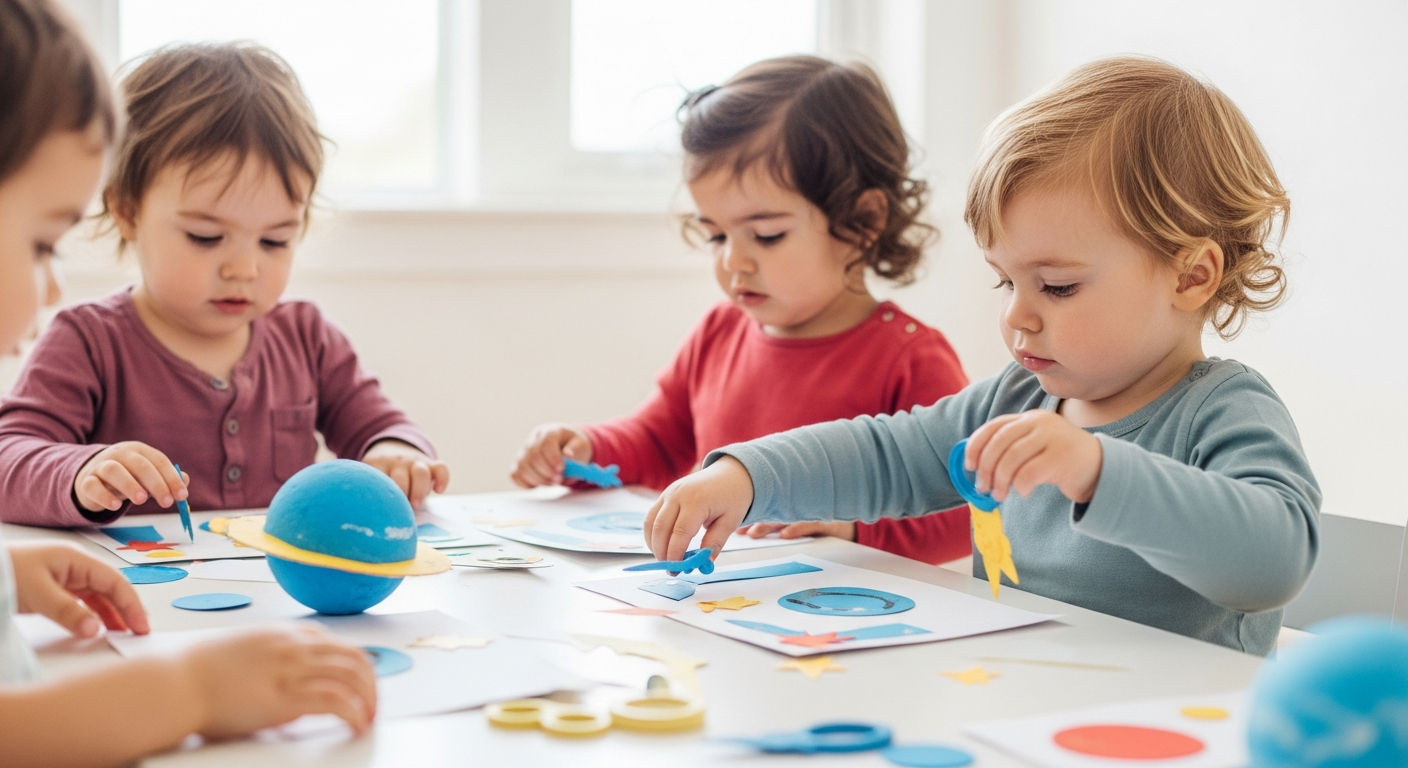
Table of Contents
- Introduction
- The Developmental Power of Space Play
- Creative Toddler Space Crafts with Recycled Materials
- Sensory Space Activities for Toddlers
- Artistic Space Projects for Early Learners
- Building Connections through Smart Screen Time
- Practical Tips for Parents of Late Talkers
- Exploring Value: Choosing the Right Plan for Your Family
- More Easy Toddler Space Crafts to Try Today
- Our Scientific Methodology: Why It Works
- Summary of Key Takeaways
- FAQ
- Conclusion
Introduction
Have you ever watched a toddler stare at the moon with pure, unadulterated awe? There is something inherently magical about the cosmos that captures a child’s imagination like nothing else. For a little one, the sky isn't just a ceiling; it is a vast playground of glowing lanterns, giant floating rocks, and shiny silver ships. This fascination provides a golden opportunity for parents. By tapping into this natural curiosity through toddler space crafts, we can create powerful learning moments that build fine motor skills, expand vocabulary, and foster a deep love for communication.
At Speech Blubs, our mission is to empower children to "speak their minds and hearts." We know that for the 1 in 4 children who need speech support, traditional methods can sometimes feel like a chore. That is why we believe in blending scientific principles with the joy of play. Whether you are building a cardboard rocket or exploring a "moon" sensory bin, these activities serve as a bridge to new words and concepts.

In this guide, we will explore a variety of hands-on, space-themed activities designed specifically for tiny hands and growing minds. We’ll cover everything from sensory exploration to "smart screen time" transitions, providing you with a toolkit to spark your child’s interest in the universe—and in their own voice. By the end of this post, you’ll have a galaxy of ideas to help your child develop foundational skills while creating joyful family memories.
The Developmental Power of Space Play
Before we dive into the glitter and glue, it is helpful to understand why space-themed play is so effective for toddler development. For a toddler, "space" is an abstract concept, but "moon," "star," and "rocket" are concrete, exciting words.
When we engage in toddler space crafts, we are doing more than just making art. We are working on:
- Fine Motor Skills: Ripping foil, sticking stars, and squeezing glue bottles strengthen the small muscles in the hands, which are later used for writing.
- Receptive Language: Following multi-step directions (e.g., "First, paint the plate blue, then add the stars") builds understanding.
- Expressive Language: Using "power words" like up, down, zoom, fast, big, and bright during play helps children express their observations.
- Confidence: Completing a project gives a child a sense of "I did it!" which is crucial for late talkers who may feel frustrated by communication barriers.
We often see parents who are concerned about their child’s progress. If you are wondering where your child stands, we recommend taking our quick 3-minute preliminary screener. It consists of 9 simple questions and provides a personalized assessment and next-steps plan.
Creative Toddler Space Crafts with Recycled Materials
You don’t need to spend a fortune at a craft store to bring the solar system into your living room. Some of the best toddler space crafts come from your recycling bin.
1. The Classic Toilet Paper Roll Rocket
This is a staple for a reason. It is easy to grip and offers endless customization.

What You’ll Need:
- Empty toilet paper or paper towel rolls
- Aluminum foil (great for sensory input!)
- Paper scraps or stickers
- Clothespins (for "landing legs")
The "Speech Blubs" Way: As you wrap the roll in foil, talk about the texture. Is it crinkly? Is it shiny? When you attach the clothespins, use the word clip. Once it’s finished, practice the countdown: "3... 2... 1... BLAST OFF!" This sequence is fantastic for practicing anticipation and speech sounds like the "b" in blast.
2. Cardboard Space Shuttle Exploration
For a parent whose 3-year-old "late talker" loves vehicles, a cardboard space shuttle offers a motivating way to practice "whoosh" and "vroom" sounds. If you have a large delivery box, don't throw it away! Cut out some wing shapes, tape them to the sides, and let your child climb inside. This "whole-body" play helps children ground themselves while they imagine soaring through the stars.
3. Paper Plate Solar System Spirals
This craft helps toddlers understand the concept of "round" and "spinning."
Steps:
- Paint a paper plate black or dark blue.
- Once dry, cut the plate in a spiral shape starting from the outer edge.
- Let your toddler stick star stickers or "planets" (circles of colored paper) along the spiral.
- Hang it from the ceiling and watch it spin!
Expert Tip: Use this activity to practice the word round or circle. Repetitive movements like spinning the plate can be very soothing and provide a rhythmic backdrop for practicing vowel sounds.
Sensory Space Activities for Toddlers
Sensory play is a cornerstone of early childhood development. It allows children to explore the world through touch, sight, and sound, which creates more "hooks" in the brain for language to stick to.
4. The Black Bean Galaxy Bin
This is one of our favorite toddler space crafts because it is so simple to set up.
- The Base: Fill a large tub with dried black beans.
- The "Stars": Add silver sequins, white pom-poms, or glow-in-the-dark stars.
- The Discovery: Hide small astronaut figures or "moon rocks" (grey painted stones) under the beans.
As your child scoops and pours, they are learning about volume and cause-and-effect. This is a great time to model words like hide, find, more, and all gone. If you’re looking for more ways to incorporate play into speech development, check out our research page to see how our methodology is backed by science.
5. "Moonwalking" in Kinetic Sand
Kinetic sand has a unique texture that holds its shape, making it perfect for "moon craters." Give your child a few toy astronauts and let them make footprints in the "lunar surface."
- Language Prompt: "Look! The astronaut is walking. Step, step, step."
- Sensory Tip: If your child is sensitive to textures, using a tool like a spoon or a small shovel can help them engage with the sand without feeling overwhelmed.
Artistic Space Projects for Early Learners
Art is a wonderful way for toddlers to express themselves before they have all their words.
6. Aluminum Foil Comets
A comet is just a chunk of rock and ice traveling through space, and it’s very easy to replicate with a toddler.
Steps:
- Ball up a piece of scrap paper.
- Wrap it in aluminum foil to create the "nucleus."
- Tape long strips of ribbon or crepe paper to one side to represent the "tail."
- Run around the room together making the comet "fly."
This activity is perfect for practicing the "f" sound in fly or fast. It also encourages gross motor movement, which is often linked to a child’s readiness to speak.
7. Watercolor Planets and Marbled Art
Using watercolors on coffee filters is a low-mess way to create beautiful, "glowing" planets. The way the colors bleed together mimics the atmosphere of gas giants like Jupiter.
- Flatten a coffee filter.
- Have your toddler dot it with washable markers.
- Spray it with a little water and watch the colors spread.
- Once dry, you have a marbled planet!
Building Connections through Smart Screen Time
At Speech Blubs, we understand that modern parenting involves technology. However, there is a big difference between "passive" screen time (like zoning out to cartoons) and "smart" screen time. Our app is designed to be a powerful tool for family connection and a screen-free alternative to passive viewing.
Our unique approach uses video modeling. Children learn best by watching and imitating their peers. In our "Space" categories, children see other kids making rocket sounds, naming planets, and mimicking the faces of funny aliens. This "kid-to-kid" connection triggers mirror neurons in the brain, making it easier for your child to try out new sounds.
We provide an immediate, effective, and joyful solution for families. Many parents have shared their success stories with us; you can read some of these testimonials here.
Transitioning from Craft to App
After you finish your toddler space crafts, try opening the Speech Blubs app. You might say, "We made a rocket! Now let’s see the rocket in our 'Smart Screen Time' game." This reinforces the vocabulary you just used during your hands-on play.
To experience the full suite of features, including our "Space" and "Vehicles" sections, download Speech Blubs on the App Store or get it on Google Play.
Practical Tips for Parents of Late Talkers
Crafting with a toddler can sometimes be messy or even a little stressful. Here are some strategies to keep the focus on joy and communication:
- Follow Their Lead: If your child is more interested in the sticky tape than the actual rocket, that’s okay! Talk about the sticky tape. Use the words stuck or pull.
- Wait and See: When you are crafting, give your child a moment to ask for what they need. Instead of handing them the next sticker, hold it up and wait for a sound or a gesture.
- Model, Don't Correct: If your child says "wocket" for rocket, don't say "No, say rocket." Instead, say, "Yes! A big, red rocket! Zoom!" This provides the correct model without causing frustration.
- Keep it Short: Toddler attention spans are famously brief. If a craft takes 5 minutes, that is 5 minutes of high-quality engagement.
Exploring Value: Choosing the Right Plan for Your Family
We want to be transparent about how you can access the best tools for your child's journey. While we offer a variety of ways to engage, our goal is to provide lasting value.
- Monthly Plan: For $14.99 per month, you get full access to the Speech Blubs app's library of activities and video modeling content.
- Yearly Plan (Best Value): Our Yearly plan is $59.99 per year, which breaks down to just $4.99 per month. This is a 66% saving compared to the monthly plan.
Why the Yearly Plan is the clear best choice:
- 7-Day Free Trial: You can explore everything for a full week at no cost.
- Reading Blubs: This plan includes the Reading Blubs app, which helps transition speech skills into early literacy.
- Early Access: You get the latest updates before anyone else.
- Support: Enjoy a 24-hour support response time for any questions you have.
The Monthly plan does not include the free trial, Reading Blubs, or early access. To give your child the best start, we recommend choosing the Yearly plan. Create your account and begin your 7-day free trial today.
More Easy Toddler Space Crafts to Try Today
If you’re ready for even more ideas, here are a few quick-fire crafts that require almost zero prep:
8. Starry Night Handprints
Use yellow paint to make your toddler's handprint on dark paper. Turn the paper upside down, and the fingers look like the rays of a shining star! This is a wonderful keepsake and a great way to talk about the word bright.
9. Moon Rock Painting
Go for a walk and find some smooth stones. Bring them home and paint them silver or grey.
- Why it works: It connects an outdoor physical activity with an indoor creative one.
- Language tip: Discuss the rocks' attributes. Are they heavy? Are they hard?
10. Galaxy Slime (Borax-Free)
Mix clear school glue with a bit of water, glitter, and liquid starch. Add a drop of purple or blue food coloring.
- Note: Always supervise toddlers with slime to ensure it doesn't end up in their mouths.
- The Benefit: The stretchy nature of slime is perfect for modeling the word long or stretch.
Our Scientific Methodology: Why It Works
Speech Blubs wasn't just built by developers; it was born from the personal experiences of our founders. They all grew up with speech problems and set out to create the tool they wished they had as children. This personal mission is what drives our commitment to scientific excellence.
Our "smart screen time" experiences are rooted in the concept of peer-to-peer learning. When a child sees another child successfully making a sound or saying a word, it reduces the intimidation factor. It feels like play, not therapy. This builds the confidence necessary for a child to "speak their minds and hearts."
We don't suggest guaranteed outcomes, such as "your child will be giving public speeches in a month." Instead, we focus on the beauty of the process:
- Fostering a love for communication.
- Building confidence through small wins.
- Reducing the frustration that often leads to tantrums.
- Developing key foundational skills like imitation and turn-taking.
Think of our app as a powerful supplement to your child’s overall development plan and professional therapy sessions. When combined with hands-on toddler space crafts, you are creating a rich, multi-sensory environment that supports every aspect of your child's growth.
Summary of Key Takeaways
Space is a theme that naturally encourages exploration and wonder. By using toddler space crafts, you can:
- Use everyday items like foil and cardboard to create engaging toys.
- Integrate sensory bins to help with vocabulary and fine motor development.
- Model "power words" to help your child express their world.
- Transition into "smart screen time" with the Speech Blubs app to reinforce learning through peer video modeling.
Whether you are building a galaxy in a box or just pointing out the moon at bedtime, these moments are the building blocks of communication. Every "ooh," "ahh," and "zoom" is a step toward your child finding their voice.
FAQ
1. Are space crafts safe for 2-year-olds who still put things in their mouths? Safety is the top priority. For younger toddlers, avoid small beads or sequins. Instead, use edible "moon sand" made from flour and oil, or large pieces of crumpled aluminum foil that are too big to swallow. Always supervise your child during craft time.
2. How can space crafts specifically help a child with a speech delay? Crafts provide a "joint attention" activity where you and your child are looking at the same thing. This is the foundation of communication. By naming the objects and actions (e.g., "glue," "stick," "star"), you are providing rich language input in a low-pressure environment.
3. What if my child isn't interested in drawing or painting? That is perfectly normal! Many toddlers prefer the "build and destroy" aspect of play. Instead of painting a planet, build a rocket out of blocks or use a sensory bin. The goal is engagement and conversation, not a perfect art project.
4. Can I use Speech Blubs if my child is already in speech therapy? Absolutely. Many speech-language pathologists (SLPs) recommend Speech Blubs as a way to practice at home between sessions. It reinforces the sounds and skills they are working on in therapy in a way that feels like a fun game.
Conclusion
The journey of speech development is a marathon, not a sprint, and it is filled with small, beautiful milestones. By bringing the stars and planets down to Earth through toddler space crafts, you are giving your child more than just a fun afternoon—you are giving them the tools to explore their own potential.
At Speech Blubs, we are honored to be a part of your family’s journey. Our goal is to make every learning moment a joyful one. Whether you are counting down to a rocket launch in your living room or following along with our peer models in the app, you are doing incredible work as a parent.
Ready to blast off? Start your journey today. Download Speech Blubs on the App Store or Google Play to begin. For the best value and access to our full suite of features—including a 7-day free trial and the Reading Blubs app—be sure to select our Yearly plan. Let's help your little one reach for the stars!
About the author