
Outdoor Game Ideas: Boost Kids' Speech & Play
 By Speech Blubs Team•Jan 28, 2026•19 min.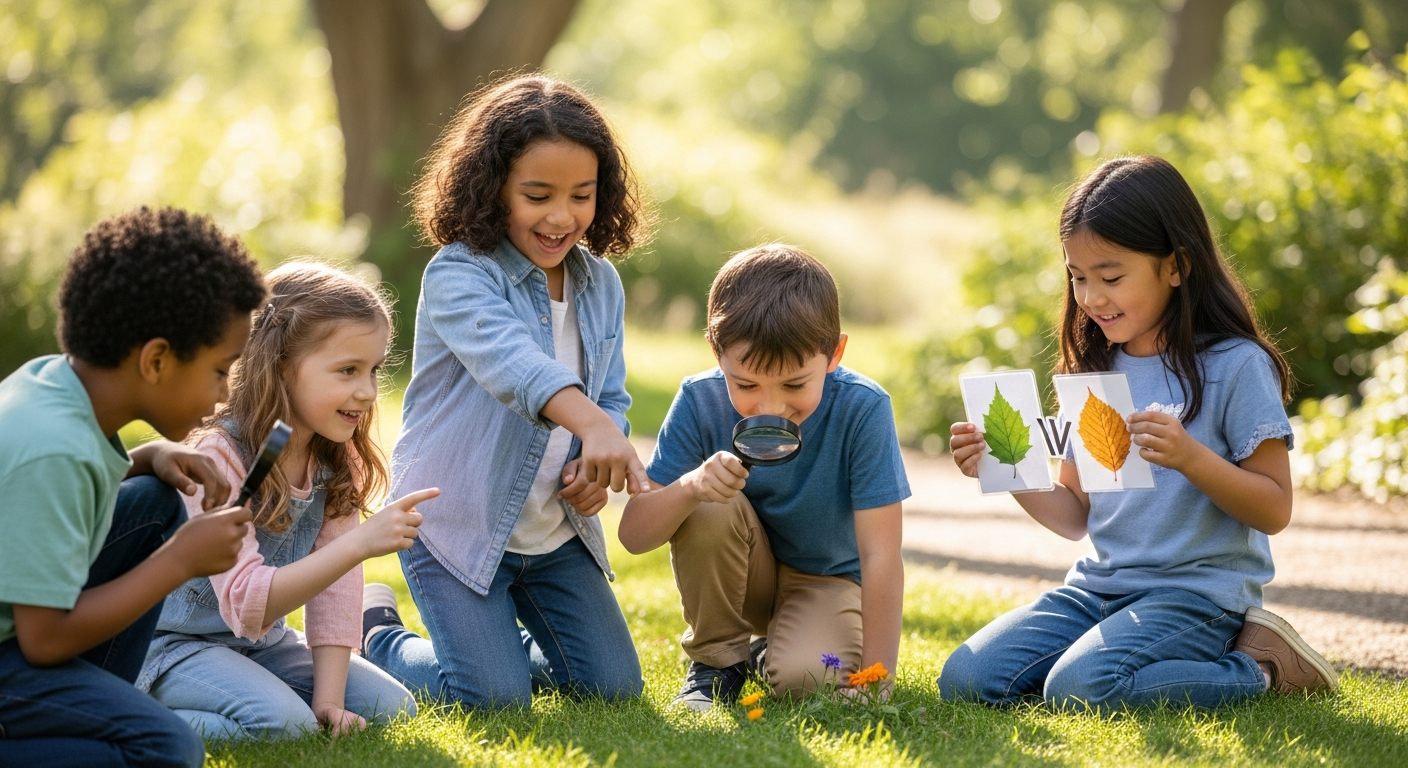
Table of Contents
- Introduction
- Why Outdoor Play Matters for Kids' Holistic Development
- Classic Outdoor Game Ideas Everyone Loves
- Creative & DIY Outdoor Game Ideas for Enhanced Engagement
- Team & Ball Games for Social Skills and Strategic Thinking
- Games for Younger Kids & Calming Down
- Integrating Speech & Language Support into Outdoor Play (and with Speech Blubs!)
- Conclusion
- FAQ
Introduction
Do you remember those long, sun-drenched summers of your childhood? Days filled with scraped knees, endless laughter, and the joyous shouts of "You're it!" or "Ready or not, here I come!" We often reminisce about a time when screens were scarce, and the great outdoors was our boundless playground. While the world has evolved, the fundamental need for children to connect with nature, engage in physical activity, and develop crucial life skills through play remains timeless. Today, we're diving deep into a treasure trove of kids outdoor game ideas that do more than just burn off energy – they ignite imagination, foster social skills, and, crucially, lay a powerful foundation for robust speech and language development.
This comprehensive guide will transport you back to those cherished memories, equipping you with classic and creative outdoor games to revitalize playtime for your children. We'll explore the multifaceted benefits of outdoor play, from boosting physical health and cognitive function to nurturing emotional intelligence and, most importantly, enhancing communication. Prepare to discover how simple games can transform into rich learning experiences, helping your child speak their minds and hearts with confidence.

Why Outdoor Play Matters for Kids' Holistic Development
Sending our children outside isn't just about giving them fresh air; it's about providing a rich, dynamic environment essential for their overall growth. The benefits extend far beyond physical exertion, touching every aspect of a child's development.
Physical Benefits: Building Strong Bodies
Outdoor games are a fantastic way to promote gross motor skills. Running, jumping, throwing, and catching all contribute to better coordination, balance, and agility. These activities help children build strength, develop endurance, and improve their cardiovascular health. Regular physical activity also contributes to better sleep patterns and helps regulate energy levels, often leading to calmer indoor times. From chasing friends in a game of tag to mastering the art of hopscotch, kids develop body awareness and control that are foundational for many other skills.
Cognitive Benefits: Sharpening Young Minds
Beyond the physical, outdoor play is a powerful catalyst for cognitive development. When children create their own games or navigate an obstacle course, they engage in problem-solving, critical thinking, and planning. They learn about cause and effect, spatial reasoning (understanding where things are in relation to each other), and how to adapt to changing situations. The unstructured nature of outdoor play sparks creativity and imagination, allowing children to invent worlds, roles, and narratives that are impossible indoors. A simple stick can become a magic wand, a sword, or a fishing rod, fostering abstract thought and flexibility.
Social-Emotional Benefits: Cultivating Connection and Resilience
Outdoor group games are mini-laboratories for social and emotional learning. Children learn invaluable lessons in teamwork, negotiation, turn-taking, and compromise. They practice empathy as they respond to others' emotions, whether it's comforting a friend who fell or celebrating a teammate's success. Dealing with wins and losses in a playful setting helps build resilience and teaches them how to manage frustration and excitement appropriately. These interactions build self-confidence, foster a sense of belonging, and help children understand social cues and boundaries in a natural, engaging way.

Language and Communication Benefits: Unlocking Their Voices
Perhaps one of the most significant, yet often overlooked, benefits of outdoor play is its profound impact on language and communication development.
- Vocabulary Expansion: The outdoor environment is teeming with new words! Describing different textures (rough bark, smooth stone), colors (vibrant green leaves, deep blue sky), actions (running, jumping, digging), and emotions (excitement, frustration, triumph) naturally expands a child’s lexicon.
- Following Instructions: Almost every game involves rules and instructions. "Run to the tree!", "Now, hop on one foot!", "It's your turn to count." These directives provide practical contexts for understanding and following multi-step commands, a crucial skill for academic success and daily life.
- Asking and Answering Questions: "Where are you hiding?", "Whose turn is it?", "What should we play next?" Outdoor games naturally encourage children to ask clarifying questions and provide answers, strengthening their conversational skills.
- Narration and Description: Children often narrate their play or describe what they see. "I'm building a huge fort!" or "Look at that tiny bug!" This practice helps them structure sentences, recount events, and express their thoughts clearly.
- Social Communication: Learning to initiate conversations, maintain a topic, take turns speaking, and understand non-verbal cues (like body language during a game) are all vital aspects of social communication. Outdoor play provides endless opportunities to refine these skills in a low-pressure, fun setting.
- Emotional Expression: Games provide a safe outlet for expressing a wide range of emotions. Children learn to verbalize their feelings, whether it's the joy of winning, the disappointment of being "out," or the excitement of a chase. This emotional literacy is fundamental to healthy communication.
At Speech Blubs, we believe deeply in empowering children to speak their minds and hearts. Our mission, born from our founders' personal experiences with speech challenges, is to provide an immediate, effective, and joyful solution for the 1 in 4 children who need speech support. We achieve this by blending scientific principles with play, creating one-of-a-kind "smart screen time" experiences. While outdoor play offers invaluable unstructured learning, our app serves as a powerful supplement, reinforcing the very communication skills honed during active play.
Classic Outdoor Game Ideas Everyone Loves
These timeless games have captivated generations for a reason: they're simple, fun, and packed with developmental benefits.
Tag (and its delightful variations)
The ultimate classic of pursuit and evasion! One player is "it" and chases others, trying to tag them. The tagged player becomes the new "it."
- Speech and Language Benefits: Following simple instructions ("You're it!"), understanding spatial concepts ("Run away!", "Catch me!"), expressing excitement.
- Variations:
- Freeze Tag: If tagged, you "freeze" in place until another unfrozen player tags you to "unfreeze" you. This adds an element of teamwork and strategic thinking.
- Language focus: Using verbs like "freeze" and "unfreeze," coordinating with teammates.
- Blob Tag: When a player is tagged, they hold hands with the person who tagged them, forming a growing "blob" that chases others.
- Language focus: Counting the number of players in the "blob," using descriptive terms like "getting bigger."
Hide and Seek
One player counts with their eyes closed while others find hiding spots. The seeker then hunts for the hidden players.
- Speech and Language Benefits: Counting practice, understanding prepositions ("behind the tree," "under the slide"), using descriptive language to give clues ("I see a little bit of red!"), asking "Where?" questions.
- Variations:
- Sardines: Only one person hides, and when found, the seeker joins them in the hiding spot. The game continues until everyone is crammed into the same spot like sardines.
- Language focus: Whispering and quiet communication, describing tight spaces.
- Kick the Can: A blend of hide-and-seek and tag. A "can" is designated as a base. One person is "it," counts, and then seeks. If they find someone, they race them back to the can. If "it" touches the can first, the player is jailed. If a hidden player kicks the can without being caught, all jailed players are freed!
- Language focus: Shouting "Kick the can, save all!" and strategic planning.
Hopscotch
Draw a hopscotch grid with chalk, then hop through the squares, picking up a marker along the way.
- Speech and Language Benefits: Counting (1-10), sequencing ("first, then, next"), body part identification ("hop on one foot"), following multi-step directions, using words like "in," "out," "on."
- Developmental Tip: For younger children, just the act of hopping through numbered squares is excellent for number recognition and gross motor skills.
Simon Says
A leader (Simon) gives commands, but players only follow if the command is preceded by "Simon Says."
- Speech and Language Benefits: Crucial for listening comprehension, identifying keywords, following single and multi-step instructions, impulse control, and learning to differentiate between commands. "Simon says, touch your nose." vs. "Touch your nose."
- Developmental Tip: This game is fantastic for pre-literacy skills as it requires careful attention to spoken language.
Red Light, Green Light
One player stands with their back to the others, calling out "Green Light!" while players run towards them. When they yell "Red Light!" and turn around, everyone must freeze. Anyone caught moving is out.
- Speech and Language Benefits: Listening for specific cues, understanding "stop" and "go," practicing impulse control, spatial awareness, and expressing anticipation.
- Developmental Tip: Great for practicing self-regulation and body control, even for the youngest children.
Musical Statues / Freeze Dance
Play music while kids dance. When the music stops, everyone freezes like a statue. Anyone still moving is out.
- Speech and Language Benefits: Listening skills, body part identification (dance with your "arms," "legs"), describing movements ("twirl," "wiggle"), understanding "still" and "moving," expressing joy and surprise.
Creative & DIY Outdoor Game Ideas for Enhanced Engagement
Sometimes, a little creativity can transform your backyard into an epic adventure. These games encourage imagination and often involve some simple setup.
Obstacle Courses
Use household items like pillows, hula hoops, ropes, buckets, or even pool noodles to create a series of challenges to navigate.
- Speech and Language Benefits: Following complex sequential instructions ("Crawl under the blanket, then step over the rope, and jump into the hoop!"), using prepositions, descriptive language to narrate the course ("This is the lava pit!"), problem-solving aloud.
- Speech Blubs Connection: After an exciting obstacle course, children can reinforce action verbs or descriptive adjectives using the "Around the House" or "Outdoor Fun" sections in the Speech Blubs app or Google Play Store.
Scavenger Hunts (Nature & Themed)
Create a list of items for children to find in the backyard or a park.
- Speech and Language Benefits: Vocabulary building (e.g., "pinecone," "feather," "smooth stone"), asking clarifying questions ("Is it rough or smooth?"), descriptive language to share findings, following instructions, turn-taking.
- Variations:
- Nature Scavenger Hunt: Look for specific natural items (a green leaf, a round rock, a bird's feather).
- Alphabet or Color Hunt: Find something that starts with "A" or something that is "blue."
- Developmental Tip: Using a checklist and a pencil can also enhance early literacy skills.
Fort Building
Provide old sheets, blankets, cardboard boxes, and pillows, then let their imaginations run wild creating a fort.
- Speech and Language Benefits: Collaborative language ("We need to hold this here!", "Can you pass me that?"), planning and problem-solving, descriptive storytelling ("This is our secret hideout from the dragons!"), using spatial words ("above," "below," "inside").
Backyard Artist (Chalk Art)
Armed with sidewalk chalk, children can transform a patio or driveway into a giant canvas.
- Speech and Language Benefits: Describing their creations, identifying colors and shapes, narrating their drawing process, asking for more materials ("I need more blue chalk!").
- Developmental Tip: Encourage them to draw a map or a story, promoting sequential thought and narrative skills.
Water Games
On a hot day, nothing beats the excitement of water play.
- Water Balloon Toss: Players stand in a circle and toss water balloons, stepping back after each successful catch until someone gets soaked.
- Language focus: Expressing excitement, counting steps, describing "wet" and "cold."
- Slip 'n Slide: A classic for shrieking laughter and cooling off.
- Language focus: Using action verbs like "slide," "splash," "giggle," and expressing sensory details.
Team & Ball Games for Social Skills and Strategic Thinking
These games often involve multiple players, making them excellent for developing social and strategic communication skills.
Spud
A ball game involving throwing, catching, and freezing. One player throws a ball up and calls a number. Everyone else scatters. The person whose number was called catches the ball, yells "Spud!" and everyone freezes. They then take four steps towards the closest player and try to tag them with the ball.
- Speech and Language Benefits: Counting, calling out names, giving commands ("Spud!"), spatial reasoning (estimating distance), verbalizing strategy.
Four Square
Played on a square court divided into four smaller squares, each numbered. Players bounce a ball between squares, trying to eliminate opponents by making them miss the ball or hit it out of bounds.
- Speech and Language Benefits: Rule-following, negotiating boundaries, calling out plays, understanding geometric terms ("square," "line"), turn-taking.
Dodgeball (with soft balls)
Two teams try to hit opponents with soft balls while avoiding being hit.
- Speech and Language Benefits: Team communication ("Throw it to me!", "Watch out!"), strategic planning, encouraging teammates, calling out names of opponents.
Tug of War
Two teams pull on opposite ends of a rope, trying to pull the other team across a central line.
- Speech and Language Benefits: Encouraging teammates ("Pull! Pull!"), coordinating efforts, expressing physical effort, understanding competition.
Capture the Flag
Teams try to steal the opponent's flag from their territory while protecting their own.
- Speech and Language Benefits: Complex strategic planning and communication, verbalizing roles ("You guard, I'll sneak!"), negotiating, problem-solving, using spatial language.
Horse (Basketball)
Players take turns shooting a basketball from a chosen spot. If they make it, the next player must replicate the shot. If they miss, they earn a letter in H-O-R-S-E.
- Speech and Language Benefits: Sequencing, describing actions ("I'm going to shoot from behind my back!"), encouraging, friendly competition, understanding rules.
Cornhole / Bean Bag Toss
Players toss bean bags onto a raised platform with a hole, earning points for landing on the board or in the hole.
- Speech and Language Benefits: Counting scores, simple instructions, encouraging, celebrating successes, understanding turn-taking.
Games for Younger Kids & Calming Down
Sometimes, we need games that are perfect for little ones or to wind down an active day.
Duck, Duck, Goose
Children sit in a circle while one player walks around, tapping heads and saying "Duck, duck, duck..." until they choose "Goose!" The "Goose" then chases the player around the circle.
- Speech and Language Benefits: Repetitive language, turn-taking, naming animals, understanding simple instructions, expressing excitement. A wonderful game for early sound recognition and rhythm.
What's the Time, Mr. Wolf?
One child is Mr. Wolf and stands with their back to the others. The other players ask, "What's the time, Mr. Wolf?" Mr. Wolf replies with a time (e.g., "2 o'clock!"), and players take that many steps forward. When Mr. Wolf finally shouts, "Dinner time!" they chase the players.
- Speech and Language Benefits: Counting, asking and answering questions, understanding time concepts, predicting outcomes, expressing urgency ("Run!").
Sleeping Lions
Everyone lies still on the ground, pretending to be asleep, while one "hunter" tries to make them move or giggle without touching them.
- Speech and Language Benefits: Practicing quietness, impulse control, self-regulation, using descriptive language to try and elicit a reaction ("Are you really asleep?"), understanding non-verbal cues. This is a great cool-down activity that still involves imaginative play.
Integrating Speech & Language Support into Outdoor Play (and with Speech Blubs!)
Outdoor play is undeniably rich for language development. As parents, we can maximize these opportunities by being active participants and intentional language models. Narrate what you're doing, describe what you see, ask open-ended questions, and encourage your child to express themselves. For instance, during a nature walk, instead of just pointing at a flower, describe its color, smell, and texture. Ask, "What do you think a squirrel says?" or "How does that rough bark feel?"
While outdoor play offers invaluable spontaneous learning, we understand that some children need a little extra support to truly speak their minds and hearts. This is where Speech Blubs comes in, offering a unique blend of scientific methodology and playful engagement. Our company was founded by individuals who grew up with speech problems, driven by the desire to create the tool they wished they had. We are committed to providing an immediate, effective, and joyful solution for the 1 in 4 children who need speech support.
We bridge the gap between traditional learning and engaging play through "smart screen time." Unlike passive viewing experiences like cartoons, Speech Blubs provides a screen-free alternative in its approach by engaging children actively. Our core methodology, "video modeling," allows children to learn complex communication skills by watching and imitating their peers. Mirror neurons in the brain activate as children observe other kids making sounds and words, facilitating natural and effective learning. This evidence-based approach has been highly rated on the MARS scale, a testament to our commitment to scientific research and efficacy.
Imagine a child who loves animals after a game of "What's the Time, Mr. Wolf?" They can transition to Speech Blubs' "Animal Kingdom" section to practice animal sounds and names by imitating their video models, reinforcing vocabulary and speech sounds in a fun, interactive way. Or, after an obstacle course, they can practice action verbs in the app, strengthening the connection between physical actions and their linguistic representations.
Speech Blubs isn't just an app; it's a powerful tool for family connection, designed for co-play and support. We help foster a love for communication, build confidence, reduce frustration, and create joyful learning moments that complement the wild adventures of outdoor play. Don't just take our word for it; read heartwarming parent testimonials about their children's progress.
Unsure if your child could benefit from a little extra speech support? Take our quick 3-minute preliminary screener. It involves 9 simple questions and provides an assessment and next-steps plan, guiding you toward the best support for your child, including a free 7-day trial of Speech Blubs.
Conclusion
Embracing outdoor play offers an unparalleled tapestry of developmental benefits for children, fostering physical prowess, sharpening cognitive abilities, nurturing social-emotional intelligence, and crucially, building robust speech and language skills. From the simple delight of a game of tag to the strategic intricacies of capture the flag, these experiences provide natural, joyful pathways for children to learn to communicate effectively and express their inner worlds.
By actively participating in and modeling language during these games, parents can significantly amplify their child's learning. And for those moments when you seek a structured, engaging, and scientifically-backed tool to further enhance communication, Speech Blubs stands ready to support your family's journey. We are dedicated to providing children with the ability to speak their minds and hearts, blending the power of play with effective speech development techniques.
Ready to embark on this journey of joyful communication and development with your child? We invite you to experience the transformative power of Speech Blubs. You can start with a 7-day free trial, which offers access to a wealth of engaging activities designed to nurture your child's speech and language skills.
To get the full suite of benefits, including the additional Reading Blubs app, early access to new updates, and 24-hour support response time, we highly recommend our Yearly plan. At just $59.99 per year, it breaks down to an incredible value of only $4.99 per month, allowing you to save 66% compared to the Monthly plan, which is $14.99 per month and does not include these exclusive features.
Download Speech Blubs today from the Apple App Store or Google Play Store, or create your account on our website to begin your 7-day free trial. Choose the Yearly plan to unlock the best value and comprehensive support for your child's communication journey. Let's make every moment a learning opportunity, indoors and out!
FAQ
Q1: How does outdoor play specifically help with speech development?
A1: Outdoor play boosts speech development in several ways: it expands vocabulary through describing nature and actions, enhances listening skills by following game rules, improves conversational skills through asking and answering questions, and encourages emotional expression in a natural, low-pressure environment. The dynamic context of games provides real-world scenarios for using language purposefully.
Q2: What age ranges are these outdoor games suitable for?
A2: Many of these games are adaptable for a wide range of ages! Classics like Tag and Duck, Duck, Goose are perfect for preschoolers (ages 3-5). Games like Hide and Seek, Hopscotch, and Simon Says are great for early elementary children (ages 5-8). More complex games like Obstacle Courses, Capture the Flag, or Spud can engage older kids and even tweens (ages 8-12+). The key is to adapt the rules and complexity to match your child's developmental stage.
Q3: How can Speech Blubs complement active outdoor play?
A3: Speech Blubs acts as "smart screen time" that perfectly complements outdoor activities. After an adventure-filled play session, children can reinforce the vocabulary, action verbs, and descriptive language they encountered by engaging with the app's interactive sections. For example, if they played a nature scavenger hunt, they can use Speech Blubs to practice animal sounds or describe colors they saw, leveraging our video modeling to learn from their peers. It's a powerful way to reinforce learning and build confidence in communication.
Q4: What's the best way to get started with Speech Blubs?
A4: The best way to get started with Speech Blubs is to choose our Yearly plan, which includes a 7-day free trial. This gives you full access to all features, including the Reading Blubs app, early updates, and priority support. You can download the app directly from the Apple App Store or Google Play Store, or create your account on our website. The Yearly plan offers the most value, breaking down to just $4.99 per month, a significant saving compared to the Monthly plan.
About the author