
Play Outside! 20+ Fun Outdoor Kid Games for Speech & Development
 By Speech Blubs Team•Jan 19, 2026•19 min.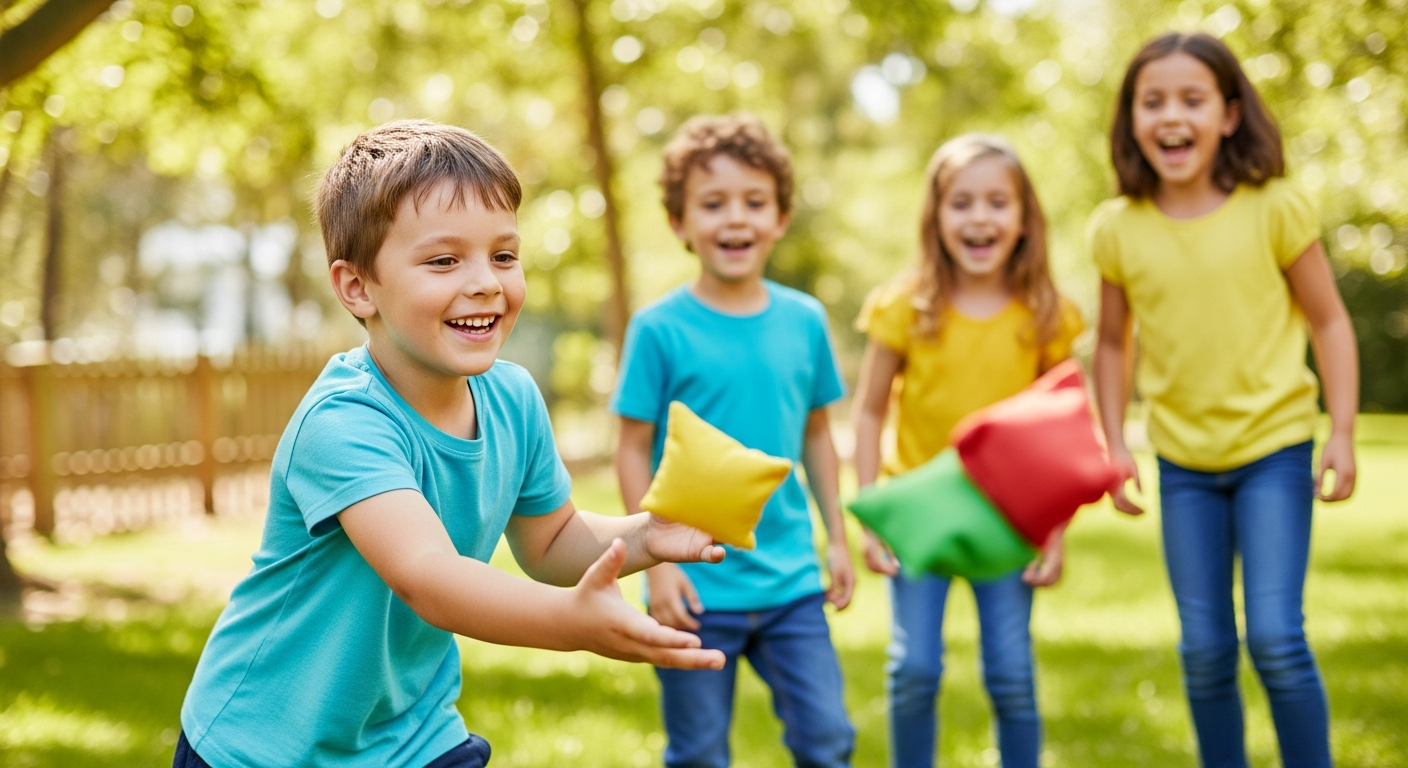
Table of Contents
- The Unrivaled Power of Outdoor Play for Child Development
- Fun Outdoor Kid Games to Get Everyone Talking and Moving!
- Boosting the Benefits: Parent Participation and Speech Blubs Synergy
- Ready to Get Started? Choose Your Plan Today!
- Frequently Asked Questions About Outdoor Play and Speech Development
Do you remember those endless summer days of your childhood? The sun on your face, the grass beneath your bare feet, the sound of laughter echoing down the street as you played tag until dusk? For many of us, these memories are vivid, filled with the simple joy of outdoor adventures. Yet, in today's screen-filled world, it can sometimes feel like those opportunities for spontaneous, open-ended outdoor play are shrinking.
But here’s the wonderful truth: getting outside and playing is not just about nostalgia; it’s an absolutely vital ingredient for a child’s holistic development, especially when it comes to communication skills. At Speech Blubs, we believe in empowering children to "speak their minds and hearts," and we know that vibrant communication blossoms in many environments – including the great outdoors. This post will take you on a journey through over 20 beloved outdoor games that don't just spark joy and burn energy, but also build crucial physical, cognitive, social, and especially, speech and language abilities. We’ll show you how to revitalize these classic pastimes and how they naturally foster the very communication skills we work to develop through our innovative "smart screen time" experiences. Get ready to ditch the devices (just for a bit!) and discover how playing outside can be a powerful tool for your child's growth.

The Unrivaled Power of Outdoor Play for Child Development
Stepping outside opens up a world of sensory experiences and learning opportunities that indoor environments simply can’t replicate. From the feel of the wind on their skin to the varied textures of grass and dirt, every element of outdoor play engages a child's senses, fueling their curiosity and developmental growth.
Physical Development: More Than Just Running Around
Outdoor games are a fantastic workout for growing bodies. They engage gross motor skills like running, jumping, hopping, and throwing, which are essential for coordination, balance, and overall physical health. Think about a child navigating a game of Hide and Seek – they're not just hiding; they're developing spatial awareness, agility, and muscle control. Or consider a game of Tag, where quick directional changes and bursts of speed hone reflexes and endurance. These activities strengthen core muscles, improve cardiovascular health, and even help with fine motor skills through tasks like picking up a marker in Hopscotch or aiming a beanbag in Corn Hole.
Cognitive Development: Minds in Motion
Beyond the physical, outdoor play is a powerful engine for cognitive growth. Children are constantly problem-solving: "Where's the best place to hide?" in Hide and Seek; "How far do I need to throw this ball?" in Spud; "What's the sequence for Hopscotch?" These games encourage strategic thinking, planning, and memory. They also foster creativity and imagination, turning a simple stick into a magic wand or a patch of grass into a dragon's lair. Understanding and following multi-step instructions, remembering rules, and adapting to changing game scenarios are all cognitive exercises that prepare children for academic success.
Social-Emotional Development: Learning Life's Lessons Through Play
Perhaps one of the most significant benefits of outdoor games is their role in social-emotional development. Playing with others teaches invaluable life skills:
- Turn-taking and Sharing: Every game has a sequence, requiring players to wait their turn and share equipment.
- Negotiation and Compromise: Deciding on rules, teams, or game variations necessitates communication and mutual understanding.
- Empathy and Perspective-taking: Understanding how others feel when they win or lose, or how their actions affect the group.
- Conflict Resolution: Learning to work through disagreements about rules or fairness.
- Building Confidence: Successfully participating in a game, making a good play, or even just being chosen for a team boosts self-esteem.
- Emotional Regulation: Managing the excitement of winning or the frustration of losing, all within a supportive play environment.
These experiences are fundamental for developing resilience, social competence, and a positive self-image.

Language and Communication Development: Speaking Up in the Sunshine
This is where the magic truly happens, and where outdoor play becomes a perfect complement to our mission at Speech Blubs. Outdoor games are a natural, low-pressure environment for children to practice and expand their language and communication skills.
- Following Instructions: Nearly every game involves listening to and executing instructions, from "count to ten" in Hide and Seek to "take three giant steps" in Mother May I? This strengthens receptive language.
- Expressive Language: Children verbalize actions ("I'm running!"), describe observations ("I see you!"), ask questions ("Whose turn is it?"), and narrate their play.
- Vocabulary Expansion: Learning new words related to movement (hop, skip, jump), directions (forward, backward, left, right), emotions (excited, frustrated), and game-specific terms (tag, base, flag).
- Social Communication: Practicing conversational turn-taking, initiating interactions, negotiating rules, and expressing wants and needs. For a parent whose child is working on verbalizing requests, asking "Can I go first?" or "Where should I hide?" in a game provides real-world practice.
- Storytelling and Imagination: Games like Ghost in the Graveyard or Capture the Flag encourage children to create narratives, build suspense, and role-play, enhancing their ability to tell stories and engage in imaginative play.
- Voice Volume and Intonation: Shouting "Red Light!" or "Polo!" allows children to experiment with voice modulation, a key aspect of pragmatic communication.
At Speech Blubs, we know that language learning is most effective when it's engaging and interactive. Our app was born from the personal experiences of our founders, who all grew up with speech challenges and created the tool they wished they had. We are committed to providing an immediate, effective, and joyful solution for the 1 in 4 children who need speech support, blending scientific principles with play. This aligns perfectly with the interactive, natural learning that outdoor games provide. When a child practices 'running' outside, they can then reinforce that word and its action through our app's action verb activities which use video modeling to show real peers performing the actions.
Unsure if your child could benefit from a little extra communication support? Take our quick 3-minute preliminary screener to get a simple assessment and a free 7-day trial.
Fun Outdoor Kid Games to Get Everyone Talking and Moving!
Let's dive into some fantastic outdoor games that are guaranteed to bring smiles, laughter, and a boost to your child’s communication skills. We've categorized them for easy exploration, but remember, the best games are often those that evolve with your child’s creativity!
Classic Favorites: Simple Rules, Big Fun
These timeless games are easy to learn and offer endless opportunities for verbal interaction.
1. Hide and Seek
- How to Play: One person is the "seeker," counting loudly with eyes closed while others hide. After counting, the seeker searches for the hidden players. The last person found often becomes the next seeker.
- Communication Boost: This game is fantastic for practicing counting, understanding prepositions ("behind the tree," "under the slide"), and using descriptive language when giving clues or describing hiding spots. Children also practice calling out names, listening for sounds, and using negotiation ("Can I have five more seconds?").
- Speech Blubs Connection: Just like children learn from observing their peers hide and seek, our app uses a unique video modeling methodology where kids learn by watching and imitating other children. This active observation of real mouths and actions helps children grasp complex communication skills more effectively than passive viewing.
2. Tag (or "It," "Tig")
- How to Play: One person is "it" and chases others. Anyone "tagged" becomes the new "it."
- Communication Boost: Excellent for practicing "You're it!" or "I got you!" as well as action words like "run," "chase," "fast," and "stop." Children learn to communicate their status ("I'm it!") and use direct commands.
- Parent Tip: Introduce variations like "freeze tag" (where tagged players freeze until unfrozen by another player), which adds the communicative aspect of "freezing" and "unfreezing," expanding vocabulary related to states and actions.
3. Hopscotch
- How to Play: Draw a hopscotch grid with chalk, numbering squares. Players toss a marker into a square, hop through the grid skipping the marked square, pick up their marker on the way back, and repeat.
- Communication Boost: Perfect for number recognition and counting, following sequential instructions, and using spatial language ("in front of," "behind," "next to"). For younger children, simply verbalizing the numbers they land on is great practice.
- Speech Blubs Connection: Our app offers various sections that help children with sequencing and numerical concepts, just like hopscotch. The ability to articulate numbers and follow patterns is a building block for more complex linguistic structures.
4. Red Light, Green Light
- How to Play: One person is the "stop light" and stands at one end of the yard. Others are "traffic" at the other end. The stop light calls "Green Light!" and turns their back, allowing traffic to run forward. When "Red Light!" is called, the stop light turns around, and anyone still moving must return to the start.
- Communication Boost: Crucial for understanding and following commands ("stop," "go"), practicing voice volume and intonation ("Red Light!"), and developing self-regulation skills as they respond to verbal cues.
- Parent Tip: Encourage the "stop light" player to enunciate clearly, and the "traffic" players to describe their movements or feelings ("I almost moved!").
5. Duck, Duck, Goose
- How to Play: Players sit in a circle. One player walks around tapping heads, saying "duck, duck, duck" until they choose someone to be "goose." The "goose" then chases the first player around the circle.
- Communication Boost: Repetitive language practice ("duck, duck, goose"), understanding rules, and social interaction. It’s an excellent game for young children to practice clear vocalizations and turn-taking in a group setting.
Teamwork & Strategy Games: Building Social Language Skills
These games encourage collaboration, negotiation, and more complex communicative strategies.
6. Capture the Flag
- How to Play: Divide into two teams. Each team hides a "flag" (a bandana or T-shirt) in their territory. The goal is to capture the opposing team's flag and bring it back to your base, while guarding your own.
- Communication Boost: This game is a powerhouse for negotiation ("You guard here, I'll go there!"), strategic planning, descriptive language ("It's behind the big oak tree!"), and verbalizing team decisions. Players must communicate their location, warn teammates, and call out opponents.
- Speech Blubs Connection: For children who struggle with sequencing and expressing complex ideas, games like Capture the Flag offer rich practice. Our app’s storytelling and sequencing activities can help children organize their thoughts and articulate their plans, making them more effective communicators in team games.
7. Kick the Can
- How to Play: A combination of hide-and-seek and tag. One person is "it" and guards a can. Others hide. "It" finds players, calls their name, and races them back to the can. If "it" gets there first, the player goes to "jail." If a hidden player kicks the can, all "jailed" players are freed.
- Communication Boost: Encourages tactical communication, calling out names, and shouting "Kick the Can! Save all!" It's great for spatial reasoning and using descriptive language to recall hiding spots.
8. Tug of War
- How to Play: Two teams pull on opposite ends of a rope, trying to drag the opposing team over a central line.
- Communication Boost: Encourages teamwork and verbal encouragement ("Pull! Pull harder!"). Children learn to coordinate actions with words and motivate their teammates. This game also subtly introduces concepts of force and resistance.
9. Spud
- How to Play: One player throws a ball high and calls out another player's name. That player catches the ball while others scatter. Once caught, the catcher yells "Spud!" and everyone freezes. The catcher takes four steps towards the nearest player and tries to hit them with the ball.
- Communication Boost: Calling out names loudly, shouting "Spud!", and expressing surprise or excitement. It also involves quick decision-making under pressure, which can translate into quick verbal responses.
10. Musical Chairs / Musical Statues
- How to Play: (Chairs) Arrange chairs in a circle, one less than the number of players. Music plays, everyone walks around. When music stops, players scramble for a seat. One chair is removed each round. (Statues) Players dance when music plays, then freeze when it stops. Anyone moving is out.
- Communication Boost: Following auditory cues, expressing preferences ("I love this song!"), and verbalizing disappointment or excitement. These games help children understand abstract concepts like "freeze" and "stop" and respond promptly.
Active Challenges: Movement and Expressive Language
These games get hearts pumping and encourage children to use action words and descriptive language.
11. Horse (or PIG)
- How to Play: With a basketball and hoop, players take turns shooting. If a player makes a shot, the next player must replicate it from the same spot. If they miss, they earn a letter (H, O, R, S, E).
- Communication Boost: Describing shots ("I'm going to try a free throw!"), explaining techniques, and expressing frustration or encouragement. It's a great game for developing competitive language and sportsmanship.
- Parent Tip: For younger kids, focus on just saying "My turn!" or "Your turn!" and naming the ball or the hoop.
12. Foursquare
- How to Play: A large square divided into four numbered quadrants (1-4). Players hit a rubber ball back and forth, trying to make it bounce in another player's square. If a player misses or hits out of bounds, they go to the lowest square (or are out).
- Communication Boost: Calling out opponents, announcing serves, and negotiating rules. It's an excellent way to practice spatial vocabulary and quick verbal responses.
13. Double Dutch
- How to Play: Two long jump ropes are turned in opposite directions by two "turners." A "jumper" enters and jumps both ropes simultaneously.
- Communication Boost: Rhythm, counting, coordinating actions with turners ("Ready, set, go!"), and sometimes chanting rhymes. This requires complex timing and auditory processing, which are foundational for speech rhythm.
- Speech Blubs Connection: Our focus on auditory processing and speech rhythm through engaging activities can provide a supportive environment for children who find the rhythmic demands of Double Dutch challenging.
14. Hot Potato
- How to Play: Players sit in a circle and quickly pass a "potato" (ball, beanbag) while music plays. When the music stops, whoever holds the potato is out.
- Communication Boost: Quick directives ("Pass it!"), expressing urgency, and understanding concepts of "in" and "out." It fosters rapid verbal responses and turn-taking.
15. Corn Hole (or Bags)
- How to Play: Teams toss beanbags at a raised platform with a hole. Points are awarded for landing on the board or in the hole.
- Communication Boost: Counting scores, cheering teammates, and making simple strategic decisions ("Aim for the hole!"). It's great for number talk and positive social reinforcement.
Creative & Imaginative Games: Sparking Narrative and Role-Play
These games tap into a child's imagination, encouraging descriptive language and storytelling.
16. Ghost in the Graveyard
- How to Play: Designate a "home base" and a "ghost." The ghost hides while others count to "midnight" (e.g., "1 o'clock, 2 o'clock..."). The players search for the ghost, and the first to spot them yells "Ghost in the Graveyard!" The ghost then chases everyone back to home base.
- Communication Boost: Building suspense ("Where is the ghost?"), calling out warnings, and using imaginative language to describe the game's atmosphere. This is excellent for narrative skills and expressing fear or excitement.
17. Pin the Tail (on the Donkey/Animal)
- How to Play: Draw an animal on a poster board. Blindfold a player, spin them, and have them try to pin a "tail" in the correct spot.
- Communication Boost: Giving instructions ("Go left! Go right!"), using directional vocabulary, and expressing encouragement or playful teasing.
18. Mother May I? (or Captain May I?)
- How to Play: One player is "Mother" and stands at one end. Others line up at the other end. Players ask "Mother, may I take [number] [type] steps?" (e.g., "3 giant steps," "5 baby steps"). Mother says "Yes, you may" or suggests an alternative.
- Communication Boost: Asking questions politely, using descriptive adjectives for steps, following multi-step commands, and creative problem-solving in their requests. This game truly hones the skill of verbal negotiation and request formation.
19. Simon Says
- How to Play: One player is "Simon" and gives commands, always prefaced with "Simon says." Players only follow commands if "Simon says" is used.
- Communication Boost: Crucial for auditory discrimination (listening for "Simon says"), following instructions, and understanding conditional statements. It also allows the "Simon" player to practice giving clear, concise commands.
20. Pooh Sticks
- How to Play: Find a bridge over a stream. Each player drops a stick into the water on one side of the bridge and then runs to the other side to see whose stick emerges first.
- Communication Boost: Describing sticks ("mine is big and brown!"), cheering for their stick, and explaining the concept of "first" and "last." It’s a gentle, observational game that encourages descriptive language.
Boosting the Benefits: Parent Participation and Speech Blubs Synergy
The power of these outdoor games is amplified when parents and caregivers actively participate. Your involvement not only makes the games more fun but also provides a rich model for language and social interaction. Talk through the game, narrate actions, ask open-ended questions, and encourage your child to express themselves.
At Speech Blubs, we understand that supporting your child's communication journey is a continuous effort, both on and off the screen. Our app is designed to be a powerful supplement to your child’s overall development plan and, when applicable, professional therapy. We offer a screen-free alternative to passive viewing, promoting engaging "smart screen time" that sparks interaction and learning.
Our unique video modeling approach – where children learn by watching and imitating their peers – is backed by science and helps develop a wide range of speech and language skills. From practicing specific sounds to building vocabulary and mastering sentence structures, Speech Blubs provides a joyful, immediate, and effective solution. We are proud to consistently rank high on the MARS (Mobile App Rating Scale) and have countless testimonials from parents who have seen incredible progress with their children.
Playing outside and using Speech Blubs together creates a powerful synergy. Imagine your child practicing animal sounds in our "Animal Kingdom" section, then running outside to play a game of "Animal Tag," making those sounds as they chase. This bridges the learning from screen to real-world application, reinforcing skills in multiple contexts.
Ready to Get Started? Choose Your Plan Today!
Empowering your child to communicate confidently is one of the greatest gifts you can give them. Combining the joy of outdoor play with the targeted support of Speech Blubs creates an unparalleled learning experience.
We offer flexible plans to fit your family's needs:
- Monthly Plan: For just $14.99 per month.
- Yearly Plan: Our best value at $59.99 per year, which breaks down to an incredible $4.99/month! That's a 66% savings compared to the monthly plan.
Choosing the Yearly plan isn't just about saving money; it unlocks a world of extra benefits that truly enhance your child's learning journey:
- Enjoy a 7-day free trial to explore all our features before committing.
- Gain exclusive access to the companion Reading Blubs app, helping to build early literacy skills.
- Receive early access to new updates and enjoy 24-hour support response time for any questions you may have.
The Monthly plan does not include these exclusive benefits. For the best value, the most features, and the chance to try it all out, the Yearly plan is the clear choice.
Join the thousands of families who are already seeing the amazing results. Download Speech Blubs today and unlock your child's full communication potential.
Download Speech Blubs on the App Store Get Speech Blubs on Google Play Or, if you prefer to sign up from your computer, create your account and begin your 7-day free trial today! Remember to select the Yearly plan to access your free trial and all the exclusive features.
Frequently Asked Questions About Outdoor Play and Speech Development
Q1: How do outdoor games specifically help with speech development, beyond just general interaction?
A1: Outdoor games offer unique benefits for speech development by creating dynamic contexts for language use. Children learn to follow multi-step verbal instructions (receptive language), practice giving commands (expressive language), expand vocabulary related to actions, directions, and emotions, and develop social communication skills like negotiation and turn-taking. The physical activity itself can also stimulate cognitive function, which is linked to language processing.
Q2: My child is a late talker. Can outdoor games really make a difference, or do we need formal therapy?
A2: Outdoor games can certainly make a positive difference by creating a natural, engaging environment for language practice, even for late talkers. They provide motivation for communication through play. However, for a late talker, outdoor games are a wonderful supplement, not a replacement, for professional guidance. We recommend consulting a speech-language pathologist for a proper assessment. Tools like Speech Blubs can also be a significant support, providing targeted practice in a playful way, blending scientific principles into fun "smart screen time" activities that complement both outdoor play and therapy.
Q3: What if my child prefers screen time to playing outside? How can I encourage outdoor games?
A3: It's all about balance and making outdoor play irresistible! Start by suggesting games that connect to their interests. Maybe they love superheroes – play a game where they "fly" or "save" something. Gradually introduce new games, and most importantly, participate with them! Your enthusiasm is contagious. You can also frame our Speech Blubs app as "smart screen time" that works in harmony with outdoor adventures. For example, after an app activity on animal sounds, suggest going outside to "find" those animals or play a game where everyone makes an animal sound.
Q4: How does Speech Blubs integrate with the idea of active, outdoor play?
A4: At Speech Blubs, we believe in supporting every aspect of a child's development. Our app offers "smart screen time" that is active, engaging, and specifically designed to foster communication skills. When children play outside, they're learning through experience; Speech Blubs helps reinforce those learned concepts and vocabulary through our unique video modeling technology. For instance, if your child learns action verbs like "run" or "jump" in the app, they can immediately apply and reinforce that knowledge during a game of Tag or Hopscotch. It's about creating a powerful learning loop where real-world play and targeted app activities complement each other, empowering children to "speak their minds and hearts" with confidence.
About the author