
Playful Group Games for Kids' Growth
 By Speech Blubs Team•Jan 19, 2026•21 min.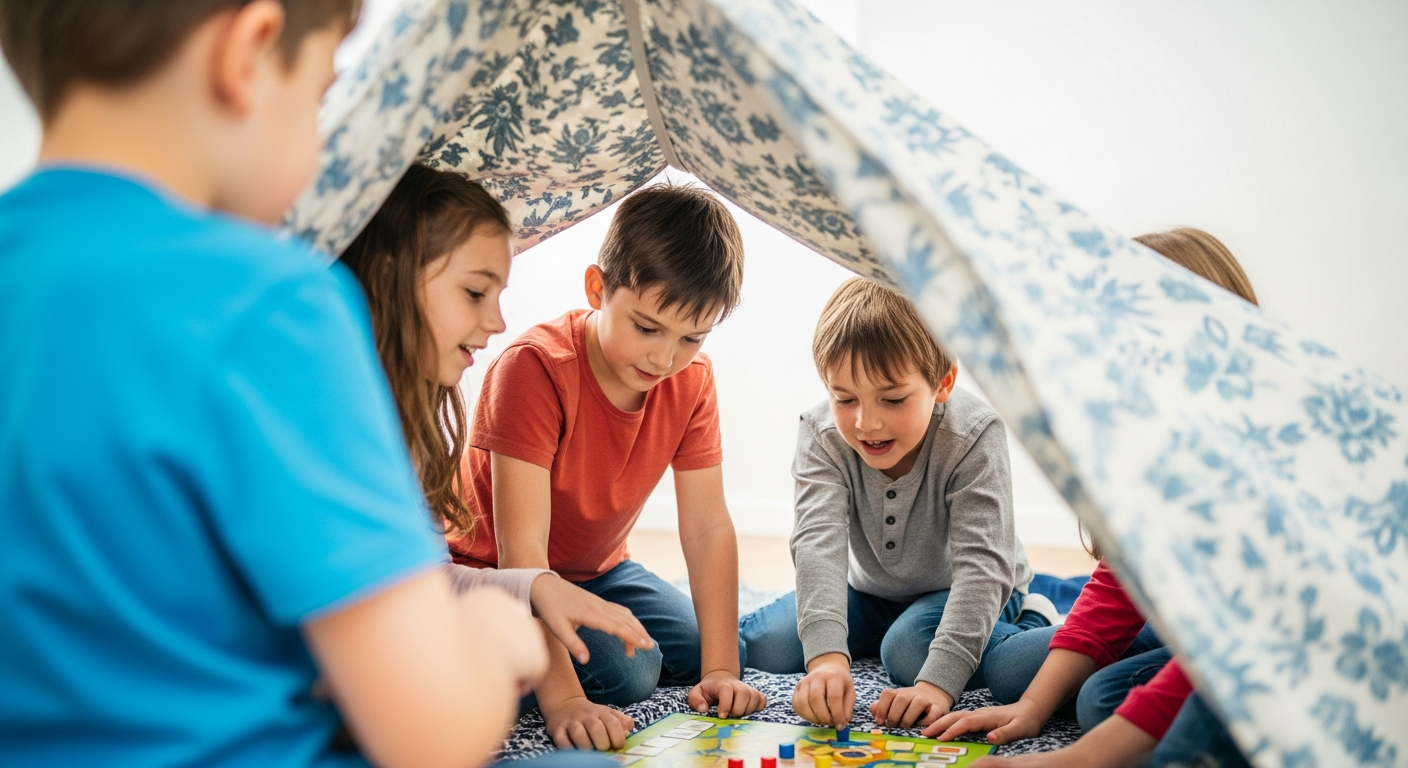
Table of Contents
- Introduction
- The Power of Play: Why Group Games Matter
- Icebreakers and Get-to-Know-You Games
- Cooperative and Team-Building Challenges
- Imagination and Storytelling Games
- Active and Movement Games
- Observational and Deductive Games
- Making Group Games a Part of Your Routine
- Investing in Your Child's Communication Journey with Speech Blubs
- Conclusion
- Frequently Asked Questions
Ever watch a group of children deeply engaged in play, their laughter echoing and their imaginations soaring? It’s more than just fun; it’s a powerful engine for development. Group games, in particular, are incredible catalysts for learning vital life skills, from communication and problem-solving to empathy and cooperation. In an age where screen time often dominates, finding ways to foster interactive, shared experiences is more crucial than ever. This post dives deep into the world of fun kids group games, exploring how these activities not only bring joy but also build a robust foundation for a child's social, emotional, and communicative growth. We’ll uncover a treasure trove of games perfect for various settings and age groups, highlighting the unique developmental benefits each one offers. By the end, you'll have a comprehensive guide to transform playtime into powerful learning opportunities, empowering your child to "speak their minds and hearts" through joyful interaction and connection.

Introduction
Imagine a world where every child feels confident to express themselves, connect with others, and navigate social situations with ease. This isn't just a dream; it's a journey nurtured through intentional play, especially through engaging in fun kids group games. These aren't just time-fillers; they are dynamic workshops for the developing mind and spirit. From the simple act of taking turns to the complex art of collaborative problem-solving, group games offer a rich tapestry of experiences that build crucial communication skills, foster resilience, and ignite creativity.
At Speech Blubs, we understand this journey intimately. Our mission is to empower children to "speak their minds and hearts," a commitment born from our founders' personal experiences with speech challenges. We created the tool we wished we had—a joyful, effective solution that blends scientific principles with play. We know firsthand the frustration that can come from communication difficulties, and we believe that every child deserves the opportunity to connect meaningfully with the world around them. That's why we champion "smart screen time" experiences like our unique video modeling methodology, where children learn by watching and imitating their peers, providing a powerful, active alternative to passive viewing. But we also firmly believe in the power of unplugged, interactive play. The very skills cultivated through group games – imitation, turn-taking, active listening, and expressive language – are the bedrock upon which strong communication is built, echoing the foundational principles embedded in the Speech Blubs app.
In this comprehensive guide, we will explore a diverse array of fun kids group games, categorizing them to help you easily find the perfect fit for your child's age, environment, and developmental goals. We'll delve into icebreakers that ease social anxieties, cooperative challenges that build teamwork, imaginative games that spark creativity, and active adventures that get bodies moving and voices chiming. More importantly, we'll connect these playful experiences to the essential communication skills they nurture, showing how they complement a child's overall development plan and can even enhance the progress made with tools like Speech Blubs. Get ready to transform everyday moments into extraordinary learning adventures, fostering a love for communication and building confidence, one joyous game at a time.

The Power of Play: Why Group Games Matter
Before we dive into specific games, let's explore why incorporating fun kids group games into your child's routine is so vital. These aren't just frivolous activities; they are essential building blocks for holistic development.
Fostering Communication and Social Skills
Perhaps the most obvious benefit of group games is the immense opportunity they provide for developing communication and social skills. Children learn to:
- Listen Actively: Following instructions, understanding rules, and paying attention to their peers.
- Express Themselves: Articulating ideas, asking questions, and sharing their thoughts and feelings.
- Take Turns: A fundamental social skill, crucial for conversational flow and cooperative play.
- Cooperate and Collaborate: Working together towards a common goal, sharing resources, and finding compromises.
- Resolve Conflicts: Navigating disagreements and learning to advocate for themselves respectfully.
- Read Non-Verbal Cues: Interpreting facial expressions, body language, and tone of voice, just like in games such as "Weasel in the Middle" where children decipher expressions.
For a child who might be a "late talker" or struggles with social interactions, these structured (but fun!) environments offer a safe space to practice. At Speech Blubs, we mirror this approach by providing interactive activities that naturally encourage imitation, turn-taking, and expressive language. Our video modeling feature, where children watch and imitate their peers, is a scientifically backed method to build these foundational skills, much like how children learn from each other in group play. By providing a screen-free alternative to passive viewing, we aim to provide a powerful tool for family connection, creating joyful learning moments that extend far beyond the app itself.
Building Confidence and Self-Esteem
Successfully participating in a group game, contributing to a team, or even just making a new friend during play significantly boosts a child's confidence. They learn that their ideas are valued, their efforts matter, and they are an important part of a larger whole. This confidence translates into other areas of their lives, including their willingness to speak up and engage in new learning experiences.
Enhancing Cognitive Development
Group games are often problem-solving challenges in disguise. Children develop:
- Strategic Thinking: Planning moves, anticipating outcomes, and adapting to changing circumstances.
- Creative Thinking: Inventing solutions, imagining scenarios, and using materials in novel ways.
- Logical Reasoning: Understanding cause and effect, and making decisions based on game rules.
- Memory and Attention: Remembering instructions and staying focused on the task at hand.
Promoting Physical Activity
Many group games involve movement, whether it's running, jumping, crawling, or intricate hand-eye coordination. This physical activity is vital for gross and fine motor skill development, energy release, and overall health.
Cultivating Empathy and Understanding
When children play together, they step into different roles, experience different perspectives, and learn to understand and appreciate others' feelings. This builds empathy, a cornerstone of healthy relationships.
Icebreakers and Get-to-Know-You Games
Starting a group activity, especially with children who may not know each other well or are feeling shy, can be daunting. Icebreaker games are fantastic for easing tension, encouraging initial interactions, and making everyone feel comfortable.
1. Birthday Lineup
- What You’ll Need: An open space.
- How to Play: Instruct children to line up in order of their birthdays, from January 1st to December 31st, without speaking. They’ll have to use gestures, head nods, and other non-verbal cues to figure out their place. For a simpler version, allow quiet talking.
- What it Teaches: Non-verbal communication, problem-solving, active listening, and subtle social negotiation. This is excellent for building early pragmatic language skills.
- Speech Blubs Connection: Just as this game encourages children to understand and react to cues, Speech Blubs' interactive features prompt children to respond to visual and auditory cues, reinforcing receptive language and processing speed.
2. Common Denominator
- What You’ll Need: Small groups, a timer.
- How to Play: Divide children into small groups. Set a timer for five minutes and challenge each group to find one unique thing that every member has in common (e.g., they all like cats, they all have a sibling, they all enjoy drawing). Once they find it, they can discuss it further.
- What it Teaches: Active listening, questioning, discussion, finding similarities, and group consensus. This builds the foundation for conversational turn-taking and shared topics.
- Speech Blubs Connection: This game encourages children to articulate preferences and shared experiences. Speech Blubs, with its diverse categories like "Animals" or "Food," helps children expand their vocabulary to describe their worlds, making it easier to find those "common denominators" with peers. Explore more about our unique methodology here.
3. This or That
- What You’ll Need: An open space, or simply a circle of seated children.
- How to Play: The leader asks a "this or that" question (e.g., "Would you rather have a pet dragon or a pet unicorn?"). Children choose their answer by moving to one side of the room or raising a specific hand. Then, invite a few children from each side to explain their choice.
- What it Teaches: Expressing preferences, making choices, articulating reasons, listening to different perspectives, and forming opinions.
- Speech Blubs Connection: The act of choosing and explaining is a crucial communication skill. Speech Blubs encourages expressive language through repetition and structured prompts, preparing children to articulate their thoughts in games like "This or That."
Cooperative and Team-Building Challenges
These games emphasize working together rather than competing, highlighting the strength of collective effort.
4. Human Knot
- What You’ll Need: 5-10 children per group, an open space.
- How to Play: Have each small group stand in a tight circle. Everyone reaches one hand into the center and grabs a random hand from someone across the circle. Then, reach in with the other hand and grab another random hand. The challenge is to untangle the "knot" without letting go of anyone's hands, forming a single circle.
- What it Teaches: Problem-solving, spatial reasoning, communication (verbal and non-verbal), patience, and physical coordination. Children must negotiate and strategize as a team.
- Speech Blubs Connection: The complex task of untangling requires clear instructions and requests ("lift your arm," "step over here"). Speech Blubs helps children build their vocabulary for actions, prepositions, and descriptive words, giving them the tools to navigate such challenges. Download Speech Blubs on the App Store to support this growth.
5. Spaghetti Tower Challenge
- What You’ll Need: Uncooked spaghetti, marshmallows (or modeling clay), string, tape for each group.
- How to Play: Divide children into groups and give each group the same materials. Their challenge is to build the tallest freestanding tower using only these items within a set time limit.
- What it Teaches: Collaborative problem-solving, engineering principles, design thinking, resource management, negotiation, and adapting to challenges (e.g., if the tower collapses).
- Speech Blubs Connection: This game offers a fantastic opportunity to practice descriptive language ("taller," "stronger," "wobbly"), action verbs ("build," "attach," "hold"), and negotiation. Our app's diverse activities reinforce these language skills through playful imitation.
6. Pipeline Challenge
- What You’ll Need: Empty paper towel rolls (one per child), a small rubber ball per group.
- How to Play: Divide children into groups. Each child gets a paper towel roll. The goal is to transport a small ball from one end of the room to the other using only the paper towel rolls, without dropping the ball. They must work together to create a continuous "pipeline."
- What it Teaches: Advanced cooperation, foresight, quick thinking, precise communication, and physical coordination.
- Speech Blubs Connection: This game requires careful planning and sequencing instructions. Speech Blubs aids in developing structured language and understanding sequences, which are vital for successful execution of complex tasks like this.
7. Caterpillar Race
- What You’ll Need: An open field or gym, enough space for groups to form lines.
- How to Play: Divide children into groups. Each group forms a line, and every child places their hands on the shoulders of the person in front of them. On "Go!", they crouch down and race to a finish line, moving as one "caterpillar." If the caterpillar breaks, they must return to the start.
- What it Teaches: Team cohesion, coordination, following instructions, perseverance, and lighthearted competition.
- Speech Blubs Connection: The emphasis on unified movement and following a shared goal can be paralleled to how Speech Blubs helps unify various speech components (sounds, words, sentences) into fluent communication.
Imagination and Storytelling Games
These games spark creativity, encourage narrative development, and offer a joyful outlet for self-expression.
8. Three Props and a Play
- What You’ll Need: A collection of varied props (hats, scarves, stuffed animals, household items), 5 or more children.
- How to Play: Select three children to be actors. The rest of the group chooses three random props and gives one to each actor. The actors then have to spontaneously create and perform a short play using their given objects, making up the story as they go.
- What it Teaches: Imaginative play, spontaneous storytelling, character development, flexible thinking, and public speaking in a low-pressure environment.
- Speech Blubs Connection: This game is a goldmine for narrative skills. Speech Blubs helps children build the vocabulary and sentence structures needed to create stories, while the video modeling encourages expressive vocalization and varied intonation.
9. Picture Book Story Time
- What You’ll Need: A collection of diverse pictures (people, places, animals, objects).
- How to Play: Give one picture to each child. The first child starts a story, incorporating the object in their picture. The next child continues the story, seamlessly weaving in their own picture. Go around the circle until everyone has contributed.
- What it Teaches: Sequential narrative, collaborative storytelling, creative linking of disparate ideas, active listening to maintain story coherence, and expanding descriptive language.
- Speech Blubs Connection: Our app's structure supports narrative development by first teaching individual words and then combining them into sentences and short stories. This game provides a "real-world" application of those skills. Create your Speech Blubs account and start your 7-day free trial today to explore how we foster expressive language.
Active and Movement Games
Getting kids moving is vital for physical development and also provides a fantastic context for verbal cues and instructions.
10. Freeze Dance
- What You’ll Need: Music, open space.
- How to Play: Play music and have the children dance freely. When the music stops, they must freeze in whatever position they are in. Anyone who moves while the music is off is out. The last dancer remaining wins.
- What it Teaches: Impulse control, listening skills, following directions, gross motor coordination, and self-regulation.
- Speech Blubs Connection: This game strengthens a child's ability to respond to auditory cues and follow instructions, skills that are crucial for language comprehension and successful participation in structured learning, including our app's guided activities.
11. Snake in the Gutter
- What You’ll Need: Large open space, 6 or more kids.
- How to Play: Designate 3 or more children as "snakes" who form a line (the "gutter") with wide spaces between them. The remaining children stand at a distance. When an adult yells "Snake in the gutter!", the children try to run through the gutter without being tagged by a snake. If tagged, they become a snake. The game continues until everyone is caught.
- What it Teaches: Agility, quick decision-making, spatial awareness, and following rules. It also provides a fun, active way to develop basic commands and responses.
- Speech Blubs Connection: The clear command-response structure of this game ("Snake in the gutter!" / "Run!") mirrors the direct, action-oriented prompts within Speech Blubs that encourage immediate verbal and non-verbal responses.
12. Giants, Wizards, and Elves
- What You’ll Need: At least 4 children, open space.
- How to Play: A whole-body version of Rock, Paper, Scissors. Explain the rules: Giants (arms high) conquer Wizards (triangle with arms over head); Wizards conquer Elves (hands by ears, index fingers extended); Elves conquer Giants. Divide into two teams. Each team huddles to decide what they'll be. On a count of three, they yell their choice and strike the pose. The winning team chases the losing team to their "safe zone." Anyone tagged joins the opposing team.
- What it Teaches: Team strategy, quick decision-making, physical activity, following complex rules, and sportsmanship.
- Speech Blubs Connection: This game is rich with opportunities for verbal strategy and team discussion, reinforcing the social communication skills that Speech Blubs aims to build, such as clear articulation and expressing complex ideas. Visit the Speech Blubs homepage to learn more about our comprehensive approach.
13. Blob Tag
- What You’ll Need: Open space, 4 or more kids.
- How to Play: One child is "it." When they tag someone, that person joins hands with the tagger to form a "blob." The blob chases other players, always holding hands. When the blob tags someone else, that person joins the blob. The blob grows until everyone is part of it. Break into smaller blobs if it gets too large.
- What it Teaches: Cooperation (within the blob), strategy, agility, and teamwork. It emphasizes collective movement and shared responsibility.
- Speech Blubs Connection: The constant communication needed within the "blob" ("go left," "faster," "look out!") enhances descriptive language and coordination, aligning with Speech Blubs' focus on practical, functional communication.
Observational and Deductive Games
These games sharpen children's ability to notice details, interpret clues, and use logical reasoning.
14. Weasel in the Middle
- What You’ll Need: A small object (ball, eraser), children seated in a circle.
- How to Play: One child is the "weasel" in the middle. The other children pass a hidden object around behind their backs. The weasel tries to guess who has the object by observing facial expressions and subtle movements. Once the weasel guesses correctly, they switch places with the child who had the object.
- What it Teaches: Observation skills, understanding non-verbal cues, interpreting body language, patience, and deductive reasoning.
- Speech Blubs Connection: This game directly taps into the social-pragmatic aspects of communication – understanding implied meaning and emotional cues. Speech Blubs, through its video modeling, helps children learn to recognize and imitate facial expressions and tones of voice, which are vital for interpreting social interactions.
15. Copy Cats
- What You’ll Need: Open space, children in a circle.
- How to Play: One child covers their eyes while the others form a circle. An adult points to a child in the circle who becomes the "leader" and begins a repetitive movement (e.g., clapping, marching, patting knees). Everyone else imitates the leader. The leader periodically changes their movement, and everyone follows. The child with covered eyes then uncovers them and has three guesses to figure out who the leader is.
- What it Teaches: Observation, imitation, focused attention, memory, and understanding patterns.
- Speech Blubs Connection: Imitation is a cornerstone of language acquisition and the core of Speech Blubs' video modeling methodology. This game provides a playful, in-person way to practice the same skill of watching and repeating that our app leverages so effectively.
16. What’s in the Bag?
- What You’ll Need: A non-transparent bag, various common household items (e.g., spoon, toy car, block, brush), blindfolds.
- How to Play: Fill the bag with various items. Blindfold each player in turn. They must reach into the bag and, by touch alone, try to guess what the items are. For a group variation, one child describes an item they feel, and the others guess.
- What it Teaches: Tactile discrimination, descriptive language (texture, shape, size), asking clarifying questions, and imaginative reasoning.
- Speech Blubs Connection: This game is fantastic for building vocabulary related to senses and attributes. Our app helps children learn descriptive words and phrases through engaging activities, empowering them to articulate what they feel and see. Read inspiring testimonials from other parents who have seen their children's vocabulary blossom with Speech Blubs.
Making Group Games a Part of Your Routine
Integrating these fun kids group games into your child's daily or weekly routine doesn't require elaborate planning. Here are some tips:
- Be Flexible: Adapt games to your available space, materials, and the number of children.
- Emphasize Participation Over Winning: The goal is the shared experience, not just who comes first.
- Model Good Sportsmanship: Celebrate efforts, show grace in losing, and encourage teamwork.
- Connect to Real Life: Discuss how the skills learned in games (like turn-taking or listening) apply to other situations.
- Co-Play: Just as Speech Blubs encourages adult co-play, engaging alongside your child in group games strengthens your bond and models active participation.
For a parent whose child might be hesitant to join a new group game due to communication challenges, Speech Blubs offers a gentle, encouraging starting point. The app's engaging "smart screen time" experiences, where children learn by watching and imitating their peers, build the foundational confidence and skills necessary to participate more fully in these in-person group interactions. Imagine a child who, after practicing animal sounds and movements in our "Animal Kingdom" section, feels more confident to act like a "weasel" in the "Weasel in the Middle" game! Our approach is designed to be an immediate, effective, and joyful solution for the 1 in 4 children who need speech support.
Investing in Your Child's Communication Journey with Speech Blubs
Just as fun kids group games are an investment in your child's holistic development, Speech Blubs is a powerful tool designed to support their speech and language journey. We are committed to providing an intuitive, research-backed solution that fits seamlessly into your family's life.
When you're ready to empower your child's communication, we offer flexible plans to suit your needs:
- Monthly Plan: Available at $14.99 per month.
- Yearly Plan: The clear best choice, priced at just $59.99 per year. This breaks down to an incredible value of only $4.99 per month, allowing you to save 66% compared to the monthly option!
The Yearly plan isn't just more affordable; it's also packed with exclusive, high-value features designed to maximize your child's progress and your family's learning experience:
- 7-Day Free Trial: Explore the full power of Speech Blubs and see the joy it brings to your child before committing.
- Reading Blubs App: Gain full access to our additional app, Reading Blubs, designed to complement language development with early literacy skills.
- Early Access to New Updates: Be among the first to experience exciting new features and content.
- 24-Hour Support Response Time: Get priority assistance whenever you need it.
The Monthly plan does not include these fantastic benefits, making the Yearly plan the superior choice for comprehensive and sustained support.
Conclusion
Fun kids group games are much more than just entertainment; they are dynamic platforms for growth, offering invaluable opportunities for children to develop essential communication, social, cognitive, and physical skills. From the playful imitation in "Copy Cats" to the collaborative problem-solving of the "Spaghetti Tower Challenge," each game contributes to building a confident, articulate, and socially adept child. These joyous interactions foster a love for communication and connection that will serve them throughout their lives.
At Speech Blubs, we believe in the power of play – both on and off the screen – to empower children to "speak their minds and hearts." Our app complements these valuable in-person experiences by providing a unique "smart screen time" solution, leveraging video modeling to build foundational speech and language skills. We're here to offer an immediate, effective, and joyful solution for the many children who need speech support, making communication a source of strength and happiness.
Ready to embark on this enriching journey with your child? Discover the transformative power of Speech Blubs today. We encourage you to choose our Yearly plan to unlock the incredible value, including a full 7-day free trial, access to the Reading Blubs app, and priority support. Don't miss out on these essential tools for your child's development.
Download Speech Blubs on the App Store or Get Speech Blubs on Google Play to get started. You can also create your Speech Blubs account and begin your 7-day free trial today and see the difference joyful learning can make!
Frequently Asked Questions
Q1: What are the key benefits of group games for child development?
A1: Group games offer a multitude of benefits, including enhancing social skills like turn-taking, cooperation, and conflict resolution; improving communication through active listening and expression; boosting confidence and self-esteem; fostering cognitive skills such as problem-solving and creative thinking; and promoting physical activity and motor skill development. They create a rich environment for holistic growth.
Q2: How can I encourage a shy child to participate in group games?
A2: Start with low-pressure, familiar games, or games where children work in smaller pairs or groups before joining larger ones. Model enthusiastic participation yourself, and provide positive reinforcement for any engagement, no matter how small. Focus on the joy of the activity rather than pressuring them to "win" or perform. Tools like Speech Blubs can also help build foundational communication confidence, making them more comfortable to engage in group settings. Don't forget, you can take our quick 3-minute preliminary screener to understand if additional speech support might benefit your child.
Q3: What makes a group game "fun" for kids of different ages?
A3: What makes a game fun often depends on the child's developmental stage. Younger children enjoy simple rules, lots of movement, and imaginative play. Older children appreciate more complex rules, strategic thinking, and cooperative challenges. Regardless of age, elements like novelty, opportunities for laughter, feeling included, and achieving a shared goal contribute to a game's enjoyment. The key is to choose games that match their abilities and interests.
Q4: How does Speech Blubs complement the benefits of playing group games?
A4: Speech Blubs acts as a powerful supplement to the skills learned in group games. Our app's video modeling methodology directly reinforces imitation, a crucial skill for both language acquisition and social learning. It helps children build vocabulary, practice expressive language, and understand social cues in a joyful, interactive "smart screen time" environment. By empowering children to communicate more effectively, Speech Blubs builds the confidence they need to fully engage, speak up, and thrive in group play settings, fostering a holistic approach to development.
About the author