
Playful Learning: Fun Card Games for Kids
 By Speech Blubs Team•Jan 19, 2026•31 min.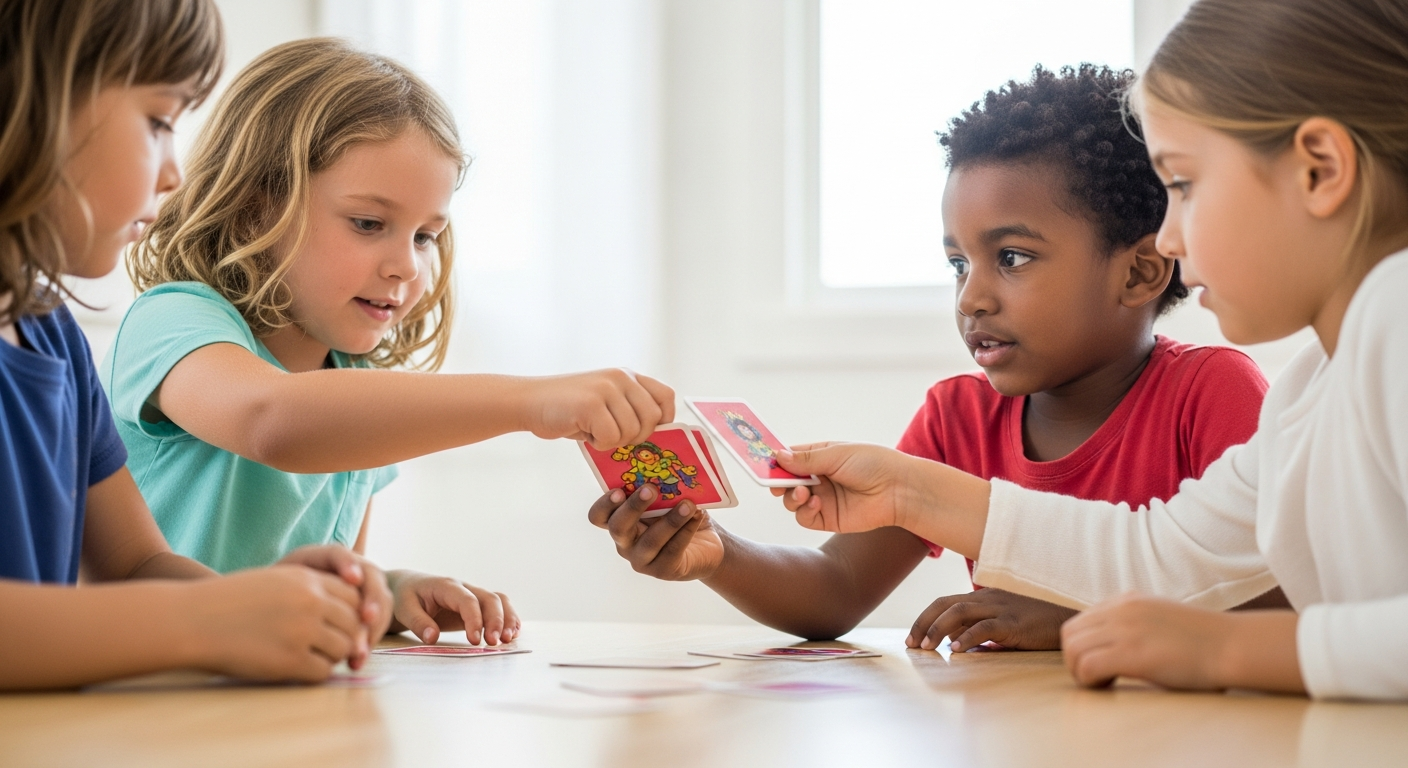
Table of Contents
- Why Card Games Are More Than Just Fun: The Developmental Benefits
- Our Favorite Fun Card Games for Kids (and How to Play Them!)
- Maximizing the Learning & Fun: Tips for Parents
- Beyond Card Games: Supporting Your Child's Communication Journey with Speech Blubs
- Conclusion
- FAQ
"Mom, I'm bored!" Has this familiar refrain echoed through your home on a rainy afternoon, a long car ride, or during a quiet weekend? While screens often offer an easy distraction, there's a timeless, simple, and incredibly powerful tool sitting in many of our drawers, ready to transform boredom into joyful learning: a deck of cards. At Speech Blubs, we believe in empowering children to "speak their minds and hearts," and often, the most effective learning happens through play and connection. This blog post will delve into a treasure trove of engaging card games, from beloved classics to exciting new discoveries, perfect for children of all ages. More than just a way to pass the time, these games are fantastic screen-free opportunities to boost language development, sharpen cognitive skills, and foster wonderful family bonding. Prepare to discover how these simple decks offer a powerful, playful pathway to enhancing your child's communication, all while creating cherished family memories.

Why Card Games Are More Than Just Fun: The Developmental Benefits
Before we dive into the games themselves, let's explore why a simple deck of cards is an unsung hero in child development, especially from a speech and language perspective. Many of us at Speech Blubs grew up with our own speech challenges, and we created the tool we wished we had – one that blends scientific principles with play. Card games align perfectly with this philosophy, offering immediate, effective, and joyful engagement that complements our "smart screen time" approach.
Boosting Language Skills
Card games are rich environments for language acquisition and practice. Think about it:
- Vocabulary Expansion: Naming cards ("King," "Queen," "Ace"), suits ("hearts," "diamonds"), and actions ("deal," "shuffle," "discard").
- Following Instructions: Understanding game rules, which often involve multi-step directions. This is a crucial skill for school readiness and daily life.
- Asking and Answering Questions: Games like Go Fish inherently require children to formulate clear questions and provide specific answers.
- Descriptive Language: Explaining why they made a certain move, describing the cards they have, or even articulating a bluff.
- Turn-Taking and Conversation: The natural ebb and flow of a game encourages conversational turn-taking, listening, and responding appropriately. These are foundational social communication skills.
Sharpening Cognitive Abilities
Beyond language, card games are mini-bootcamps for the brain:
- Memory and Concentration: Games like Concentration explicitly target working memory. Remembering where cards are, what other players have, or the sequence of play is excellent mental exercise.
- Strategy and Problem-Solving: Deciding which card to play, when to bluff, or how to collect a set requires critical thinking and planning. Children learn cause and effect, and how their actions impact the game.
- Numerical and Pattern Recognition: Identifying numbers, suits, and sequences in games like Rummy or War helps reinforce early math concepts in a fun, tactile way.
- Observation and Attention: Paying attention to other players' reactions, the cards played, and the state of the game hones observation skills.
Fostering Social-Emotional Growth
Card games are powerful tools for social-emotional development, teaching valuable life lessons in a low-stakes environment:

- Turn-Taking and Patience: Waiting for your turn is a fundamental social skill.
- Sportsmanship: Learning to win graciously and lose with dignity is an invaluable lesson that extends far beyond the card table.
- Cooperation and Teamwork: Some games involve partners, teaching children to collaborate and communicate effectively with a teammate.
- Emotion Regulation: Managing the frustration of a bad hand or the excitement of a winning one provides practice in emotional control.
- Connecting with Others: Sharing a laugh, celebrating a good play, or even commiserating over a bad hand builds bonds and strengthens relationships.
Screen-Free Connection & Family Bonding
In an increasingly digital world, card games offer a precious screen-free alternative, promoting active engagement over passive viewing. This aligns with our commitment at Speech Blubs to provide tools that foster genuine family connection. Sitting around a table, eyes meeting, laughter flowing – these are the moments that build strong family ties and create lasting memories. When you're ready to extend this hands-on learning to targeted speech support, remember that we offer a one-of-a-kind "smart screen time" experience designed to facilitate language development. You can learn more about our science-backed approach by visiting our main website at Speech Blubs.
Our Favorite Fun Card Games for Kids (and How to Play Them!)
Ready to shuffle up and deal? We've compiled a comprehensive list of card games, complete with age recommendations and easy-to-follow instructions. You'll find everything from simple matching games perfect for preschoolers to strategic challenges that will engage older kids and even adults!
Easy-to-Learn Classics for All Ages (3+)
These games are perfect for introducing younger children to the world of card playing. They focus on basic concepts like matching, memory, and simple comparison.
1. Concentration (Memory)
- Age: 3+
- Players: 2+
- Cards: Standard deck of 52 cards (or fewer for younger kids, ensuring an even number of pairs).
- How to Play:
- Shuffle the deck thoroughly.
- Spread the cards face down on a flat surface in a grid or random pattern.
- The object is to find matching pairs of cards.
- Players take turns flipping over two cards. Everyone should see and try to remember what and where the cards are.
- If the cards are a matching pair (e.g., two 7s, two Queens), the player removes them from the table, keeps them, and takes another turn.
- If the cards do not match, the player turns them back over, trying to remember their locations for future turns.
- The game ends when all cards have been matched and removed.
- The player with the most collected pairs wins.
- Developmental Benefits: This game is a powerhouse for working memory, visual recognition, and turn-taking. For language, it encourages children to name the cards ("Is this a King? No, it's a 4!") and to express disappointment or excitement appropriately.
2. Go Fish!
- Age: 5+ (can be adapted for 4+)
- Players: 2+
- Cards: Standard deck of 52 cards.
- How to Play:
- Choose a dealer. For 2-3 players, deal seven cards each. For more players, deal five cards each.
- Place the remaining cards face down in a pile – this is the "fish pond."
- Players sort their cards into groups of the same number or rank, keeping their hand secret.
- The player to the left of the dealer starts by asking another player for cards to complete a set (four cards of the same rank). For example, "Do you have any Kings?"
- If the asked player has any Kings, they must hand them all over. The requester continues asking the same player for more cards until the player doesn't have what they're asked for.
- If the asked player doesn't have the requested cards, they say "Go fish!"
- The requester then draws one card from the fish pond. If that card is what they asked for, they show it and get another turn. Otherwise, their turn ends.
- The player who said "Go fish" becomes the new requester.
- When a player collects all four cards of a set (e.g., all four 8s), they place them face down in front of them.
- The game ends when all sets have been made. The player with the most sets wins.
- Developmental Benefits: Go Fish is fantastic for formulating questions ("Do you have any...?"), identifying numbers/ranks, and social interaction. It also practices auditory memory (remembering who asked for what) and polite requesting.
3. Old Maid
- Age: 5+
- Players: 3+
- Cards: Standard deck of 52 cards, with one Queen removed (leaving one Queen unmatched).
- How to Play:
- Remove one Queen from the deck. This lone Queen is the "Old Maid."
- Deal all cards face down to the players. Some players may have more cards, which is fine.
- Each player sorts their cards, forming and discarding any pairs of matching ranks (e.g., two 7s, two Jacks). They lay these pairs face up on the table.
- The player to the left of the dealer offers their hand, fan-style and face-down, to the player on their left.
- That player draws one card randomly. If it forms a pair with a card already in their hand, they discard the pair. If not, they keep the card.
- This player then offers their hand to the person on their left, and play continues clockwise.
- The game ends when all cards have been discarded in pairs, except for the Old Maid. The person left holding the Old Maid loses the game.
- Developmental Benefits: This game reinforces pair matching, visual discrimination, and a bit of strategic thinking (trying not to be obvious about holding the Old Maid). It's also great for discussing feelings around winning and losing in a lighthearted way.
4. War
- Age: 6+
- Players: 2
- Cards: Standard deck of 52 cards.
- How to Play:
- Deal the entire deck evenly, face down, to each of the two players (26 cards each). Players do not look at their cards.
- Both players simultaneously turn over the top card of their piles and place them face up in the center.
- The player with the higher-ranking card takes both cards and adds them face down to the bottom of their own pile. (Aces are high in War).
- Play continues until two cards of the same rank are turned over – this is "War!"
- When War occurs, each player places one card face down, then one card face up. The player with the higher face-up card wins all six cards from that "battle" (the two initial matching cards, the two face-down cards, and the two new face-up cards).
- If another tie occurs during War, they "go to War again" with another face-down, then face-up card.
- The game is won by the player who collects all 52 cards.
- Developmental Benefits: War is excellent for number comparison and understanding card hierarchy. It's a fast-paced game that keeps kids engaged and provides practice with quick decision-making.
Games for Growing Minds: Developing Strategy & Language (5+)
As children get a little older, they're ready for games that require a bit more planning, memory, and social interaction.
5. Crazy Eights (or Switch)
- Age: 6+
- Players: 2-4 (up to 6 with two decks)
- Cards: Standard deck of 52 cards.
- How to Play:
- For 2 players, deal seven cards each. For 3-4 players, deal five cards each.
- Place the rest of the deck face down as the draw pile. Turn the top card over to start the discard pile.
- The player to the left of the dealer plays a card that matches either the rank or the suit of the top card on the discard pile. (e.g., if a 5 of Hearts is showing, they can play any 5 or any Heart).
- If a player cannot play a matching card, they must draw cards from the draw pile until they find a playable card.
- Eights are wild! A player can play an 8 on any card and choose the new suit that the next player must follow.
- The first player to get rid of all their cards wins.
- Developmental Benefits: Crazy Eights encourages matching skills, strategic thinking (when to use that wild 8!), and planning ahead. It also practices following rules with exceptions, a key cognitive skill.
6. Snap
- Age: 6+
- Players: 2+
- Cards: Standard deck of 52 cards (two decks for more than 3 players).
- How to Play:
- Deal all cards evenly among players, face down, in individual stacks. Players do not look at their cards.
- Starting with the player to the left of the dealer, players take turns flipping their top card face up, placing it next to their face-down pile.
- The goal is to be the first to shout "Snap!" when two cards on top of any two face-up piles match in rank (e.g., two Jacks, two 6s).
- The player who shouts "Snap!" first wins both matched face-up piles and adds them to the bottom of their face-down pile.
- If two players shout "Snap!" simultaneously, the matched piles are put into a "Snap Pool" in the center. Play continues, and the first player to shout "Snap Pool!" when a card matches the top of this central pile wins the entire pool.
- If a player runs out of face-down cards, they can shuffle their face-up pile and continue. If they run out of both, they are out of the game.
- The winner is the player who collects all the cards.
- Developmental Benefits: Snap is excellent for developing rapid visual processing and quick verbal response. It encourages players to pay close attention and react swiftly.
7. I Doubt It (Cheat / Baloney)
- Age: 6+
- Players: 3-12 (use two decks for more than 7 players)
- Cards: Standard deck of 52 cards.
- How to Play:
- Deal all cards evenly among players. Some may have more, which is fine. Players organize their hand secretly.
- The player to the left of the dealer starts. They place one to four cards face down in the center of the table and announce a rank, starting with Aces. For example, "Two Aces."
- The kicker: they don't have to be Aces. They can be lying!
- Play continues clockwise, with the next player announcing the next rank in sequence (e.g., "Three Twos," then "Four Threes," etc., restarting with Aces after Kings).
- At any point, if a player suspects another player is lying about the cards they just played, they can call "I Doubt It!" (or "Cheat!").
- The cards just played are then revealed:
- If the player was lying, they must take back all the cards in the discard pile.
- If the player was not lying (i.e., the challenger was wrong), the challenger must take all the cards in the discard pile.
- The game continues with the player who didn't pick up the pile starting the next round, announcing the next sequential rank.
- The first player to get rid of all their cards wins.
- Developmental Benefits: This game is a fantastic exercise in social deduction, bluffing, and reading non-verbal cues. It encourages children to listen critically to what others say and evaluate credibility. It’s a fun way to explore the nuances of communication beyond just literal meaning.
Advanced Play for Budding Strategists (7+)
These games introduce more complex rules, strategic depth, and often require more sustained focus.
8. Rummy
- Age: 7+
- Players: 2-6
- Cards: Standard deck of 52 cards.
- How to Play:
- Deal cards based on players: 10 cards for 2 players; 7 cards for 3-4 players; 6 cards for 5-6 players.
- Place the remaining cards face down as the "stock" pile. Turn the top card face up to start the "discard" pile.
- The object is to form "melds" in your hand:
- Sets: Three or four cards of the same rank (e.g., three 7s).
- Runs: Three or more cards of the same suit in sequence (e.g., 4, 5, 6 of Hearts).
- Players organize their hands secretly to identify potential melds.
- The player to the left of the dealer starts by drawing the top card from either the stock pile or the discard pile.
- They then try to form melds. If they can, they lay them face up on the table.
- Players can also "lay off" cards onto existing melds on the table. For example, if there's a meld of three Queens, and you have the fourth Queen, you can add it. Or if there's a run of 4, 5, 6 of Spades, and you have the 3 or 7 of Spades, you can add it.
- After drawing and potentially melding/laying off, the player must discard one card onto the discard pile, face up.
- The first player to get rid of all their cards (by melding and discarding their last card) wins the round. The goal is often to win multiple rounds.
- Developmental Benefits: Rummy significantly enhances strategic planning, categorization, and numerical sequencing. It requires sustained focus and the ability to adapt plans based on what cards are drawn and discarded. Children practice mental arithmetic and pattern recognition.
9. Kemps
- Age: 8+
- Players: 4-10 (must be an even number, played in teams of two)
- Cards: Standard deck of 52 cards.
- How to Play:
- Players divide into teams of two. Partners sit across from each other.
- Establish a secret signal with your partner (e.g., a wink, a slight nod, touching your nose) before the game starts.
- Deal four cards face up in the center of the table. Each player also receives four cards.
- The goal is for a player to collect four cards of the same rank (e.g., four Jacks) in their hand and then silently signal their partner.
- Players can swap cards from their hand with the four cards face up in the center. There are no turns; everyone swaps simultaneously.
- When a player gets four of a kind, they give their secret signal to their partner.
- If a partner sees the signal, they yell "Kemps!" If their partner indeed has four of a kind, their team scores a point.
- However, if an opponent suspects a player has four of a kind and is signaling, they can yell "Counter-Kemps!" If the player does have four of a kind, the opponents score a point. If they don't, the opponents lose a point.
- After each round (either a "Kemps!" or "Counter-Kemps!" call), cards are reshuffled and redealt. The first team to a set number of points wins.
- Developmental Benefits: Kemps is a powerhouse for non-verbal communication, observation skills, and teamwork. It teaches children to be subtle, to pay close attention to their partner and opponents, and to coordinate actions without speaking. This is excellent for developing social intelligence.
10. Spoons
- Age: 7+
- Players: 3-13 (you need one fewer spoon than players)
- Cards: Standard deck of 52 cards. (Use two decks for more than 6 players).
- How to Play:
- Place spoons in the center of the table, one fewer than the number of players.
- Each player receives four cards. The dealer has the remaining deck.
- The object is to get four cards of the same rank.
- The dealer starts by drawing a card from the deck, deciding whether to keep it or pass it. They then discard one card face down to the player on their left.
- Play continues quickly around the table, with each player drawing from the person on their right and discarding to the person on their left. This happens simultaneously and without waiting for turns.
- As soon as any player collects four of a kind, they silently grab a spoon from the center.
- Once one spoon is taken, other players must quickly grab a spoon.
- The player left without a spoon is eliminated from the round.
- Remove one spoon and one player for the next round. The last player remaining wins the game.
- Developmental Benefits: Spoons is fantastic for quick reflexes, observation, and fast decision-making. While it's a frantic game, the "silent grab" aspect adds an element of stealth and observation of others.
11. Speed (or Spit)
- Age: 6+
- Players: 2
- Cards: Standard deck of 52 cards.
- How to Play:
- Deal half the deck (26 cards) to each player. Each player then forms five piles in front of them:
- One face-up card.
- One face-down card with a face-up card on top.
- Two face-down cards with a face-up card on top.
- Three face-down cards with a face-up card on top.
- The remaining cards form their draw pile (face down).
- The two players simultaneously say "1, 2, 3, Go!" and turn over the top card of their draw piles, placing them in the center between their respective layouts. These become the two "center piles."
- Players then play cards from their five layout piles onto either of the center piles. A card can be played if it is one rank higher or one rank lower than the top card of a center pile (e.g., if a 7 is showing, you can play a 6 or an 8). Suits do not matter.
- There are no turns; players play as fast as they can.
- If a player cannot make a play, they can turn over a face-down card from one of their five layout piles. If all five layout piles are face up, they can draw from their personal draw pile to replenish.
- If both players get stuck and cannot make a move, they both turn over a new card from their main draw piles to create new center cards.
- The goal is to get rid of all the cards in your layout piles and then your draw pile. The first player to do so wins.
- Developmental Benefits: Speed is excellent for rapid visual processing, quick decision-making, and number sequencing. It helps children develop agility in their thinking and reactions. Shouting out "One, two, three, SPIT!" (or "Go!") at the start can also be a fun way to practice verbal initiation and enthusiasm.
12. Golf Card Game
- Age: 7+
- Players: 2+ (typically 2-4)
- Cards: Standard deck of 52 cards.
- How to Play:
- The goal is to get the lowest score possible over nine "holes" (rounds).
- Deal four cards face down to each player, arranging them in a 2x2 grid. Players cannot look at these cards.
- Place the rest of the deck face down as the draw pile, and turn the top card face up to start the discard pile.
- Players can secretly peek at their bottom two cards (or any two of their four cards, depending on house rules) once at the start of the round.
- The first player draws a card from either the draw pile or the discard pile.
- If they draw from the discard pile, they must immediately replace one of their four face-down cards with it, then discard the replaced card face up.
- If they draw from the draw pile, they can either replace one of their face-down cards (then discard the replaced card) or discard the drawn card without replacing anything.
- The key is the values: Aces are 1 point, face cards (J, Q, K) are 10 points. 2s are -2 points (good to get!). All other cards are face value.
- The round ends when one player replaces their last face-down card and discards, or when one player thinks they have a good score and declares "Golf!" (or "Knock!"). Each other player then gets one last turn.
- All cards are then revealed and points are tallied. Matching pairs in a vertical or horizontal column cancel each other out (0 points for that pair).
- Developmental Benefits: Golf is a fantastic game for numerical strategy, probability assessment, and risk-taking. It encourages children to analyze their hand, remember discarded cards, and make calculated decisions to minimize their score.
More Card Games For Kids You’ve Never Heard Of (But Should Try!)
We love discovering new ways to play! These games offer unique challenges and endless fun.
13. Garbage Card Game
- Age: 6+
- Players: 2+
- Cards: One deck per 2 players.
- How to Play:
- Each player is dealt 10 cards face down, arranged in two rows of five, in front of them. These are their "spot" cards. The goal is to fill spots 1 through 10 with cards in ascending order (Ace, 2, 3... 10).
- The remaining cards form a draw pile.
- A player draws the top card from the draw pile. If it's an Ace through 10, they place it face up in the corresponding spot in their layout (Ace goes in spot 1, 2 in spot 2, etc.).
- If a card is placed, it replaces the face-down card that was there. The player then picks up that face-down card and plays it if possible.
- If they draw a King or Queen, it's "garbage" and immediately goes into their discard pile (unless using a variation where Kings are wild).
- Jacks are wild and can be placed in any spot 1-10.
- A turn ends when a player cannot make a play from the card they just picked up, or they draw a King/Queen.
- The first player to fill all 10 spots in their layout (1 through 10) wins the round.
- Developmental Benefits: Garbage is excellent for numerical sequencing, strategic placement, and visual organization. It helps children understand order and the concept of filling a sequence.
14. Kings In The Corner
- Age: 7+
- Players: 2-4
- Cards: Standard deck of 52 cards.
- How to Play:
- Deal seven cards to each player. Place the remaining deck in the center as a draw pile.
- Turn the top four cards of the draw pile face up around the draw pile to form the four starting "foundation" piles.
- The object is to be the first to get rid of all your cards.
- Players build on the foundation piles (or create new ones with a King). Cards are played in descending order and alternating colors (e.g., a Black 8 on a Red 9).
- A player can move entire stacks of cards from one foundation pile to another to open up spaces or create longer sequences.
- If a player plays a King, they can start a new foundation pile in any of the four "corner" positions, hence "Kings in the Corner."
- If a player cannot make a move, they must draw a card. They can then play the drawn card if possible.
- The first player to play all their cards wins.
- Developmental Benefits: This game is fantastic for spatial reasoning, sequencing, pattern recognition (colors and ranks), and strategic planning. It encourages children to look for multiple ways to play their cards.
15. President Card Game
- Age: 8+
- Players: 3-7
- Cards: Standard deck of 52 cards.
- How to Play:
- Deal all cards out evenly. Some players may have more cards.
- The game is played in rounds, with ranks ascending: 3 is lowest, 2 is highest. Aces are high, but 2s beat Aces.
- The player with the 3 of Clubs starts the first round by playing it, or any number of 3s they have.
- Players must play the same number of cards as the lead player, but of a higher rank. For example, if someone plays two 5s, the next player must play two cards that are higher than 5s (e.g., two 7s, two Queens).
- If a player cannot or chooses not to play, they pass.
- A round ends when all players have passed after a play. The player who made the last play starts the next round with any card(s) they choose.
- The goal is to be the first player to get rid of all your cards. The first player to go out becomes the "President," the second the "Vice-President," and so on, with the last player being the "Scum" (or "Asshole").
- In subsequent rounds, the Scum must give their best card(s) to the President, who then gives back their worst card(s). This creates an interesting social dynamic!
- Developmental Benefits: President is excellent for strategic discarding, understanding hierarchy, and long-term planning (trying to save high cards or get rid of low ones). The social roles add an element of fun and negotiation.
Maximizing the Learning & Fun: Tips for Parents
Making card games a truly enriching experience goes beyond just knowing the rules. Here are some tips to supercharge the learning and fun:
Adapting Games for Different Ages/Skill Levels
- Simplify: For very young children, start with fewer cards (e.g., half a deck for Concentration) or simplify the rules (e.g., in Go Fish, only ask for a specific color instead of a rank).
- Visual Cues: Use verbal cues and gestures to help children understand concepts like "higher" or "matching."
- Patience is Key: Learning new games takes time. Don't rush or get frustrated. Celebrate effort over perfection.
Emphasizing the Process, Not Just Winning
- Focus on Sportsmanship: Teach children how to win gracefully and, more importantly, how to lose with dignity. "Good game!" and shaking hands are great habits.
- Praise Effort and Strategy: Instead of just "You won!", try "You made a really smart move when you held onto that King!" or "I liked how you remembered where that card was."
- Discuss Choices: After a hand, you can ask, "Why did you play that card?" or "What might have happened if you played a different card?" This encourages reflection and strategic thinking.
Creating a Positive Play Environment
- Dedicated Game Time: Make it a regular family activity – "Family Game Night" can become a cherished tradition.
- Minimize Distractions: Turn off the TV, put phones away. Focus on connecting with your child.
- Make it Playful: Silly voices, funny sound effects, or exaggerated reactions can make games even more engaging.
- Let Them Win (Sometimes!): Especially for younger children, letting them experience success builds confidence and keeps them motivated to play.
Connecting Card Games to Speech & Language Goals
This is where the magic truly happens! Actively integrate speech and language practice into your card games:
- Articulate Clearly: Encourage your child to speak clearly when asking for cards ("Do you have any SEVENS?") or announcing plays ("I play a RED SIX!").
- Sentence Structure: Prompt them to use full sentences. Instead of "Kings," encourage "Do you have any Kings for me?"
- Descriptive Vocabulary: Ask them to describe the cards ("What color is that card? What picture is on it?").
- Following Multi-Step Directions: Explicitly break down game rules into smaller, manageable steps for children who struggle with auditory processing.
- Emotional Language: Help them articulate their feelings during the game: "I feel frustrated right now because I can't find a match" or "I'm excited because I almost have a Rummy!"
If you're noticing your child could use a little extra boost in their communication journey, we encourage you to take our quick 3-minute preliminary screener. It involves just 9 simple questions and will provide you with an assessment and a personalized next-steps plan. It’s a great way to understand if your child might benefit from more targeted support.
Beyond Card Games: Supporting Your Child's Communication Journey with Speech Blubs
While card games are incredible for fostering communication and connection, sometimes children need a little extra, targeted support to truly "speak their minds and hearts." This is the core mission of Speech Blubs. Our company was born from the personal experiences of our founders, who all grew up with speech problems and created the innovative tool they wished they had. We are committed to providing an immediate, effective, and joyful solution for the 1 in 4 children who need speech support, blending scientific principles with play into one-of-a-kind "smart screen time" experiences.
At Speech Blubs, we go beyond passive viewing (like cartoons) to provide a powerful tool for active learning and family connection. Our unique approach teaches complex communication skills through our "video modeling" methodology, where children learn by watching and imitating their peers. This natural, engaging method is backed by extensive research, placing us in the top tier of speech apps worldwide. You can explore the research behind our methodology to understand more about its effectiveness.
How Speech Blubs Complements Card Game Learning
Think of Speech Blubs as an ideal complement to the foundational skills built through card games.
- Reinforcing Vocabulary: If your child loves the "Animal Kingdom" section in Speech Blubs, practicing animal sounds and names, they can then carry that vocabulary into a game like Go Fish by asking for "any animal cards." For a parent whose 3-year-old 'late talker' loves animals, the 'Animal Kingdom' section offers a fun, motivating way to practice 'moo' and 'baa' sounds, building on the concepts of categorization they might encounter in card games.
- Structured Questioning: Our app's interactive exercises encourage children to listen, process, and respond. This directly supports the question-and-answer exchanges crucial in games like Go Fish.
- Social Interaction Practice: The peer-to-peer video modeling helps children understand social cues and imitation, skills that are invaluable when playing interactive card games with others.
- Building Confidence: Success within the app, mastering new sounds and words, translates into increased confidence in other communication settings, including the verbal interactions during family card games.
We're proud to see countless children thrive with our approach. Don't just take our word for it; see what other parents are saying about their child's success with Speech Blubs.
Unlock Your Child's Potential: Choose the Yearly Plan for Best Value!
Ready to combine the joy of card games with the impactful, research-backed support of Speech Blubs? We've made it easy and affordable to join our community.
Our Subscription Plans:
- Monthly Plan: Just $14.99 per month.
- Yearly Plan: Only $59.99 per year. This breaks down to an incredible $4.99 per month, saving you a fantastic 66% compared to the monthly option!
Why the Yearly Plan is the Smartest Choice: The Yearly Plan isn't just about significant savings; it's about unlocking the full Speech Blubs experience and providing your child with consistent, long-term support.
- 7-Day Free Trial: Only available with the Yearly Plan, allowing you to explore everything Speech Blubs has to offer before committing.
- Bonus Reading Blubs App: Get access to our complementary Reading Blubs app, further enhancing your child's literacy journey.
- Early Access to New Updates: Be the first to experience our latest features and content.
- Priority 24-Hour Support: Our dedicated team is ready to help you quickly.
The Monthly Plan does not include these high-value benefits. For the most comprehensive support, the greatest value, and access to all our features, the Yearly Plan is the clear choice.
Ready to provide your child with joyful, effective speech support? You can download Speech Blubs on the App Store or Google Play Store today! Alternatively, you can create your account and start your 7-day free trial directly on our website. Remember to choose the Yearly Plan to get the free trial and the full suite of features!
Conclusion
From the simplest games of Concentration to the strategic depths of Rummy and the social nuances of I Doubt It, card games offer a rich, screen-free landscape for learning and connection. They are invaluable tools for developing language, cognitive skills, and social-emotional intelligence, all while bringing families closer together. As a powerful complement to these playful interactions, Speech Blubs stands ready to further empower your child's communication journey, offering a unique blend of scientific methodology and joyful, engaging activities.
By embracing both the timeless fun of card games and the innovative support of Speech Blubs, you're investing in your child's confidence, their ability to express themselves, and the creation of cherished family memories. So, gather your loved ones, shuffle that deck, and get ready for countless hours of laughter, learning, and connection.
And when you're ready to give your child the additional boost they deserve, we invite you to experience the full potential of Speech Blubs. Start your free 7-day trial and unlock all premium features today by choosing our Yearly Plan. Simply download the app from the Apple App Store or Google Play Store, or sign up on our website to begin this exciting journey!
FAQ
Q1: What are the best card games for a 3-year-old?
A1: For a 3-year-old, the best card games are those that focus on simple matching and visual recognition. Games like Concentration (Memory), with a reduced number of cards to make pairs, are ideal. You can also create your own simple matching games by taking out just a few pairs from a deck. The goal is to make it fun and keep it short, focusing on identifying colors, numbers, and pictures rather than complex rules.
Q2: How do card games help with a child's language development?
A2: Card games offer numerous opportunities for language development. Children practice vocabulary by naming cards and suits, following multi-step instructions as they learn game rules, and asking and answering questions (e.g., in Go Fish). They also enhance turn-taking skills crucial for conversation, and encourage descriptive language as they talk about their cards or plays. These interactions build a strong foundation for clear and confident communication.
Q3: What is the benefit of using Speech Blubs alongside playing card games?
A3: Speech Blubs complements card games by providing targeted, engaging activities that reinforce and expand communication skills. While card games build general language and social skills, Speech Blubs offers "smart screen time" experiences using video modeling to help children practice specific sounds, words, and sentence structures. For example, vocabulary learned in Speech Blubs' themed sections (like animals or colors) can then be used in conversation during card games, creating a holistic and joyful learning environment. It’s about blending scientific principles with play to empower children to speak their minds and hearts.
Q4: Which Speech Blubs plan offers the best value and features for families?
A4: The Yearly Plan offers the best value and features for families. At just $59.99 per year (breaking down to $4.99/month), it provides a 66% savings compared to the monthly plan. Crucially, the Yearly Plan includes a 7-day free trial, access to the bonus Reading Blubs app, early access to new updates, and priority 24-hour support. These benefits are not available with the Monthly Plan, making the Yearly Plan the most comprehensive and cost-effective choice for supporting your child's communication journey.
About the author